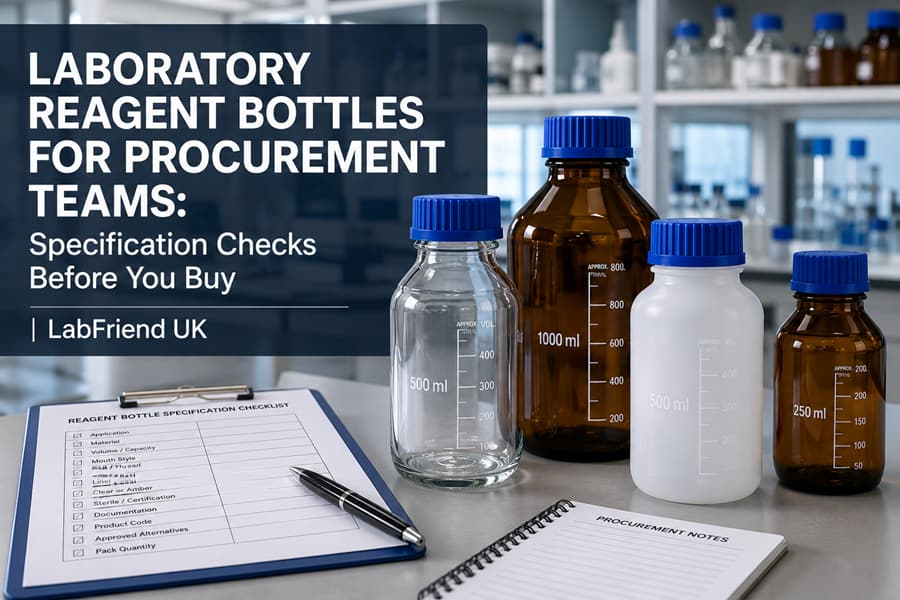
Laboratory Reagent Bottles for Procurement Teams: Specification Checks Before You Buy
23 mins read
Laboratory Reagent Bottles for Procurement Teams: Specification Checks Before You Buy
By Donal O’Sullivan, BSc. Reviewed by Michael Anderson, MBA.
Quick answer
Procurement teams should buy laboratory reagent bottles from a complete specification, not from a product title alone. Before requesting a quote or approving an alternative, confirm the application, reagent type, bottle material, volume, cap/thread, closure or liner, clear or amber requirement, documentation needs, product code, acceptable alternatives and expected repeat demand.
This matters because reagent bottles are often used in controlled laboratory workflows. A bottle that looks similar online may differ in material, closure, thread, liner, colour, pack size or documentation. Those differences can affect suitability, repeat ordering and laboratory confidence.
For the broader selection framework, read LabFriend UK’s Laboratory Bottles: Selection Guide for UK Laboratories. For technical guidance on reagent storage suitability, use LabFriend UK’s How to Select Laboratory Reagent Bottles for Chemical Storage. Once the specification is clear, procurement teams can compare LabFriend UK’s laboratory reagent bottles by material, volume, cap/thread and clear or amber format.
Why reagent bottle procurement needs specification control
Laboratory reagent bottles are not complex instruments, but they can still create procurement risk when ordered without enough technical detail. A request for “500 ml reagent bottles” may seem clear, but it leaves too much open. It may not state whether the bottle should be glass or plastic, clear or amber, narrow-mouth or wide-mouth, supplied with a cap, fitted with a particular thread, suitable for a particular storage condition, or matched to an existing product code.
In a procurement environment, that ambiguity creates three problems. First, the wrong product may be ordered. Second, a substitute may be offered that looks acceptable commercially but has not been checked technically. Third, the next reorder may not match the previous supply, creating inconsistency for the laboratory.
For reagent bottles, specification control protects both the buyer and the lab. It gives procurement a clearer basis for requesting quotes, comparing options, managing alternatives and setting up repeat supply. It also reduces avoidable back-and-forth between procurement, scientists, QA/QC teams and suppliers.
The aim is not to make procurement responsible for technical approval. The aim is to give procurement enough structure to ask the right questions before buying.
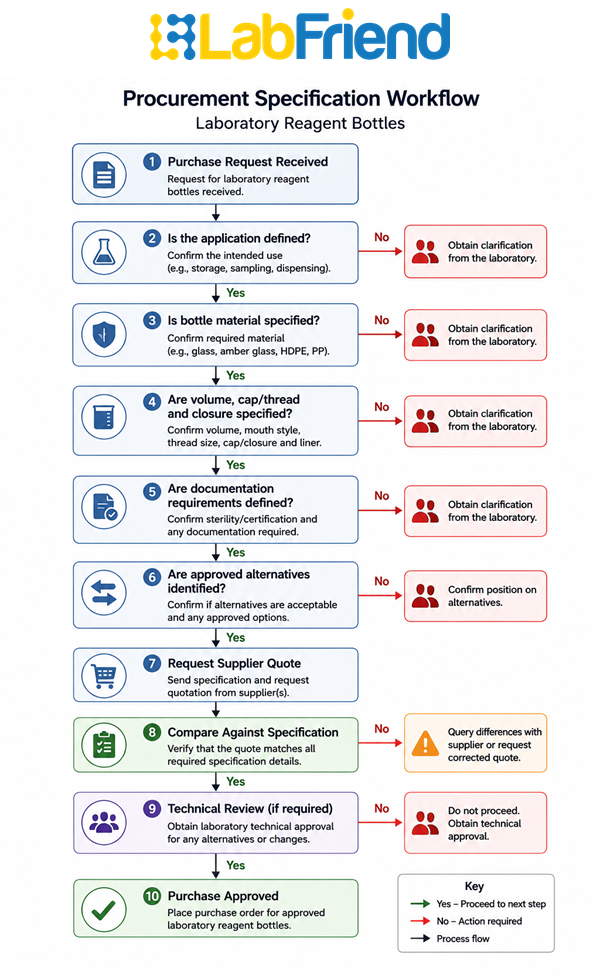
How this differs from technical reagent bottle selection
This article is written for procurement teams. It does not replace the technical assessment of chemical compatibility or laboratory suitability.
The technical question is:
Which bottle is suitable for this reagent, concentration, storage condition and workflow?
The procurement question is:
What information do I need to buy the correct bottle, request an accurate quote, control alternatives and reorder the same specification?
Those questions overlap, but they are not the same. Procurement should not be expected to decide chemical compatibility alone. However, procurement should know when a quote request is incomplete, when a proposed alternative needs technical approval, and when a missing cap/thread or product code could create a repeat-order issue.
For technical selection, the supporting guide How to Select Laboratory Reagent Bottles for Chemical Storage should remain the deeper reference. This procurement article focuses on buying control, quote quality and repeat purchasing.
Start with the purchasing specification, not the product title
A product title is rarely enough to control reagent bottle purchasing. Product names can vary between suppliers, and similar-looking bottles may differ in important ways. Procurement should therefore work from a purchasing specification.
A strong purchasing specification should identify what the bottle is for, what it must be made from, how it must close, whether it must be clear or amber, whether documentation is required and whether alternatives are acceptable. It should also include the preferred product code where one already exists.
This is especially important where reagent bottles are purchased repeatedly. If the laboratory has already approved a particular bottle, procurement should capture that product code and specification rather than restarting the search each time. Where a product is unavailable or a value alternative is being considered, the proposed substitute should be compared against the original specification before it is accepted.
Procurement efficiency is valuable, but it should not replace technical suitability assessment.
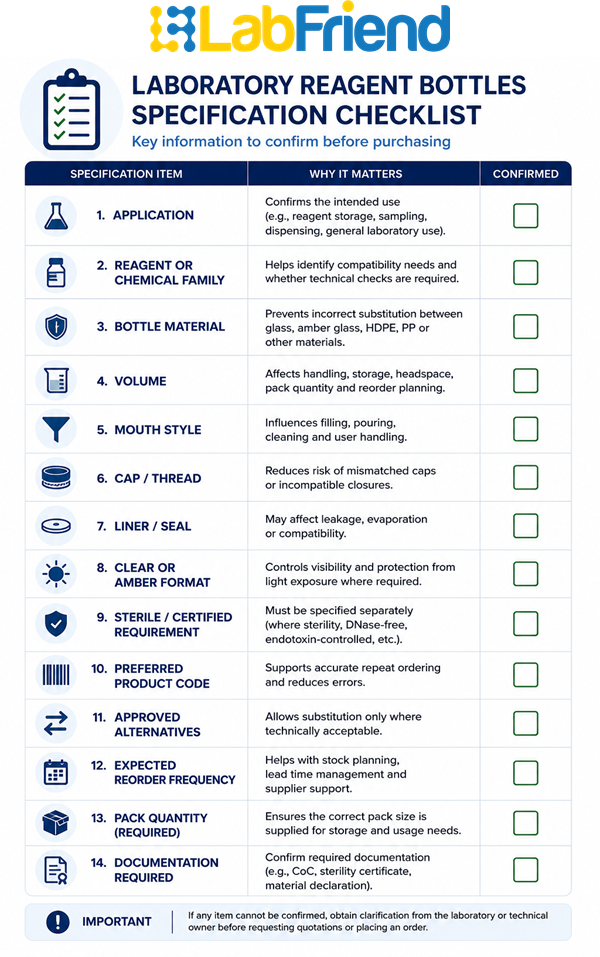
Core specification checks before buying reagent bottles
|
Specification item |
Why procurement should capture it |
|
Application |
Confirms whether the bottle is for reagent storage, prepared solutions, samples, dispensing or general laboratory use |
|
Reagent or chemical family |
Helps identify whether technical compatibility checks are needed from a scientist or QA/QC colleague |
|
Bottle material |
Prevents uncontrolled substitution between glass, amber glass, HDPE, PP or other materials — each has different chemical resistance and temperature tolerance |
|
Volume |
Affects handling, storage, headspace, pack quantity and reorder planning |
|
Mouth style |
Influences filling, pouring, cleaning and user handling |
|
Cap/thread |
Reduces risk of mismatched caps or incompatible closures |
|
Cap material |
Caps are commonly PP, PBT or phenolic, with different chemical and heat resistance |
|
Liner/seal |
May affect leakage, evaporation or compatibility (e.g. PTFE-faced, foam or rubber liners have different chemical resistance) |
|
Clear or amber format |
Controls visibility and light-exposure requirements |
|
Sterile/certified requirement |
Must be specified separately where needed |
|
Preferred product code |
Supports accurate repeat ordering |
|
Approved alternatives |
Allows substitution only where technically acceptable |
|
Expected reorder frequency |
Helps LabFriend UK support repeat supply and quote planning |
This table should be treated as a procurement control tool. It does not determine chemical suitability by itself, but it helps procurement gather the information needed for a better buying decision.
Material, volume and clear/amber checks
Material is one of the most important specification fields because it affects whether an alternative can be considered. A glass reagent bottle should not be casually replaced with plastic, and a plastic reagent bottle should not be replaced with a different plastic material unless the laboratory has approved the change.
Borosilicate glass is commonly selected for many reagent storage applications, particularly where chemical resistance, thermal stability and established laboratory practice matter. Amber glass is commonly selected where reduced light exposure is required. Plastic reagent bottles may be useful where lower breakage risk, lighter handling or routine storage practicality matters. However, suitability depends on the reagent, concentration, storage duration, temperature and closure system.
Procurement should record the required material exactly. If the technical user specifies amber glass, procurement should not treat a clear glass bottle as an equivalent. If HDPE is specified, procurement should not assume PP is acceptable, as the two materials differ in chemical resistance and heat tolerance. If a product is described simply as “plastic”, procurement should confirm the actual material before buying.
Volume also deserves attention. A 250 ml, 500 ml and 1 litre bottle may all belong to the same product family, but they can affect handling, storage space, headspace (the empty air gap above the liquid) and reorder quantity. If the laboratory has standardised on specific volumes, procurement should preserve that standard unless there is approval to change it.
Where procurement is still comparing general bottle families, LabFriend UK’s laboratory vessels category can support wider product discovery. Where the requirement is specifically reagent-led, the better route is laboratory reagent bottles.
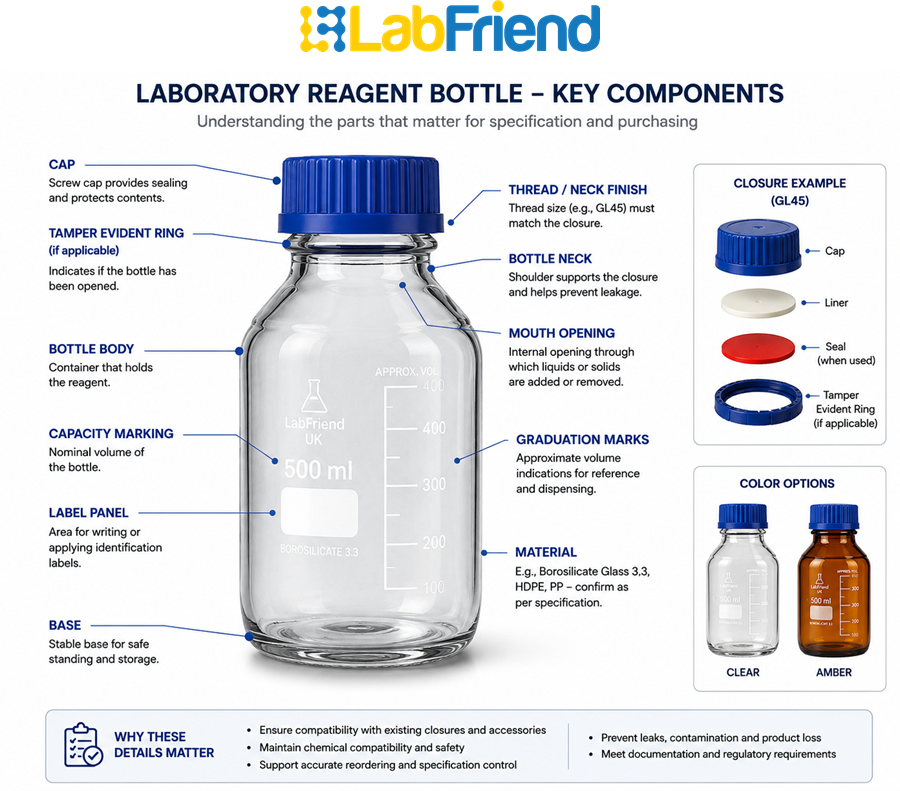
Cap, thread, liner and closure checks
A reagent bottle should be purchased as a complete container system. The bottle body is only one part of that system.
Cap, thread and liner details are common sources of procurement errors. A buyer may find a bottle with the right volume and material but overlook whether the cap is included, whether the thread matches the existing closure, or whether the liner is suitable for the intended storage workflow. This matters because reagent bottles are often handled repeatedly, opened and closed frequently, or stored for defined periods.
GL45, GL32 and other laboratory bottle thread references can be useful, but they should not be treated as a guarantee that every cap or accessory is interchangeable. Procurement should confirm whether the bottle is supplied with the cap, whether replacement caps are required, and whether the cap, liner or seal is part of the approved specification, and what material the cap is made from.
If the bottle and cap are being purchased separately, the risk increases. In that case, procurement should capture both product codes and confirm compatibility before ordering. Procurement should also confirm whether the bottle needs to be blank or pre-printed with hazard, content or reagent labelling, as this can affect product code and lead time.
Acceptable alternatives: when substitution is and is not safe
Acceptable alternatives can help procurement manage availability, cost and supplier choice, but only when the substitute is technically suitable. The phrase “equivalent alternative” should be used carefully. Two reagent bottles may look equivalent commercially while differing technically.
A sensible procurement approach is to classify alternatives before requesting a quote. Some alternatives may be low risk, such as the same product code supplied in a different pack quantity where the lab accepts that change. Other alternatives require technical review, such as changing material, cap type, clear/amber format, sterility status or certification.
|
Proposed change |
Procurement position |
|
Same product code, same pack size |
Usually acceptable |
|
Same product code, different pack size |
Check stockroom and purchasing preference |
|
Same material, same volume, same closure, different brand |
May be acceptable after technical review |
|
Glass changed to plastic |
Requires technical approval |
|
Clear changed to amber |
Requires review; may affect visibility and workflow |
|
Amber changed to clear |
High caution where light sensitivity may matter |
|
Cap/thread/liner changed |
Requires compatibility check |
|
Sterile, certified or pre-cleaned status changed |
Do not substitute without documented approval |
|
Product code unknown |
Request clarification before ordering |
Procurement teams should avoid accepting substitutions based only on price or availability. If the lab has not defined acceptable alternatives, the safest action is to ask before buying.
Documentation, sterility and certification checks
Reagent bottle procurement becomes more sensitive when documentation is required. Routine reagent storage may only need a suitable bottle and closure. Other workflows may require sterile supply, certified containers, pre-cleaned bottles or specific purity-related claims.
These terms are not interchangeable. Sterile does not automatically mean DNase-free, RNase-free, pyrogen-free or endotoxin-controlled. Autoclavable does not automatically mean sterile, and an autoclavable bottle does not guarantee the cap is autoclave-rated. Certified or pre-cleaned status must be supported by product documentation. Some certified, sterile or pre-cleaned bottles also carry a shelf-life or expiry date, which procurement should check where the product will be stored before use. Procurement should therefore capture documentation requirements explicitly rather than assuming they are included.
If the request mentions QA, trace analysis, contamination-sensitive workflows, biological work, validated methods or audit requirements, procurement should ask whether documentation is required before requesting a quote. The cost of buying the wrong product can be higher than the apparent saving from a cheaper bottle.
The same principle applies to LLG Labware or any value alternative. LabFriend UK’s LLG Labware range can be relevant where a value alternative is acceptable, but procurement should not assume equivalence without specification review.
Repeat-order control and product-code capture
Reagent bottles are often repeat-purchase items. That makes product-code capture commercially important.
A one-off purchase can become a recurring supply opportunity if the specification is recorded properly. Procurement should capture the approved product code, material, volume, mouth style, cap/thread, pack size and accepted alternatives. This helps avoid repeated product searches and reduces the risk of ordering a similar but different bottle next time.
This is especially valuable for laboratories that buy the same reagent bottles monthly, quarterly or against project demand. A controlled repeat-order record helps procurement work more efficiently and gives LabFriend UK’s inside sales team a clearer basis for supporting repeat supply.
For procurement teams, the practical question is not only “Can we buy this bottle?” It is also “Can we buy the same approved bottle again without rechecking the entire requirement?”
Reagent bottle quote request template
Procurement teams can use the following structure before requesting a quote.
|
Quote field |
Example of useful detail |
|
Application |
Routine reagent storage / prepared solution storage / chemical stock bottle |
|
Required material |
Borosilicate glass / amber glass / HDPE / PP / other specified material |
|
Required volume |
100 ml / 250 ml / 500 ml / 1 litre / other |
|
Mouth style |
Narrow-mouth / wide-mouth / not specified |
|
Cap/thread |
GL45 (a common laboratory bottle screw-thread size) / screw cap / cap included / cap separate |
|
Cap material |
PP / PBT / phenolic / not specified |
|
Closure or liner |
State requirement if known |
|
Clear or amber |
Clear / amber / either acceptable |
|
Documentation |
Sterile / certified / pre-cleaned / none required / confirm |
|
Preferred product code |
Existing code if known |
|
Approved alternatives |
Yes / no / technical approval required |
|
Expected demand |
One-off / monthly / quarterly / project-based |
|
Quote requirement |
Price, pack size, lead time, alternative options if acceptable |
Once this information is available, procurement can compare LabFriend UK’s laboratory reagent bottles and use the product-page quote generation function where available. For specification-led support or broader quote enquiries, procurement teams can also contact LabFriend UK.
Common procurement mistakes when buying reagent bottles
One common mistake is ordering from an incomplete product description. A short product title may not include the cap, thread, material, liner, pack size or documentation status. Procurement should check the full product specification before ordering.
Another mistake is approving a substitute without asking whether the laboratory accepts alternatives. This is particularly risky when changing from glass to plastic, clear to amber, amber to clear, or one cap/thread system to another.
A third mistake is treating the first order as a one-off when the item is likely to be reordered. If the laboratory uses the same reagent bottles repeatedly, procurement should capture the product code and repeat frequency at the start.
Finally, procurement teams should avoid assuming that a lower unit price always represents a saving. If a cheaper bottle creates a mismatch, return, user complaint, stockroom duplication or technical review delay, the true cost can be higher.
Relevant LabFriend category pathways
The main commercial route for this article is LabFriend UK’s laboratory reagent bottles. This is the best starting point once procurement has confirmed the material, volume, cap/thread and clear or amber requirement.
Where the requirement is broader than reagent storage, use laboratory vessels. Where a specification-checked value alternative may be appropriate, review LLG Labware. Where procurement needs quote support or help clarifying a specification, use LabFriend UK’s contact-us route.
These links should support the buying process, not replace the specification check. The correct sequence is: confirm the requirement, compare suitable options, then request a quote.
What this article does not solve
This article helps procurement teams request better quotes and reduce buying errors. It does not confirm that a specific reagent bottle is chemically compatible, method-approved, sterile, certified, pre-cleaned, autoclavable, pressure-rated, vacuum-rated or regulatory-compliant.
Those checks must come from the laboratory’s technical requirements, product documentation, manufacturer information, SDS, COSHH assessment, method requirements and local procedures.
Procurement should also avoid treating any alternative product as equivalent unless the relevant specification has been reviewed and accepted.
FAQs
What should procurement check before buying laboratory reagent bottles?
Procurement should check the application, reagent type, material, volume, mouth style, cap/thread, closure or liner, clear or amber requirement, documentation needs, product code, approved alternatives and expected reorder frequency.
What should be included in a reagent bottle quote request?
A good quote request should include the bottle material, volume, cap/thread, clear or amber format, pack size, preferred product code, documentation needs, whether alternatives are acceptable and expected repeat demand.
Can procurement substitute one reagent bottle for another?
Only where the laboratory has approved the alternative or the specification has been reviewed. Changes to material, cap, liner, thread, clear/amber format, sterile status or certification should not be treated as automatic substitutions.
Are amber reagent bottles always required for light-sensitive chemicals?
Not always. Amber bottles are commonly selected where reduced light exposure is required, but the reagent, method and storage conditions should determine whether amber glass is necessary and sufficient.
Are GL45 reagent bottle caps interchangeable?
Not automatically. GL45 is a common thread format, but procurement should still check bottle, cap, liner and accessory compatibility at product level.
Are sterile reagent bottles the same as certified bottles?
No. Sterile, certified, pre-cleaned, DNase-free, RNase-free, pyrogen-free and endotoxin-controlled are all separate product characteristics — one does not imply another. Procurement should request documentation where any of these requirements matter.
How can procurement reduce reagent bottle reorder errors?
Capture the approved product code, material, volume, cap/thread, pack size and acceptable alternatives. This creates a controlled repeat-order record and avoids repeated product searches.
When should procurement contact LabFriend UK before ordering?
Contact LabFriend UK when the specification is incomplete, when alternatives are being considered, when repeat demand is expected, or when procurement needs support turning a technical requirement into a quote request.
Conclusion
Laboratory reagent bottle procurement should be controlled by specification, not by product title alone. A procurement team that captures application, material, volume, cap/thread, closure, clear or amber format, documentation needs and approved alternatives will make better buying decisions and reduce repeat-order errors.
The most important principle is simple: procurement can support cost control and supplier efficiency, but it should not override technical suitability. If an alternative is being considered, the specification should be reviewed before it is accepted.
Once the requirement is clear, compare LabFriend UK’s laboratory reagent bottles. For wider bottle options, review laboratory vessels. For specification-led quote support, contact LabFriend UK.
Request a quote for laboratory reagent bottles
Confirm the reagent bottle specification first: material, volume, cap/thread, closure, clear or amber format, documentation needs, approved alternatives and expected repeat demand. Then compare LabFriend UK’s laboratory reagent bottles or contact LabFriend UK for quote support.
Written by: Donal O’Sullivan, BSc, Co-Founder and Sales Director, LabFriend UK. Donal brings deep chemistry-led technical expertise across analytical chemistry, biochemistry, environmental monitoring, laboratory instrumentation, consumables and scientific product selection.
Reviewed by: Michael Anderson, MBA, Founder and Managing Director, LabFriend UK. Michael reviews LabFriend UK content for customer relevance, commercial accuracy, operational practicality and alignment with LabFriend UK’s laboratory supply model.
Frequently asked questions
Delivery times vary by product and supplier. Each product page shows current stock levels and the expected lead time, and we confirm this when you place your order. Most items arrive within 2 to 3 weeks. Specialised items can take longer if they are not in stock. If you need something by a certain date, contact us and we’ll check for you.
Yes. Register for a commercial account and, once it’s approved, you will be able to process orders via PO Once you have a commercial account, you can directly email your purchase orders
Add products to your cart and click Get a Quote. You’ll get a formal quote instantly, ready to send to your email address. For bulk orders or custom requirements, send us your product list and we’ll reply with itemized pricing.
If your item is faulty, not as described or sent in error, let us know within 14 days of delivery and we’ll arrange a return. Change of mind returns are only accepted if the item is unused and in its original packaging. A restocking fee will apply and you pay the return freight. Read our full Returns Policy for details.
Yes, prices are shown including VAT by default. Use the Prices Inc. VAT toggle at the top of the page to view prices without VAT.