

Share :
GL45 Bottle Procurement: How to Avoid Mismatched Caps, Threads and Reorders
Updated On 07/29/2026

By Donal O’Sullivan, BSc. Reviewed by Michael Anderson, MBA.
Summary
Procurement teams should not treat GL45 (a DIN-standard screw-thread designation denoting an approximate 45 mm neck diameter) as a complete compatibility guarantee. GL45 is an important bottle thread or neck specification, but it is only one part of the buying decision. To avoid mismatched caps, incorrect reorders and unsuitable substitutions, procurement should capture the bottle product code, cap product code where separate, thread type, cap material, liner or seal details (the seal insert inside the cap that contacts the bottle contents), bottle material, volume, application, documentation requirements, approved alternatives and expected reorder frequency before requesting a quote.
A cap may screw onto a GL45 bottle and still be unsuitable for the workflow. The cap material, liner, seal, bottle body, stored contents, cleaning process, temperature exposure and manufacturer specification all matter. Procurement efficiency is valuable, but it should not replace technical suitability assessment.
For broader bottle selection context, use LabFriend UK’s Laboratory Bottles: Selection Guide for UK Laboratories. Where the requirement involves reagent storage, compare LabFriend UK’s laboratory reagent bottles by material, volume, cap/thread and closure specification. If the bottle or cap match is unclear, contact LabFriend UK before placing or repeating the order.
Why GL45 mismatch creates procurement and laboratory disruption
GL45 bottle and cap issues usually look simple from the outside. A laboratory needs replacement caps, a buyer sees “GL45” in the product description, and the order appears straightforward. The problem is that thread fit alone does not confirm full suitability.
A mismatched cap can create avoidable disruption. The cap may not seal in the same way as the original. The liner may differ, which can affect sealing, evaporation or volatile loss and, for documented-clean applications, contamination risk such as DNase/RNase-free integrity. The cap material may not match the workflow. The replacement may be visually similar but not specified by the manufacturer for the bottle in use. If the bottle is used for reagent storage, washing, heat exposure or repeated opening and closing, those small differences may matter.
For procurement, the operational risk is repetition. If the wrong cap or bottle is ordered once, the mistake can be captured in the purchasing system and repeated. That creates user frustration, return requests, stockroom confusion and extra supplier communication. In busy QA/QC, research, teaching or industrial laboratory environments, a poor bottle-and-cap match can become a recurring nuisance rather than a one-off issue.
The best procurement response is to convert the requirement into a controlled specification. That means capturing the exact details needed to buy the right bottle and cap combination again, not simply searching for the nearest GL45-labelled product.
Why thread fit is not the same as full compatibility
GL45 is useful because it helps identify a common laboratory bottle thread format. It gives procurement an important specification field. It does not confirm that every cap, liner, seal, accessory or bottle system is suitable for every use.
This distinction matters when a buyer is sourcing replacements. A cap may physically screw onto a bottle, but procurement still needs to ask whether it is the correct cap for that bottle and workflow. The cap material, liner, seal design, manufacturer compatibility, chemical exposure and temperature conditions may differ from the original. Nominal thread designations such as GL45 can also carry small dimensional tolerance variation between manufacturers, so a shared thread name does not guarantee identical fit or seal performance across brands.
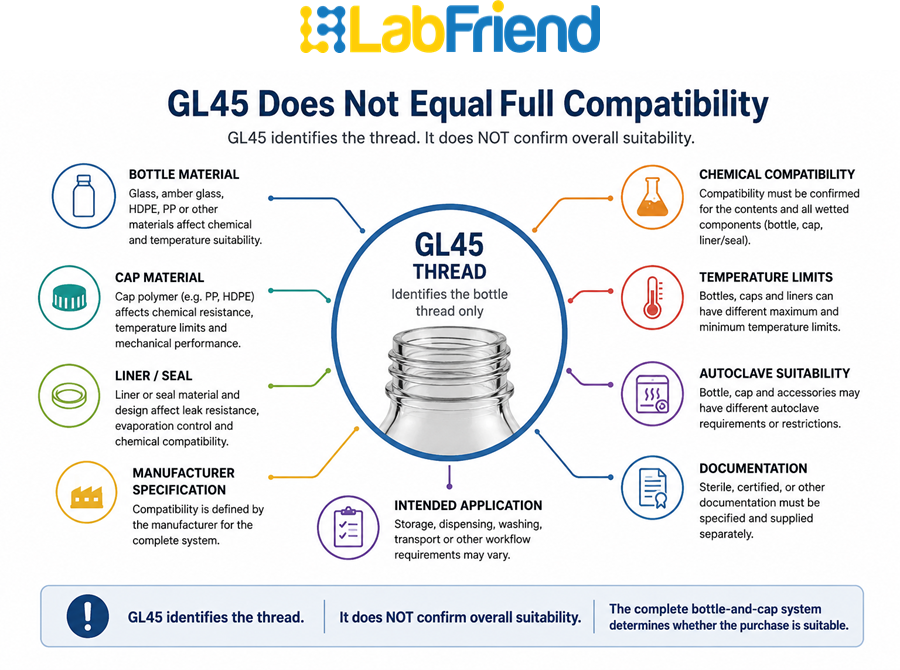
The safest procurement principle is:
GL45 can help narrow the search, but the complete bottle-and-cap system determines whether the purchase is suitable.
That principle protects both the customer and LabFriend. It prevents overconfident substitution and supports a more reliable quote process. Under LabFriend’s trust-first approach, the commercial objective is not simply to move the buyer quickly to a product. The objective is to help them avoid an avoidable mismatch and then route them to the correct bottle, cap or support pathway.
The quote-ready GL45 bottle and cap specification
A good GL45 quote request should give the supplier enough information to identify the correct bottle, cap or replacement part without guessing. The more incomplete the request, the greater the risk of a wrong match. In short, the table below lists what to confirm before requesting a quote.
|
Specification field |
Why procurement should capture it |
|
Bottle product code |
The strongest reference for accurate repeat ordering |
|
Cap product code |
Essential where caps are supplied or replaced separately |
|
Thread type |
Confirms GL45 or another thread format |
|
Bottle material |
Glass, amber glass, HDPE, PP or another material may affect suitability |
|
Bottle volume |
Prevents selecting the wrong bottle format or cap family |
|
Cap material |
May affect chemical, temperature or handling suitability |
|
Liner or seal detail |
May affect leakage, evaporation, compatibility or closure performance |
|
Pouring ring or accessory |
Avoids missing or mismatched accessories |
|
Application |
Reagent storage, general storage, dispensing, washing or another workflow |
|
Chemical exposure |
Important where contents may contact cap, liner or seal |
|
Autoclave or temperature requirement |
Must be checked for both bottle and closure |
|
Documentation requirement |
Sterile, certified or other documentation must be specified separately |
|
Approved alternatives |
Controls substitution and prevents unsuitable swaps |
|
Reorder frequency |
Supports repeat supply and account planning |
|
Storage/light exposure conditions |
Ambient or controlled temperature and light-sensitive storage may affect suitability separately from in-use conditions |
This is not bureaucracy for its own sake. It is a practical way to prevent avoidable procurement errors. Once the bottle-and-cap specification is clear, procurement can compare relevant laboratory reagent bottles or ask LabFriend UK for help matching the requirement.
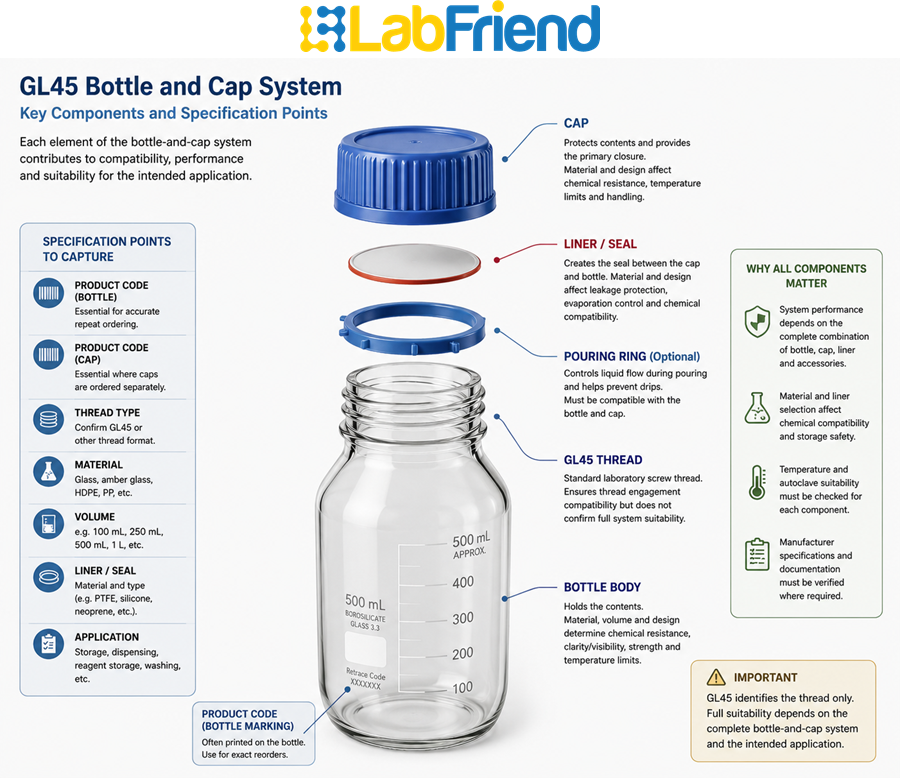
Product-code capture: bottle, cap, liner, seal and accessories
Product-code capture is one of the simplest ways procurement can reduce GL45 reorder errors. GL45 is a thread-family designation, not a product code, and is shared across many unrelated bottle and cap products, which is why the exact product code — not the thread name — is the reliable purchasing reference. If the laboratory already has an approved bottle-and-cap system, the product code should be treated as a controlled purchasing reference.
The bottle code alone may not be enough. Some bottles are supplied with caps; others may require caps, liners, pouring rings (a fitted spout insert for controlled dispensing) or accessories to be ordered separately. If the cap is ordered separately, procurement should capture the cap product code as well. If a liner or seal is part of the approved system, that detail should also be recorded.
This is especially important where the laboratory uses multiple similar bottle systems. Two bottles may both be GL45, both be 500 ml and both appear suitable in a catalogue, but they may differ in cap material, liner, glass type, amber or clear format, accessory compatibility or pack configuration. Without product-code discipline, reorder accuracy becomes dependent on memory or visual comparison.
A practical procurement record should therefore include:
|
Record item |
Capture status |
|
Bottle product code |
Required where known |
|
Cap product code |
Required if cap supplied separately |
|
Bottle material and volume |
Required |
|
Thread type |
Required |
|
Cap material |
Required where relevant |
|
Liner/seal detail |
Required where relevant |
|
Pouring ring/accessory |
Required where used |
|
Pack size |
Recommended |
|
Approved alternatives |
Recommended |
|
Internal user or department |
Recommended |
|
Reorder frequency |
Recommended |
For repeat customers, this is commercially valuable. It gives LabFriend’s inside sales team a clear way to support reorder reminders, equivalent-check discussions and future quote requests without forcing the customer to respecify the same bottle and cap system each time.
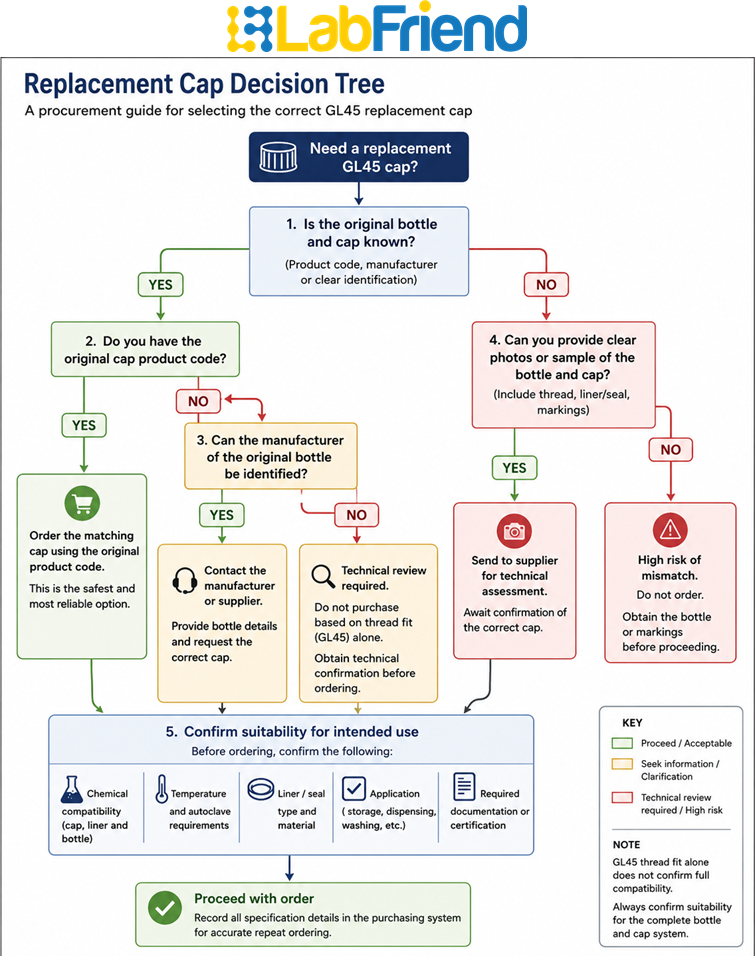
Replacement caps: what procurement should check
Replacement cap requests deserve particular care. They often arrive after the original bottle has already been purchased, used and separated from its paperwork. A user may ask for “GL45 caps” without knowing the original product code or liner detail.
Procurement should not assume that every GL45 replacement cap is acceptable. The buyer should check whether the cap is for a specific bottle brand or product family, whether the bottle is used for chemicals, whether a liner or seal is required, whether autoclaving or cleaning is involved, and whether the cap is part of an approved laboratory method or SOP.
A cap replacement request should ideally answer four questions:
- What bottle is the cap for? Confirms the starting specification.
- What is the bottle used for? Identifies chemical, temperature or workflow risk.
- Is the original cap code known? Supports like-for-like replacement.
- Are alternatives acceptable? Determines whether technical approval is needed.
Where these answers are unclear, the buyer should pause before ordering. This does not slow procurement down unnecessarily; it prevents an avoidable mismatch. Where support is needed, procurement can contact LabFriend UK with the bottle details, known product codes and intended use.
Acceptable alternatives and when technical approval is needed
Alternatives can be useful. They can help manage availability, cost and supplier choice. But GL45 alternatives must be handled carefully because a thread match is not the same as an approved bottle-and-cap system.
Procurement should classify proposed alternatives before accepting them.
|
Proposed change |
Procurement position |
|
Same bottle product code, same cap, same pack size |
Usually acceptable |
|
Same bottle product code, different pack size |
Check stockroom or buyer preference |
|
Same bottle, alternative manufacturer-confirmed cap |
May be acceptable if documentation supports it |
|
Same GL45 thread, different cap material |
Requires technical review |
|
Same GL45 thread, different liner or seal |
Requires technical review |
|
Same GL45 thread, different bottle manufacturer |
Requires specification review |
|
Glass bottle changed to plastic |
Requires technical approval |
|
Clear bottle changed to amber |
Requires review; may affect visibility and method expectations. Amber glass reduces UV/visible light transmission, which matters specifically for light-sensitive or photosensitive reagents |
|
Amber bottle changed to clear |
High caution where light exposure matters, particularly for light-sensitive or photosensitive reagents, since clear glass does not provide the UV/visible light protection of amber glass |
|
Sterile, certified or documented status changed |
Do not substitute without documented approval |
|
Product code unknown |
Clarify before buying |
A value alternative should never be presented as equivalent simply because it appears similar or has the same thread format. The alternative must be reviewed against the approved specification. This protects the laboratory and improves long-term supplier confidence.
Autoclaving, chemical exposure and documentation checks
Some GL45 bottle and cap requests are straightforward. Others involve additional technical requirements that procurement must capture before requesting a quote.
Autoclaving is a common example. A bottle may be suitable for heat exposure where specified, but the cap, liner, pouring ring or accessory may not be suitable under the same conditions. Autoclave cycles typically operate at or above 121°C, and the cap, liner or accessory can carry a lower temperature or cycle-count rating than the bottle body. Procurement should therefore avoid assuming that a GL45 bottle-and-cap system is autoclavable unless the product documentation confirms suitability for the complete system.
Chemical exposure is another important area. In reagent storage workflows, the cap and liner may be exposed to vapours, splashes, residues or repeated handling. Compatibility may depend on the stored substance, concentration, temperature and exposure duration. The bottle material may be suitable while the closure system is not. Chemical compatibility should be checked against the SDS or a chemical compatibility chart for the cap and liner materials specifically, not only the bottle material.
Documentation must also be treated carefully. Sterile, certified, pre-cleaned, DNase-free, RNase-free and endotoxin-controlled are separate product characteristics. They do not follow from the GL45 thread type. If a laboratory requires any of these characteristics, procurement should include them explicitly in the quote request.
For technical reagent-storage context, use LabFriend UK’s How to Select Laboratory Reagent Bottles for Chemical Storage. For broader product discovery, laboratory vessels can support comparison where the buyer is still defining the bottle system.
Repeat-order control and reorder reminders
GL45 bottle procurement is often a repeat-order issue. A laboratory may buy the same bottles and caps every month, every quarter or at the start of each project. If procurement captures the correct specification at the first order, future purchasing becomes much easier.
A good repeat-order record should show the approved bottle and cap combination, the product codes, pack sizes, internal user group, acceptable alternatives and expected reorder frequency.
For procurement teams, this record is valuable because it prevents the same clarification process from repeating every time bottles or caps are reordered. If the approved specification is saved after the first correct order, future purchases can be handled more quickly and with less risk of mismatch. It also makes it easier to confirm whether an alternative is genuinely acceptable or whether the laboratory needs the original bottle-and-cap combination.
Common procurement mistakes
The most common mistake is buying from the thread description alone. “GL45” is important, but it is not enough. Procurement should still capture bottle material, cap material, liner or seal, product code and application.
Another common mistake is ordering replacement caps without confirming the original bottle. This can lead to caps that physically fit but do not match the intended workflow.
A third mistake is accepting alternatives based on availability or price without technical review. This is risky where material, cap, liner, clear/amber format, sterile status or certification changes.
A fourth mistake is failing to capture the repeat-order record. If a bottle-and-cap combination is likely to be reordered, the specification should be saved after the first successful purchase. Otherwise, the same clarification process repeats every time.
The final mistake is treating procurement support as only a transaction. GL45 mismatch problems need to be rectified with the end user helping them avoid the wrong purchase in the future.
If a mismatch has already been ordered, the priority is to pause further reordering rather than repeat the error. Contact LabFriend UK to confirm the correct bottle or cap before ordering again.
What this article does not solve
This article helps procurement teams reduce GL45 cap mismatch and reorder errors. It does not confirm that a specific bottle, cap, liner, seal or accessory is chemically compatible, leakproof, pressure-safe, vacuum-safe, autoclavable, sterile, certified, pre-cleaned or method-approved.
Those checks must be confirmed through the product documentation, manufacturer information, laboratory requirements, SDS, COSHH assessment, method requirements and local procedures.
Procurement should also avoid treating any replacement cap or alternative bottle as equivalent unless the specification has been reviewed and accepted.
Where to go next once the specification is clear
Once the bottle-and-cap specification has been confirmed, procurement can move from clarification to comparison. If the requirement is for GL45-related reagent bottle purchasing, start by reviewing LabFriend UK’s laboratory reagent bottles, checking material, volume, cap/thread and closure details against the approved requirement.
If the laboratory is still comparing wider bottle or vessel formats, LabFriend UK’s laboratory vessels range can help procurement review broader options before narrowing the specification. Where the correct bottle, cap, liner or replacement part is uncertain, use the contact LabFriend UK route for specification-led support before ordering.
FAQs
What should procurement check before buying GL45 bottles?
Procurement should check the bottle product code, thread type, bottle material, volume, cap material, liner or seal, application, documentation requirements, approved alternatives and expected reorder frequency.
Are all GL45 caps interchangeable?
No. GL45 caps may share a thread format, but cap material, liner, seal, manufacturer specification and workflow suitability can differ. A cap that screws on may still be unsuitable.
Can procurement buy replacement GL45 caps separately?
Yes, where suitable replacement caps are available, but procurement should confirm the original bottle, cap product code, liner or seal requirement and intended use before ordering.
What product codes should be captured for GL45 reorders?
Capture the bottle product code and, where caps are supplied separately, the cap product code. Also record pack size, material, volume, thread type, cap material, liner or seal and approved alternatives.
When does a GL45 cap substitution need technical approval?
Technical approval is needed when the cap material, liner, seal, manufacturer, bottle system, chemical exposure, autoclave requirement, sterile status or certified status changes.
Does GL45 confirm chemical compatibility?
No. Chemical compatibility depends on the materials in contact with the substance — the bottle body (for example glass, HDPE or PP), the cap (for example PP or PBT) and the liner (for example PTFE-faced or silicone) — as well as contents, concentration, temperature, exposure duration and storage conditions. GL45 only describes the thread or neck format.
Does GL45 confirm autoclavability?
No. Autoclave suitability must be confirmed for the complete bottle-and-closure system. Thread type alone does not confirm suitability.
How can procurement reduce GL45 reorder errors?
Create a repeat-order record that includes the approved bottle and cap product codes, thread type, cap material, liner or seal, pack size, internal user and accepted alternatives.
What does a GL45 bottle or cap mismatch cost procurement?
A mismatch commonly leads to return requests, stockroom confusion and extra supplier communication, adding avoidable time and repeat clarification cycles to what should be a straightforward reorder.
What if the supplier or documentation cannot confirm compatibility?
Procurement should pause before ordering rather than assume a thread match is sufficient, and contact LabFriend UK with the bottle details, known product codes and intended use.
Conclusion
GL45 bottle procurement should be controlled by a complete bottle-and-cap specification, not by thread type alone. GL45 helps identify an important part of the system, but it does not confirm cap material suitability, liner compatibility, chemical compatibility, autoclave suitability or full workflow suitability.
For procurement teams, the practical goal is to prevent mismatch before it happens. Capture the bottle code, cap code, thread type, cap material, liner or seal, bottle material, volume, application, documentation requirements, approved alternatives and reorder frequency. That makes the quote more accurate and the repeat order more reliable.
Once the specification is clear, compare LabFriend UK’s laboratory reagent bottles or review broader laboratory vessels. Where the match is uncertain, contact LabFriend UK for support before ordering.
Request a quote for GL45 bottle and cap options
Confirm the GL45 bottle-and-cap specification first: bottle product code, cap product code where separate, thread type, bottle material, cap material, liner or seal, volume, application, documentation needs, approved alternatives and repeat demand. Then compare LabFriend UK’s laboratory reagent bottles, GL45 bottles and caps or contact LabFriend UK for quote and matching support.
Written by: Donal O’Sullivan, BSc, Co-Founder and Sales Director, LabFriend UK. Donal brings deep chemistry-led technical expertise across analytical chemistry, biochemistry, environmental monitoring, laboratory instrumentation, consumables and scientific product selection.
Reviewed by: Michael Anderson, MBA, Founder and Managing Director, LabFriend UK. Michael reviews LabFriend UK content for customer relevance, commercial accuracy, operational practicality and alignment with LabFriend UK’s laboratory supply model.
Related Stories

Laboratory Bottle Selection for Lab Managers - Standardising Everyday Storage and Handling
Learn how UK lab managers can standardise laboratory bottle selection by material, volume, mouth style, closure, sterility, compatibility and reorder requirements to reduce stockouts and simplify repeat purchasing.

Glass vs Plastic Laboratory Bottles - Which Should UK Labs Choose
Glass vs Plastic Laboratory Bottles - Which Should UK Labs Choose

Laboratory Bottle Materials Explained - Borosilicate Glass - Amber Glass - HDPE - LDPE and PP
Laboratory Bottle Materials Explained - Borosilicate Glass - Amber Glass - HDPE - LDPE and PP

How to Select Laboratory Reagent Bottles for Chemical Storage
How to Select Laboratory Reagent Bottles for Chemical Storage