How CROs Can Standardise Centrifuge Tubes for Cell Culture Project Workflows
26 mins read
How CROs Can Standardise Centrifuge Tubes for Cell Culture Project Workflows
By Donal O’Sullivan, BSc. Reviewed by Michael Anderson, MBA.
Opening answer
Contract Research Organisations (CROs) can standardise centrifuge tubes for cell culture project workflows by defining approved tube formats, project-specific technical requirements, substitution rules and repeat-order controls before purchasing becomes fragmented across project teams. The goal is not to force every client project into one tube type. The goal is to make routine purchasing more consistent while preserving technical suitability, documentation control and project continuity.
For most CRO cell culture workflows, standardisation should focus on the formats used repeatedly across projects, such as 15mL and 50mL centrifuge tubes. Each approved format should be linked to its intended use, required sterility or aseptic status (sterility being validation against a defined sterility assurance standard, and aseptic status describing manufacture or handling under controlled conditions to minimise contamination — the two are not equivalent), any endotoxin or pyrogen-related requirements where applicable, product-specific RCF rating and rotor compatibility (the centrifuge-specific checks that confirm a tube can be used safely with a given centrifuge and rotor/adapter setup), and documentation expectations.
CROs reviewing suitable formats can start with LabFriend UK’s centrifuge tubes, then build a controlled repeat-order model around the tube specifications their projects genuinely require.
Why CROs need controlled standardisation
CRO laboratories operate differently from single-project research labs. A CRO may run multiple client projects, use different cell culture models, support different scientific teams and manage changing project timelines. This creates a practical purchasing challenge: the same consumable category can be ordered repeatedly, but the technical requirements behind those orders may not always be identical.
Centrifuge tubes are a good example. A 50mL tube used for routine cell suspension handling in one project may not have the same requirements as a tube used in a more sensitive or documented workflow. A sterile tube may be sufficient for one workflow, while another project may require additional documentation or specific claims. A tube that works well with one centrifuge setup may need checking before being used with another rotor or adapter.
Without a standardisation process, project teams may start making local decisions. One team orders one product, another team orders a similar-looking alternative, and procurement has limited visibility of what is being used where. Over time, this creates avoidable SKU growth, substitution risk and inconsistent repeat ordering.
Controlled standardisation gives the CRO a better operating model. It allows routine tube purchasing to become more efficient while keeping project-specific technical requirements visible.
Standardise approved formats, not every workflow
The most important principle for CROs is this:
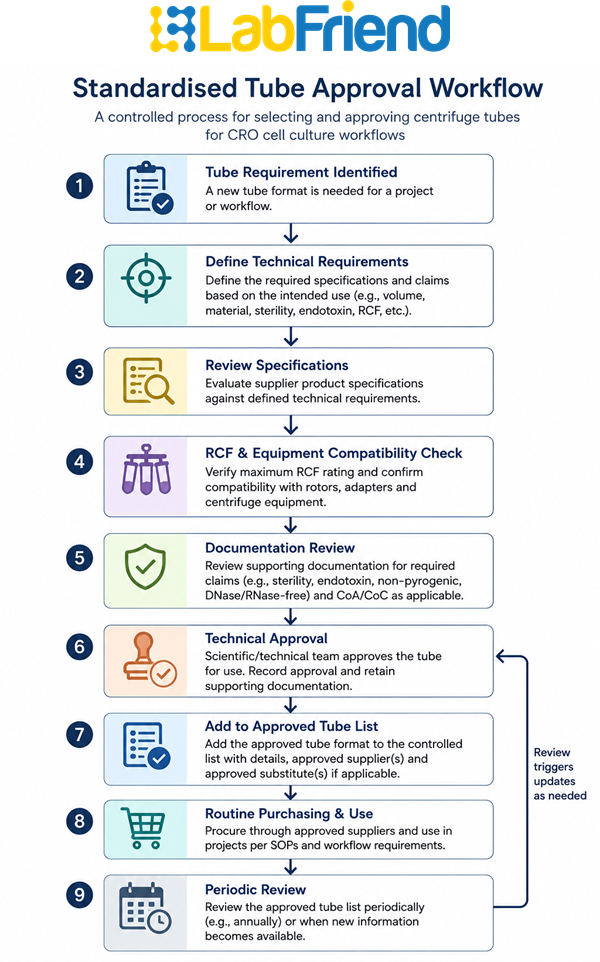
Standardise the approved purchasing framework, not the scientific judgement required for each project.
A CRO should not standardise centrifuge tubes so aggressively that client-specific requirements, SOPs or workflow conditions are lost. Instead, it should define a set of approved tube formats that cover common use cases, then make clear when a project-specific exception or technical approval is needed.
For example, a CRO may decide that routine 15mL and 50mL sterile or aseptic centrifuge tubes are approved for defined cell culture support workflows. That does not mean those tubes are automatically suitable for every cell culture project, every centrifugation condition or every documentation requirement. It means they are accepted options within defined boundaries.
This protects both operational efficiency and scientific control.
What CROs can standardise across projects
Standardisation works best when it focuses on repeatable purchasing decisions that do not compromise project requirements. CRO operations teams should identify the tube formats that are used frequently, then define when each format is appropriate.
|
Standardisation area |
What the CRO should define |
Why it matters |
|
Core tube formats |
Approved 15mL and 50mL options |
Reduces unnecessary product variation |
|
Workflow use case |
Which project steps each tube can support |
Prevents unsuitable cross-use |
|
Sterility or aseptic requirement |
Whether the workflow requires sterile or aseptic tubes |
Supports contamination-control decisions, as sterile and aseptic status address contamination control in different ways and should be defined separately |
|
Additional claims |
Endotoxin, pyrogen, DNase or RNase claims where required |
Avoids unsupported assumptions |
|
RCF and rotor suitability |
Maximum RCF, rotor and adapter compatibility |
Reduces centrifugation risk |
|
Substitution rule |
What can replace the preferred product |
Controls supplier switching |
|
Reorder model |
Who orders, when and at what level |
Supports project continuity |
This table should be treated as a management tool, not a rigid scientific rule. The CRO still needs technical review where project requirements demand it.
What should remain project-specific
Some requirements should not be absorbed into a general standard product list too quickly. Client project requirements, method-specific SOPs, contamination-control expectations, endotoxin or pyrogen-related needs, centrifugation conditions and documentation requirements may all vary between projects.
A tube used for routine media handling may not need the same level of evidence as a tube used in a project with stricter documentation expectations. A sterile or aseptic tube may support some workflows, but it does not automatically confirm endotoxin-free, low-endotoxin, non-pyrogenic, DNase-free or RNase-free status. These are independent claims — none of them implies any of the others — and each must be separately supported by product documentation where it is required.
CROs should therefore use a two-level model: standard approved tubes for routine, repeatable workflows, and project-specific tubes for client-specific, sensitive or documented workflows, as set out below:
|
Level |
Suitable for |
Control approach |
|
Standard approved tubes |
Routine, repeatable project workflows |
Approved product list and repeat-order control |
|
Project-specific tubes |
Client-specific, sensitive or documented workflows |
Technical review before approval |
|
Restricted substitutes |
Alternative products during supplier changes |
Specification comparison and project approval |
|
Specialist formats |
Non-routine technical requirements |
Separate review and documentation |
This keeps the routine purchasing process efficient without weakening project-specific technical control. The model works best when project-specific review requests have a clear, reasonably prompt turnaround, so scientific teams are not tempted to substitute informally while waiting for approval.
Approved tube list for CRO cell culture projects
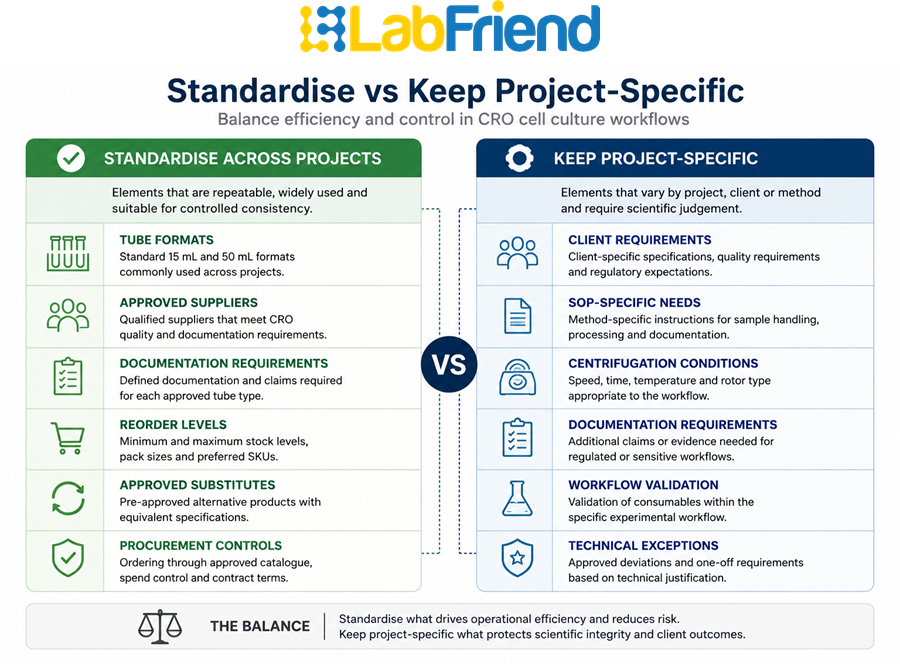
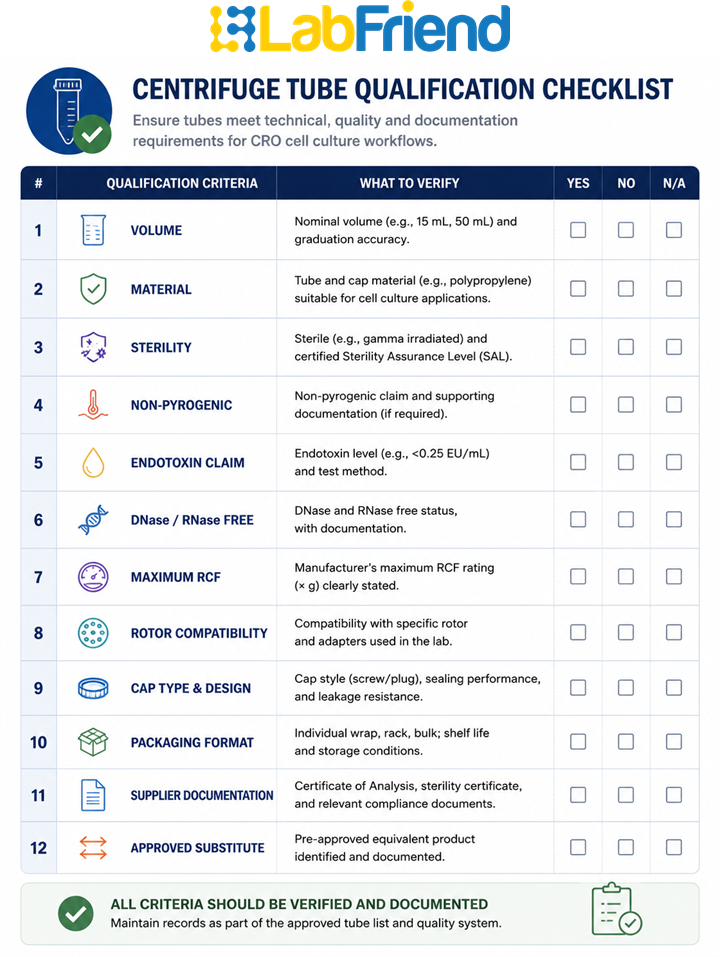
An approved tube list is one of the most useful tools for CRO operations managers. It gives scientists, project managers and procurement teams a shared reference point.
The list should not just name the product. It should explain what the product is approved for, what claims are required, what substitute is acceptable and who owns the decision if something changes. Changes to the list should be dated and logged so there is a traceable record of what was approved, when, and by whom — relevant for CROs working to client or regulatory documentation expectations.
A practical approved tube list should include:
|
Field |
Why it matters |
|
Approved tube format |
Defines the accepted 15mL, 50mL or other format |
|
Intended project use |
Prevents use outside the approved workflow |
|
Required claims |
Separates sterile, aseptic, endotoxin, pyrogen and nuclease-related requirements |
|
Maximum RCF |
Supports centrifugation suitability |
|
Rotor / adapter notes |
Helps avoid equipment compatibility assumptions |
|
Preferred supplier route |
Supports repeat ordering |
|
Approved substitute |
Reduces ad hoc switching |
|
Technical owner |
Identifies who approves changes |
|
Review date |
Keeps the list current as projects change |
For broader tube-selection context, CRO teams can use the Complete Guide to Centrifuge Tubes as the cluster authority reference.
Substitution control is the core CRO risk
For CROs, the biggest operational risk is often not the first tube selection. It is what happens later when the preferred product is unavailable, a project team orders a similar product, or procurement switches supplier to reduce cost.
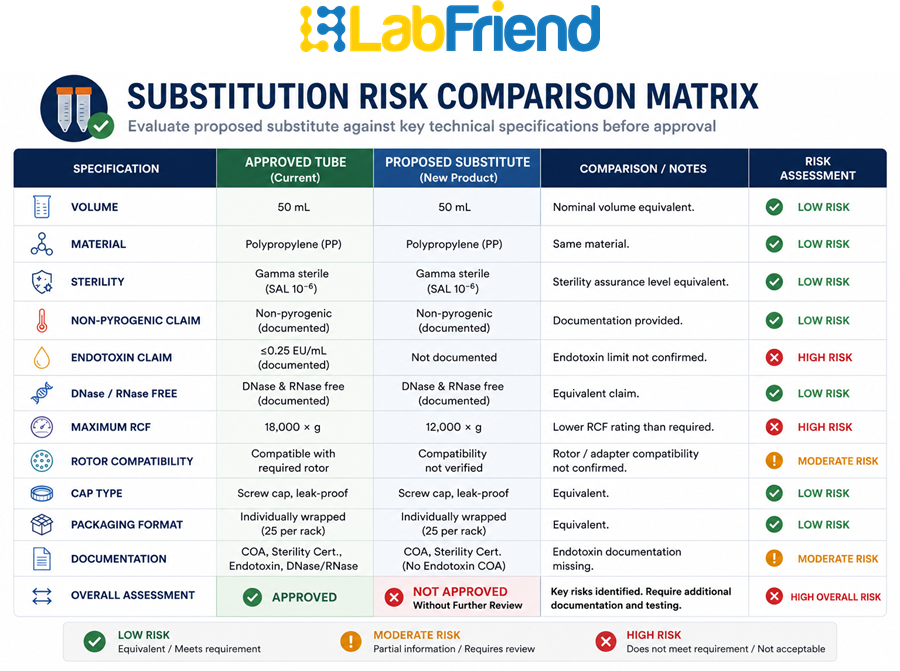
Supplier switching can be commercially sensible, but it should not happen invisibly. Candidate substitutes should be compared against the accepted specification before they become part of a project workflow.
The comparison should include volume, material, dimensions, cap design, cap or closure seal integrity (which affects leak resistance under centrifugal force and during storage independently of the tube body's RCF rating), sterility or aseptic status, any required endotoxin or pyrogen-related claims, maximum RCF, packaging format and available documentation, including supporting evidence such as a Certificate of Analysis (CoA) or Certificate of Conformance (CoC) where the workflow requires it. If the workflow is subject to a client requirement or CRO SOP, the substitute may also need internal approval before routine use.
Procurement efficiency is valuable but should not replace technical suitability assessment.
Supplier switching without project disruption
CROs often need supplier flexibility. Projects can scale quickly, demand can change, and repeat consumables may need to be sourced more efficiently. A responsive supplier route can help, especially where the CRO uses the same tube formats across multiple active projects.
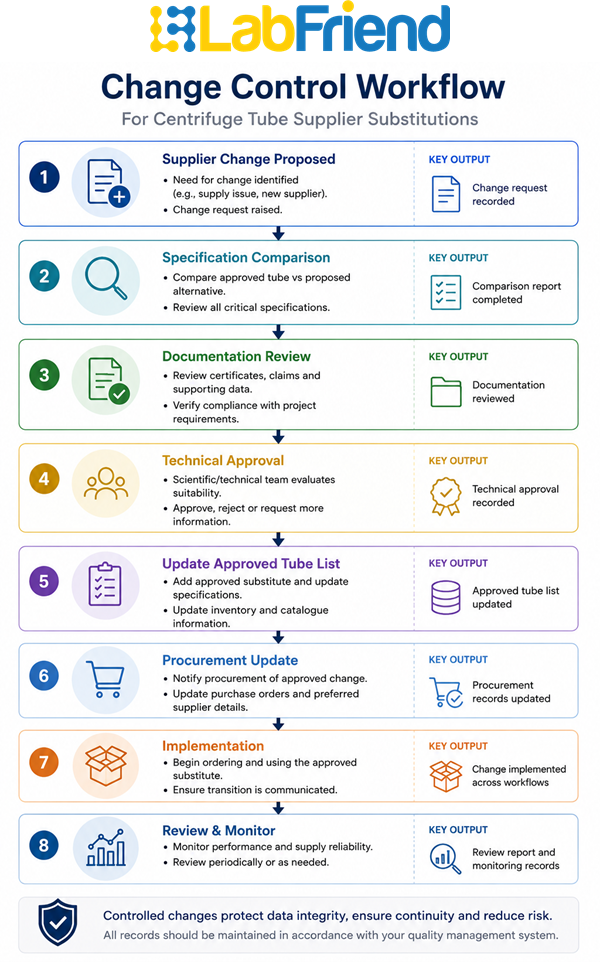
However, the CRO should treat supplier switching as a controlled process. A cheaper or more available tube is only useful if it preserves the specification required by the project.
A simple switching review can help:
|
Switching question |
Why it matters |
|
Does the candidate tube match the approved format? |
Prevents volume or geometry changes |
|
Are required claims explicitly documented? |
Avoids sterility, endotoxin or pyrogen assumptions |
|
Is the RCF rating suitable for the workflow? |
Supports centrifugation safety and performance |
|
Does it fit the rotor and adapter setup? |
Avoids equipment compatibility issues |
|
Is the packaging practical for project use? |
Supports handling and stock control |
|
Does the project require change approval? |
Protects client and SOP expectations |
|
Is supporting documentation (e.g. CoA/CoC) available for the required claims? |
Confirms claims are evidenced, not assumed |
The best supplier-switching process is practical, visible and proportionate to project risk.
RCF and rotor compatibility still matter after standardisation
Once a tube is on an approved list, it can be tempting to treat it as universally acceptable. CROs should avoid that. Standardisation does not remove the need to check centrifugation conditions.
A tube may be approved for one project workflow but not suitable for another if the centrifugation force, rotor type, adapter, fill volume or temperature condition changes. RCF depends on both the tube's maximum rated RCF and the specific rotor's radius and speed, so it must be recalculated for each rotor and centrifuge combination rather than assumed to carry over from one setup to another. RPM alone is not enough to confirm suitability. Separately, standard polypropylene centrifuge tubes have a defined temperature operating range and freeze-thaw tolerance that sterility, aseptic or RCF claims do not confirm, so workflows involving freezing or cryogenic storage need this checked independently.
CROs managing multiple projects should be especially careful when the same tube is used across different centrifuges or rotors. A product that physically fits does not automatically mean it is suitable for the intended condition.
For technical background, read centrifuge tube RCF and rotor compatibility.
Repeat ordering and project continuity
Repeat ordering is where CRO standardisation creates commercial value. Once a tube format is accepted for a project or group of projects, the CRO should protect that decision through a repeat-order process.
That means defining the preferred product, expected usage rate, reorder point, minimum stock level, approved substitute and escalation route if supply changes. This reduces reactive purchasing and helps prevent scientists from making last-minute substitutions.
For CROs, project continuity is the key benefit. A standardised repeat-order process reduces the chance that a client project is disrupted because a routine consumable was not reordered in time or was replaced without review.
For wider repeat-use purchasing guidance, read Choosing 15mL and 50mL Centrifuge Tubes for High-Usage Laboratories.
Project organisation and bench control
CRO project teams often work with multiple samples, conditions, project identifiers and tube formats at the same time. Tube standardisation should therefore include practical handling and organisation, not only product selection.
Tube racks can support project separation, bench organisation, short-distance movement and clearer sample layout. They are not a substitute for technical tube selection, but they can help teams keep project workflows more orderly.
Where CRO teams are standardising both tubes and bench handling, LabFriend UK’s tube racks category can support adjacent workflow organisation.
Where LLG Labware alternatives may fit
LLG Labware may offer a useful value route where the product specification matches the CRO’s accepted requirement. This can be relevant when the CRO uses recurring tube formats and wants to reduce purchasing fragmentation or improve value across routine consumables.
However, LLG Labware should not be treated as an automatic substitute for an existing tube. A specification match does not by itself confirm equivalent manufacturing, quality control or certification pedigree — this should be confirmed through the product's own documentation rather than assumed from group or brand relationship. The CRO should still compare the required specification, including volume, material, cap design, sterility or aseptic status, RCF rating, packaging and documentation.
Where the workflow requires specific endotoxin, pyrogen, DNase, RNase or other claims, those claims must be explicit. If they are not documented, they should not be assumed.
LLG Labware can therefore sit within a controlled standardisation process, but it should not bypass technical review.
Common CRO mistakes
Forcing one tube format across too many projects
A single tube format may simplify purchasing, but it can create technical risk if project requirements differ. Standardisation should reduce unnecessary variation, not remove justified project-specific choices.
Treating sterile as a complete cell culture claim
Sterile or aseptic status may be important, but it does not automatically confirm endotoxin-free, low-endotoxin, non-pyrogenic, DNase-free or RNase-free status. Each of these is an independent claim that must be checked and documented on its own.
Allowing informal substitutions
A visually similar tube may differ in dimensions, cap design, material, RCF rating, packaging or documentation. Substitutes should be compared against the accepted specification.
Ignoring centrifuge setup differences
CROs may use the same tube format across different rotors or centrifuges. Product-specific RCF, adapter fit and cap clearance should still be checked where centrifugation is part of the workflow.
Letting project teams order independently
Independent ordering can solve a short-term problem but create long-term inconsistency. A CRO needs visibility of repeat consumables used across projects.
What this article does not solve
This article supports CRO operations teams in standardising centrifuge tubes for cell culture project workflows. It does not confirm that any specific centrifuge tube is suitable for all CRO projects, cell culture workflows, clinical work, diagnostic use, GMP workflows, regulated methods, endotoxin-sensitive workflows, pyrogen-sensitive workflows, cryogenic storage or chemical exposure.
Those decisions must be made using product documentation, manufacturer information, client project requirements, CRO SOPs and internal technical review.
The article also does not suggest that standardisation should override scientific judgement. Standardisation should make routine purchasing more controlled, but it should always preserve technical suitability and project-specific requirements.
CRO standardisation framework
A practical CRO standardisation process can be kept simple.
|
Stage |
Action |
Outcome |
|
1 |
Map recurring cell culture tube use across projects |
Identifies repeat demand |
|
2 |
Separate routine and project-specific workflows |
Prevents over-standardisation |
|
3 |
Define required claims and documentation |
Controls technical assumptions |
|
4 |
Create an approved tube list |
Reduces uncontrolled variation |
|
5 |
Communicate the approved list and any changes to project teams |
Reduces informal or outdated ordering |
|
6 |
Define substitute rules |
Controls supplier switching |
|
7 |
Set reorder points |
Protects project continuity |
|
8 |
Review when projects change |
Keeps the system aligned with live work |
This framework should be practical rather than bureaucratic. Its purpose is to protect project delivery while improving purchasing control.
Frequently asked questions
How can CROs standardise centrifuge tubes across cell culture projects?
CROs can standardise by defining approved tube formats, linking each format to project use cases, documenting required claims, setting substitution rules and creating repeat-order controls.
Should CROs use one centrifuge tube across all projects?
Usually not. CROs should standardise common formats where appropriate, but project-specific requirements should remain under technical control.
What should be included in a CRO approved tube list?
The list should include approved tube format, intended project use, required claims, RCF rating, rotor notes, preferred supplier route, approved substitute, technical owner and review date.
How should CROs control tube substitution?
Candidate substitutes should be compared against the accepted specification before use. Volume, material, dimensions, cap design, sterility or aseptic status, RCF rating and documentation should be reviewed.
Does sterile mean suitable for all cell culture project workflows?
No. Sterile or aseptic status does not automatically confirm endotoxin-free, low-endotoxin, non-pyrogenic, DNase-free or RNase-free status.
Why does RCF matter for CRO tube standardisation?
A tube may be used across different centrifuges or rotors. Product-specific RCF, rotor compatibility, adapter fit and fill conditions should be checked where centrifugation is part of the workflow.
Can CROs use LLG Labware alternatives?
Yes, where the specification matches the workflow and required claims are documented. LLG Labware should be evaluated through the same substitution process as any other alternative.
How does standardisation support project continuity?
Standardisation helps CROs define preferred products, reorder points, approved substitutes and escalation routes, reducing the risk of project disruption from reactive purchasing.
Who should own centrifuge tube standardisation in a CRO?
Ownership should be shared. Scientific teams define workflow needs, operations manage project continuity, procurement manages supplier routes and technical or QA leads review controlled requirements.
What is the biggest risk in CRO centrifuge tube standardisation?
The biggest risk is prioritising procurement simplicity over project-specific technical suitability. Standardisation should reduce variation without weakening workflow control.
Does standardising centrifuge tubes reduce costs for a CRO?
Standardisation can reduce costs by lowering SKU count, supporting repeat-order pricing and reducing reactive purchasing, but cost savings should not come at the expense of project-specific technical suitability.
Conclusion
CROs should standardise centrifuge tubes for cell culture project workflows through a controlled operating model. The aim is not to make every project use the same tube. The aim is to define approved formats, protect technical suitability, control substitution and support repeat ordering.
A strong standardisation process helps CROs reduce uncontrolled SKU growth, avoid informal supplier switching and maintain project continuity. It also gives procurement, operations and scientific teams a shared basis for decision-making.
Start with the recurring tube formats used across active projects. Define the workflow, required claims, RCF and rotor considerations, approved substitutes and reorder rules. Then review the approved list as client projects and workloads change.
To compare suitable options, browse LabFriend UK’s centrifuge tubes. For broader technical context, return to the Complete Guide to Centrifuge Tubes.
Read more from LabFriend UK:
- Complete Guide to Centrifuge Tubes
- Understanding RCF, RPM and Rotor Compatibility for Centrifuge Tubes
- Choosing 15mL and 50mL Centrifuge Tubes for High-Usage Laboratories
- Browse LabFriend UK Centrifuge Tubes
Written by: Donal O’Sullivan, BSc, Co-Founder and Sales Director, LabFriend UK. Donal brings deep chemistry-led technical expertise across analytical chemistry, biochemistry, environmental monitoring, laboratory instrumentation, consumables and scientific product selection.
Reviewed by: Michael Anderson, MBA, Founder and Managing Director, LabFriend UK. Michael reviews LabFriend UK content for customer relevance, commercial accuracy, operational practicality and alignment with LabFriend UK’s laboratory supply model.
Frequently asked questions
Delivery times vary by product and supplier. Each product page shows current stock levels and the expected lead time, and we confirm this when you place your order. Most items arrive within 2 to 3 weeks. Specialised items can take longer if they are not in stock. If you need something by a certain date, contact us and we’ll check for you.
Yes. Register for a commercial account and, once it’s approved, you will be able to process orders via PO Once you have a commercial account, you can directly email your purchase orders
Add products to your cart and click Get a Quote. You’ll get a formal quote instantly, ready to send to your email address. For bulk orders or custom requirements, send us your product list and we’ll reply with itemized pricing.
If your item is faulty, not as described or sent in error, let us know within 14 days of delivery and we’ll arrange a return. Change of mind returns are only accepted if the item is unused and in its original packaging. A restocking fee will apply and you pay the return freight. Read our full Returns Policy for details.
Yes, prices are shown including VAT by default. Use the Prices Inc. VAT toggle at the top of the page to view prices without VAT.