

Share :
Chemical Compatibility Guide for Centrifuge Tubes
Updated On 08/10/2026

By Donal O’Sullivan, BSc. Reviewed by Michael Anderson, MBA.
Chemical compatibility should be checked before choosing centrifuge tubes by reviewing the tube material, cap material, reagent or solvent, concentration, temperature, exposure time, fill volume, centrifugation conditions and manufacturer documentation (such as the product’s Safety Data Sheet or technical datasheet). Confirm suitability against the actual workflow — being polypropylene, polystyrene, 15 mL, 50 mL or commonly used in the laboratory does not, on its own, confirm it.
For routine aqueous buffers and general sample preparation, many laboratories use plastic centrifuge tubes successfully. However, chemical compatibility is always workflow-specific. A material that performs well with one reagent may be unsuitable with another, especially if concentration, temperature, exposure duration or centrifugation force changes.
Laboratories comparing options can start with LabFriend UK’s centrifuge tubes, then narrow their selection by material, volume, RCF rating, cap design and product documentation. For broader tube selection context, read the Complete Guide to Centrifuge Tubes.
At a glance — what to check
- Tube material
- Cap material
- Reagent or solvent
- Concentration
- Temperature
- Exposure time
- Fill volume
- Centrifugation conditions
- Manufacturer documentation
For quick, practical guidance, see the Frequently asked questions and Common mistakes sections further down this guide.
Why chemical compatibility matters
Chemical compatibility is often treated as a material question, but in practice it is a workflow question. The tube material matters, but so do the chemical, concentration, contact time, temperature, sample density, centrifugation force and closure design.
A centrifuge tube may be exposed to reagents before centrifugation, during centrifugation, after centrifugation or during temporary storage. Each situation can create different stresses. A short contact time at room temperature is not the same as extended exposure. A low-speed spin is not the same as higher RCF centrifugation. A lightly filled tube is not the same as a dense or nearly full sample. For example, a brief bench-top mixing step before centrifugation is a very different exposure to the same reagent left in contact with the tube overnight in a fridge. Appropriate disposal of chemically contaminated tubes at the end of use should also be considered as part of this exposure lifecycle.
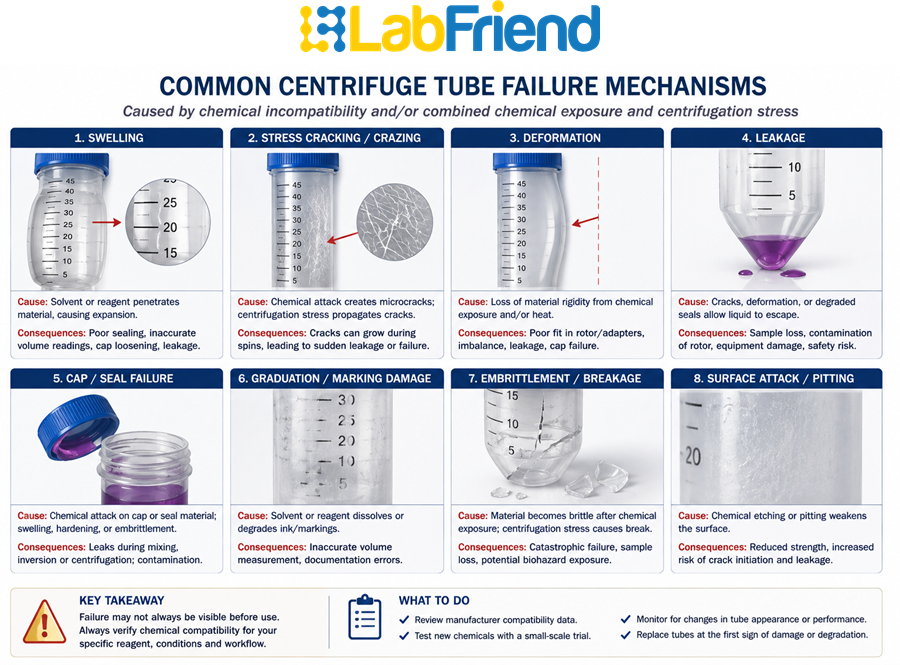
The consequences of poor compatibility can include softening, swelling, cracking, deformation, leakage, cap failure, sample contamination or sample loss. In some cases, incompatibility may not be obvious until the tube is under mechanical stress.
That is why chemical compatibility should be checked before a tube becomes part of a routine workflow.
Compatibility is not a single material property
It is tempting to ask whether a material is “chemically resistant.” That question is too broad. Chemical resistance depends on the exact conditions of use. For example, a solvent that is fully compatible when static on a bench may still be unsuitable once the tube is spun at higher RCF, because centrifugation adds mechanical stress on top of the chemical exposure.
Polypropylene, polystyrene, PPCO, polycarbonate, polysulfone and glass may all appear in laboratory tube discussions, but none of these materials should be treated as universally suitable. Each has its own performance profile, and that profile should be checked against manufacturer guidance.
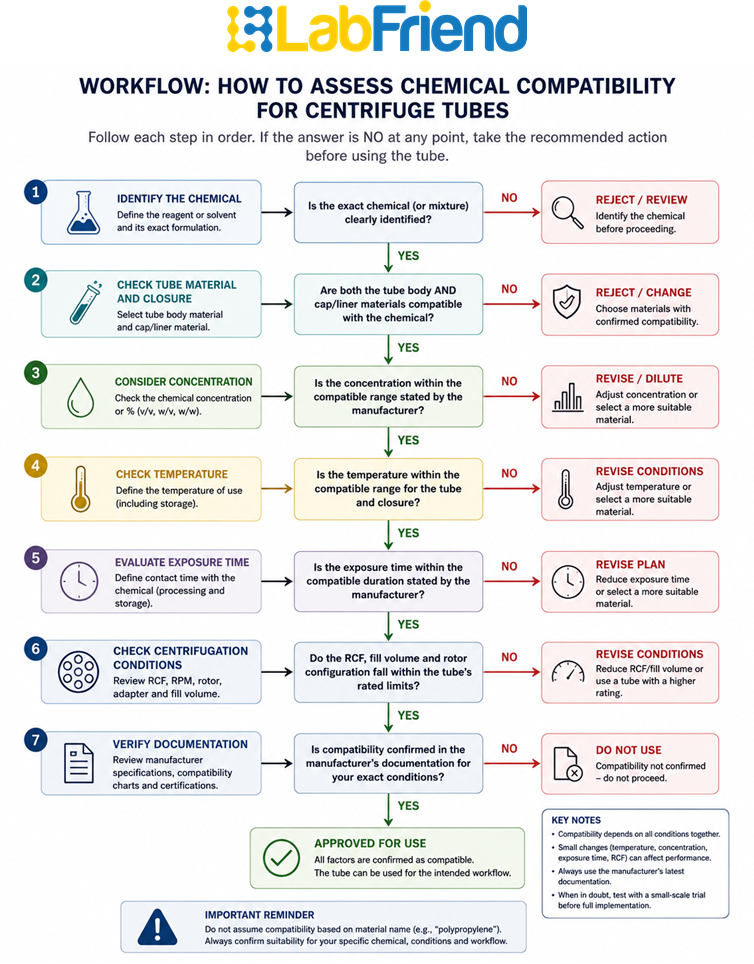
The most reliable approach is to assess compatibility through several linked factors.
|
Compatibility factor |
What to check |
Why it matters |
|
Reagent or solvent identity |
Exact chemical or mixture |
Different chemicals interact differently with tube materials |
|
Concentration |
Dilute, concentrated or mixed formulation |
Compatibility can change with concentration |
|
Temperature |
Room temperature, refrigerated, heated or low-temperature use |
Material behaviour can change with temperature |
|
Exposure time |
Brief contact, processing time or storage exposure |
Longer exposure may increase material stress |
|
Centrifugation conditions |
RCF, RPM, rotor, adapter and fill volume |
Mechanical stress can worsen compatibility problems |
|
Tube body material |
PP (polypropylene), PS (polystyrene), PPCO (polypropylene copolymer), PC (polycarbonate), glass or other material |
The main contact surface must be suitable |
|
Cap and closure material |
Cap, seal or liner material |
The closure may not match the tube body material |
|
Fill volume relative to rated maximum |
Actual sample fill level compared with the tube’s maximum rated volume |
Overfilling can increase mechanical stress and leakage risk under centrifugation |
|
Documentation |
Product specification or manufacturer compatibility data |
Confirms whether suitability is supported |
This table should be used as a review aid. It does not replace manufacturer documentation.
Polypropylene, polystyrene and other materials
Polypropylene is commonly used for many routine centrifuge tube workflows. It is widely chosen because it can offer a practical balance of durability, general laboratory suitability and availability across common 15 mL and 50 mL formats. However, polypropylene should not be described as suitable for every solvent, reagent, temperature or centrifugation condition without checking product-specific guidance.
Polystyrene may be useful where clarity is important, but it should also be assessed carefully. Visibility alone does not confirm chemical compatibility, centrifugation suitability or resistance to the specific reagent being used.
PPCO (polypropylene copolymer), polycarbonate, polysulfone and glass may be relevant in certain workflows, but each requires the same cautious review. Some materials may offer advantages in particular circumstances, but no material should be treated as a universal answer.
For laboratories standardising material choices across workflows, the article on polypropylene and polystyrene centrifuge tube selection provides useful context. For chemical compatibility decisions, final suitability should still be confirmed against the actual reagent and workflow.
Tube body and cap compatibility
Chemical compatibility is not only about the tube body. The cap, seal, liner or closure may be made from a different material. If the sample or vapour contacts the closure, that material may also need review.
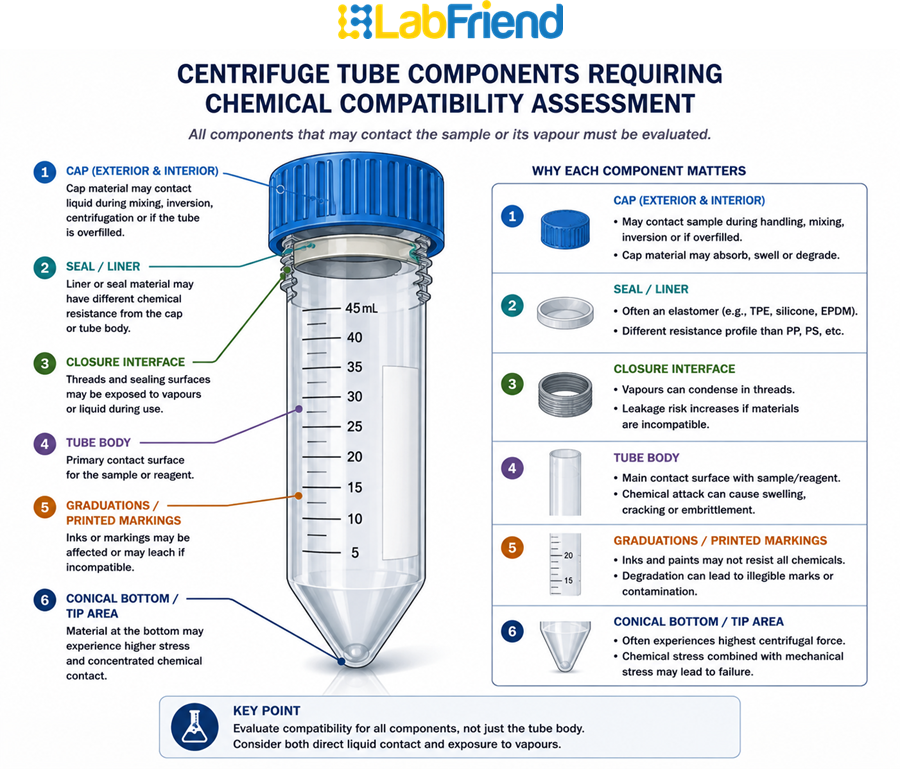
This is especially important where tubes are filled close to working limits, inverted, mixed, transported, stored temporarily or centrifuged. A tube body may appear suitable, but a cap seal or closure could still be affected by the reagent, temperature or mechanical stress. Volatile solvents can also build up vapour pressure inside a sealed tube during centrifugation, so venting or pressure risk should be considered alongside the chemical compatibility of the closure material.
The table below breaks this down by component, since the cap, seal and closure may not share the tube body’s chemical resistance:
|
Component |
Why it should be checked |
|
Tube body |
Main contact surface for the sample or reagent |
|
Cap |
May contact liquid during mixing, inversion or centrifugation |
|
Seal or liner |
May have different chemical resistance from the tube body |
|
Graduation / printed markings |
May be affected by some chemicals or cleaning processes |
|
Closure fit |
Can influence leakage risk under centrifugation or handling |
Where compatibility matters, laboratories should check both the tube and closure materials before routine use.
Solvents, buffers and reagents
Different workflows create different compatibility questions. A tube used with a routine aqueous buffer may not need the same review as a tube exposed to organic solvents, strong acids, strong bases or aggressive reagents.
The aim is not to memorise every compatibility scenario. The aim is to recognise when compatibility needs formal checking before purchase or substitution.
|
Workflow exposure |
Compatibility question |
Practical control |
|
Aqueous buffers |
Is the tube suitable for the buffer and pH range used? |
Check product specification where needed |
|
Alcohols |
Is the material suitable for the alcohol type, concentration and exposure time? |
Check manufacturer compatibility data |
|
Organic solvents |
Is the material suitable for the exact solvent or mixture? |
Do not assume; verify before use |
|
Acids or bases |
Is the material suitable for concentration, temperature and exposure time? |
Use documented compatibility guidance |
|
Biological samples with additives |
Could additives affect material or closure suitability? |
Check workflow and documentation — assess additives such as preservatives, detergents or chaotropic agents in the same way as any other reagent |
|
Temporary storage |
Does exposure duration change compatibility risk? |
Distinguish processing from storage |
|
Centrifugation after exposure |
Does RCF add mechanical stress to the tube? |
Check tube rating and rotor conditions |
This matrix is deliberately cautious. It avoids broad compatibility promises and keeps the decision tied to the laboratory’s actual workflow.
Centrifugation can increase material stress
A tube that tolerates a reagent while standing on the bench may not necessarily tolerate the same reagent under centrifugation. Centrifugation introduces mechanical stress. If the tube material has been weakened, softened or stressed by chemical exposure, the risk of cracking, deformation, leakage or failure may increase.
RCF (Relative Centrifugal Force) is the actual mechanical stress applied to a sample during centrifugation, while RPM (Revolutions Per Minute) is simply the rotor’s rotational speed. The same RPM can produce different RCF values depending on the rotor’s radius, so compatibility and mechanical stress should be assessed against RCF rather than RPM alone.
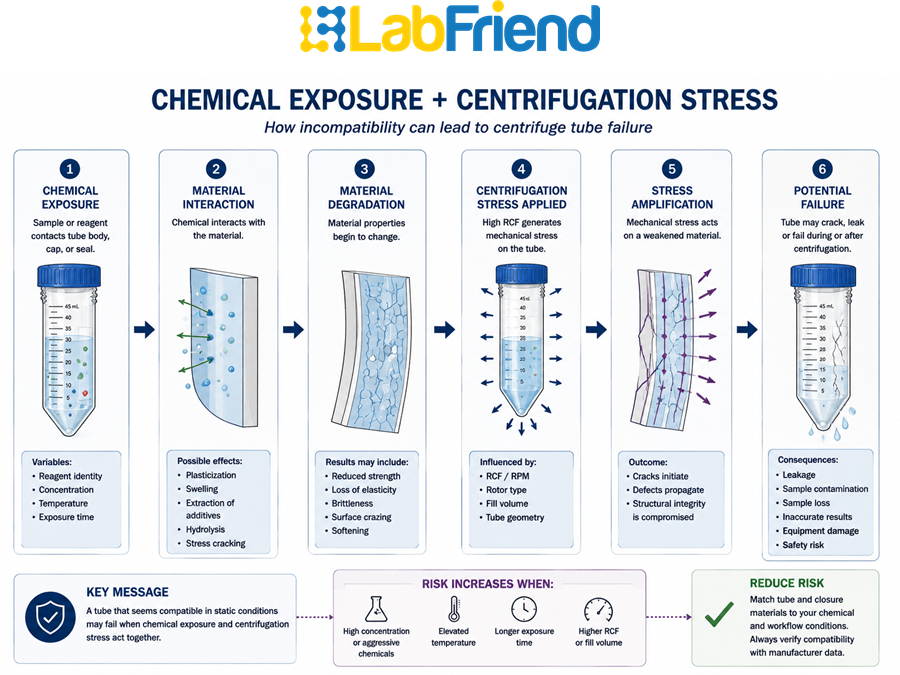
This is why chemical compatibility should be considered alongside RCF, rotor fit, adapter support, fill volume and temperature. The question is not only whether the material resists the chemical. The question is whether the tube remains suitable under the full workflow conditions.
A tube used at low speed for a short spin may face a different risk profile from a tube used at higher RCF, near working volume or in a refrigerated centrifuge. Dense samples may also change the load placed on the tube.
For technical background on centrifugation conditions, read centrifuge tube RCF and rotor compatibility.
Temperature, exposure time and storage
Temperature and time are often overlooked in compatibility decisions. A chemical exposure that is acceptable at room temperature for a short process may not be acceptable at elevated temperature, low temperature or extended storage.
Temperature can affect material stiffness, brittleness, flexibility and sealing behaviour. Exposure time can affect swelling, softening or gradual material change. Repeated use conditions may also differ from one-off exposure.
Routine refrigeration is not the same risk category as cryogenic exposure. Storage at around -80°C or in liquid nitrogen at -196°C can make many plastics brittle and prone to fracture, so cryogenic use should be checked separately from standard low-temperature storage.
If a workflow involves refrigeration, heating, incubation, low-temperature storage or prolonged chemical contact, the laboratory should check whether the product documentation supports that use. Confirm autoclavability, cryogenic suitability and low-temperature suitability against the product documentation rather than the material name. Where autoclaving is required, the standard reference condition to check product documentation against is 121°C at 15 psi for around 15–20 minutes.
Documentation to check before purchase
Chemical compatibility decisions should be supported by evidence. The level of evidence required depends on the workflow risk, but the basic review should be clear enough for another user or buyer to understand why a tube was selected. Note that most published chemical resistance charts are generated from static immersion testing rather than testing under centrifugal load, so a favourable chart rating does not by itself confirm suitability under centrifugation.
|
Evidence source |
What it may support |
|
Product specification |
Material, volume, dimensions, cap type and RCF rating |
|
Manufacturer datasheet |
Detailed usage conditions and product limits |
|
Chemical resistance chart |
Material compatibility with defined chemicals |
|
Application notes |
Use guidance for specific workflows |
|
Certificate or declaration |
Specific product claims where available |
|
Internal SOP |
Workflow-specific requirements |
|
Substitution record |
Why an alternative product was accepted |
|
Safety Data Sheet (SDS) |
Reagent hazard, handling and chemical compatibility information for the specific substance |
Not every workflow needs every document. A routine low-risk buffer step may only need a product specification. A workflow involving aggressive chemicals, higher RCF or controlled methods may require more formal review. For higher-risk workflows, this documentation review should also involve the laboratory’s EHS or COSHH officer, or equivalent safety lead.
Supplier switching and compatibility control
Supplier switching can be useful when a laboratory needs better value, easier ordering, improved availability or a broader product range. However, where chemical compatibility matters, substitution should be controlled.
A visually similar tube should not be treated as equivalent without checking the accepted specification. Volume, material, cap design, closure material, maximum RCF, packaging and documentation may differ between products.
A potential alternative should be compared against the existing product and the workflow requirement before routine use. If the laboratory uses an approved product list, the compatibility requirement should be preserved in the substitute rule. Where practical, this comparison should include a small-scale trial spin using a sacrificial tube before the alternative is adopted for routine use.
Procurement efficiency is valuable but should not replace technical suitability assessment.
For laboratories managing repeated tube demand, high-usage centrifuge tube purchasing provides useful repeat-order context.
Chemical compatibility and repeat ordering
Once a centrifuge tube has been accepted for a workflow involving chemical exposure, the repeat-order process should protect that specification. A buyer should not replace the tube with a cheaper or more available alternative unless the compatibility requirement is still met.
This becomes important in busy laboratories where different users may order consumables independently. If the original selection was based on material compatibility, RCF rating, cap design or documentation, those criteria should remain visible.
A simple internal note can help: “Approved for this workflow because material, closure, RCF and documentation were checked against the reagent and processing conditions.” That level of control helps prevent accidental substitution.
Common mistakes in chemical compatibility decisions
Assuming material name is enough
Knowing that a tube is polypropylene or polystyrene is useful, but it is not the full compatibility answer. The reagent, concentration, temperature, exposure time and centrifugation conditions still matter.
Forgetting the cap
The cap or seal may be made from a different material from the tube body. If it contacts the sample or vapour, it should be checked.
Treating short exposure and storage as the same
A material may behave differently during brief processing compared with extended contact. Storage exposure should be reviewed separately.
Checking chemical resistance but not RCF
Chemical exposure and centrifugation stress can interact. A tube that is acceptable without centrifugation may require additional review if it will be spun.
Substituting without documentation
A replacement tube should be checked against the accepted specification. Similar appearance is not enough.
Not inspecting tubes during use
Periodic visual inspection for crazing, discoloration, softening or deformation can catch developing incompatibility before a tube fails under centrifugation.
What this article does not solve
This article supports chemical compatibility decision-making for centrifuge tubes, but it does not confirm that any specific tube is suitable for any specific solvent, reagent, temperature, centrifugation condition, cryogenic workflow, regulated workflow, clinical use, diagnostic use or GMP application.
It also does not replace manufacturer documentation, compatibility charts, product datasheets, internal SOPs or the laboratory’s own technical review.
Where compatibility matters, the final decision should be based on product-specific documentation and actual workflow conditions.
What to check before purchase
Before purchasing centrifuge tubes for a workflow involving chemical exposure, laboratories should confirm the following:
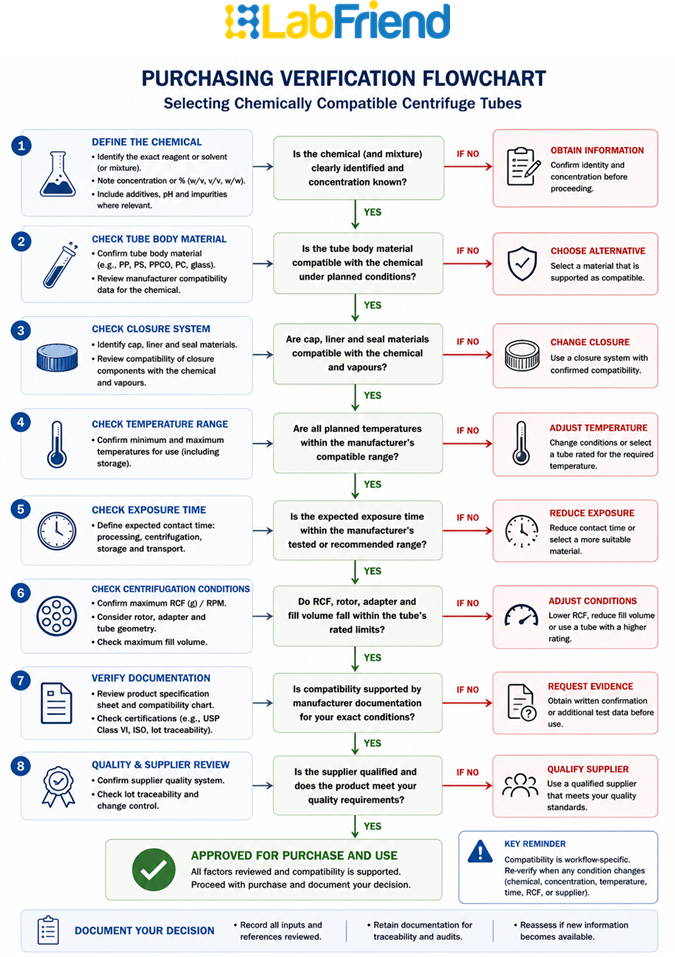
The table below summarises the pre-purchase checks in one place:
|
Check |
Decision question |
|
Material |
Is the tube body material suitable for the chemical exposure? |
|
Cap / closure |
Is the closure material also suitable? |
|
Reagent |
What exact solvent, buffer or reagent will contact the tube? |
|
Concentration |
Does concentration affect compatibility? |
|
Temperature |
Will temperature change material behaviour? |
|
Exposure time |
Is contact brief, repeated or extended? |
|
Centrifugation |
Will RCF, fill volume or rotor support increase stress? |
|
Documentation |
Is compatibility supported by manufacturer information? |
|
Substitution |
Would an alternative preserve the accepted specification? |
This should be treated as a practical purchasing check, not as a universal compatibility guarantee.
Frequently asked questions
How do I check chemical compatibility for centrifuge tubes?
Check the tube material, cap material, exact reagent or solvent, concentration, temperature, exposure time, centrifugation conditions and manufacturer documentation. Do not rely on material name or tube volume alone.
Are polypropylene centrifuge tubes chemically resistant?
Polypropylene is commonly used in many laboratory workflows, but compatibility should still be checked against the specific reagent, concentration, temperature, exposure time and centrifugation conditions.
Are polystyrene centrifuge tubes suitable for solvents?
Confirm polystyrene’s suitability against the specific solvent before use — suitability depends on the solvent, concentration, temperature, exposure duration and product documentation.
Does chemical compatibility depend on concentration?
Yes. A material may behave differently with dilute and concentrated reagents. Concentration should be checked whenever compatibility matters.
Can a tube be chemically compatible but unsuitable for centrifugation?
Yes. A tube may tolerate a chemical during static contact but still be unsuitable under centrifugation if RCF, fill volume, rotor support or temperature increases material stress.
Should cap material be checked separately?
Yes. The cap, seal or liner may be made from a different material from the tube body and may need separate compatibility review.
Is glass always better for aggressive chemicals?
No material should be treated as universally better. Glass may be relevant in some workflows, but suitability still depends on chemical exposure, centrifugation conditions, product design and manufacturer guidance. Glass does have broadly established resistance to most solvents and acids, with hydrofluoric acid and hot, concentrated alkalis as well-documented exceptions — but this general resistance still does not confirm suitability for a specific centrifugation workflow.
Can I switch supplier if chemical compatibility matters?
Yes, but the substitute should be compared against the accepted specification. Material, cap design, RCF rating, documentation and workflow conditions should be reviewed before switching.
Are chemical compatibility charts enough?
They are useful, but they should be read alongside the product specification, centrifugation conditions, temperature, exposure time and laboratory workflow.
What is the biggest mistake when choosing tubes for chemical exposure?
The biggest mistake is assuming compatibility from tube volume, appearance or general material name. Chemical compatibility must be checked against the actual workflow.
Conclusion
Chemical compatibility should be treated as a core part of centrifuge tube selection. The right tube is not simply the correct volume or a familiar material. It must be suitable for the reagent, concentration, temperature, exposure time, cap design, centrifugation conditions and documentation requirements of the workflow.
Polypropylene, polystyrene, PPCO, polycarbonate, polysulfone, glass and other materials may all have a place in laboratory workflows, but none should be treated as universally compatible. The safest approach is to verify compatibility against manufacturer guidance and the laboratory’s actual use conditions.
To compare available formats, browse LabFriend UK’s centrifuge tubes. For broader selection guidance, return to the Complete Guide to Centrifuge Tubes.
Written by: Donal O’Sullivan, BSc, Co-Founder and Sales Director, LabFriend UK. Donal brings deep chemistry-led technical expertise across analytical chemistry, biochemistry, environmental monitoring, laboratory instrumentation, consumables and scientific product selection.
Reviewed by: Michael Anderson, MBA, Founder and Managing Director, LabFriend UK. Michael reviews LabFriend UK content for customer relevance, commercial accuracy, operational practicality and alignment with LabFriend UK’s laboratory supply model.
Related Stories

Extractables and Leachables in Analytical Filtration Explained
Extractables and Leachables in Analytical Filtration Explained

How Lab Managers Can Standardise Centrifuge Tube Purchasing Without Increasing Technical Risk
How Lab Managers Can Standardise Centrifuge Tube Purchasing Without Increasing Technical Risk

Low Protein Binding Membranes Explained for Laboratory Filtration
Low Protein Binding Membranes Explained for Laboratory Filtration

Choosing Tube Racks for 15mL and 50mL Centrifuge Tubes
Choosing Tube Racks for 15mL and 50mL Centrifuge Tubes