Choosing Low-Contamination Filters for PFAS and Ultra-Trace Analysis
23 mins read
Choosing Low-Contamination Filters for PFAS and Ultra-Trace Analysis
By Donal O’Sullivan, BSc. Reviewed by Michael Anderson, MBA.
Selecting filters for PFAS and ultra-trace analysis requires
more than choosing a membrane with the correct pore size or chemical
compatibility. The filter itself can introduce contamination, retain target
analytes or affect the sample in ways that become significant when measuring
very low concentrations. For laboratories carrying out per- and polyfluoroalkyl
substances (PFAS) analysis or other contamination-sensitive testing, the
most appropriate filter is one whose complete construction, analytical
background and analyte recovery are suitable for the intended method. This means considering the membrane, housing and other
sample-contact components, reviewing manufacturer documentation and determining
whether the filtration step performs acceptably under representative analytical
conditions. |
Key Takeaways
- There
is no universally suitable filter for PFAS or ultra-trace analysis.
Selection depends on the target analytes, sample matrix, analytical method
and complete filter construction.
- PTFE
and other fluoropolymer-containing components require particular scrutiny
in PFAS workflows. However, material identity alone does not establish
whether a particular device will contaminate a sample.
- A
non-PTFE membrane is not automatically PFAS-free or low-contamination.
Housings, seals, manufacturing residues and other wetted components must
also be considered.
- Low
extractables and acceptable analyte recovery are separate requirements.
A filter may contribute little measurable background while still retaining
some target analytes.
- Product
documentation and method-specific checks are essential where filtration
could influence results. Relevant blanks and recovery comparisons can
help establish suitability.
- A controlled specification supports repeatable purchasing. Alternative filters should be assessed before substitution rather than assumed equivalent from their membrane material or pore size.
Why Low-Contamination Filter Selection Matters
Filtration is commonly used to remove suspended particles
before analytical measurement. Depending on the method, it may help reduce
particulate loading, protect downstream equipment or prepare a sample for
subsequent processing.
However, filtration also introduces additional
sample-contact surfaces.
These surfaces may contribute substances to the filtrate or
interact with compounds already present in the sample. In routine applications,
some of these effects may have limited analytical significance. In ultra-trace
measurements, relatively small contributions or losses can become important.
Two risks require separate consideration.
Filter-derived contamination occurs when substances
associated with the filtration device enter the sample. These may originate
from the membrane, housing, additives, processing residues or other components.
Analyte loss occurs when target compounds are
retained by, adsorbed onto or otherwise interact with the filtration system.
This can reduce the amount of analyte reaching the instrument.
Both effects can influence the reported result, but they do
not necessarily occur together.
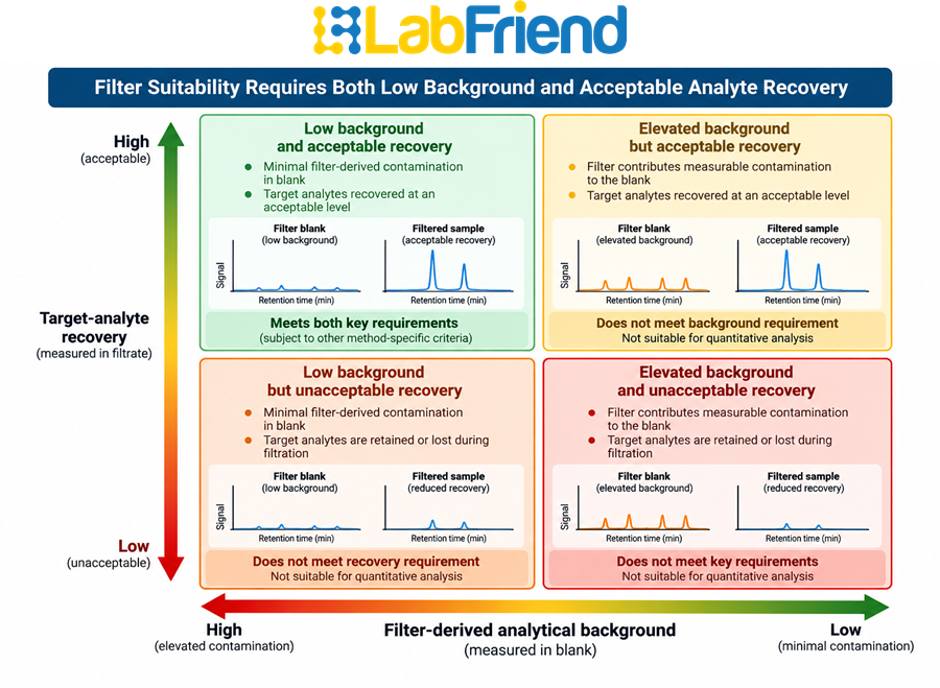
A filter that produces a low analytical background is not
automatically suitable for quantitative analysis if analyte recovery is
unacceptable. Equally, satisfactory recovery does not establish that the device
contributes no interfering substances.
For PFAS analysis, these considerations are particularly
important because some fluorinated materials used in laboratory consumables may
be relevant potential contamination sources.
The objective is not simply to identify a material described
as clean. It is to establish whether the complete filtration step is
appropriate for the specific analytical method.
1. Define the Sample and Analytical Requirements First
Before comparing filter products, establish exactly what the
filtration step needs to achieve.
Identify the sample matrix
The characteristics of the sample affect filtration
performance and the potential for interactions with the filter.
Relevant questions include:
- Is
the sample predominantly aqueous, organic or a mixture?
- Does
it contain suspended solids, dissolved organic matter or other components
that could interact with the membrane?
- What
sample volume must be processed?
- Is
the sample likely to block a fine membrane?
- Are
the target analytes present at concentrations where small contamination
contributions or recovery losses could materially affect the result?
A filter suitable for one aqueous sample may not perform
identically with a different matrix, even when the same analytes are being
measured.
Establish the analytical objective
Identify the target compounds and the analytical
requirements that govern the result.
For PFAS testing, the compounds included in the method
matter. PFAS is a broad group of substances with different chemical and
physical characteristics, so a filter assessment based on one compound or a
limited test mixture should not automatically be extended to every PFAS
analyte.
For other ultra-trace applications, the relevant
contamination mechanisms and material risks may differ.
Consider the method's required sensitivity, reporting
requirements and acceptable analytical performance. These determine how much
filter-derived background or analyte loss can be tolerated.
Check whether filtration is required
Do not assume that every PFAS or ultra-trace sample
should be filtered.
Some analytical methods specify particular
sample-preparation steps, while others prohibit filtration or require an
alternative approach. For example, US EPA Method 1633A requires the entire
aqueous sample to be prepared without filtration before extraction. Where the
applicable method prohibits filtration, selecting a low-contamination filter
does not make that additional step permissible. Any proposed departure must be
evaluated against the method's requirements and applicable quality or
regulatory controls.
Filtration may be inappropriate if it changes the fraction
of the sample being measured, removes analytes associated with suspended
material or introduces unacceptable contamination.
Where an established method specifies whether and how
filtration should be performed, those requirements should guide the selection.
The first decision is therefore whether filtration is
appropriate. Only then should the laboratory choose the filtration device.
2. Assess Membrane and Complete-Device Materials
Membrane chemistry is an important selection criterion, but
it is only one part of the filter specification.
For contamination-sensitive applications, the entire wetted
flow path must be considered.
Why PTFE requires attention in PFAS analysis
Polytetrafluoroethylene (PTFE) is a fluoropolymer used in
laboratory filtration products because of its chemical resistance and other
useful properties.
In PFAS analysis, PTFE-containing components warrant
particular scrutiny because fluorinated materials may be relevant to the
contamination-control strategy.
However, it is important to distinguish between the chemical
identity of a polymer and evidence of contamination in a particular analytical
method.
The presence of PTFE does not, by itself, establish that a
specific filter releases the target PFAS compounds at analytically significant
levels. Likewise, a manufacturer's description of a material as chemically
resistant does not demonstrate low PFAS background.
Where an analytical method excludes particular materials,
those restrictions should be followed.
Where a method permits material selection, suitability
should be established using relevant product information and appropriate
analytical evidence.
Are non-PTFE membranes automatically suitable?
No. Choosing a non-PTFE membrane may remove one potential
material concern, but it does not establish that the complete filter is free
from PFAS or other interfering substances.
Other membrane families, including regenerated cellulose
(RC), polyethersulfone (PES), nylon and polyvinylidene fluoride (PVDF), may be
encountered in laboratory filtration products.
Their suitability depends on the specific product and
application.
In particular, PVDF is also a fluoropolymer and should not
be treated as a non-fluorinated alternative to PTFE.
Non-fluorinated membrane materials may be useful candidates
where supported by the method and product documentation, but their chemical
identity alone cannot demonstrate acceptable analytical background or recovery.
The broader principles of material selection are covered in Low Extractable Syringe Filters for LC-MS and Trace Analytical Applications.
Check the complete filter construction
The membrane is not necessarily the only component
contacting the sample.
Depending on the device, the wetted flow path may include:
- Membrane
material and any surface treatment.
- Housing
or support components.
- Seals,
gaskets or other internal components.
- Adhesives
or bonding materials, where present.
- Other
surfaces involved in the filtration arrangement.

A product described by its membrane material alone may not
provide enough information for a contamination-sensitive method.
Where material composition is important, request
manufacturer documentation for the complete device rather than assuming that
the housing and membrane have the same properties.
3. Evaluate Contamination Risk and Analyte Recovery Separately
A defensible filter-selection process should distinguish the
risk of adding contaminants from the risk of losing analytes.
Filter-derived analytical background
Potential background contributions can arise from materials
or residues associated with the filter.
Their significance depends on the substances released, the
analytical method and the concentrations at which they are present.
A product described as having low extractables may have been
assessed under defined test conditions. Those conditions may not represent the
solvents, contact times or analytical targets used in a particular PFAS method.
The term low extractables should therefore be treated
as a product characteristic requiring interpretation, not as universal evidence
of suitability for every ultra-trace application.
Where available, review the manufacturer's test conditions,
the substances or analytical signals assessed, and whether the information is
relevant to the intended method.
Analyte adsorption and recovery
Some target compounds may interact with membrane or housing
surfaces during filtration.
The extent of this interaction can depend on the analyte,
membrane chemistry, sample composition, concentration, contact conditions and
device geometry.
For quantitative analysis, an unacceptable loss of target
analyte can produce a biased result even if the filtered sample shows little
additional contamination.
Recovery comparisons under representative conditions can
help assess whether the filtration step changes the measured analyte
concentration.
Where relevant, compare filtered and appropriately matched
unfiltered or otherwise prepared samples using an approach consistent with the
analytical method. When assessing retention by the filtration device, use
suitable controls or spiked samples to distinguish losses associated with the
device from changes caused by removing suspended particles. A difference
between filtered and unfiltered sample results does not, by itself, establish
adsorption onto the membrane.
Why blank results alone are insufficient
A suitable blank can help identify contamination introduced
by the filtration process.
However, a satisfactory blank does not establish that target
analytes pass through the filter without loss.
Likewise, acceptable recovery for selected compounds does
not prove that all possible filter-derived contaminants are absent.
Both questions should be addressed where they could materially affect analytical performance.
|
Assessment |
Main question |
Possible evidence |
|
Filter-derived background |
Does the filtration device contribute relevant interfering
substances? |
Appropriate filtration blanks and relevant
product-specific data |
|
Analyte recovery |
Does filtration alter the amount of target analyte
measured? |
Method-appropriate recovery comparisons |
|
Chemical compatibility |
Can the device tolerate the actual sample and solvent
conditions? |
Manufacturer compatibility and operating specifications |
|
Repeatability |
Does the filtration step perform consistently under
controlled conditions? |
Suitable replicate or routine quality-control observations |
The extent of testing should reflect the method's
requirements and the consequences of an unsuitable filter.
4. Check the Complete Filtration Specification
Once potential contamination risks have been considered,
compare the practical characteristics of the available filtration devices.
Chemical compatibility
Confirm that the membrane and all relevant wetted components
are compatible with the sample and solvent system.
Chemical compatibility is necessary for safe and appropriate
use, but it does not establish low analytical background or acceptable
recovery.
A filter can be chemically compatible with a solvent while
still being unsuitable for a particular ultra-trace method.
Membrane wettability
Some membranes wet readily with aqueous samples, while
others may require different operating conditions or a suitable pretreatment.
Wettability affects whether filtration can be performed
consistently and appropriately.
Do not introduce a wetting solvent or pretreatment simply to
make a membrane usable without considering its potential effect on
contamination, analyte recovery and method requirements.
Pore size and particle retention
Choose a pore size that meets the method's particle-removal
requirements.
A smaller nominal pore size is not automatically better for
PFAS or ultra-trace analysis.
Finer membranes may increase filtration resistance or
blockage, depending on the sample and device. They may also change the
practical contact conditions experienced by the sample.
The appropriate pore size depends on the intended filtration
purpose and any applicable method requirements.
Sample volume and filter hold-up
For small-volume samples, liquid retained within the
filtration device may represent a meaningful proportion of the available
material.
Consider the filter's recommended sample-volume range,
membrane area and potential hold-up.
A larger filter is not necessarily preferable. It may
provide more filtration area but can also introduce additional wetted surface
or retained volume.
Operating conditions
Check manufacturer limits for the complete device, including
relevant pressure, temperature and operating requirements.
If a filter blocks or requires excessive force, do not
exceed the manufacturer's operating limits to complete the filtration.
Instead, reassess the sample characteristics, filtration
requirement and appropriate device specification.

This checklist supports comparison. It does not establish
that any product is suitable without the relevant evidence.
5. Review Manufacturer Evidence and Confirm Suitability
For PFAS and ultra-trace applications, product documentation
should be considered alongside the membrane specification.
A useful starting point is to establish exactly what the
manufacturer has tested or declared.
What information should laboratories request?
Depending on the analytical method and the significance of
contamination risk, relevant information may include:
- Identification
of the membrane and other wetted materials.
- Manufacturer-stated
intended applications and limitations.
- Relevant
extractables or analytical-background information.
- Any
PFAS-related material or performance statements, including their defined
scope.
- Solvent
compatibility and operating limits.
- Product
reference, manufacturing information and applicable quality documentation.
Not every manufacturer provides the same level of evidence,
and the absence of a particular document does not automatically prove that a
product is unsuitable.
However, where critical suitability information is
unavailable, the laboratory should not replace that evidence with an assumption
based on a generic membrane description.
Interpret product claims carefully
Statements such as low contamination, low
extractables, PFAS-free or suitable for trace analysis need
to be interpreted according to their actual meaning and supporting evidence.
For example, a claim may relate to selected materials,
particular analytes, a defined analytical test or specific operating
conditions.
It should not be extended beyond that scope without
justification.
Similarly, an analytical result below a stated reporting or
detection limit is not proof of absolute absence.
The relevant question is whether the available evidence is
sufficient for the intended method.
Use method-specific checks where necessary
Where filter-derived contamination or analyte loss could
affect analytical results, appropriate checks may include:
Filtration blanks: Pass a suitable method-compatible
blank solution through the filtration device under representative operating
conditions and analyse it using the intended analytical procedure. Where
necessary, compare this with an appropriate unfiltered procedural blank to help
distinguish contributions from the filter and filtration process from
background already present in the reagents, containers or analytical procedure.
Use the blank acceptance criteria specified by the method or established by the
laboratory for the intended application.
Recovery comparisons: Assess whether filtration
changes the measured amount of relevant target analytes.
Repeatability checks: Determine whether the
filtration step gives sufficiently consistent results under the intended
conditions.
Comparison with the established procedure: Where a
laboratory is changing an approved filter, assess whether the proposed
alternative performs acceptably relative to the existing arrangement.
The precise testing approach should be determined by the
analytical method, laboratory quality requirements and consequences of changing
the filtration step.
Before evaluating a candidate filter, establish the
applicable acceptance criteria for analytical background, target-analyte
recovery and any other relevant performance characteristics. Use criteria
specified by the analytical method where available. Where the method does not
prescribe filter-specific criteria, the laboratory should establish
scientifically justified limits based on the intended analytical performance,
reporting requirements and measurement uncertainty. Record the criteria before
testing and assess the results against them rather than treating a favourable
individual result as sufficient evidence of suitability.
A single favourable result should not automatically be
interpreted as proof of suitability across different analytes, matrices or
operating conditions.
6. A Practical Low-Contamination Filter Selection Framework
A structured approach helps QA/QC laboratories compare
candidate filters without relying on unsupported assumptions about membrane
materials.

The selection should stop or return to an earlier step when
a critical requirement cannot be established.
For example, a membrane that appears promising on material
grounds should not be approved if its complete-device construction remains
incompatible with a defined method restriction.
Similarly, a filter that meets the physical filtration
requirements may still need further assessment if analytical background or
recovery is uncertain.
For laboratories reviewing filtration choices beyond this
specialist application, The Ultimate Guide to Laboratory Filtration for UK Laboratories provides
broader context on filtration methods and selection considerations.
7. Common Mistakes When Choosing Filters for PFAS and Ultra-Trace Analysis
Assuming every PTFE filter causes PFAS contamination
PTFE-containing devices warrant scrutiny in PFAS workflows,
but the actual contamination risk depends on the device, target analytes and
analytical conditions.
Follow method restrictions and use relevant evidence rather
than relying on an unsupported universal conclusion.
Assuming a non-PTFE membrane is automatically PFAS-free
The membrane is only one component of the filtration system.
Other wetted materials and manufacturing-related residues
may matter, and non-PTFE does not necessarily mean non-fluorinated.
Treating low extractables as proof of analytical
suitability
Low-extractables information may be useful, but its
relevance depends on the test conditions and analytical targets.
It does not automatically establish acceptable background or
analyte recovery for the intended PFAS method.
Choosing the finest available pore size
A finer membrane may not provide additional analytical
benefit and can increase filtration resistance or blockage.
Select the pore size required for the actual
sample-preparation purpose.
Changing the filtration procedure without assessment
Changing membrane material, device format, rinsing practice
or supplier can alter the sample-contact conditions.
Where the filtration step is part of an established
analytical procedure, evaluate changes in accordance with the laboratory's
method and quality requirements.
Assuming similar products are interchangeable
Two filters may share a membrane material and nominal pore
size while differing in housing construction, surface treatment, manufacturing
process or analytical performance.
For contamination-sensitive applications, those differences
may be relevant.
Choosing Filters for Routine QA/QC Laboratory Use
Once a filter has been found suitable for an analytical
method, recording the approved specification helps maintain consistency.
A practical record may include the manufacturer and product
reference, membrane and housing materials, pore size, device format, relevant
method, supporting evidence and any defined restrictions on use.
This information helps laboratory staff distinguish an
approved filter from a potentially suitable alternative that has not yet been
assessed.
For repeat purchasing, the objective should be to maintain
the required analytical performance rather than simply match the most visible
catalogue specifications.
Where a proposed substitute differs from the established
filter, the laboratory should determine whether additional assessment is
necessary before routine use.
Laboratories reviewing available options can browse laboratory syringe filters through LabFriend UK.
The category provides product-discovery options, but
inclusion does not establish PFAS-specific suitability. The complete product
specification and relevant evidence should be checked before selection.
Where documentation or suitability information is unclear,
laboratories can ask LabFriend UK about filter specifications before making a purchasing decision.
Frequently Asked Questions
Are PTFE syringe filters suitable for PFAS analysis?
PTFE syringe filters should only be used for PFAS analysis
where the analytical method permits their use and the specific device has
adequate evidence of suitability. PTFE is a fluoropolymer, so PTFE-containing
filtration components require particular scrutiny in contamination-sensitive
PFAS workflows.
Material identity alone does not establish whether a
particular device will contribute analytically significant contamination.
Method restrictions, complete-device construction and relevant analytical
evidence should guide the decision.
Are non-PTFE syringe filters automatically PFAS-free?
No. A non-PTFE membrane does not establish that the complete
syringe filter is PFAS-free or suitable for PFAS analysis. Other wetted
components, manufacturing residues and product-specific characteristics may
affect contamination risk.
Check the complete-device materials and the scope of any
manufacturer statements rather than relying on membrane identity alone.
How can a laboratory determine whether a filter is
suitable for ultra-trace analysis?
A laboratory can assess filter suitability by checking the
complete product specification against the analytical method and reviewing
relevant evidence for contamination, compatibility and analyte recovery.
Where filtration could materially influence results,
appropriate method-specific blanks, recovery comparisons and other quality
checks may be needed before routine use.
Does a low-extractables filter automatically meet PFAS
testing requirements?
No. A low-extractables designation does not automatically
establish suitability for PFAS testing. Its relevance depends on which
substances were assessed, the test conditions and whether the evidence
addresses the target analytical method.
The laboratory must also consider complete-device materials,
potential analyte loss and any method-specific restrictions.
Can an approved PFAS filtration product be replaced with
another filter of the same pore size?
A replacement filter with the same nominal pore size should
not be assumed analytically equivalent. Membrane chemistry, housing materials,
surface characteristics and manufacturing differences may affect contamination
background or analyte recovery.
Assess the proposed alternative against the approved
specification and determine whether method-specific verification is required
before routine substitution.
Conclusion
Choosing low-contamination filters for PFAS and ultra-trace
analysis requires a method-led assessment of the complete filtration system.
Membrane material, pore size and chemical compatibility are
important, but they do not establish analytical suitability on their own.
Potential filter-derived contamination, analyte recovery, device construction
and supporting documentation must also be considered.
For QA/QC laboratories, the most reliable approach is to
define the analytical requirements first, compare candidate filters against
those requirements and carry out appropriate suitability checks where
necessary.
Recording the approved specification then supports
consistent filtration practice and more controlled repeat purchasing.
Read More
- The Ultimate Guide to Laboratory Filtration for UK Laboratories — Broader
guidance on laboratory filtration methods, materials and selection.
- Low Extractable Syringe Filters for LC-MS and Trace Analytical Applications
— Further guidance on filter-derived analytical background and
low-extractables selection.
Explore More
- Browse Laboratory Syringe Filters — Explore available filtration products and
compare specifications against your analytical requirements.
- Contact LabFriend UK —
Enquire about filter specifications and available manufacturer
documentation before ordering.
Written by: Donal O’Sullivan, BSc, Co-Founder and Sales Director, LabFriend UK. Donal brings deep chemistry-led technical expertise across analytical chemistry, biochemistry, environmental monitoring, laboratory instrumentation, consumables and scientific product selection.
Reviewed by: Michael Anderson, MBA, Founder and Managing Director, LabFriend UK. Michael reviews LabFriend UK content for customer relevance, commercial accuracy, operational practicality and alignment with LabFriend UK’s laboratory supply model.
Frequently asked questions
Delivery times vary by product and supplier. Each product page shows current stock levels and the expected lead time, and we confirm this when you place your order. Most items arrive within 2 to 3 weeks. Specialised items can take longer if they are not in stock. If you need something by a certain date, contact us and we’ll check for you.
Yes. Register for a commercial account and, once it’s approved, you will be able to process orders via PO Once you have a commercial account, you can directly email your purchase orders
Add products to your cart and click Get a Quote. You’ll get a formal quote instantly, ready to send to your email address. For bulk orders or custom requirements, send us your product list and we’ll reply with itemized pricing.
If your item is faulty, not as described or sent in error, let us know within 14 days of delivery and we’ll arrange a return. Change of mind returns are only accepted if the item is unused and in its original packaging. A restocking fee will apply and you pay the return freight. Read our full Returns Policy for details.
Yes, prices are shown including GST by default. Use the Prices Inc. GST toggle at the top of the page to view prices without GST.