

Share :
Choosing Centrifuge Tubes for Molecular Biology and PCR Workflows
Updated On 07/17/2026

By Donal O’Sullivan, BSc. Reviewed by Michael Anderson, MBA.
For molecular biology and PCR workflows, the right centrifuge tube is the one that matches the required sample volume, material, sterility, DNase/RNase status, RCF rating, rotor compatibility and contamination-control requirement.
The most important point is this: sterile does not automatically mean DNase-free, RNase-free, DNA-free or PCR-clean. These are separate product claims and must be checked in the product documentation before a tube is approved for sensitive molecular biology use.
For routine molecular biology support work, laboratories commonly use different tube formats at different stages of the workflow. Microcentrifuge tubes are often used for small-volume work, while 15mL and 50mL centrifuge tubes are used for larger preparation, washing, sample handling, buffer preparation and biological sample processing.
Laboratories comparing suitable formats can start with LabFriend UK’s centrifuge tubes, then narrow the choice by workflow, contamination-control requirement, material and documented product specification. For broader category guidance, use the Complete Guide to Centrifuge Tubes.
Why tube selection matters in molecular biology
Molecular biology workflows are sensitive to contamination, sample loss and inconsistent handling. A centrifuge tube may appear to be a simple consumable, but the wrong specification can create real workflow risk.
In PCR and nucleic acid workflows, the main concern is not only whether the tube can hold the sample. The tube also needs to support the required contamination-control standard. That may involve sterility, but it may also involve DNase-free, RNase-free, DNA-free or PCR-clean claims, depending on the method.
A sterile polypropylene tube may be suitable for some biological sample handling steps. It may not be suitable for RNA work, PCR setup support or nucleic acid preparation unless the required purity claims are explicitly documented.
That is why molecular biology tube selection should be based on documented specification, not appearance, habit, brand familiarity or volume alone.
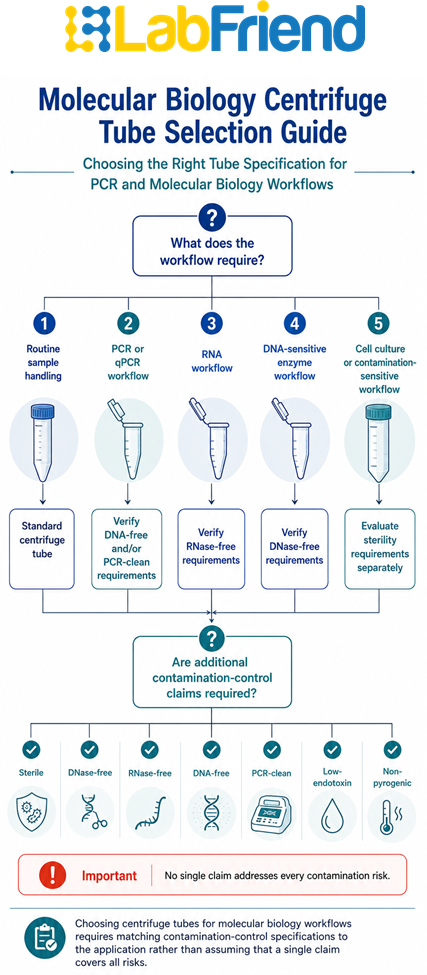
The key selection rule
For PCR and molecular biology workflows, do not ask:
“Is this tube sterile?”
Ask:
“Which contamination-control claim does this workflow actually require, and does the product documentation support it?”
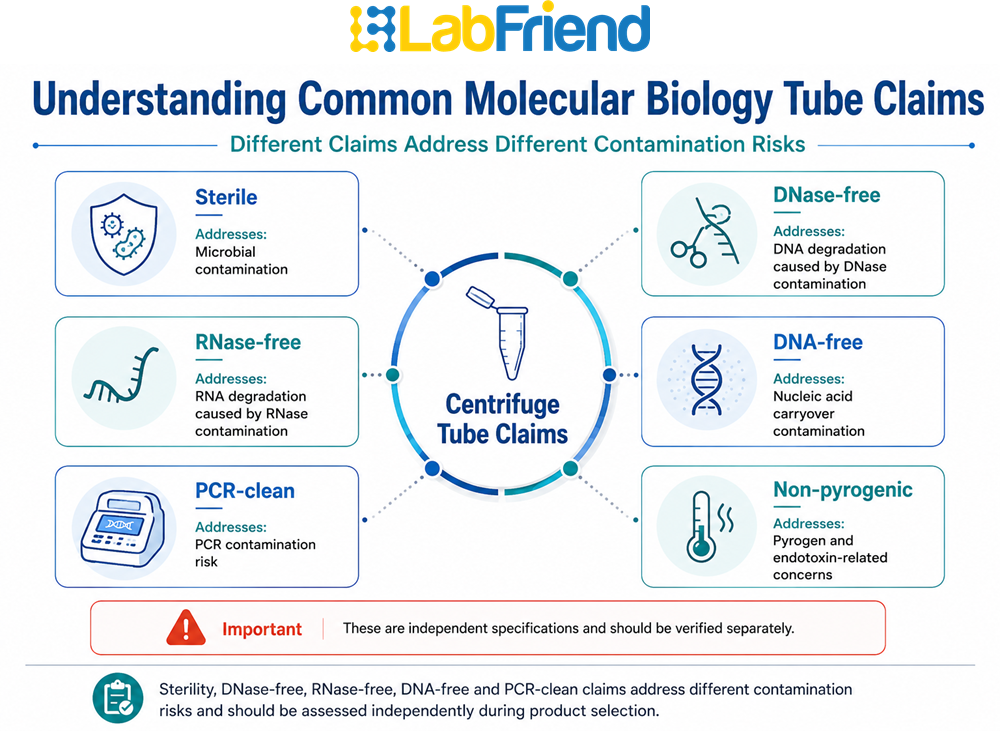
This distinction matters because different claims solve different risks.
|
Requirement |
What it means in practice |
Selection implication |
|
Sterile |
Product has a sterility claim |
Useful where microbial contamination control is required |
|
DNase-free |
Product claims absence or control of DNase contamination |
Important where DNA degradation risk matters |
|
RNase-free |
Product claims absence or control of RNase contamination |
Important for RNA workflows |
|
DNA-free |
Product claims absence or control of DNA contamination |
Relevant where DNA carryover could affect results |
|
PCR-clean |
Product is positioned for PCR-sensitive workflows |
Must be explicitly stated; do not infer it from sterility |
|
Endotoxin-free / non-pyrogenic |
Product has specific endotoxin or pyrogen-related claim |
Relevant only where the workflow requires it |
Sterility is valuable in the right workflow, but it is not a substitute for nuclease-related or PCR-specific claims.
PCR-clean terminology may vary between manufacturers and is not necessarily defined identically across suppliers. Laboratories should review the supporting product documentation rather than relying on the claim name alone.
For more detail on sterility decisions, read sterile vs non-sterile centrifuge tubes.
|
Claim |
What Risk It Addresses |
|
Sterile |
Microbial contamination |
|
DNase-free |
DNA degradation |
|
RNase-free |
RNA degradation |
|
DNA-free |
DNA carryover contamination |
|
PCR-clean |
PCR contamination risk |
|
Non-pyrogenic |
Endotoxin/pyrogen concerns |
When sterile tubes may be enough
Sterile or aseptic centrifuge tubes may be suitable where the primary concern is microbial contamination rather than nuclease contamination.
This can apply to general biological sample handling, buffer preparation, reagent aliquoting, short-term sample handling or workflows where the laboratory SOP specifies sterile consumables but does not require DNase-free or RNase-free status.
However, this should not become a shortcut. A laboratory should not use “sterile” as a general proxy for molecular biology suitability. If the workflow involves RNA, PCR-sensitive samples or nucleic acid preparation, the relevant purity claims should be checked separately.
The practical rule is simple: use sterile tubes where sterility is the requirement; use DNase-free, RNase-free, DNA-free or PCR-clean tubes where those claims are the requirement.
When DNase-free and RNase-free claims matter
DNase-free and RNase-free claims matter when nucleic acid integrity is central to the workflow.
For DNA workflows, DNase contamination can compromise sample quality. For RNA workflows, RNase contamination is especially problematic because RNA is vulnerable to degradation. In PCR and qPCR support workflows, unwanted DNA contamination or nuclease activity may affect reliability, depending on the method.
For highly sensitive PCR, qPCR and sequencing workflows, contaminating nucleic acids from previous amplification products may present a greater risk than microbial contamination.
This is why laboratories working with DNA, RNA, PCR setup support, qPCR preparation, extraction workflows or sensitive molecular biology assays should avoid informal substitution. A replacement tube that looks identical may have different purity claims, packaging, cap design, material specification or documentation.
If the product documentation does not explicitly state the claim, it should not be treated as having that claim.
Choosing the right tube volume
Molecular biology workflows often use more than one tube format. The correct choice depends on the stage of the workflow and the volume being handled.
Microcentrifuge tubes are usually the practical choice for small-volume molecular biology work, including many bench-level preparation steps. They are not the focus of this centrifuge tube article, but they are part of the wider molecular biology workflow.
15mL centrifuge tubes are useful when the workflow moves beyond micro-volume handling but does not require a larger 50mL tube format. They are often used for intermediate sample preparation, aliquots, wash steps, moderate-volume biological sample handling and buffer preparation.
50mL centrifuge tubes are more useful where larger volumes are involved. They may be appropriate for larger cell suspensions, media handling, bulk buffer preparation, larger wash steps or workflows where using multiple smaller tubes would add unnecessary handling.
The aim is to choose the smallest practical tube that supports the workflow safely and efficiently. Oversized tubes can increase dead volume, storage footprint and handling inefficiency. Undersized tubes can create extra transfers and increase contamination or sample mix-up risk.
Where samples will be frozen, laboratories should also consider freeze-thaw performance, cap integrity and storage-temperature suitability.
For more detail, read 15mL vs 50mL centrifuge tubes.
Tube volume selection matrix
|
Workflow stage |
Common tube format |
Key selection issue |
|
Small-volume PCR setup support |
Microcentrifuge tube, PCR tube or plate |
Purity claim and contamination control |
|
Intermediate sample preparation |
15mL centrifuge tube |
Volume, material, cap and documentation |
|
Moderate biological sample handling |
15mL centrifuge tube |
Sterility or nuclease-free requirement where relevant |
|
Larger wash steps |
50mL centrifuge tube |
Capacity, cap design and centrifuge compatibility |
|
Cell suspension handling |
15mL or 50mL centrifuge tube |
Volume, sterility and workflow suitability |
|
Buffer or reagent preparation |
15mL or 50mL centrifuge tube |
Material, cleanliness and handling convenience |
|
Repeat molecular biology workflows |
Approved product list |
Consistency, documentation and reorder control |
Material considerations
Material matters, but it should not be considered in isolation.
For some biomolecules, proteins, enzymes or low-concentration analytes, laboratories may also evaluate low-binding or low-retention tube options where sample recovery is important.
Polypropylene is commonly used for many centrifuge tube workflows because it offers a practical balance of durability and routine laboratory suitability where the product specification supports the intended use. Polystyrene may offer clarity advantages in some contexts, but it is not suitable for every centrifugation condition, chemical exposure or workflow.
For molecular biology and PCR support work, material should be considered alongside the required purity claims, RCF rating, closure design, temperature conditions, sample type, documentation and repeat availability.
A polypropylene tube is not automatically DNase-free, RNase-free or PCR-clean. Material tells you what the tube is made from; it does not tell you the full contamination-control specification.
Material selection should also consider temperature exposure, chemical compatibility and long-term storage requirements where relevant.
For a dedicated material comparison, read polypropylene vs polystyrene centrifuge tubes.
RCF and rotor compatibility still matter
Molecular biology workflows often include centrifugation steps, so mechanical suitability must be checked as well as contamination-control suitability.
A tube may have the correct purity claim but still be unsuitable if it is used above its maximum rated RCF, placed in the wrong rotor, poorly supported in an adapter or filled beyond the manufacturer’s recommended conditions.
Before a tube is approved for centrifugation, the laboratory should confirm the maximum RCF, rotor compatibility, adapter fit, tube dimensions, cap clearance, fill volume and temperature conditions. These checks are especially important where the tube will be used repeatedly in a defined method or shared across multiple teams.
For further insights into RCF/RPM compatibility see our article Understanding RCF RMP And Rotor Compatibility for Centrifuges.
A practical workflow for choosing tubes
The best way to choose centrifuge tubes for molecular biology is to move from the workflow requirement to the product specification.
Start by defining what the tube will actually be used for. A tube used for buffer aliquoting may not need the same specification as a tube used in RNA handling. A tube used for general biological sample preparation may not need the same purity claims as one used near a PCR setup workflow.
Once the workflow is clear, identify the contamination-control requirement. This is where many mistakes happen. Sterility, DNase-free status, RNase-free status, DNA-free status and PCR-clean status should be treated as separate requirements.
Next, choose the appropriate volume. Use microcentrifuge tubes for small-volume work, 15mL tubes for moderate-volume preparation and 50mL tubes for larger-volume handling. Then check the material, cap design, RCF rating, rotor fit and documentation.
The final step is repeat-use control. If the tube will be used regularly, approve it properly rather than allowing informal reordering or substitution. This protects the workflow from small specification changes that may not be obvious at the bench.
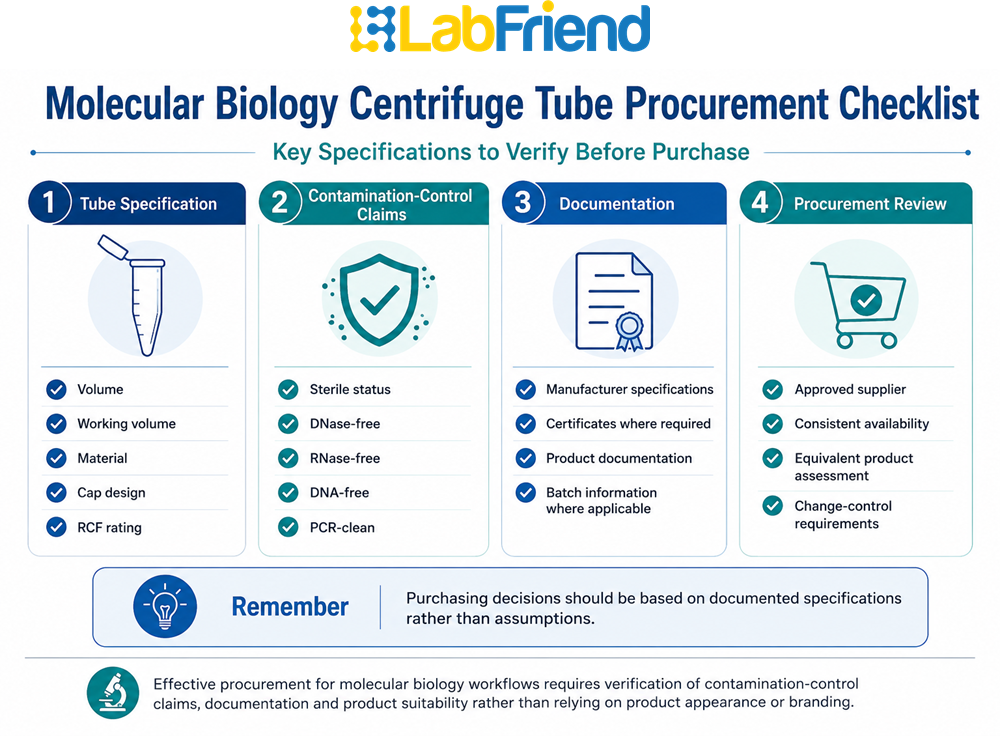
Product selection checklist
This checklist should be used before approving a centrifuge tube for molecular biology or PCR support workflows.
|
Check |
Why it matters |
|
Workflow use |
Confirms whether the tube is for PCR support, RNA handling, sample preparation, buffer handling or general use |
|
Tube volume |
Ensures microcentrifuge, 15mL or 50mL format is appropriate |
|
Material |
Helps assess suitability for sample type, handling and centrifugation |
|
Sterility status |
Required where microbial contamination control matters |
|
DNase-free status |
Required where DNA degradation risk matters |
|
RNase-free status |
Required where RNA integrity matters |
|
DNA-free or PCR-clean status |
Required only where the workflow or SOP specifies it |
|
Maximum RCF |
Required if the tube will be centrifuged |
|
Rotor compatibility |
Confirms fit, support and safe use in the intended centrifuge |
|
Cap design |
Affects sealing, handling and contamination risk |
|
Packaging format |
May affect cleanliness, convenience and workflow control |
|
Packaging integrity |
Important where contamination-control claims must be maintained prior to use |
|
Documentation |
Supports technical approval and repeat purchasing |
|
Reorder route |
Helps prevent uncontrolled substitution |
This table should be adapted to the laboratory’s own SOPs and quality requirements.
Common workflow failures
Using sterile tubes where nuclease-free tubes are required
This is one of the most common specification mistakes. A sterile tube may reduce microbial contamination risk, but it does not automatically address DNase, RNase or DNA contamination risk.
Changing supplier without checking documentation
Two tubes may have the same nominal volume and material but different purity claims, cap design, dimensions, RCF rating or packaging. Molecular biology workflows should not rely on visual similarity as evidence of suitability.
Ignoring RCF rating
Contamination-control claims do not confirm mechanical suitability. If the tube will be centrifuged, its maximum RCF and rotor compatibility must be checked.
Using the wrong tube volume
A tube that is too large can make handling less efficient and increase dead volume. A tube that is too small can create unnecessary transfers. Both situations can increase workflow risk.
Treating all polypropylene tubes as equivalent
Polypropylene is a useful material for many workflows, but it is not a complete specification. The laboratory still needs to check purity claims, documentation, cap design, centrifuge compatibility and intended use.
Supplier switching considerations
Supplier switching can be commercially sensible where the replacement product offers better value, easier ordering, improved availability or stronger service. In molecular biology workflows, however, switching must be controlled.
A suitable substitute should match the required volume, material, cap design, dimensions, RCF rating, sterility status and purity claims. Where the workflow requires DNase-free, RNase-free, DNA-free or PCR-clean status, those claims must be explicit.
Where validated methods, accredited activities or regulated procedures are involved, substitutions may require technical assessment, equivalence review or formal change control.
Procurement decisions should therefore be based on documented specifications rather than assumptions arising from product appearance, volume or brand familiarity.
The procurement question should not be:
“Is this tube cheaper?”
It should be:
“Does this tube meet the documented workflow requirement, and can it be reordered consistently?”
That distinction protects both the laboratory workflow and the purchasing process.
Stock control and repeat use
Once a molecular biology workflow accepts a tube, the laboratory should avoid uncontrolled product variation.
For recurring workflows, it is good practice to maintain an approved product list. This does not need to be complicated, but it should make clear which tube is approved, which specification matters, which substitutes are acceptable and who can approve a change.
A useful approved-product record should include the preferred product, required claims, acceptable substitutes, pack size, reorder point, technical owner, purchasing owner and review date.
This is particularly important for SME biotech labs, CROs, university research groups and testing laboratories where the same workflows are repeated regularly. A small substitution mistake can create uncertainty, especially where purity claims or documentation are part of the workflow.
For procurement-led standardisation, read standardising centrifuge tube purchasing.
Sample organisation and handling
Molecular biology workflows often involve multiple tubes, controls, aliquots and preparation stages. Tube selection should therefore include handling and organisation, not only product specification.
Clear labelling, consistent rack layouts and separation of workflow stages can help reduce mix-ups and support contamination control. This is especially useful where teams are handling several sample groups, moving material between benches or separating pre-PCR and post-PCR areas.
Many laboratories physically separate pre-PCR and post-PCR activities because amplified DNA from previous reactions can contaminate future assays and affect results.
LabFriend UK’s tube racks category can support laboratories organising centrifuge tube workflows at the bench.
Which laboratories need tighter control?
Tighter centrifuge tube control is most important where the workflow is sensitive to contamination, repeated frequently or linked to documented methods.
This often includes molecular biology labs, PCR and qPCR laboratories, RNA workflows, sequencing support workflows, SME biotech companies, CROs handling client projects, QA/QC laboratories, university research groups and private testing labs.
In these environments, informal product substitution should be avoided. A tube that appears equivalent may not carry the same documentation or contamination-control claims.
What this article does not solve
Choosing a suitable centrifuge tube does not replace good laboratory technique, validated methods or local SOPs.
This article does not confirm that any specific product is DNase-free, RNase-free, PCR-clean, DNA-free, low-endotoxin, endotoxin-tested, non-pyrogenic, diagnostic-suitable, clinical-suitable or GMP-suitable. It also does not confirm that any tube is compatible with every rotor, reagent, temperature condition or molecular biology method.
Those decisions must be made using product documentation, manufacturer information and the laboratory’s own workflow requirements.
FAQs
Are sterile centrifuge tubes suitable for PCR?
Sterile centrifuge tubes may be suitable for some PCR support workflows, but sterility alone does not prove PCR suitability. If the workflow requires DNase-free, RNase-free, DNA-free or PCR-clean consumables, those claims must be explicitly stated in the product documentation.
Does sterile mean DNase-free?
No. Sterile and DNase-free are separate claims. A sterile tube should not be treated as DNase-free unless the product documentation explicitly states that claim.
Does sterile mean RNase-free?
No. Sterile and RNase-free are separate claims. RNase-free status must be confirmed separately where RNA workflows require it.
What tube size is best for PCR workflows?
Small PCR reactions usually use PCR tubes, strips, plates or microcentrifuge tubes. 15mL and 50mL centrifuge tubes are more often used in supporting preparation steps, buffer handling, biological sample preparation or larger-volume workflows.
When should I use 15mL centrifuge tubes in molecular biology?
15mL centrifuge tubes are useful for moderate-volume preparation, aliquots, wash steps, intermediate biological sample handling and buffer or reagent preparation where the required specification is met.
When should I use 50mL centrifuge tubes in molecular biology?
50mL centrifuge tubes are useful for larger sample volumes, cell suspensions, media handling, bulk buffer preparation and larger wash steps where a smaller tube would create unnecessary transfers.
Are polypropylene centrifuge tubes always suitable for molecular biology?
No. Polypropylene is commonly used, but suitability depends on the product’s purity claims, RCF rating, cap design, dimensions, documentation and workflow requirements.
Do I need DNase-free and RNase-free tubes for every molecular biology workflow?
Not always. The requirement depends on the assay, sample type, SOP and contamination sensitivity. Use those specifications where the workflow requires them.
Can I switch to a cheaper centrifuge tube for PCR support workflows?
Possibly, but only after comparing the required specifications. Do not substitute a tube unless the material, purity claims, cap design, RCF rating, dimensions and documentation are suitable for the workflow.
What should I check before approving a tube for repeat use?
Check the workflow requirement, volume, material, sterility, DNase/RNase claims, RCF rating, rotor fit, cap design, packaging, documentation and repeat-order route.
Are sterile centrifuge tubes automatically suitable for RNA workflows?
No. RNA workflows may require RNase-free consumables in addition to any sterility requirement. Sterility and RNase-free status are separate specifications and should be verified independently.
Can two DNase-free tubes from different suppliers be treated as equivalent?
Not automatically. Laboratories should review documentation, packaging, dimensions, RCF rating, closure design and any additional contamination-control claims before approving a substitute product.
Conclusion
Centrifuge tubes used in molecular biology and PCR support workflows should be selected by specification, not by appearance, habit or nominal volume alone.
The most important rule is that sterile does not mean DNase-free, RNase-free, DNA-free or PCR-clean. These are separate claims and must be verified in product documentation.
For most laboratories, the correct process is to define the workflow, identify the contamination-control requirement, choose the right tube volume, check material and cap design, verify RCF and rotor compatibility, confirm documentation and then standardise repeat use only after suitability has been confirmed.
To compare available formats, browse LabFriend UK’s centrifuge tubes, or return to the Complete Guide to Centrifuge Tubes for broader selection guidance.
Written by: Donal O’Sullivan, BSc, Co-Founder and Sales Director, LabFriend UK. Donal brings deep chemistry-led technical expertise across analytical chemistry, biochemistry, environmental monitoring, laboratory instrumentation, consumables and scientific product selection.
Reviewed by: Michael Anderson, MBA, Founder and Managing Director, LabFriend UK. Michael reviews LabFriend UK content for customer relevance, commercial accuracy, operational practicality and alignment with LabFriend UK’s laboratory supply model.
Read more in the centrifuge tubes cluster
- Complete Guide to Centrifuge Tubes
- Sterile vs Non-Sterile Centrifuge Tubes
- 15mL vs 50mL Centrifuge Tubes
- Polypropylene vs Polystyrene Centrifuge Tubes
- Standardising Polypropylene vs Polystyrene Centrifuge Tubes Across Laboratory Workflows
Related Stories

Hydrophilic vs Hydrophobic Membranes: How to Choose the Right Filter for Your Laboratory Application
Hydrophilic vs Hydrophobic Membranes: How to Choose the Right Filter for Your Laboratory Application

How UK Laboratories Can Validate Filtration Membrane Chemical Compatibility
How UK Laboratories Can Validate Filtration Membrane Chemical Compatibility | LabFriend UK

Understanding RCF RPM and Rotor Compatibility for Centrifuge Tubes
Understanding RCF, RPM and Rotor Compatibility for Centrifuge Tubes

Complete Guide to Centrifuge Tubes
Complete Guide to Centrifuge Tubes