

Share :
15 ml vs 50 ml Centrifuge Tubes - How to Choose the Right Volume for Your Workflow
Updated On 07/17/2026

By Donal O’Sullivan, BSc. Reviewed by Michael Anderson, MBA.
For most laboratory workflows, 15ml centrifuge tubes are the better choice when sample volumes are moderate, bench space is limited, handling accuracy matters, or the workflow involves routine preparation, pelleting or smaller-volume processing. 50ml centrifuge tubes are usually better when the workflow involves larger sample volumes, media preparation, cell culture, environmental samples, bulk processing or reducing the number of sample transfers.
The correct choice is not simply “small tube or large tube.” It depends on sample volume, working volume, rotor compatibility, RCF rating, cap design, sterility requirements, storage conditions and how often the tubes are reordered. Laboratories comparing options can start by reviewing LabFriend UK’s centrifuge tubes range, then narrowing the choice by volume, material, sterility and workflow suitability.
For broader guidance on tube materials, sterility, cryogenic use and procurement considerations, read the Complete Guide to Centrifuge Tubes.
Why this matters
Centrifuge tubes are routine consumables, but they are not interchangeable containers. A tube that works well for one workflow may be inefficient, unsuitable or risky in another.
Choosing the wrong volume can lead to:
- unnecessary sample transfers
- poor pellet recovery
- inefficient centrifugation
- wasted storage space
- higher consumables cost
- tube overfilling
- increased leakage risk
- avoidable stock complexity
A laboratory using 50ml tubes for every workflow may be over-consuming plastic and storage space. A laboratory using 15ml tubes for larger workflows may be creating extra handling steps and increasing error risk.
The practical question is:
Which tube volume gives the laboratory enough capacity for the workflow without creating unnecessary handling, cost or compatibility problems?
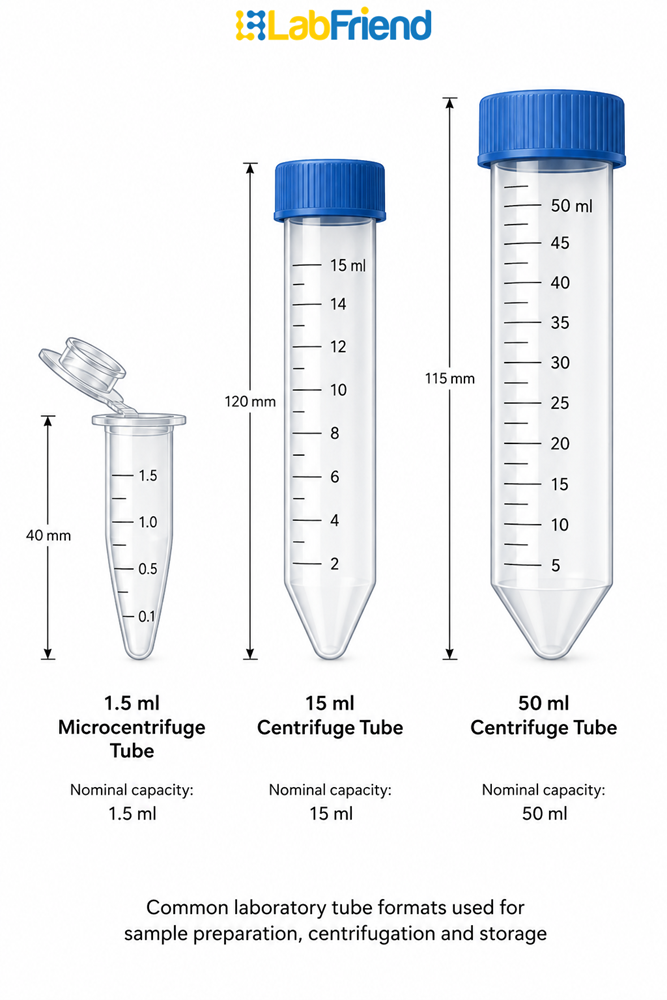
What 15ml centrifuge tubes are typically used for
15ml centrifuge tubes are widely used for routine laboratory workflows where the sample volume is modest and easy handling is important.
They are commonly used for:
- routine sample preparation
- cell pelleting at moderate volumes
- buffer and reagent aliquots
- microbiology workflows
- molecular biology support workflows
- small-volume environmental or testing samples
- short-term sample handling
- teaching and university laboratory work
- low-to-medium volume centrifugation
A 15ml format is often practical where the laboratory needs a balance between capacity and control. The tube is large enough for many routine samples but small enough to handle easily on the bench, store efficiently and use in common centrifuge adapters.
Many 15ml and 50ml centrifuge tubes use a conical-bottom design that concentrates sedimented material into a small area, which can facilitate pellet visualisation and recovery.
Some laboratories also prefer 15ml tubes when they need to minimise headspace, reduce storage footprint or keep individual samples separated into manageable aliquots.
Where a 15ml format is appropriate, laboratories can compare examples such as 15ml PP centrifuge tubes, while still checking the exact product specification before purchase.
What 50ml centrifuge tubes are typically used for
50ml centrifuge tubes are usually selected for larger-volume workflows where capacity, batch processing and fewer transfers matter.
They are commonly used for:
- cell culture workflows
- media preparation
- larger sample preparation
- environmental testing
- food and water testing
- bulk reagent handling
- larger-volume centrifugation
- sample storage before further processing
- workflows where 15ml tubes would require too many repeat tubes
A 50ml tube can reduce handling steps when the workflow regularly exceeds the comfortable working range of a 15ml tube. This can be useful for laboratories processing multiple samples, larger suspensions or larger preparation volumes.
However, larger tubes are not automatically better. They require appropriate centrifuge rotors or adapters, occupy more storage space and may be inefficient for small samples.
Where a 50ml format is appropriate, laboratories can compare examples such as 50ml PP centrifuge tubes, while confirming RCF rating, cap type, material and workflow compatibility before use.
15ml vs 50ml centrifuge tubes: comparison table
|
Selection factor |
15ml centrifuge tubes |
50ml centrifuge tubes |
|
Typical workflow role |
Routine medium-volume sample handling |
Larger-volume preparation and processing |
|
Common applications |
Small sample prep, cell pelleting, reagent aliquots, routine testing |
Cell culture, media preparation, environmental samples, larger batch processing |
|
Handling convenience |
Easier to handle for smaller samples |
Better for larger samples but bulkier |
|
Storage footprint |
Lower |
Higher |
|
Sample transfer burden |
May require more tubes for larger workflows |
Can reduce transfers for larger volumes |
|
Pellet recovery |
Depends primarily on pellet size, tube geometry, rotor type and centrifugation conditions rather than nominal tube volume. |
|
|
Rotor/adaptor requirements |
Requires compatible 15ml rotor/adaptor |
Requires compatible 50ml rotor/adaptor |
|
Cost control |
Often efficient for moderate-volume workflows |
Efficient where larger volume prevents multiple smaller tubes |
|
Over-specification risk |
Too small for bulk workflows |
Too large for small samples |
|
Procurement role |
Common routine tube format |
Common high-consumption tube format in larger workflows |
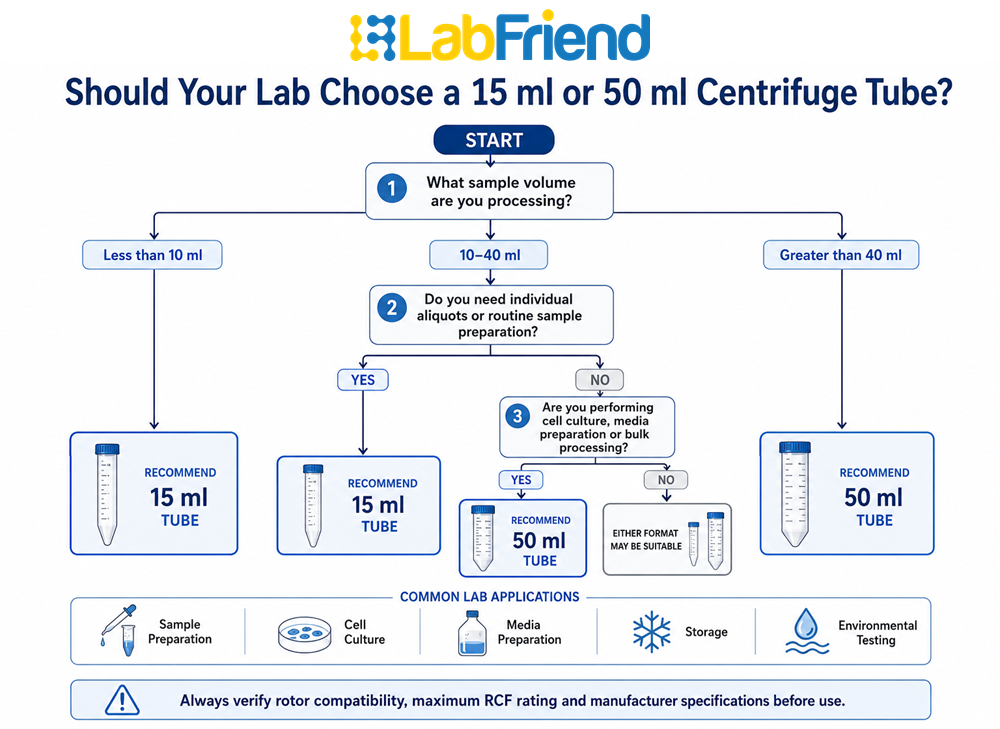
Decision framework: when to choose 15ml vs 50ml tubes
Choose 15ml centrifuge tubes when:
- the sample volume is modest
- individual samples need to remain separated
- bench handling convenience matters
- storage space is limited
- the workflow involves routine preparation or pelleting
- using a 50ml tube would create unnecessary headspace or plastic use
- the centrifuge rotor is configured for 15ml tubes
- the laboratory wants a standard medium-volume format for daily use
Choose 50ml centrifuge tubes when:
- the workflow regularly exceeds comfortable 15ml volumes
- fewer sample transfers would reduce handling time
- larger sample volumes, dense suspensions or workflows generating larger pellets are expected
- the workflow involves media preparation or cell culture
- environmental, food or water testing samples require larger capacity
- the centrifuge rotor is configured for 50ml tubes
- the laboratory needs a high-volume routine tube format
Choose both formats when:
Many laboratories need both 15ml and 50ml centrifuge tubes. The practical aim is not to force one format into every workflow, but to define when each size should be used.
A sensible approach is:
- 15ml tubes for routine medium-volume workflows
- 50ml tubes for larger-volume workflows
- microcentrifuge tubes for small molecular biology workflows
- specialist tubes only where the workflow requires them
This supports technical suitability while helping procurement teams avoid uncontrolled SKU growth.
Nominal volume is not the same as working volume
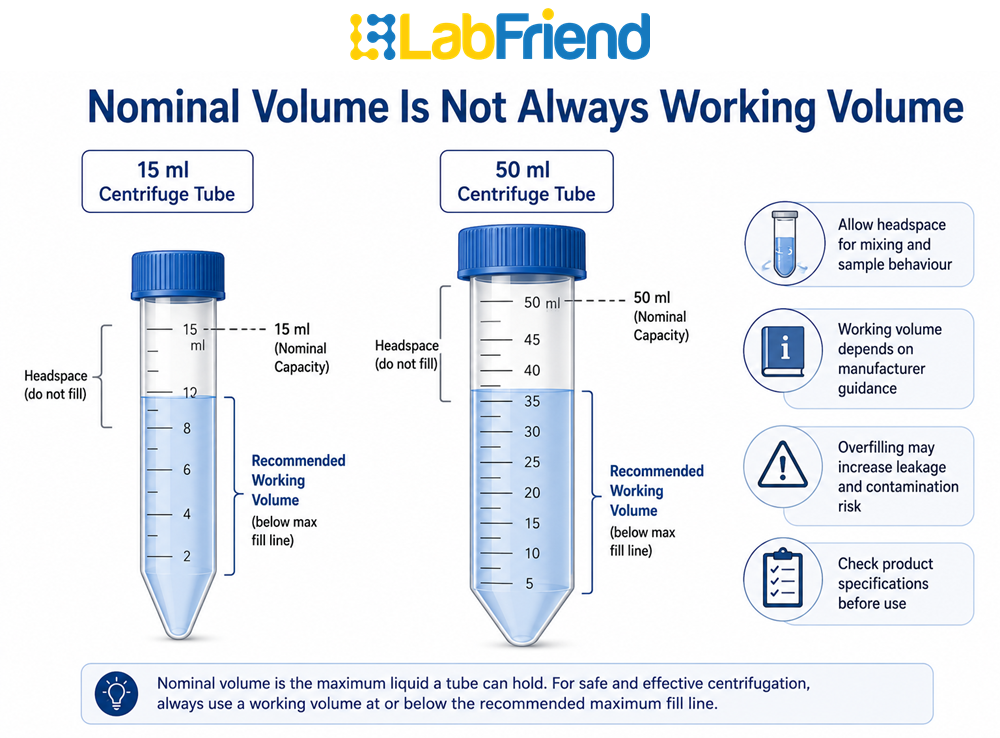
A 15ml or 50ml label describes nominal tube capacity, but laboratories should not assume that every workflow can safely use the full nominal volume.
Working volume can be affected by:
- centrifugation speed
- rotor angle
- cap design
- sample foaming
- thermal expansion
- mixing requirements
- transport requirements
- storage conditions
- manufacturer fill recommendations
Overfilling can increase the risk of leakage, cap contamination, poor balancing and sample loss. Underfilling is generally acceptable provided minimum sample volume requirements for the workflow are met, although very small sample volumes may make pellet visualisation, aspiration and recovery more difficult in some applications.
Before purchase, check the manufacturer’s recommended working volume and operating conditions.
Rotor and adapter compatibility
Tube volume must match the centrifuge rotor and adapter system.
Before using either 15ml or 50ml tubes, confirm:
- the tube fits securely in the rotor or adapter
- the tube length and diameter are suitable
- the cap clears the rotor lid and bucket
- the maximum rated RCF is suitable for the workflow
- the tube is appropriate for the rotor type
- balancing can be performed correctly
- the tube material is suitable for the temperature conditions
Maximum RCF ratings are tube-specific and may vary substantially between products of the same nominal volume. Manufacturer specifications should always be verified before use.
When balancing centrifuge loads, matched mass is generally more important than matched fill volume, particularly when sample densities differ.
RCF matters because RPM alone does not describe the force experienced by the tube. Centrifugal force depends on rotor radius as well as speed.
If the tube is used beyond its specified limits, the laboratory may increase the risk of cracking, leakage or sample loss. The live LabFriend centrifuge tube guide also highlights the need to verify maximum rated RCF, compatible rotor specifications and manufacturer operating limits when choosing tubes.
Material choice still matters
Volume is only one part of tube selection. Material can be just as important.
Most routine 15ml and 50ml centrifuge tubes are made from polypropylene, but laboratories may also encounter other materials depending on application and supplier range.
Polypropylene is commonly selected because it is suitable for many routine centrifugation and sample-preparation workflows. However, not all polypropylene centrifuge tubes are suitable for cryogenic storage or liquid nitrogen use. Laboratories should verify the manufacturer’s stated temperature limits and cryogenic suitability. Polystyrene may be used where optical clarity is important, but it generally has lower chemical resistance and lower tolerance for high centrifugation forces than polypropylene. However, material suitability depends on chemical exposure, temperature, centrifugation force and manufacturer specifications.
For a full material comparison, read Polypropylene vs Polystyrene Centrifuge Tubes.
Sterile or non-sterile: volume does not decide sterility
Both 15ml and 50ml centrifuge tubes may be available in sterile and non-sterile formats. The correct choice depends on the workflow, not the tube size.
Sterile centrifuge tubes may be required for:
- cell culture
- microbiology
- contamination-sensitive biological workflows
- sterile media or reagent handling
- procedures where SOPs specify sterile consumables
Non-sterile centrifuge tubes may be suitable for:
- routine sample handling
- buffer preparation
- non-sensitive chemical workflows
- educational laboratory work
- some industrial or environmental testing workflows
The important point is that sterility is not a quality ranking. It is a contamination-control specification.
Sterile does not automatically mean:
- DNase-free
- RNase-free
- DNA-free
- endotoxin-free
- non-pyrogenic
- PCR-clean
- suitable for cell culture
- suitable for molecular biology
Endotoxin-free and non-pyrogenic claims are related but are distinct specifications and should be verified independently where required by the application.
These claims must be checked separately in manufacturer documentation. For more detail, read Sterile vs Non-Sterile Centrifuge Tubes.
Application examples
Routine sample preparation
For routine sample preparation, 15ml tubes are often sufficient when sample volumes are moderate. They are easy to handle, store and label. If the workflow regularly requires splitting one sample across multiple 15ml tubes, a 50ml tube may be more efficient.
Cell culture workflows
Cell culture workflows often use both 15ml and 50ml tubes. A 15ml tube may be suitable for smaller cell pellets or reagent handling. A 50ml tube is often more practical for larger suspensions, media handling or larger-volume centrifugation. Sterility and documentation should be checked carefully.
Molecular biology workflows
Many molecular biology workflows use smaller microcentrifuge tubes, but 15ml tubes may be useful for intermediate preparation steps. If 15ml or 50ml tubes are used for nucleic acid workflows, DNase/RNase-free or PCR-clean status should be verified separately where required.
Environmental and testing laboratories
Environmental, food and water testing laboratories may use 50ml tubes for sample collection, transport, extraction or larger-volume preparation workflows. However, if the workflow involves smaller aliquots or repeated replicate samples, 15ml tubes may be more practical.
University teaching laboratories
Teaching laboratories may use either format depending on the experiment. Cost, ease of handling, durability and availability are usually important, but technical suitability should still come first.
Procurement considerations for recurring use
Centrifuge tubes are repeat consumables. Once a laboratory standardises around a suitable 15ml or 50ml format, the same product may be reordered regularly.
For high-usage laboratories, the best purchasing decision is usually not the cheapest tube on the day. It is the tube that is:
- technically suitable
- consistently available
- easy to reorder
- appropriate for the workflow
- accepted by laboratory users
- supported by clear product documentation
- compatible with existing centrifuge equipment
Procurement efficiency is valuable but should not replace technical suitability assessment.
Where laboratories are reviewing recurring tube usage, it can be useful to read the cluster article on standardising centrifuge tube purchasing.
Workflow organisation: do not forget tube racks
Tube selection is not only about the tube itself. Laboratories using both 15ml and 50ml formats should also consider how tubes are organised, transported and stored at the bench.
Good rack selection can help with:
- sample identification
- batch organisation
- safe handling
- bench workflow efficiency
- avoiding sample mix-ups
- separating 15ml and 50ml formats
- supporting repeat workflows
LabFriend UK’s tube racks category can support laboratories standardising sample handling alongside centrifuge tube purchasing.
Common mistakes when choosing between 15ml and 50ml tubes
Mistake 1: Choosing by nominal capacity only
Nominal capacity is not enough. Check practical working volume, closure design, rotor compatibility and fill recommendations.
Mistake 2: Using 50ml tubes for every workflow
This may simplify purchasing, but it can waste space and increase plastic use when the sample volume is small.
Mistake 3: Using 15ml tubes for workflows that need larger capacity
This can create unnecessary transfers and increase handling time.
Mistake 4: Ignoring rotor compatibility
A tube that looks correct may still be unsuitable for the centrifuge rotor, bucket or adapter.
Mistake 5: Assuming all tubes with the same volume are equivalent
Two 15ml tubes or two 50ml tubes may differ in material, wall strength, cap design, RCF rating, sterility, packaging and documentation.
Mistake 6: Treating sterility as a complete contamination-control specification
Sterility is only one specification. DNase-free, RNase-free, endotoxin-free and PCR-clean claims must be verified separately.
What choosing the correct volume tube does not solve
Choosing the correct tube volume does not automatically solve:
- rotor compatibility
- maximum RCF suitability
- cap leakage risk
- chemical compatibility
- freeze-thaw suitability
- cryogenic storage suitability
- sterility requirements
- DNase/RNase requirements
- endotoxin or pyrogen requirements
- sample adsorption risk
- documentation requirements
- change-control requirements in regulated workflows
A 15ml or 50ml tube can be the right volume and still be the wrong product if the material, cap, RCF rating or contamination-control specification is unsuitable.
What to check before purchase
Before purchasing 15ml or 50ml centrifuge tubes, check:
- Nominal volume
Confirm whether 15ml or 50ml is appropriate for the workflow. - Practical working volume
Check manufacturer guidance and avoid routine overfilling. - Material
Confirm whether polypropylene, polystyrene or another material is suitable. - Cap and closure design
Check sealing performance, handling needs and leakage risk. - Maximum RCF rating
Confirm the tube is suitable for the centrifugation force required. - Rotor and adapter compatibility
Check fit, balance, cap clearance and rotor type. - Sterility status
Use sterile tubes only where the workflow requires sterility. - Purity claims
Verify DNase-free, RNase-free, endotoxin-free or PCR-clean status where required. - Temperature conditions
Confirm suitability for refrigerated centrifugation, freezer storage or low-temperature workflows. - Chemical compatibility
Check compatibility with buffers, solvents, reagents and sample matrices. - Documentation availability
Confirm whether certificates, lot information or manufacturer specifications are needed. - Reorder practicality
Consider pack size, supplier continuity and repeat purchasing.
How to verify before switching suppliers
If your laboratory is switching from one 15ml or 50ml tube to another, do not rely on volume alone.
A practical switching check should include:
- compare nominal volume and working volume
- compare tube dimensions
- compare material
- compare cap and seal design
- compare maximum RCF
- check rotor and adapter fit
- confirm sterility status
- confirm any purity claims required by the method
- review packaging format and labelling
- test with representative workflows where required
- document the switch if the workflow is controlled, accredited or regulated
For routine workflows, a controlled internal comparison may be enough. For regulated or quality-controlled workflows, the laboratory’s own quality system should determine whether change control, equivalence assessment or method verification is required.
UK purchasing considerations
UK laboratories often need centrifuge tubes that are technically suitable, easy to source and practical to reorder. This is especially important for CROs, independent testing laboratories, SME biotech companies and university groups with recurring consumables demand.
When reviewing 15ml and 50ml tube options, consider:
- how often each format is used
- whether departments are ordering duplicate products
- whether sterile and non-sterile variants are both needed
- whether one approved product can support several workflows
- whether pack sizes match usage patterns
- whether tube racks or storage accessories should be standardised at the same time
- whether supplier consolidation could improve repeat purchasing without increasing technical risk
For laboratories ready to compare available formats, browse LabFriend UK’s centrifuge tubes.
Product and category connection
LabFriend UK supports laboratories comparing centrifuge tube formats for routine and specialist workflows. The best starting point is the main centrifuge tubes category.
For specific examples, laboratories may review:
- 15ml PP centrifuge tubes
- 50ml PP centrifuge tubes
- tube racks for sample organisation and workflow support
Product pages should always be checked for the final specification before purchase.
Frequently asked questions
What is the main difference between 15ml and 50ml centrifuge tubes?
The main difference is capacity and workflow role. 15ml centrifuge tubes are commonly used for moderate-volume sample preparation, smaller pellets and routine handling. 50ml centrifuge tubes are used for larger sample volumes, media preparation, cell culture workflows and higher-volume processing.
Are 15ml centrifuge tubes better than 50ml tubes?
No. Neither size is automatically better. A 15ml tube is better for smaller workflows where handling and storage efficiency matter. A 50ml tube is better when larger sample capacity reduces transfers and improves workflow efficiency.
Can I use a 50ml centrifuge tube for small samples?
You can sometimes use a 50ml tube for smaller samples if the workflow and rotor setup allow it, but it may be inefficient. Larger tubes can increase storage footprint, plastic use and dead volume. Check whether a 15ml or microcentrifuge tube would be more appropriate.
Can I fill a centrifuge tube to its full labelled volume?
Do not assume that the labelled volume is the safe working volume for every workflow. Check manufacturer guidance for fill limits, centrifugation conditions, cap design and sample behaviour.
Do 15ml and 50ml tubes have the same RCF rating?
Not necessarily. RCF rating is product-specific. Two tubes with the same volume may have different maximum RCF ratings depending on material, wall design, cap type and manufacturer specification.
Are 15ml and 50ml centrifuge tubes usually sterile?
Both sterile and non-sterile versions may be available. Sterility depends on the specific product, not the tube volume. Always check the product specification.
Does sterile mean DNase-free or RNase-free?
No. Sterile does not automatically mean DNase-free, RNase-free, endotoxin-free or PCR-clean. These are separate claims that must be verified in manufacturer documentation.
Which tube size is better for cell culture?
Cell culture workflows often use both 15ml and 50ml tubes. The correct choice depends on sample volume, pellet size, media volume, centrifuge setup and sterility requirements.
Which tube size is better for environmental testing?
Environmental testing workflows often use 50ml tubes when larger sample volumes are required, but 15ml tubes may be appropriate for aliquots, replicates or smaller preparation steps.
Should procurement standardise on one tube size?
Usually not. Most laboratories need more than one tube size. Procurement should standardise where workflows allow it, but technical suitability should always come before purchasing simplicity.
Conclusion
The choice between 15ml and 50ml centrifuge tubes should be based on workflow need, not habit.
Use 15ml centrifuge tubes when the laboratory needs a practical medium-volume format for routine handling, moderate sample preparation, smaller pellets and efficient storage.
Use 50ml centrifuge tubes when larger sample volumes, media preparation, cell culture, environmental samples or reduced transfer steps make the larger format more efficient.
For most operational laboratories, the best approach is to define where each format belongs, confirm technical suitability and then standardise repeat purchasing around approved products.
To compare current options, browse LabFriend UK’s centrifuge tubes range or review the Complete Guide to Centrifuge Tubes for broader selection guidance.
Written by: Donal O’Sullivan, BSc, Co-Founder and Sales Director, LabFriend UK. Donal brings deep chemistry-led technical expertise across analytical chemistry, biochemistry, environmental monitoring, laboratory instrumentation, consumables and scientific product selection.
Reviewed by: Michael Anderson, MBA, Founder and Managing Director, LabFriend UK. Michael reviews LabFriend UK content for customer relevance, commercial accuracy, operational practicality and alignment with LabFriend UK’s laboratory supply model.
Related Stories

Complete Guide to Centrifuge Tubes
Complete Guide to Centrifuge Tubes

The Ultimate Guide to Laboratory Filtration for UK Laboratories
The Ultimate Guide to Laboratory Filtration for UK Laboratories

Polypropylene vs Polystyrene Centrifuge Tubes
Polypropylene vs Polystyrene Centrifuge Tubes: Which Is Best for Laboratory Workflows?

PTFE vs PES Syringe Filters: Which Membrane Should You Choose?
PTFE vs PES Syringe Filters: Differences, Solvent Compatibility and Laboratory Applications