

Share :
Sterile vs Non-Sterile Centrifuge Tubes - Which Should Your Laboratory Choose
Updated On 07/17/2026

By Donal O’Sullivan, BSc. Reviewed by Michael Anderson, MBA.
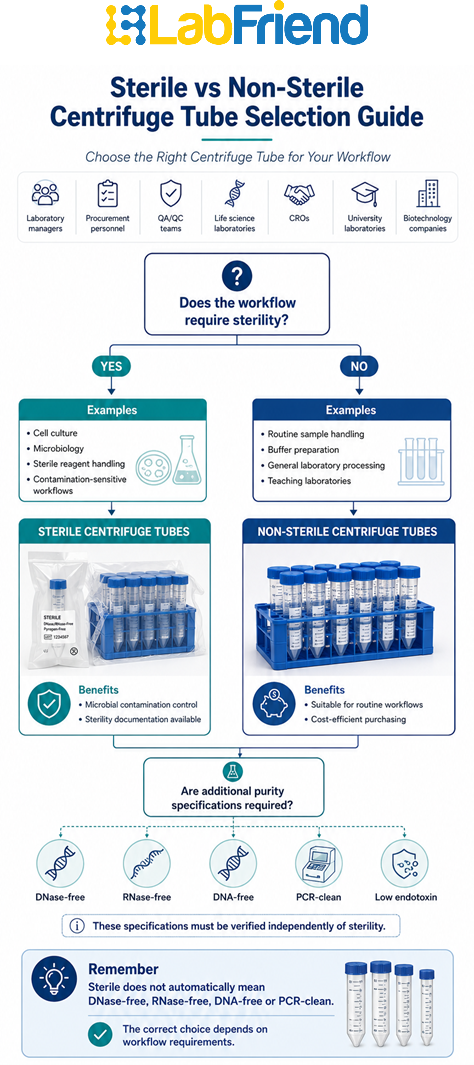
Sterile centrifuge tubes are typically selected when contamination control is important, such as cell culture, microbiology, molecular biology, or workflows where introducing microorganisms could compromise results. Non-sterile centrifuge tubes are often suitable for routine laboratory handling, sample preparation, buffer work, and other processes where sterility is not a workflow requirement.
Neither option is automatically better. The correct choice depends on sample type, contamination risk, downstream analysis, quality requirements, and cost control.
Importantly, sterile does not automatically mean DNase-free, RNase-free, DNA-free, endotoxin-tested, low-endotoxin, non-pyrogenic or pyrogen-tested, or PCR-clean. These are separate specifications and should be verified through manufacturer documentation before purchase.
Sterile centrifuge tubes are typically supplied following a validated sterilisation process and packaged in a manner intended to maintain sterility until use, where supported by manufacturer documentation.
Depending on the manufacturer, sterilisation may be achieved using gamma irradiation, electron-beam treatment or other validated sterilisation methods.
Why this matters
Choosing the wrong specification can create two different problems.
A laboratory may pay more for sterile centrifuge tubes when non-sterile tubes would be technically suitable. Alternatively, a laboratory may use non-sterile tubes in contamination-sensitive workflows and increase the risk of failed experiments, compromised samples, or repeat work.
For routine purchasing, start with the workflow rather than the label. If you are reviewing available options, the LabFriend UK centrifuge tubes category is the primary commercial destination for comparing suitable formats.
What sterile centrifuge tubes are for
Sterile centrifuge tubes are used where microbial contamination could affect the sample, workflow, or interpretation of results.
They are commonly considered for:
- cell culture
- microbiology
- clinical research or clinical sample-handling workflows
- environmental microbiology
- contamination-sensitive sample handling
- sterile media or reagent handling
In cell-culture workflows, sterile centrifuge tubes form part of a broader aseptic technique strategy and do not by themselves create sterile handling conditions.
Sterility is therefore a contamination-control specification. It does not remove the need to check material, cap design, RCF rating, working volume, temperature suitability, or chemical compatibility.
For laboratories that also run high-speed workflows, tube selection should be considered alongside centrifuge use, balancing, rotor condition, and compatibility. The LabFriend guide to laboratory centrifuge maintenance is a useful supporting read because tube failure risk is not only about the tube; it also depends on correct centrifuge operation.
What non-sterile centrifuge tubes are for
Non-sterile centrifuge tubes are suitable for many routine laboratory workflows where microbial contamination is not a critical risk.
Typical examples include:
- routine sample handling
- buffer preparation
- general laboratory processing
- non-sterile chemical workflows
- some environmental or industrial testing workflows
- training and teaching laboratories
For high-volume laboratories, non-sterile tubes may reduce consumables cost where sterility is not required. This is especially relevant for CROs, private testing laboratories, university groups, and SME biotech organisations where repeat purchasing volumes can be significant. For highly sensitive analytical workflows, laboratories may also evaluate extractables, leachables and background contamination characteristics independently of sterility status.
The key question is not “Which is better?” The better question is: “Does this workflow require sterility?”
Sterile does not mean molecular biology grade
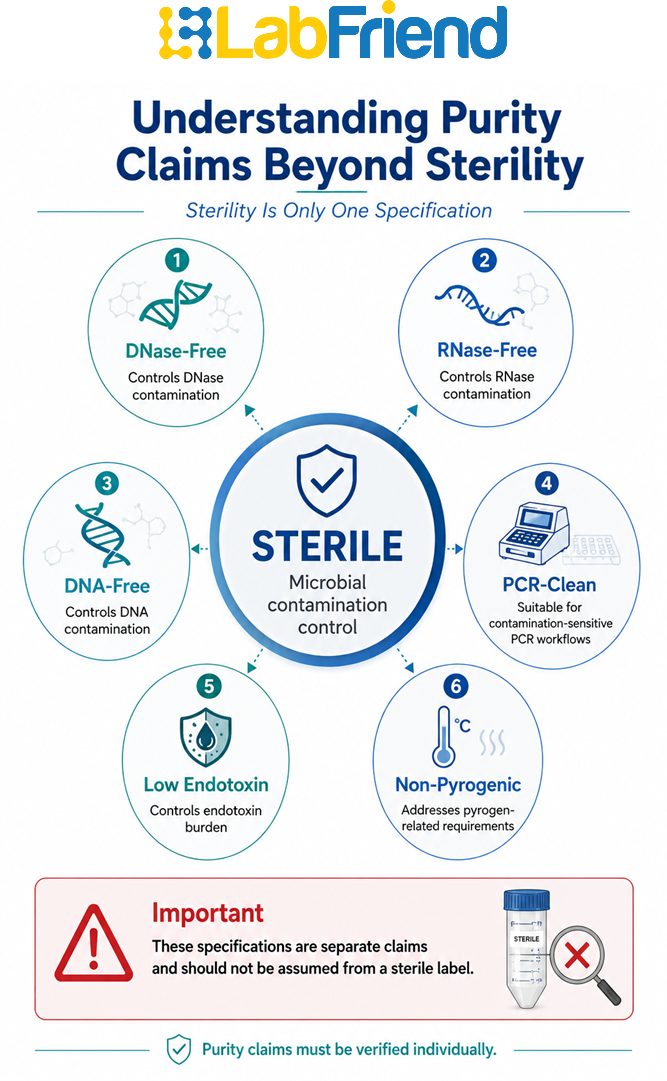
Understanding Purity Claims Beyond Sterility
In many life-science workflows, sterility is only one specification among several that may be required. Laboratories may also evaluate DNA-free, DNase-free, RNase-free, low-endotoxin, non-pyrogenic or PCR-clean claims depending on the application. These specifications address different contamination risks and should be verified independently through manufacturer documentation rather than assumed from a sterile label alone.
This is one of the most important purchasing distinctions.
A sterile centrifuge tube may still not be suitable for molecular biology unless additional purity specifications are confirmed.
|
Specification |
Same as sterile? |
Must be verified separately? |
|
Sterile |
Sterility claim only |
Verify manufacturer documentation |
|
DNase-free |
No |
Yes |
|
RNase-free |
No |
Yes |
|
DNA-free |
No |
Yes |
|
Endotoxin-tested |
No |
Yes |
|
Pyrogen-free |
No |
Yes |
|
PCR-clean |
No |
Yes |
DNA-free, DNase-free and RNase-free claims address different contamination risks and should not be treated as interchangeable.
For PCR, qPCR, RT-qPCR, and RNA workflows, contamination control extends beyond sterility. In molecular biology workflows, contamination from previously amplified nucleic acids may present a greater risk than viable microbial contamination, which is why additional purity specifications are often evaluated alongside sterility. Related molecular biology workflows may also require filter tips, certified consumables, and careful liquid handling technique. See LabFriend’s qPCR pipetting best practices guide for a wider view of contamination and variability control in sensitive assays.
Sterile vs non-sterile centrifuge tubes: comparison table
|
Selection factor |
Sterile centrifuge tubes |
Non-sterile centrifuge tubes |
|
Microbial contamination control |
Higher |
Lower |
|
Cell culture suitability |
Often required |
Usually unsuitable unless validated |
|
Routine sample handling |
Suitable |
Often suitable |
|
Molecular biology suitability |
Only if required purity claims are documented |
Only if required purity claims are documented |
|
Cost |
Usually higher |
Usually lower |
|
Procurement efficiency |
Useful where standardised for sensitive workflows |
Useful where routine high-volume consumption is high |
|
Documentation need |
Sterility documentation may be required |
Standard product documentation may be sufficient |
|
Switching risk |
Requires specification review |
Requires specification review |
|
Additional purity claims |
Must be verified separately |
Must be verified separately |
Decision framework: which should your lab choose?
Choose sterile centrifuge tubes when:
- contamination could compromise results
- sterile technique is part of the workflow
- samples are used in cell culture or microbiology
- quality procedures specify sterile consumables
- downstream analysis is sensitive to contamination
- the laboratory requires sterility documentation
- packaging integrity and contamination-control procedures are important
Choose non-sterile centrifuge tubes when:
- the workflow is routine and not contamination-sensitive
- samples are not being introduced into sterile systems
- sterility is not required by SOP or quality process
- cost control is important
- high-volume repeat purchasing makes over-specification expensive
If your laboratory is unsure, do not choose solely on price. Review the tube specification, application risk, and documentation requirements first, then compare suitable options in the LabFriend centrifuge tubes range.
Common mistakes
Assuming sterile means better
Sterile is not a quality ranking. It is a specific contamination-control property.
Assuming sterile means RNase-free or DNase-free
Sterility and nuclease-free status are different claims. Do not substitute one for the other.
Buying sterile tubes for every workflow
This may simplify procurement, but it can increase consumables spend unnecessarily if many workflows do not require sterility.
Using non-sterile tubes in contamination-sensitive work
This can increase the risk of failed experiments, repeat work, and compromised samples.
Ignoring centrifuge compatibility
Sterility does not determine whether a tube is suitable for a rotor, adapter, fill volume, temperature condition, or RCF requirement.
What this does not solve
Choosing sterile centrifuge tubes does not automatically solve:
- RNase contamination risk
- DNase contamination risk
- endotoxin control
- chemical compatibility
- rotor compatibility
- RCF suitability
- cap leakage
- freeze-thaw suitability
- regulated change-control requirements
- tube wall strength
- impact resistance
- chemical resistance
- long-term storage suitability
Choosing non-sterile tubes does not automatically mean the product is lower quality. It simply means sterility is not part of that specification.
What to check before purchase
Before purchasing sterile or non-sterile centrifuge tubes, confirm:
- nominal volume
- working volume
- material (for example polypropylene or polystyrene where relevant)
- RCF rating
- cap and seal design
- rotor and adapter compatibility
- temperature requirements, including freezing, refrigerated storage and elevated-temperature processing where relevant
- chemical compatibility
- sterility status
- DNase/RNase status where required
- endotoxin or pyrogen status where required
- certificate or documentation availability
Where regulated or accredited procedures are involved, supplier changes may require workflow verification, change control or equivalence assessment.
For supplier switching, the most commercially sensible route is to shortlist technically suitable products first, then compare price, availability, and repeat purchasing fit.
UK purchasing considerations
For UK laboratories, the choice often has a procurement dimension as well as a technical one.
Lab managers and procurement teams should consider:
- whether sterile tubes are being used by default
- whether SOPs actually require sterility
- whether different departments are buying different equivalents
- whether non-sterile options could reduce cost in routine workflows
- whether documentation is adequate for quality-controlled environments
- whether tube standardisation could simplify repeat ordering
Where a laboratory has recurring demand, standardising a small number of suitable centrifuge tube formats can reduce purchasing complexity and support more consistent stock control.
Product and category connection
LabFriend UK provides access to laboratory centrifuge tubes across routine and specialist workflows. The primary commercial destination for this article is the centrifuge tubes category. For life science-specific navigation, the centrifugation tubes category may also be relevant.
If your laboratory needs help comparing sterile and non-sterile options, or requires support identifying equivalent products for repeat supply, use the LabFriend contact page to raise a technical or purchasing enquiry.
FAQs
Are sterile centrifuge tubes always better?
No. Sterile centrifuge tubes are better only when the workflow requires sterility. For routine workflows where microbial contamination is not a meaningful risk, non-sterile tubes may be technically suitable and more cost-effective.
Does sterile mean DNase-free?
No. DNase-free status is a separate specification and should be confirmed through manufacturer documentation.
Does sterile mean RNase-free?
No. RNase-free status is separate from sterility and must be verified independently.
Are sterile centrifuge tubes suitable for PCR?
Only if the required molecular biology purity claims are documented. PCR workflows may require DNase-free, RNase-free, DNA-free, or PCR-clean consumables depending on the application.
Can non-sterile centrifuge tubes be used for routine lab work?
Yes. Many routine laboratory workflows can use non-sterile centrifuge tubes where sterility is not required by the method, sample type, or quality system.
Should a lab standardise on sterile tubes?
Not automatically. Standardising on sterile tubes may simplify purchasing, but it can increase costs unnecessarily if many workflows do not require sterility.
Do sterile centrifuge tubes improve centrifuge performance?
No. Sterility does not affect centrifuge performance. Tube suitability for centrifugation depends on factors such as RCF rating, material, wall strength, rotor compatibility, fill volume and operating conditions. Sterility and centrifuge performance should be considered separately.
Can a non-sterile centrifuge tube be used for molecular biology?
Potentially, provided the workflow does not require sterility and the tube meets any required purity specifications. Molecular biology workflows may require DNA-free, DNase-free, RNase-free or PCR-clean consumables regardless of sterility status.
Conclusion
Sterile and non-sterile centrifuge tubes both have a valid role in laboratory operations.
The right choice depends on contamination risk, workflow sensitivity, documentation requirements, and repeat purchasing strategy. Sterility should never be treated as a shortcut for broader technical suitability.
For most laboratories, the best approach is to define where sterility is genuinely required, where non-sterile tubes are suitable, and where additional purity claims must be documented. For more insights see our article Complete Guide to Centrifuge Tubes
Final CTA
Review your current centrifuge tube usage and separate workflows that genuinely require sterility from those that do not. Then compare suitable options in the LabFriend UK centrifuge tubes category, or contact LabFriend for help identifying commercially practical alternatives for repeat purchasing.
Written by: Donal O’Sullivan, BSc, Co-Founder and Sales Director, LabFriend UK. Donal brings deep chemistry-led technical expertise across analytical chemistry, biochemistry, environmental monitoring, laboratory instrumentation, consumables and scientific product selection.
Reviewed by: Michael Anderson, MBA, Founder and Managing Director, LabFriend UK. Michael reviews LabFriend UK content for customer relevance, commercial accuracy, operational practicality and alignment with LabFriend UK’s laboratory supply model.
Related Stories

Complete Guide to Centrifuge Tubes
Complete Guide to Centrifuge Tubes

The Ultimate Guide to Laboratory Filtration for UK Laboratories
The Ultimate Guide to Laboratory Filtration for UK Laboratories

Polypropylene vs Polystyrene Centrifuge Tubes
Polypropylene vs Polystyrene Centrifuge Tubes: Which Is Best for Laboratory Workflows?

PTFE vs PES Syringe Filters: Which Membrane Should You Choose?
PTFE vs PES Syringe Filters: Differences, Solvent Compatibility and Laboratory Applications