

Share :
Amber Centrifuge Tubes for Light-Sensitive Samples
Updated On 09/01/2026

By Donal O’Sullivan, BSc. Reviewed by Michael Anderson, MBA.
Amber centrifuge tubes may be useful when samples, reagents or analytes are sensitive to light during preparation, handling, temporary storage or centrifugation. They should be selected when the workflow requires reduced light exposure and the product specification supports the intended use. Amber colour alone should not be treated as complete light protection or as a guarantee against photodegradation.
The decision should consider the sample’s light sensitivity, exposure duration, wavelength sensitivity where known, tube material, cap design, storage condition, centrifugation condition, RCF rating, rotor compatibility and manufacturer documentation. A 15mL or 50mL amber tube may be useful in one workflow and unsuitable in another if the sample, handling time or centrifugation conditions differ.
Laboratories comparing suitable formats can start with LabFriend UK’s centrifuge tubes, then narrow the choice by volume, colour, material, cap design, RCF rating and documented product claims. For broader tube-selection guidance, read the Complete Guide to Centrifuge Tubes.
Why light-sensitive sample handling matters
Some laboratory samples and reagents can be affected by light exposure. The effect may depend on the compound, concentration, wavelength, exposure time, container material, storage condition and workflow step. Compound classes commonly treated as light-sensitive in laboratory settings include certain vitamins, nucleic acid stains, photosensitive pharmaceutical compounds and some pigments, though sensitivity should always be confirmed for the specific sample. This kind of light-driven chemical breakdown is generally referred to as photodegradation. In some workflows, the risk may be minor. In others, unnecessary exposure may affect sample quality, analytical consistency or downstream interpretation.
Amber centrifuge tubes are used where reduced light exposure is desirable during sample preparation or handling. They can be particularly relevant when clear tubes would expose samples to more light than the workflow allows. However, amber tubes should be treated as one part of a light-control approach, not as a complete protection system.
A laboratory may still need to control bench exposure time, storage location, tube handling, labelling, transport between work areas and sample processing time. Writing or marking directly on an amber-tinted surface can be harder to read than on a clear tube, so laboratories may need to adjust labelling practice, for example using labels rather than direct marking. If a method, SOP or manufacturer instruction requires specific light-protection measures, those requirements should take priority over general container choice.
The practical goal is to choose a tube that supports the workflow without assuming that amber colour solves every light-sensitivity risk.
Amber tubes reduce light exposure but do not remove the need for workflow controls
It is easy to simplify the decision to “clear for normal samples, amber for light-sensitive samples.” That is a useful starting point, but it is not enough for technical selection.
Amber colour may help reduce light exposure in suitable workflows, but performance depends on the product, sample, exposure duration and conditions of use. Some samples may be sensitive to specific wavelengths. Some workflows may involve only brief handling. Others may involve extended bench exposure, centrifugation, temporary storage or transfer between instruments. Amber or brown-tinted polypropylene typically attenuates UV and blue-violet light, roughly below 500nm, rather than blocking light uniformly across the spectrum, so it does not protect against sensitivity to longer wavelengths.
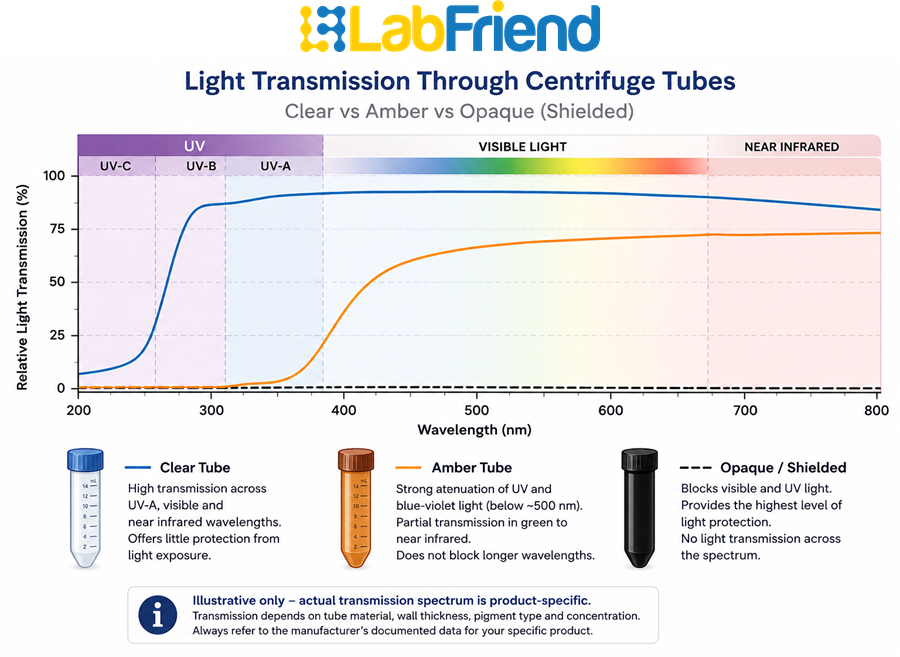
The tube also has to meet the normal requirements of centrifuge tube selection. It must have the correct volume, material, cap closure, RCF rating, rotor compatibility, fill-volume suitability and documentation. An amber tube that helps with light exposure is still not suitable if it does not meet the mechanical, chemical or workflow requirements.
This is why amber tube selection should be made by workflow requirement, not by colour alone.
When amber centrifuge tubes may be useful
Amber centrifuge tubes may be worth considering when the sample, reagent or analyte has known or suspected light sensitivity and the workflow involves handling in a tube format that may expose the contents to light.
They may be relevant in analytical sample preparation, environmental testing, pharmaceutical testing, molecular biology support workflows, biological sample preparation or any workflow where light exposure is controlled by method, SOP or laboratory practice.
|
Workflow situation |
Why amber tubes may be considered |
What still needs checking |
|
Light-sensitive reagent handling |
Reduced light exposure may support sample handling |
Reagent sensitivity, exposure time and product documentation |
|
Analytical sample preparation |
May reduce light exposure during transfer or centrifugation |
Method requirements and sample matrix |
|
Temporary protected handling |
May help where samples are handled briefly before analysis |
Storage time, bench exposure and cap closure |
|
Centrifugation of light-sensitive samples |
May reduce light exposure before or after spinning |
RCF rating, rotor fit and fill volume |
|
Repeat routine workflows |
May support consistent handling where amber format is accepted |
Approved product, substitute rule and reorder control |
|
Method-controlled work |
May be required by SOP or internal method |
Exact method requirement and documentation |
This matrix is a decision aid. It should not be read as a claim that amber centrifuge tubes are suitable for all light-sensitive workflows.
Amber vs clear centrifuge tubes
Clear centrifuge tubes are useful where visibility matters. They allow users to see sample volume, pellet formation, phase separation, clarity, precipitate, colour change and contamination indicators more easily. In many routine workflows, that visibility is helpful.
Amber centrifuge tubes reduce visual transparency but may be preferred where light exposure is a concern. That trade-off matters. A tube that supports light-sensitive handling may make it harder to visually inspect the sample or pellet. The laboratory should decide which requirement matters more for the workflow.
|
Tube colour |
Main advantage |
Main limitation |
|
Clear |
Better visibility of sample, pellet and volume |
More light exposure |
|
Amber |
Reduced light exposure for suitable workflows |
Reduced visibility and not complete protection |
|
Coloured / assorted |
Workflow identification and sample organisation |
Colour coding does not confirm light protection |
|
Opaque or shielded systems |
Stronger light-control approach where used |
May reduce visibility and require separate suitability checks |
Amber vs clear is therefore not a quality ranking. It is a workflow decision. Coloured or assorted tubes and opaque or shielded systems are further options beyond this binary choice, each with their own trade-offs between identification, light control and visibility.
Sample sensitivity and exposure duration
The level of light protection required depends on the sample. A mildly light-sensitive reagent handled briefly at the bench may need a different approach from a highly photosensitive analyte exposed repeatedly during preparation.
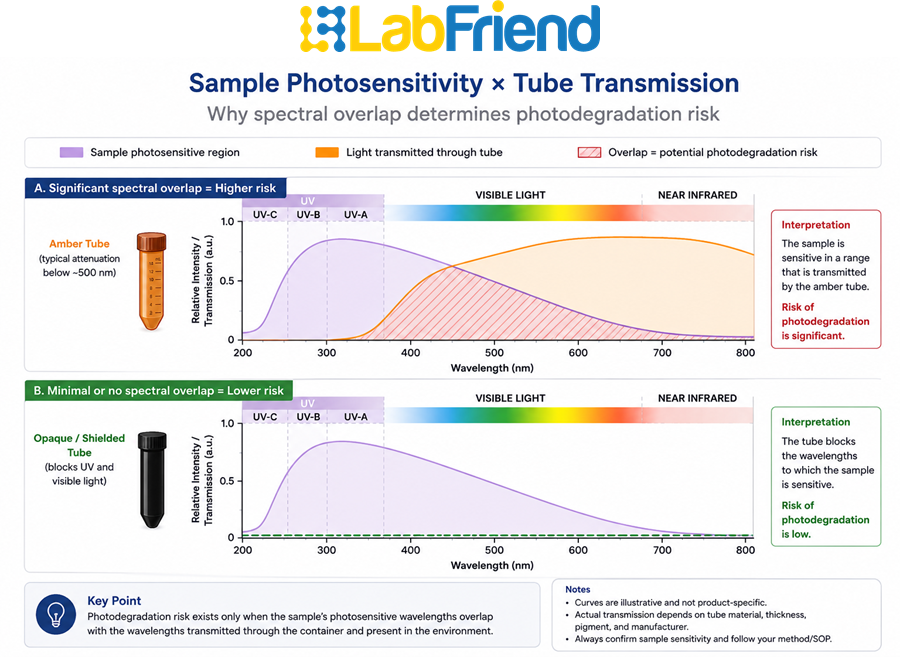
Exposure duration is important. A sample briefly transferred into a tube and processed quickly may face less risk than a sample left on the bench, queued for centrifugation or stored temporarily in a lit environment. Repeated handling can also increase cumulative exposure.
Where light sensitivity matters, the laboratory should ask three questions:
- What is the sample sensitive to?
- How long will it be exposed?
- What does the method or product documentation require?
If those answers are not known, amber tubes may be part of a cautious handling approach, but they should not be presented as proof that the sample is protected.
Tube material and amber colour are separate considerations
Amber colour does not replace material selection. A tube may be amber and still need material compatibility checks. Amber colouring in polypropylene tubes is typically achieved by adding pigment to the base resin, and pigment content is a separate manufacturing variable from the base polymer’s chemical resistance. The tube body, cap and closure should be suitable for the sample, reagent, temperature, centrifugation condition and handling workflow.
Polypropylene is commonly used for many centrifuge tube formats, including some amber products, but polypropylene should not be assumed suitable for every solvent, reagent, temperature or centrifugation condition. If the sample contains solvents, additives, biological material or reactive components, chemical compatibility should be checked against manufacturer guidance.
The same principle applies to the cap. Cap material, closure type, seal design and thread performance may matter where leakage, contamination or sample loss would affect the workflow. The cap and tube body are not always the same polymer, for example a polypropylene tube may be paired with an HDPE or silicone cap, so compatibility should be checked for each component separately.
Amber colour answers only one part of the selection question. It does not answer the full workflow suitability question.
RCF, rotor compatibility and centrifugation suitability
Amber centrifuge tubes used in centrifugation still need the same mechanical checks as clear tubes. The tube should be checked against its product-specific RCF rating, rotor type, adapter fit, fill volume, cap clearance and centrifuge conditions.
A tube that protects the sample from some light exposure is not automatically suitable for the centrifuge run. Similarly, a tube that physically fits a rotor is not automatically suitable for the intended RCF. RPM alone is not enough because RCF depends on rotor radius and centrifuge setup: for a given RPM, a larger rotor radius produces a higher RCF, so two centrifuges running at the same RPM can subject a tube to different forces. RCF measures force, expressed as a multiple of gravity, while RPM is simply rotation speed, and the two should not be treated as interchangeable when checking suitability.
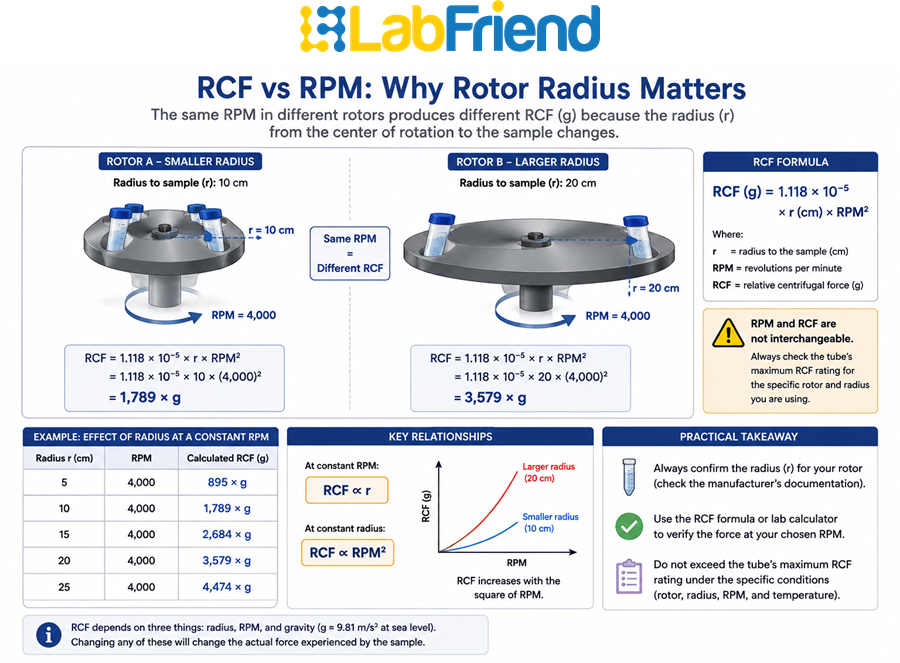
If amber tubes are being introduced as a substitute for clear tubes, the laboratory should compare the specifications carefully. Colour should not distract from RCF, material, cap and dimensional requirements.
For technical support, read centrifuge tube RCF and rotor compatibility.
Product claims and documentation
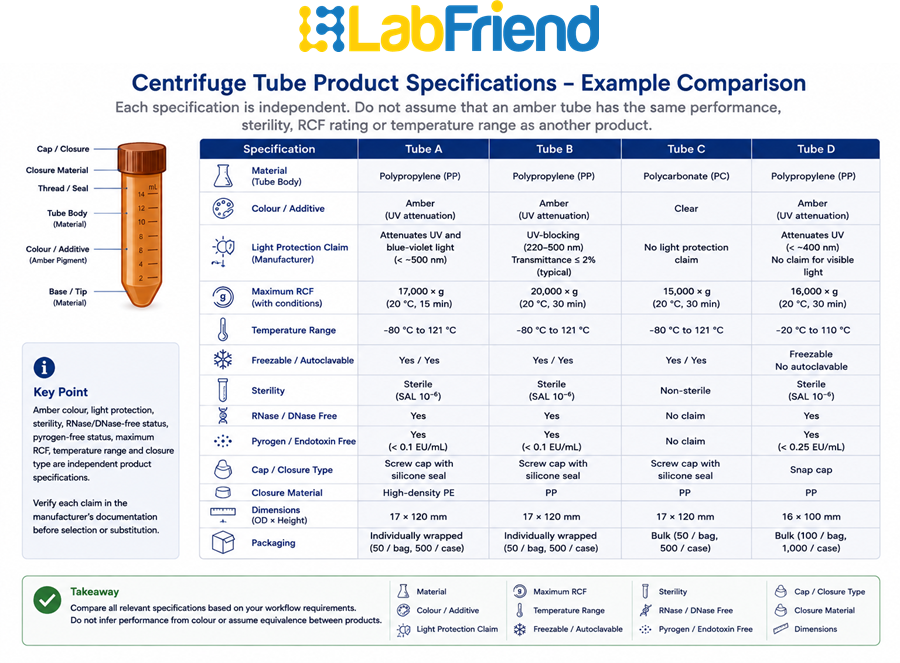
Amber tube product pages may include details such as colour, material, cap type, sterility, RNase/DNase-free status, pyrogen-free status, maximum RCF, temperature information, packaging and intended sample-use wording. These fields should be read exactly. RNase/DNase-free and pyrogen-free status are typically established through defined manufacturing controls or certified testing, not through visual or colour-based inference.
A product page might describe an amber 15mL or 50mL tube as suitable for light-sensitive samples, or include wording about UV-blocking or light-sensitive sample handling. That wording should be treated as product-specific. It should not be applied to every amber tube. “UV-blocking” is a distinct, more specific claim than general amber or light-reducing wording, and the two should not be treated as equivalent when comparing products.
|
Product information to check |
Why it matters |
|
Colour |
Confirms whether the product is amber, clear or another format |
|
Material |
Supports compatibility and workflow suitability review |
|
Cap design |
Affects closure, handling and leakage risk |
|
Maximum RCF |
Confirms centrifugation suitability where relevant |
|
Sterility |
Relevant only where sterile status is required |
|
RNase/DNase-free status |
Separate product claim; do not infer from amber colour |
|
Pyrogen-free status |
Separate product claim; must be explicit where needed |
|
Temperature information |
Relevant where storage or cold handling is involved |
|
Manufacturer documentation |
Confirms supported claims and limits |
The safest buying habit is to ask: which claim is explicitly stated, and which claim am I assuming?
Amber tubes and storage conditions
Amber tubes may be used during temporary handling, but storage conditions still matter. A light-sensitive sample may require controlled storage temperature, reduced exposure time, secondary shielding, dark storage or specific handling instructions.
Amber colour alone should not be treated as equivalent to dark storage or validated light-protection procedures. If the sample is stored for longer periods, the laboratory should confirm whether the tube, cap and storage method are appropriate for that condition.
If the workflow includes cold storage, freezing or low-temperature exposure, temperature suitability must be checked separately. An amber tube is not automatically suitable for -20°C, -80°C, refrigerated storage or cryogenic-adjacent workflows unless product documentation supports that use. Standard polypropylene centrifuge tubes are typically rated to around -20°C, and -80°C or cryogenic-adjacent use requires a specifically rated product rather than being inferred from amber colouring.
Supplier switching and repeat ordering
Amber centrifuge tubes are often introduced because a workflow has a specific sample-handling requirement. Once that requirement has been accepted, repeat ordering should preserve it.
A potential substitute should not be accepted simply because it is also amber. The laboratory should compare volume, material, dimensions, cap design, RCF rating, sterility or purity claims, packaging and documentation. If light-sensitive handling is the reason for choosing amber, the replacement should also support that requirement. Amber tinting can also vary in shade or opacity between manufacturing batches or suppliers, so laboratories relying on consistent light exposure for QA/QC or CRO workflows should confirm colour and opacity consistency, not just the “amber” descriptor, when switching or reordering.
Procurement efficiency is valuable but should not replace technical suitability assessment.
For repeat-use purchasing context, read high-usage centrifuge tube purchasing.
When clear tubes may still be the better choice
Amber centrifuge tubes are not automatically better than clear tubes. Clear tubes may be preferred where visibility is critical, where light sensitivity is not relevant, or where the method requires visual inspection of pellet formation, phase separation, precipitate or sample clarity.
Using amber tubes unnecessarily can make handling less convenient. It may also increase purchasing complexity if the workflow does not require light reduction.
A good selection process should therefore define the problem first. If light exposure is not a meaningful risk, clear tubes may remain the more practical option. If light exposure is a risk, amber tubes may be appropriate where the product specification supports the workflow.
Common mistakes in amber tube selection
Assuming amber means complete protection
Amber colour may help reduce light exposure, but it should not be treated as complete light protection. Exposure time, wavelength sensitivity and handling conditions still matter.
Ignoring visibility needs
Amber tubes can make sample inspection more difficult. If visual monitoring is important, the laboratory should decide whether reduced visibility creates a workflow problem.
Forgetting centrifugation requirements
An amber tube used in a centrifuge still needs appropriate RCF rating, rotor fit, adapter support, fill volume and cap clearance.
Treating all amber tubes as equivalent
Amber tubes can differ in material, capacity, closure, RCF rating, sterility, purity claims and packaging. Similar colour does not confirm equivalent suitability.
Inferring sterility or purity claims
Amber colour does not imply sterile, RNase/DNase-free, pyrogen-free or PCR-clean status. Those claims must be stated separately.
Switching supplier without preserving the specification
A replacement amber tube should be compared against the accepted product and workflow requirement before routine use.
What this article does not solve
This article supports centrifuge tube selection for light-sensitive sample workflows. It does not confirm that any specific amber tube prevents photodegradation, provides complete UV protection, protects all photosensitive samples, replaces dark-storage procedures, or suits every analytical, biological, molecular biology, clinical, diagnostic or regulated workflow.
It also does not confirm chemical compatibility, temperature suitability, RCF suitability, sterility, RNase/DNase-free status, pyrogen-free status or method suitability for any specific product unless those claims are supported by product documentation.
Where light protection is critical, laboratories should follow the relevant method, SOP, manufacturer guidance and internal technical review.
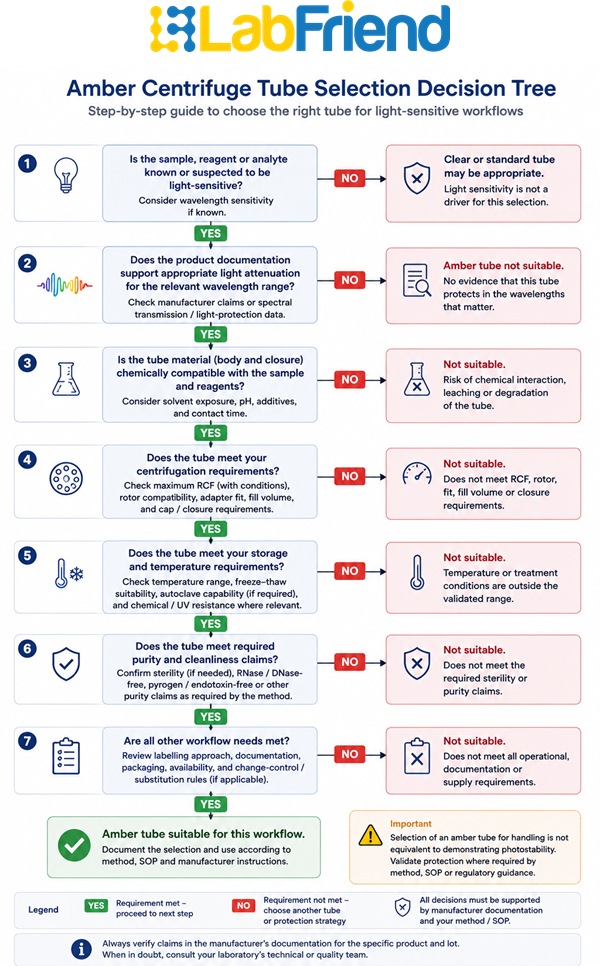
What to check before purchase
Before purchasing amber centrifuge tubes for light-sensitive samples, laboratories should confirm the following, alongside the product-information fields covered earlier in this article:
|
Check |
Decision question |
|
Sample sensitivity |
Is the sample known or suspected to be light-sensitive? |
|
Exposure duration |
How long will the sample be exposed during handling? |
|
Tube colour |
Is amber colour required or useful for this workflow? |
|
Tube volume |
Is the required format 5mL, 15mL, 50mL or another size? |
|
Material |
Is the tube material suitable for the sample or reagent? |
|
Cap design |
Does the closure suit handling, storage and centrifugation? |
|
RCF rating |
Is the tube suitable for the intended centrifugation condition? |
|
Rotor fit |
Does the tube fit the rotor and adapter correctly? |
|
Sterility or purity claims |
Are sterile, RNase/DNase-free or pyrogen-free claims required? |
|
Storage condition |
Will temperature or storage duration affect suitability? |
|
Documentation |
Are the relevant claims supported by manufacturer information? |
|
Substitute control |
Would a replacement preserve the accepted specification? |
This checklist is a buying aid, not a guarantee of light protection.
Frequently asked questions
When should I use amber centrifuge tubes?
Use amber centrifuge tubes when the workflow involves light-sensitive samples or reagents and reduced light exposure is required or useful. The decision should be based on the sample, exposure duration, method requirements and product documentation.
Do amber centrifuge tubes protect light-sensitive samples?
Amber centrifuge tubes may help reduce light exposure in suitable workflows, but they should not be treated as complete protection or as a guarantee against photodegradation.
Are amber tubes better than clear tubes?
Not always. Amber tubes may be useful for light-sensitive samples, while clear tubes may be better where sample visibility, pellet inspection or phase observation is important.
Can amber centrifuge tubes be centrifuged?
Only if the specific product is suitable for the intended centrifugation conditions. Check the product-specific RCF rating, rotor fit, adapter support, fill volume and cap clearance.
Can amber centrifuge tubes be autoclaved?
Autoclave suitability depends on the specific product’s temperature rating and material, and should be confirmed from manufacturer documentation rather than assumed from tube colour.
What sizes do amber centrifuge tubes come in?
Amber tubes are commonly available in the same formats as clear tubes, for example 5mL, 15mL and 50mL. Volume should be selected against the same workflow requirements as any other centrifuge tube.
Do amber tubes prevent photodegradation?
Do not assume that amber tubes prevent photodegradation. Photodegradation risk depends on the sample, wavelength sensitivity, exposure time, storage condition and method requirements. Risk also depends on cumulative light dose, which combines light intensity with exposure time, rather than exposure time alone.
Are amber centrifuge tubes sterile?
Some amber centrifuge tubes may be sterile, but sterility is a separate product claim. It should be confirmed from the product specification.
Are amber tubes RNase/DNase-free or pyrogen-free?
Only where the product documentation explicitly states those claims. Amber colour does not imply RNase/DNase-free, pyrogen-free, PCR-clean or other purity status.
Can I replace clear tubes with amber tubes?
Possibly, but the amber replacement should be compared against the accepted specification. Volume, material, dimensions, cap design, RCF rating, sterility or purity claims and documentation should be checked.
Are amber tubes suitable for all photosensitive reagents?
No. Suitability depends on the reagent, wavelength sensitivity, exposure time, container material, storage condition and product documentation.
What is the biggest mistake when choosing amber centrifuge tubes?
The biggest mistake is assuming that amber colour alone confirms suitability. Amber colour is one selection factor; workflow suitability still depends on the full product specification and sample requirements.
Conclusion
Amber centrifuge tubes can be useful for light-sensitive sample workflows, but they should be selected carefully. Amber colour may help reduce light exposure where the product and workflow support that use, but it does not replace method requirements, dark-storage procedures, chemical compatibility checks, RCF verification or product documentation.
The right tube depends on the sample’s light sensitivity, exposure duration, tube material, volume, cap design, RCF rating, rotor compatibility, storage condition and required product claims.
For routine purchasing, laboratories should avoid treating all amber tubes as equivalent. A 15mL amber tube, a 50mL amber tube and a 5mL amber tube may differ significantly in material, cap type, RCF rating, sterility and documentation.
To compare available options, browse LabFriend UK’s centrifuge tubes. For broader selection guidance, return to the Complete Guide to Centrifuge Tubes.
Read more from LabFriend UK:
- Complete Guide to Centrifuge Tubes
- Understanding RCF, RPM and Rotor Compatibility for Centrifuge Tubes
- Choosing 15mL and 50mL Centrifuge Tubes for High-Usage Laboratories
- Browse LabFriend UK Centrifuge Tubes
Written by: Donal O’Sullivan, BSc, Co-Founder and Sales Director, LabFriend UK. Donal brings deep chemistry-led technical expertise across analytical chemistry, biochemistry, environmental monitoring, laboratory instrumentation, consumables and scientific product selection.
Reviewed by: Michael Anderson, MBA, Founder and Managing Director, LabFriend UK. Michael reviews LabFriend UK content for customer relevance, commercial accuracy, operational practicality and alignment with LabFriend UK’s laboratory supply model.
Related Stories

Filtration Best Practices for LC-MS and Trace Analytical Methods
Filtration Best Practices for LC-MS and Trace Analytical Methods

Centrifuge Tube Reorder Planning for High-Usage Laboratories
Centrifuge Tube Reorder Planning for High-Usage Laboratories

Extractables and Leachables in Analytical Filtration Explained
Extractables and Leachables in Analytical Filtration Explained

How Lab Managers Can Standardise Centrifuge Tube Purchasing Without Increasing Technical Risk
How Lab Managers Can Standardise Centrifuge Tube Purchasing Without Increasing Technical Risk