

Share :
Troubleshooting Low-Volume Pipetting in PCR & qPCR Workflows
Updated On 08/20/2026

By Donal O’Sullivan, BSc. Reviewed by Michael Anderson, MBA.
Low-volume pipetting can expose inconsistencies that remain almost invisible when larger volumes are transferred. A workflow that appears perfectly repeatable at 100 µL may become noticeably less consistent when transfers fall to 10 µL, 2 µL or below.
This matters particularly in PCR and quantitative PCR (qPCR), where small quantities of template, primers, probes, enzymes and other reagents may contribute directly to reaction composition. When replicate results become unexpectedly variable, the pipette is often the first component to be questioned. In practice, the cause may lie elsewhere.
Low-volume pipetting is influenced by the interaction between the pipette, pipette tip, liquid, operator, environment and method. At small volumes, relatively minor differences in aspiration, evaporation, temperature, liquid retention or tip sealing can represent a much larger proportion of the total transferred volume.
Low-volume pipetting becomes inconsistent because small absolute deviations represent a larger proportion of the intended transfer. Pipette selection, evaporation, temperature differences, aspiration technique, air bubbles, liquid retention and pipette-tip fit can therefore produce disproportionately important variability at low volumes.
The most effective response is not to change several components immediately. It is to identify where variability is entering the workflow and test likely causes systematically.
For broader guidance on pipette tips, compatibility and liquid handling performance, see LabFriend UK's Complete Guide to Pipette Tips, Pipetting Accuracy & Laboratory Liquid Handling.
Key Takeaways
- Small absolute deviations become a larger proportion of the total transfer as volumes shrink, which is why low-volume PCR/qPCR work exposes liquid-handling problems that are invisible at larger volumes.
- Replicate variability is a symptom, not a diagnosis — investigate systematically before assuming the pipette is at fault.
- Change one variable at a time (pipette, technique, tip, liquid) so any improvement can be attributed to a specific cause.
- Consumable changes (low-retention or filter tips) should follow evidence that retention or contamination control is the actual problem, not precede it.
- Use the Contents list below or the Troubleshooting Matrix to jump straight to the symptom you are seeing.
Why Low-Volume Pipetting Is Less Forgiving
Every liquid transfer contains some degree of uncertainty. The practical significance of that uncertainty depends partly on the size of the volume being transferred.
Consider a small absolute difference between two transfers. At a relatively large volume, that difference may represent only a small proportion of the intended amount. As the target volume decreases, the same absolute difference becomes proportionally more significant.
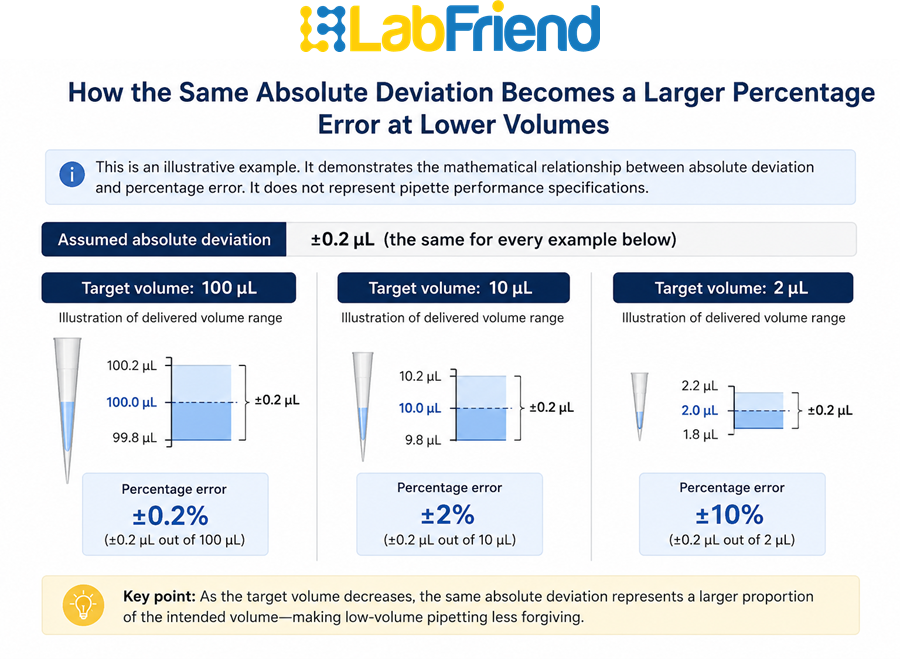
That is one reason PCR and qPCR workflows can reveal liquid-handling inconsistencies particularly clearly.
The problem is not simply that "small volumes are difficult". Rather, the operating margin becomes narrower. Differences in operator technique, liquid behaviour or environmental conditions that have little practical consequence at larger volumes can become much more influential as transfer volumes decrease.
For qPCR, this can appear as increased replicate variability, inconsistent reaction setup or unexplained differences between otherwise similar runs. However, qPCR variability should never automatically be attributed to pipetting. Sample quality, assay design, reaction chemistry and other experimental variables may also contribute.
The role of troubleshooting is therefore to determine whether liquid handling is a plausible source of the observed variation before attempting to correct it.
For preventative guidance covering the wider reaction-setup process, see qPCR Pipetting Best Practices: How to Reduce Variability and Improve Accuracy at Low Volumes.
First Establish Where the Variability Is Occurring
Before investigating individual causes, define the symptom as precisely as possible.
"Poor qPCR reproducibility" is not yet a diagnosis. A scientist needs to know whether the observed problem is associated with liquid transfer, sample preparation, reaction setup, amplification or another stage of the method.
Within the pipetting workflow, useful questions include whether the problem:
- occurs at one particular transfer volume;
- appears only below a certain volume;
- affects one pipette but not another;
- occurs with one reagent but not others;
- appears with one pipette-tip type;
- differs between operators;
- becomes worse as plates are prepared;
- affects particular wells or positions; or
- appears only under certain laboratory conditions.
Patterns are diagnostically valuable.
For example, a problem that becomes progressively more apparent during lengthy plate preparation may prompt investigation of evaporation or workflow timing. A problem that occurs only with a viscous mastermix may point towards liquid-handling technique rather than instrument calibration. Variability associated with one pipette-tip combination may justify examining fit and seal integrity.
The aim is to reduce the number of possible causes before changing the method.
Is the Pipette Appropriate for the Transfer Volume?
A logical first check is whether the pipette being used is well suited to the intended volume.
A pipette may technically include the required volume within its stated operating range without necessarily being the best available choice for that particular transfer. When scientists repeatedly work near the lower end of an instrument's range, small differences in handling can become increasingly significant.
As a general guide, a pipette tends to perform most reliably when the target volume falls within roughly the upper third to two-thirds of its stated operating range, rather than at the extreme lower end of that range.
If an alternative pipette places the required volume more comfortably within its working range, it may be worth comparing performance under controlled conditions.
This is particularly relevant when a laboratory has historically standardised on a small number of pipette sizes for convenience. Operational simplicity is useful, but it should not override the requirements of the method.
Before changing consumables or technique, confirm:
- that the correct pipette has been selected;
- that the target volume falls within the manufacturer's specified range;
- that the instrument is suitable for the accuracy and precision required by the method; and
- that its maintenance and calibration status are appropriate.
In this context, accuracy refers to how close the delivered volume is to the intended target (sometimes called trueness), while precision refers to how repeatable that delivery is across replicates, often expressed as a coefficient of variation (CV%). This distinction matters diagnostically: poor agreement between replicates points towards a precision problem, whereas a consistent over- or under-delivery points towards an accuracy problem.
Pipette calibration and performance verification are commonly governed by ISO 8655, the international standard covering piston-operated volumetric apparatus. In practice, this typically means verifying and recalibrating pipettes at intervals defined by the laboratory’s SOPs — commonly every three to twelve months depending on usage and risk, or immediately if a fault is suspected — rather than treating calibration as a one-off check.
If the same low-volume problem occurs across several appropriately selected pipettes, the investigation should move beyond instrument choice.
Evaporation: A Small Loss Can Become a Large Problem
Evaporation deserves particular attention in low-volume workflows because the amount of liquid lost does not need to be large to become proportionally important.
PCR and qPCR preparation may involve open tubes, strips or plates while multiple reagents and samples are added. The longer small volumes remain exposed, the greater the opportunity for evaporation to alter reaction composition.
The practical effect depends on the workflow and laboratory conditions. Temperature, humidity, vessel geometry, liquid composition and exposure time can all influence evaporative loss.
In practical terms, evaporative loss scales with a vessel’s surface-area-to-volume ratio: because open, low-volume wells or tubes present a comparatively large liquid surface relative to their contents, they lose a proportionally greater share of their volume to evaporation than larger or sealed vessels under the same conditions.
This means that unexplained variability may sometimes be related not to how much liquid entered the vessel, but to what happened after it arrived.
A useful diagnostic question is:
Does variability increase with the amount of time reactions remain open during setup?
If wells prepared early and late in a plate show different behaviour, workflow timing deserves investigation alongside pipetting technique.
Corrective actions may include reorganising the sequence of preparation, reducing unnecessary exposure, using appropriate plate or tube handling practices and following established PCR/qPCR procedures for sealing and reaction setup.
The objective is not simply to work faster. It is to create a controlled workflow in which comparable reactions experience comparable conditions.
Temperature Differences and the Air Cushion
Temperature is another variable that can be underestimated during routine troubleshooting.
Most laboratory micropipettes used for PCR and qPCR are air-displacement instruments. Their operation depends on the air cushion between the piston and the liquid being aspirated.
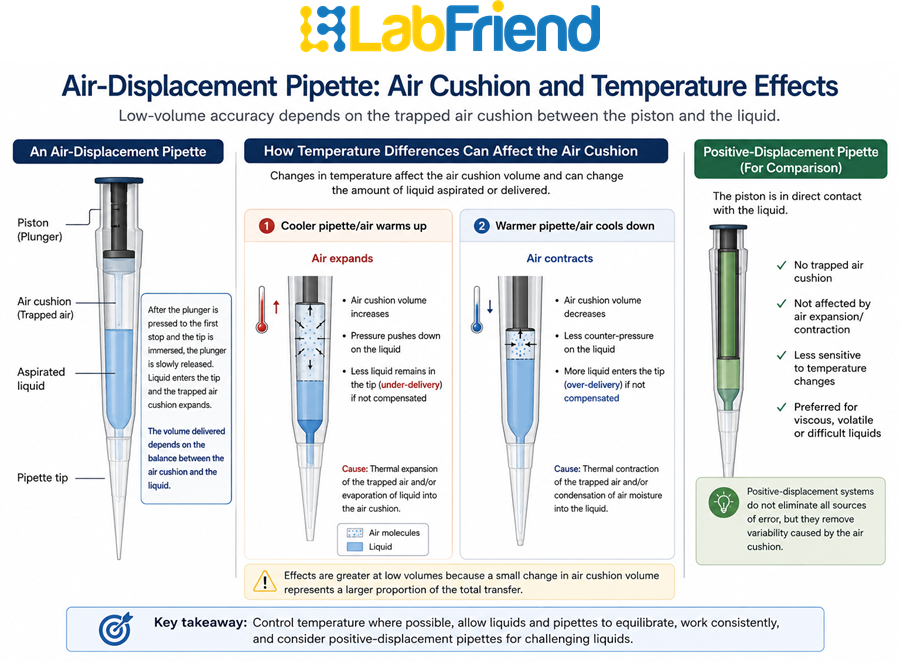
Differences in temperature between the pipette, pipette tip, liquid and surrounding environment can influence this system and may become more relevant when precise low-volume transfers are required.
Temperature differences can also alter the liquid’s own viscosity and density, independently of any effect on the air cushion, and both factors can influence the volume actually aspirated and dispensed.
This is particularly worth considering when reagents have recently been removed from refrigerated or frozen storage, or when equipment and liquids have not reached the conditions expected by the method.
The appropriate response depends on the reagent and procedure. Temperature-sensitive PCR components must, of course, be handled according to the assay protocol and manufacturer's instructions. Troubleshooting should not introduce an equilibration step that compromises reagent stability merely to simplify pipetting.
Instead, scientists should ask whether temperature differences are consistent between transfers and whether the method adequately controls them.
Where temperature-related effects are suspected, compare performance under controlled and repeatable conditions rather than making assumptions from a single transfer.
Aspiration Speed Matters More Than Many Operators Realise
At low volumes, aspiration should be controlled and repeatable.
Moving the plunger too rapidly can disturb liquid uptake and increase the likelihood of inconsistent aspiration. The appropriate speed will depend on the pipette, liquid and method, but the central principle is consistency.
The pipette should also be allowed sufficient time for aspiration to complete before the tip is removed from the liquid. Immediately withdrawing the tip after operating the plunger may not provide appropriate behaviour for every liquid.
This pause — commonly referred to as dwell time or wait time — allows the aspirated liquid to fully stabilise within the tip before withdrawal, and is a specific, controllable parameter that can be adjusted alongside aspiration speed.
This becomes especially important with solutions that do not behave like water.
The goal is not to make every aspiration artificially slow. Excessively cautious technique can reduce productivity without necessarily improving performance. Instead, operators should establish a controlled technique appropriate to the workflow and apply it consistently across samples and replicates.
If one operator achieves repeatable results and another does not, observing aspiration behaviour side by side can reveal differences that are difficult to identify from a written SOP alone.
For broader PCR liquid-handling technique, LabFriend's Pipetting for PCR: How to Maximise Accuracy in DNA Amplification Workflows provides additional workflow guidance.
Immersion Depth and Tip Position
How the pipette tip enters the liquid also matters.
If the tip is positioned too close to the liquid surface, changes in liquid level during aspiration can increase the risk of drawing air. If it is immersed unnecessarily deeply, additional liquid may adhere to the outside of the tip and the pressure conditions around aspiration may change.
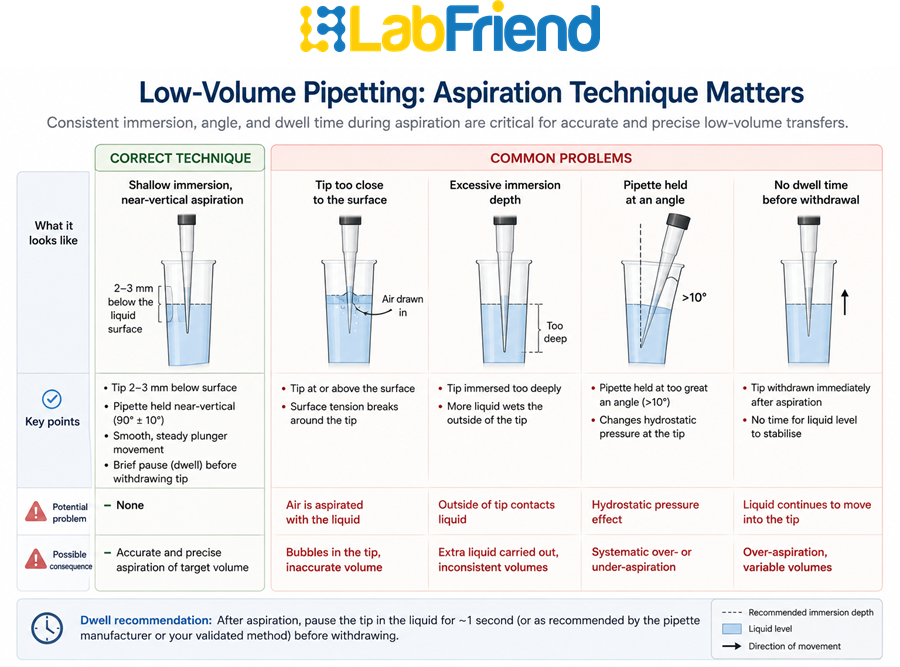
The appropriate immersion depth depends on the tip, volume and vessel, so laboratories should follow relevant pipette-manufacturer instructions and validated methods rather than adopting one arbitrary depth for every application.
Consistency is again the important principle.
During troubleshooting, observe whether the operator maintains a similar tip position between transfers and whether the liquid level changes significantly as material is removed from the source vessel.
Small source volumes deserve particular attention because the available liquid depth can change rapidly during repeated transfers.
Why Air Bubbles Matter at Low Volumes
Air bubbles are an obvious sign that the intended liquid column has not been aspirated cleanly.
At larger volumes, a small bubble may sometimes appear visually insignificant. At very low volumes, the air space can represent a meaningful proportion of the intended transfer.
Repeated bubbles should therefore be treated as a diagnostic symptom rather than an unavoidable feature of micropipetting.
Potential causes include:
- aspiration that is too rapid for the liquid;
- insufficient or inconsistent immersion;
- removing the tip before aspiration is complete;
- poor seal integrity between pipette and tip;
- air entering because the available liquid depth is inadequate; or
- challenging liquid properties.
The correct response is not simply to aspirate again and hope for a better result. Identify why the bubble formed.
If bubbles occur across different liquids and operators with one pipette-tip combination, seal integrity deserves closer investigation. If they appear primarily with one viscous reagent, liquid-handling technique becomes a stronger candidate.
This distinction is important because changing pipette tips will not correct a problem caused primarily by aspiration behaviour, just as retraining the operator will not repair a damaged pipette seal.
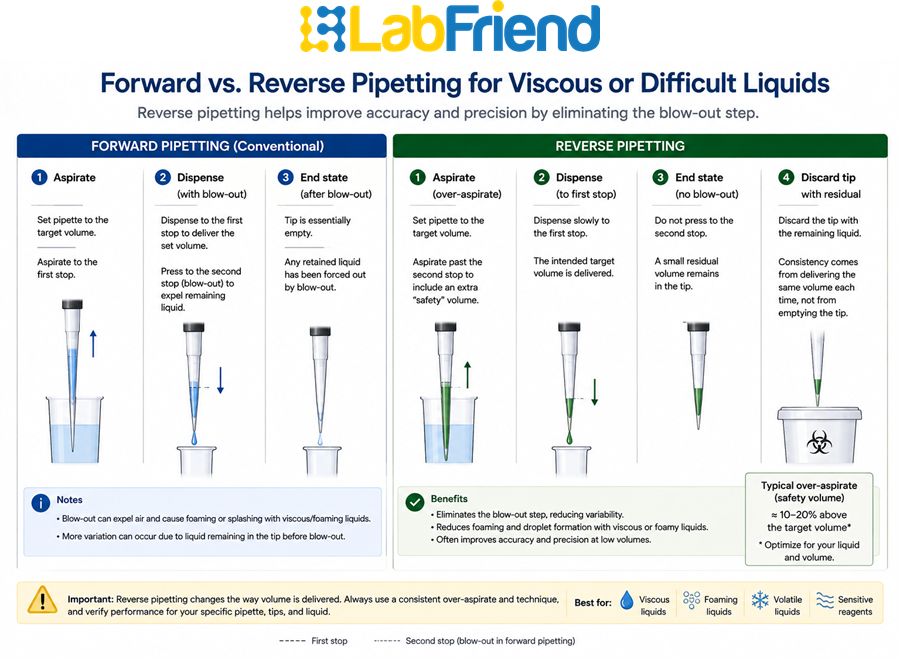
Where bubble formation persists with a difficult liquid despite controlled technique, reverse pipetting is worth considering as a targeted corrective measure (see Viscous Mastermixes, Enzymes and Difficult Liquids).
Does Pre-Wetting Improve Low-Volume Pipetting?
Pre-wetting involves aspirating and dispensing the liquid with the pipette tip before performing the measured transfer. It is commonly used in some pipetting workflows to condition the internal surface of the tip and help establish more consistent conditions for subsequent aspiration.
In appropriate applications, pre-wetting can support repeatability, particularly where liquid characteristics or low volumes make consistent aspiration more demanding.
Mechanistically, pre-wetting is thought to work by saturating the air cushion inside the pipette tip with the liquid’s vapour, which can reduce evaporative loss from the aspirated volume between aspiration and dispensing and help establish more consistent conditions for the measured transfer.
It should not, however, be treated as a universal rule.
Whether pre-wetting is appropriate depends on the pipette, tip, liquid, method and laboratory procedure. The number and manner of pre-wetting cycles should not be improvised where a validated method or manufacturer's guidance specifies how the transfer should be performed.
For PCR and qPCR, scientists must also consider contamination control and reagent handling. A technique that improves repeatability in one context may be inappropriate if it creates additional sample-handling or contamination risk in another.
A useful troubleshooting approach is therefore to compare performance under controlled conditions using the method's established technique and an appropriately defined pre-wetting procedure, where permitted.
If repeatability improves consistently, pre-wetting may be a meaningful workflow variable. If it does not, repeatedly cycling liquid through the tip merely adds unnecessary manipulation.
The Low-Volume Troubleshooting Principle
At this point, the central diagnostic principle should be clear.
Low-volume inconsistency is rarely resolved by searching for one universally "best" pipette tip or one technique that applies to every PCR and qPCR workflow. Reliable results depend on understanding which part of the liquid-handling system is contributing to variability.
The first half of the investigation should therefore establish:
pipette suitability → workflow timing → evaporation → temperature conditions → aspiration behaviour → immersion → bubbles → pre-wetting
Only after these factors have been considered should the scientist decide whether liquid retention, pipette-tip fit, filter-tip selection or other consumable characteristics are likely to be contributing.
Liquid Retention Becomes More Significant at Low Volumes
When only a few microlitres—or less—are being transferred, liquid remaining on the internal surface of a pipette tip can represent a meaningful proportion of the intended volume.
The extent to which this matters depends on the liquid. Water-like solutions may behave differently from solutions containing proteins, enzymes, detergents or other components that influence surface interaction. Some liquids visibly leave droplets or films behind after dispensing, while retention with others may be less obvious.
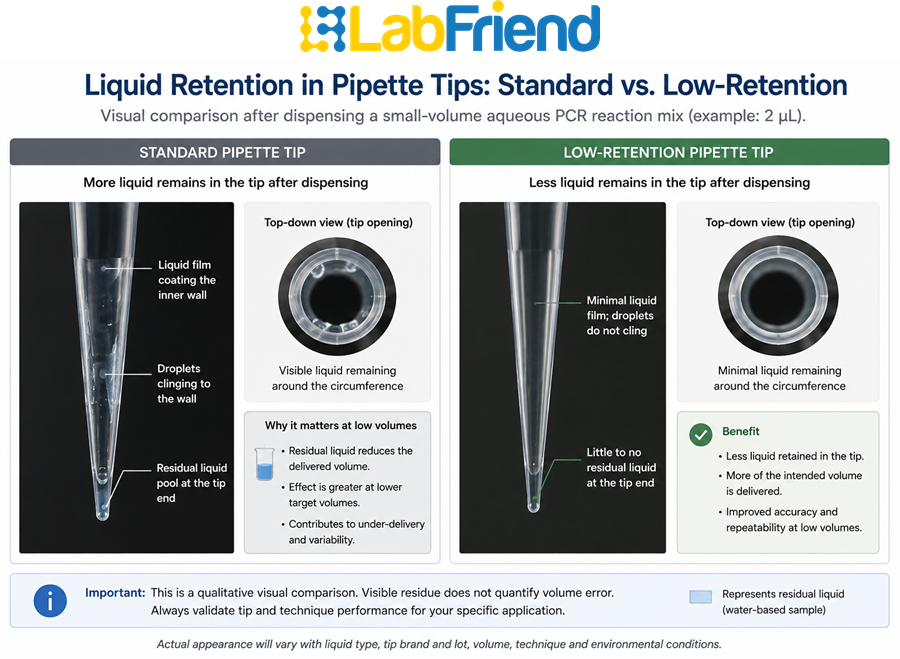
For PCR and qPCR workflows, this deserves attention because the reagents involved can be both valuable and functionally important to the reaction. Inconsistent recovery of a reagent across replicate wells can introduce another source of variability into an already sensitive low-volume workflow.
The first step is observation rather than immediate product substitution.
After dispensing, examine whether liquid is visibly retained within the tip and whether the behaviour is repeatable. Consider whether retention is associated with one reagent, one tip type or the complete workflow.
If the problem occurs primarily with a particular liquid, its surface characteristics may be more important than the pipette itself.
When Low-Retention Pipette Tips May Help
Low-retention pipette tips are designed to reduce liquid interaction with the internal tip surface. In appropriate applications, this can help improve liquid recovery and reduce residual droplets after dispensing.
This is typically achieved through a hydrophobic or specially treated polymer surface that reduces surface tension and electrostatic interaction between the liquid and the tip wall, making it easier for the full aspirated volume to separate cleanly from the tip on dispensing.
They can therefore be worth evaluating when troubleshooting low-volume transfers involving valuable reagents or liquids that demonstrate significant surface retention.
However, low-retention does not mean error-free.
A low-retention tip cannot compensate for:
- inappropriate pipette selection;
- poor aspiration technique;
- evaporation;
- air bubbles;
- inconsistent dispensing;
- inadequate tip sealing; or
- a pipette requiring maintenance.
The decision to use low-retention tips should follow evidence that liquid retention is relevant to the observed problem.
This distinction prevents laboratories from adding cost or complexity to workflows where the underlying source of variability lies elsewhere.
For qPCR, the practical question is not simply “Are low-retention tips better?” It is:
Does reducing liquid retention improve the repeatability of this particular transfer under controlled conditions?
That can be evaluated experimentally.
Tip Fit and Seal Integrity at Low Volumes
Reliable aspiration depends upon an effective interface between the pipette and pipette tip.
A tip may attach physically to a pipette without necessarily providing the consistent seal required for repeatable liquid handling. At low volumes, small inconsistencies within that system may become proportionally more important.
Signs that fit or seal integrity deserves investigation include:
- bubbles appearing despite controlled aspiration;
- inconsistent liquid uptake;
- dripping after aspiration;
- tips becoming loose during normal use;
- unusually high force being required to load tips; or
- performance changing after switching tip type or supplier.
This is why physical fit and functional fit should not be treated as the same thing.
A tip that stays attached has demonstrated physical fit. Functional compatibility requires confidence that the pipette-tip combination supports reliable performance in the intended workflow.
Where fit is suspected as a contributor to low-volume variability, see Why Pipette Tip Fit Matters for Accurate Laboratory Pipetting for the more detailed compatibility assessment.
Importantly, changing tip brand is still a diagnostic test rather than proof of the cause. If the same problem persists with an appropriately validated alternative, investigation should return to the pipette, technique, liquid and method.
Do Filter Tips Improve Low-Volume qPCR Pipetting?
Filter pipette tips have an important role in many PCR and qPCR workflows, but their purpose needs to be understood correctly.
The filter provides an aerosol barrier intended to help reduce movement of aerosols and contamination towards the pipette body. This can be valuable in contamination-sensitive molecular biology applications.
In PCR and qPCR workflows specifically, the primary concern this addresses is amplicon or template carryover contamination between samples via aerosols generated during pipetting, rather than contamination in a more general sense.
A filter does not, by itself, correct inaccurate pipetting.
If low-volume variability is being caused by poor aspiration technique, evaporation, inappropriate pipette selection or inconsistent tip sealing, adding a filter does not remove those underlying causes.
Filter-tip selection should therefore address contamination-control requirements while also ensuring that the complete pipette-tip combination is appropriate for the intended low-volume workflow.
For a detailed discussion of this distinction, see When Should You Use Filter Pipette Tips in qPCR and Molecular Biology?.
For laboratories performing qPCR, the practical objective is to satisfy both requirements: appropriate contamination control and reliable liquid handling.
Neither should be assumed to guarantee the other.
Viscous Mastermixes, Enzymes and Difficult Liquids
PCR and qPCR reagents do not necessarily behave like water.
Most PCR/qPCR pipettes are air-displacement instruments (see Temperature Differences and the Air Cushion), and this design is one reason their performance can differ noticeably with atypical liquids such as mastermixes and enzyme solutions compared with water-like reference liquids.
Mastermixes and other reagent formulations may have physical properties that influence aspiration, dispensing and residual liquid behaviour. Enzyme-containing solutions can also be valuable enough that apparently small transfer inconsistencies become commercially as well as analytically undesirable.
When variability is associated with one reagent rather than every transfer, scientists should investigate the characteristics of that liquid before assuming instrument failure.
Observe whether:
- aspiration takes noticeably longer;
- bubbles form more readily;
- liquid remains inside the tip after dispensing;
- the liquid column moves differently from water-like solutions; or
- repeatability improves when the handling technique is adjusted according to the applicable method or manufacturer guidance.
The appropriate technique will depend on the liquid, pipette and validated procedure. It is therefore better to diagnose the observed behaviour than to apply a generic rule such as simply pipetting more slowly.
This is also where controlled comparison becomes useful. If a pipette performs consistently with an appropriate reference liquid but variability appears with a particular reagent, the evidence increasingly points towards the interaction between liquid characteristics and the method.
Where technique optimisation alone does not resolve difficulties with a particular liquid, two further options are worth considering. Reverse pipetting — aspirating a larger volume than required and dispensing only the intended amount, leaving the excess in the tip — is an established technique that can reduce bubble formation and improve delivery of viscous or foaming liquids. For liquids that remain problematic on an air-displacement instrument, a positive-displacement pipette, which displaces liquid directly with a piston in contact with the sample rather than through an air cushion, is a recognised alternative for viscous, dense or volatile reagents.
Why qPCR Replicates Can Reveal Pipetting Problems
Poor agreement between qPCR replicates can be one of the first signs that scientists investigate for possible low-volume liquid-handling variability.
However, replicate variability is an observation, not proof that pipetting is responsible.
qPCR performance can be affected by multiple factors, including sample characteristics, assay design, reagent preparation, reaction setup and amplification conditions. Liquid handling is only one part of that system.
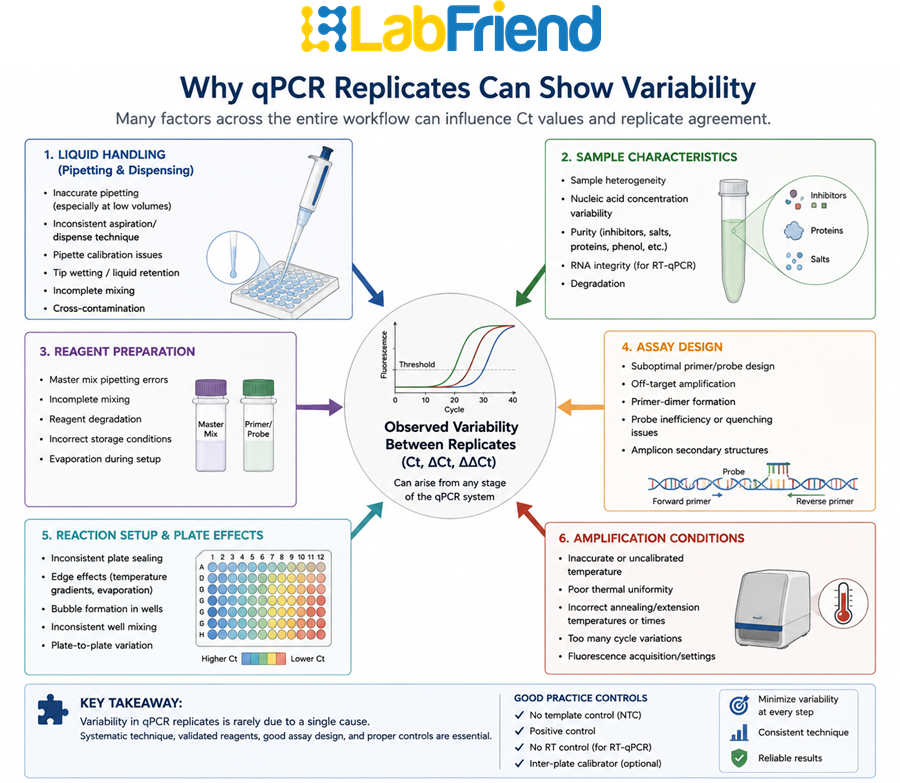
The useful question is therefore:
Does the pattern of replicate variability provide evidence that liquid transfer may be contributing?
For example, if variation changes with operator, pipette, transfer volume or plate-setup sequence, those relationships may justify closer investigation of the liquid-handling workflow.
Conversely, if controlled liquid-handling checks show good repeatability but qPCR variability persists, the investigation should broaden beyond pipetting.
This distinction protects scientists from spending time optimising a transfer that is not actually responsible for the analytical problem.
The preventative companion to this troubleshooting article is qPCR Pipetting Best Practices: How to Reduce Variability and Improve Accuracy at Low Volumes, which considers the wider reaction-setup workflow.
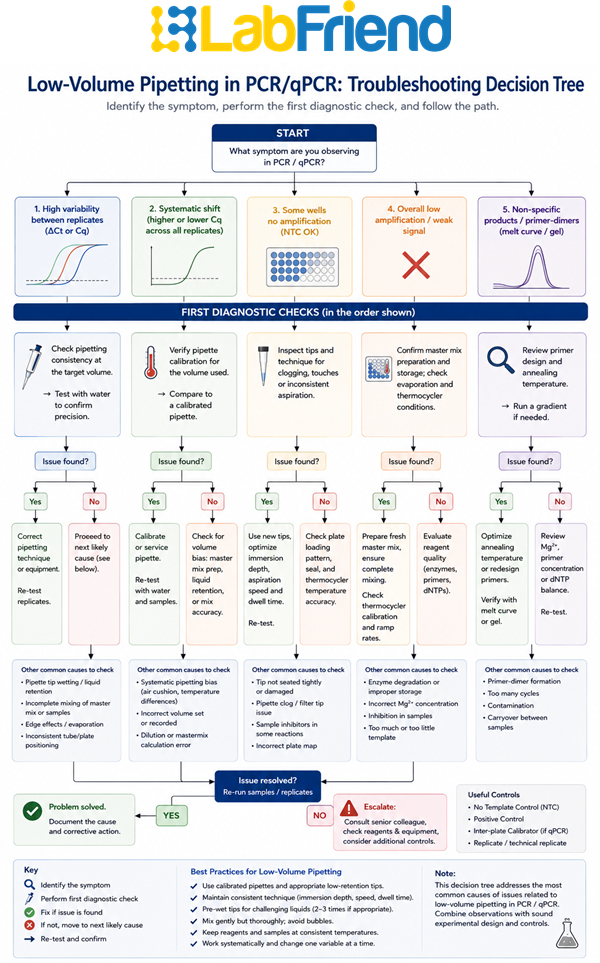
A Controlled Troubleshooting Sequence for Low-Volume Pipetting
Low-volume troubleshooting becomes considerably more effective when variables are changed individually.
Changing the pipette, tip, technique and reagent-handling procedure simultaneously may improve the result, but it provides little information about what caused the original problem.
A stronger diagnostic sequence is the following.
Quick Checklist (Bench Reference)
- Define the symptom precisely
- Confirm pipette selection and calibration status
- Observe the transfer for bubbles, immersion and aspiration behaviour
- Control workflow timing and evaporation exposure
- Consider temperature consistency
- Evaluate pre-wetting where appropriate
- Investigate liquid behaviour for the specific reagent
- Examine tip fit and seal integrity
- Evaluate liquid retention
- Consider contamination-control requirements separately
- Change one variable at a time and record the result
1. Define the symptom
Determine whether you are investigating poor repeatability, bubbles, retained liquid, apparent under-delivery, replicate variation or another specific observation.
2. Confirm pipette selection
Establish that the target volume is appropriate for the pipette being used and that the instrument's calibration and maintenance status meet laboratory requirements.
3. Observe the transfer
Watch aspiration and dispensing carefully. Look for bubbles, inconsistent immersion, rapid plunger movement, insufficient aspiration time or residual liquid.
Where a quantitative check is needed, gravimetric verification (weighing dispensed volumes on an analytical balance) or dye-based volume verification can provide an objective measure of accuracy and precision, complementing visual observation of the transfer.
4. Control workflow timing
Consider whether evaporation or differences in exposure time could explain the observed pattern.
5. Consider temperature
Check whether reagents, tips, pipettes and working conditions are being handled consistently with the method.
6. Evaluate pre-wetting where appropriate
If permitted by the method and applicable guidance, determine whether a defined pre-wetting procedure measurably improves repeatability.
7. Investigate liquid behaviour
Determine whether the problem is specific to a particular mastermix, enzyme solution or other reagent.
8. Examine tip fit and sealing
If bubbles, dripping or inconsistent aspiration persist, assess whether the pipette-tip interface may be contributing.
9. Evaluate retention
Where residual liquid is evident, compare appropriate standard and low-retention options under controlled conditions.
10. Consider contamination-control requirements separately
Determine whether filter tips are appropriate for the PCR/qPCR workflow without assuming that filtration itself corrects volumetric variability.
11. Change one variable at a time
Where practical, make controlled comparisons so that an improvement can be attributed to a specific change.
Recording each controlled comparison — the variable changed, the conditions used and the outcome observed — supports traceability and allows the laboratory to build an evidence-based case for any resulting change to the method or SOP.
This final step is particularly important. Troubleshooting is most useful when it identifies a cause that can subsequently be controlled through the method.
Low-Volume Pipetting Troubleshooting Matrix
|
Symptom |
Possible factors |
First diagnostic check |
|
Poor repeatability at very low volumes |
Pipette selection, technique, evaporation, temperature |
Confirm pipette suitability and observe controlled replicate transfers |
|
Air bubbles |
Aspiration speed, immersion, liquid depth, tip seal |
Observe aspiration and inspect pipette-tip fit |
|
Liquid remains in tip |
Liquid properties, surface retention, dispensing technique |
Compare behaviour across liquids and appropriate tip types |
|
Variability increases during plate setup |
Evaporation, exposure time, workflow sequence |
Compare early and late preparation conditions |
|
One reagent performs poorly |
Viscosity, surface behaviour, temperature |
Compare with an appropriate reference liquid |
|
Problem follows one tip type |
Fit, seal integrity, tip characteristics |
Compare with an appropriately validated alternative |
|
qPCR replicates remain variable |
Liquid handling or non-pipetting assay factors |
Isolate the liquid-handling workflow before attributing cause |
|
Different operators obtain different results |
Aspiration/dispensing technique, method interpretation |
Observe technique under controlled conditions |
This matrix is intended to guide investigation. It does not replace manufacturer instructions, laboratory SOPs or validated assay procedures.
What Should You Change First?
The most useful correction is the one supported by the evidence.
If the investigation indicates evaporation, change the workflow conditions rather than the pipette tip.
If bubbles arise from aspiration technique, correct the technique rather than assuming the pipette requires calibration.
If residual liquid is associated consistently with a particular reagent, evaluate whether liquid-handling technique or low-retention consumables improve recovery.
If seal integrity is inconsistent, investigate pipette-tip compatibility.
If the pipette is inappropriate for the transfer volume, change the instrument rather than trying to compensate through technique.
This sounds straightforward, but it is an important discipline. Laboratories can spend considerable time and money addressing the wrong variable because several different problems produce similar symptoms.
Frequently Asked Questions
Why is low-volume pipetting inconsistent?
Low-volume pipetting is less forgiving because small absolute deviations represent a larger proportion of the intended transfer. Pipette selection, evaporation, temperature, aspiration technique, bubbles, liquid properties, retention and pipette-tip sealing can all contribute to variability.
Why is qPCR sensitive to low-volume pipetting error?
qPCR reaction setup frequently involves small reagent and sample volumes. Variability in those transfers can alter reaction composition and may contribute to differences between replicates. However, qPCR variability can also arise from non-pipetting factors, so liquid handling should be investigated rather than automatically blamed.
Does pre-wetting pipette tips improve low-volume pipetting?
Pre-wetting can support repeatability in appropriate workflows by conditioning the internal tip surface and helping establish consistent aspiration conditions. It is not universally required, and laboratories should follow the relevant method and manufacturer guidance.
How does evaporation affect low-volume qPCR?
At low volumes, relatively small evaporative losses can represent a meaningful proportion of the total reaction volume. Exposure time, temperature, humidity, vessel geometry and workflow organisation can therefore become relevant during troubleshooting.
Why do I get bubbles when pipetting small volumes?
Bubbles may result from rapid aspiration, inconsistent immersion, insufficient liquid depth, withdrawing the tip before aspiration is complete, challenging liquid properties or poor pipette-tip sealing. Repeated bubbles should be investigated as a symptom rather than accepted as normal.
Are low-retention pipette tips better for low-volume pipetting?
They can be beneficial where liquid retention on the tip surface is contributing to incomplete or inconsistent recovery. They do not automatically improve every low-volume workflow and cannot correct unrelated problems such as evaporation, poor technique or inappropriate pipette selection.
Should I use filter pipette tips for qPCR?
Filter tips are commonly considered for contamination-sensitive PCR and qPCR workflows because the filter acts as an aerosol barrier. Their role is principally contamination control rather than correcting pipetting error. See When Should You Use Filter Pipette Tips in qPCR and Molecular Biology? for detailed guidance.
Can poor pipette-tip fit affect low-volume repeatability?
Yes, inadequate or inconsistent sealing between the pipette and tip can affect aspiration and dispensing behaviour. Physical attachment alone does not establish functional compatibility. The issue is explored further in Why Pipette Tip Fit Matters for Accurate Laboratory Pipetting.
How can I improve reproducibility when pipetting very small volumes?
Begin by confirming that the pipette is appropriate for the required volume. Then investigate workflow timing, evaporation, temperature, aspiration and dispensing technique, bubbles, liquid behaviour, tip sealing and retention systematically. Change one variable at a time so that any improvement can be attributed to a specific corrective action.
From Variability to a Controlled Low-Volume Workflow
Reliable low-volume pipetting is not achieved by one product or one technique.
It depends on controlling a system in which the pipette, pipette tip, liquid, operator, environment and method interact. At larger volumes, modest differences between those elements may have limited practical impact. At low volumes, the same differences can become much more visible.
For PCR and qPCR laboratories, the most effective response to inconsistent results is therefore systematic diagnosis.
Start with the instrument and intended volume. Examine evaporation and temperature. Observe aspiration and dispensing. Look for bubbles. Consider whether pre-wetting is appropriate. Investigate liquid behaviour. Then assess tip fit, retention characteristics and contamination-control requirements.
Only after the likely mechanism has been identified should equipment, technique or consumables be changed.
This approach does more than correct one problematic transfer. It allows the laboratory to incorporate the corrective action into its working method, helping improve repeatability across operators, experiments and future workflows.
For scientists who need the wider liquid-handling framework, LabFriend UK's Complete Guide to Pipette Tips, Pipetting Accuracy & Laboratory Liquid Handling provides the broader authority resource.
Choosing Pipette Tips for PCR and qPCR Workflows
Where troubleshooting indicates that pipette-tip fit, liquid retention or contamination-control requirements are relevant, the next step is to select consumables according to the identified need rather than simply changing products.
For contamination-sensitive molecular biology applications, filter tips may form part of the laboratory's wider contamination-control strategy. Where liquid retention is demonstrably affecting recovery, low-retention options may warrant evaluation.
The objective is not to specify the most technically elaborate tip for every transfer. It is to use the pipette-tip characteristics that support the actual workflow.
If systematic troubleshooting through each of these steps does not resolve the variability, it may be appropriate to escalate: contact the pipette manufacturer or an accredited service provider for an out-of-cycle service and calibration check, involve the laboratory's QA or quality systems function to review the method and documentation, or contact LabFriend UK for support in evaluating suitable pipettes and consumables for the workflow.
LabFriend UK can help laboratories compare pipette-tip options for existing pipettes and PCR/qPCR applications, with product selection guided by compatibility, workflow requirements and the specific liquid-handling problem being addressed.
Conclusion
Low-volume pipetting in PCR and qPCR becomes challenging because small variations in liquid handling can represent a significant proportion of the total volume being transferred. When reproducibility deteriorates, the most effective response is therefore systematic troubleshooting rather than immediately changing the pipette, pipette tip or method.
Start by confirming that the pipette is appropriate for the required volume. Then investigate workflow timing, evaporation and temperature before observing aspiration and dispensing technique, immersion depth and the presence of air bubbles. Where appropriate, assess whether pre-wetting improves repeatability and whether the physical properties of individual reagents are influencing liquid handling.
Only then should consumable-related factors such as liquid retention, pipette-tip fit and filter-tip selection be investigated.
The important principle is to treat low-volume liquid handling as an interconnected system:
pipette + pipette tip + liquid + operator + environment + method
Changing one variable at a time allows scientists to identify the genuine source of variability and incorporate the corrective action into the laboratory method. This provides a more sustainable route to improved PCR and qPCR reproducibility than attempting to compensate for an unidentified problem through technique or consumable changes alone.
Where troubleshooting indicates that pipette-tip fit, liquid retention or contamination control is contributing to the problem, LabFriend UK can help laboratories evaluate suitable pipette-tip options for their existing pipettes and molecular biology workflows.
Glossary
- Dwell time (wait time) — The pause after aspiration, before the tip is withdrawn from the liquid, allowing the aspirated volume to stabilise.
- Aerosol barrier — The function of a filter tip that helps prevent aerosols, and the template/amplicon they may carry, from reaching the pipette body.
- Air-displacement pipette — A pipette that aspirates and dispenses liquid via an air cushion between the piston and the liquid.
- Positive-displacement pipette — A pipette in which the piston contacts the liquid directly, without an intervening air cushion; often used for viscous, dense or volatile liquids.
- Low-retention tip — A pipette tip with a treated or hydrophobic surface designed to reduce liquid adhesion and improve recovery.
- Filter tip — A pipette tip containing a physical barrier designed to reduce aerosol and cross-contamination risk.
- CV% (precision) — Coefficient of variation; a common way of expressing the repeatability of replicate transfers.
- Trueness (accuracy) — How closely the average delivered volume matches the intended target volume.
- Reverse pipetting — A technique in which a larger volume than required is aspirated and only the intended amount is dispensed, leaving the excess in the tip; used for viscous or foaming liquids.
Read More
For further guidance on pipetting accuracy, PCR/qPCR workflows and pipette-tip selection, read:
- The Complete Guide to Pipette Tips, Pipetting Accuracy & Laboratory Liquid Handling — the wider LabFriend authority guide covering pipette tips, compatibility and liquid-handling performance.
- qPCR Pipetting Best Practices: How to Reduce Variability and Improve Accuracy at Low Volumes — preventative guidance for improving consistency during qPCR reaction setup.
- Pipetting for PCR: How to Maximise Accuracy in DNA Amplification Workflows — practical guidance for accurate liquid handling across PCR workflows.
- Why Pipette Tip Fit Matters for Accurate Laboratory Pipetting — deeper guidance where tip fit or seal integrity may be contributing to inconsistent aspiration or dispensing.
- When Should You Use Filter Pipette Tips in qPCR and Molecular Biology? — guidance on the role of filter tips in contamination-sensitive molecular biology workflows.
- Common Causes of Pipetting Error in Laboratory Liquid Handling
Written by: Donal O’Sullivan, BSc, Co-Founder and Sales Director, LabFriend UK. Donal brings deep chemistry-led technical expertise across analytical chemistry, biochemistry, environmental monitoring, laboratory instrumentation, consumables and scientific product selection.
Reviewed by: Michael Anderson, MBA, Founder and Managing Director, LabFriend UK. Michael reviews LabFriend UK content for customer relevance, commercial accuracy, operational practicality and alignment with LabFriend UK’s laboratory supply model.
Related Stories

Low-Retention Pipette Tips for Protein and Enzyme Workflows
Low-Retention Pipette Tips for Protein and Enzyme Workflows

Pipetting Technique Errors That Affect Laboratory Reproducibility
Pipetting Technique Errors That Affect Laboratory Reproducibility

Why Pipette Tips Leak or Fall Off During Laboratory Pipetting
Why Pipette Tips Leak or Fall Off During Laboratory Pipetting

Common Causes of Pipetting Error in Laboratory Liquid Handling
Common Causes of Pipetting Error in Laboratory Liquid Handling