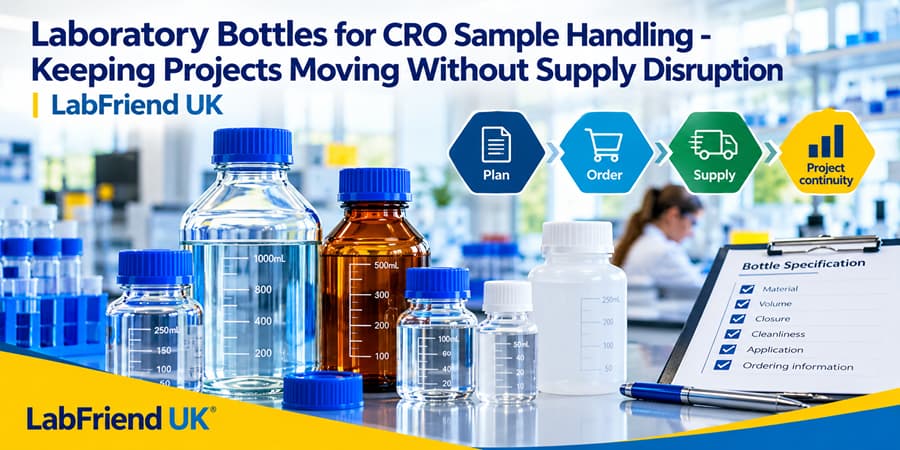
Laboratory Bottles for CRO Sample Handling - Keeping Projects Moving Without Supply Disruption
24 mins read
Laboratory Bottles for CRO Sample Handling - Keeping Projects Moving Without Supply Disruption
By Donal O’Sullivan, BSc. Reviewed by Michael Anderson, MBA.
For a contract research organisation, laboratory bottle
supply can become an operational problem when a routine consumable is needed
across multiple active projects but the required specification, product
reference or replenishment process is unclear. The practical answer is not simply to hold more bottles. A
better approach is to establish which bottle characteristics are critical to
each recurring workflow, record the approved product or specification,
understand expected consumption and identify supply risks before they affect
project work. |
Key Takeaways
- Establish
the technical bottle specification before planning repeat supply.
- Record
the exact bottle and closure configuration where these characteristics
matter to the workflow.
- Distinguish
routine requirements from project-specific exceptions rather than forcing
every project onto one bottle.
- Use
actual consumption and project requirements to anticipate replenishment
needs.
- Treat
an alternative bottle as a potential replacement requiring assessment, not
as an equivalent product simply because it looks similar or has the same
capacity.
- Keep
enough information in the repeat-order specification that another member
of the team can identify the required product without relying on
individual knowledge.
- Consider supply continuity as part of workflow planning, but do not allow availability or purchasing convenience to override technical suitability.
Why Bottle Supply Can Become a CRO Operations Issue
Laboratory bottles are often relatively straightforward
consumables. The operational difficulty arises when the same organisation is
supporting multiple projects, clients or testing workflows at the same time.
One project may require a particular bottle material or
closure. Another may use a different format. A third may consume the same
general bottle type at a much higher rate.
If these requirements are not clearly recorded, the
laboratory can end up relying on:
- individual
knowledge of the usual product;
- old
purchase orders;
- generic
descriptions;
- different
product references for apparently similar bottles;
- last-minute
searches when stock is low; or
- informal
decisions about whether an alternative is acceptable.
The resulting problem is not necessarily that bottles are
difficult to purchase. It is that the required specification may not be
sufficiently controlled to make purchasing routine.
For a CRO, that matters because consumables are supporting
active client work. Avoidable uncertainty can create additional purchasing work
at exactly the point when project teams need predictable execution.
Start With the Project and Workflow Requirements
Before establishing a recurring bottle supply arrangement,
identify how the bottles are actually used.
A useful starting point is to ask:
- Which
projects use the bottle?
- Is
the requirement recurring or project-specific?
- What
sample or material will be handled?
- What
bottle characteristics are technically important?
- Is
a particular closure or bottle-and-closure configuration required?
- Does
the method or client requirement specify a particular container
characteristic?
- What
quantity is normally consumed?
- How
variable is demand between projects?
- What
would happen if the usual bottle were unavailable?
The answers should not automatically produce one
organisation-wide bottle specification.
The aim is to identify where standardisation is practical
and where controlled exceptions are necessary.
For example, two workflows may both use 500 mL bottles but
have different material, closure, cleanliness or handling requirements.
Treating the shared volume as sufficient information could create an unsuitable
substitution.
Where the technical selection itself needs broader
consideration, the Laboratory Bottles: Selection Guide for UK Laboratories provides the wider
bottle-selection framework.
Establish a Controlled Bottle Specification
Once the workflow requirement is understood, record the
characteristics that must be maintained.

A practical recurring specification can include:
|
Specification area |
What to record |
|
Application |
Project or workflow in which the bottle is used |
|
Bottle identity |
Manufacturer and product reference where applicable |
|
Material |
Required bottle material |
|
Volume |
Nominal capacity and relevant working-volume requirement |
|
Closure |
Cap, liner, seal or complete supplied configuration where
relevant |
|
Cleanliness / sterility |
Any specified requirement |
|
Preparation |
Any preservative, neutralising agent or other defined
preparation |
|
Packaging |
Any packaging characteristic important to the workflow |
|
Handling conditions |
Relevant storage, transport or temperature conditions |
|
Method requirements |
Any characteristic specified by the applicable method |
|
Ordering information |
Pack quantity and other information needed for routine
ordering |
The purpose is not to create unnecessary administration. It
is to make the approved requirement identifiable and repeatable.
This becomes particularly valuable when different people are
responsible for purchasing at different times.
Record the Bottle and Closure Together
Where the closure affects suitability, the bottle and
closure should be treated as one system.
Do not assume that another cap is interchangeable merely
because it physically fits the bottle. Closure configuration, liner or seal
construction and operating conditions can all matter.
For bottles using common thread systems, the thread
designation itself describes the bottle/closure interface; it does not by
itself establish complete suitability.
Where a recurring CRO workflow depends on GL45 bottles, for
example, detailed information on threads, caps and compatibility is covered in GL45 Laboratory Bottles Explained: Threads, Caps and Compatibility Checks.
Separate Routine Bottle Requirements From Project Exceptions
CROs often need to balance standardisation with
project-specific requirements.
Standardisation can make routine purchasing easier where the
same bottle specification is suitable across multiple workflows. But
standardisation should not become a reason to disregard a project requirement.
A useful distinction is:
Routine specification
The bottle format normally used where the workflow requirements are the same.
Controlled exception
A different bottle specification required for a particular project, method,
sample or client requirement.

This approach avoids two opposite problems.
The first is excessive variation, where similar workflows
use multiple products without a clear reason.
The second is over-standardisation, where a convenient
common bottle is used even though a particular workflow requires something
different.
The technical requirement should decide where the boundary
lies.
Plan Replenishment Around Project Demand
Once the bottle specification is controlled, supply planning
becomes much easier.
Start with actual consumption rather than a generic stock
target.
Consider:
- normal
bottle consumption;
- current
usable stock;
- upcoming
project requirements;
- known
changes in project activity;
- pack
quantity;
- storage
capacity;
- purchasing
frequency; and
- the
operational consequence of running out.
For replenishment decisions, usable stock means bottles that
are physically available, meet the approved specification and remain suitable
for their intended use. Stock that is damaged, contaminated, quarantined,
reserved for another project or otherwise unavailable should not automatically
be counted as usable. Where relevant, expiry dates, sterile-packaging integrity
and specified storage conditions should also be checked before stock is
included in the available quantity.
There is no single reorder quantity or stock-cover period
that is appropriate for every CRO. Replenishment planning should account for
the expected time between placing an order and receiving usable stock,
including any known supplier lead-time variability, internal purchasing delays
or receiving checks. Where supply or demand is uncertain, an appropriate stock
allowance may be needed to reduce the risk of interruption. Reorder decisions
should therefore consider both projected consumption and the time required to
replenish the approved bottle specification.
A bottle used intermittently for one project creates a
different supply requirement from a format consumed routinely across several
active studies.
The objective is to identify when the expected requirement
is approaching the available supply while there is still a practical
opportunity to reorder or resolve a supply issue.
This is particularly important where demand can change
quickly as projects start, finish or move between stages.
Watch for Supply Risks Before They Affect the Project
A recurring bottle requirement should not be reviewed only
when stock reaches zero.
Potential warning signs include:
- a
product reference appearing on several active project requirements;
- consumption
increasing beyond the previous pattern;
- an
upcoming project using an established high-volume bottle;
- an
approved bottle becoming difficult to source;
- uncertainty
about which product reference should be ordered;
- a
proposed replacement being offered without a completed specification
check; or
- different
teams ordering apparently similar bottles without a common specification.
These signals do not necessarily mean that additional stock
should be purchased immediately.
They indicate that the requirement may need review.
The earlier the issue is identified, the more options the
operations team has to confirm the specification, review available supply and
assess alternatives without making a last-minute decision.
Assess Alternatives Before Changing Product
A supply problem can create pressure to accept a replacement
quickly.
The first question should remain:
Does the proposed product meet the requirements of the
workflow?
Compare the alternative against the characteristics that
have been identified as critical.
Depending on the application, this may include:
- bottle
material;
- nominal
volume and required fill volume;
- bottle
format;
- closure
configuration;
- liner
or seal;
- cleanliness
or sterile status;
- packaging;
- compatibility
requirements;
- storage
and transport conditions; and
- any
method- or project-specific characteristics.

A matching nominal volume is not enough to establish
equivalence. Where relevant, suitability must also be assessed against the
actual sample or chemical composition, concentration, contact time, temperature
and any pressure or vacuum conditions. Chemical resistance and leak-tightness
depend on the specific bottle-and-closure system and its operating conditions;
a general material compatibility rating or matching thread designation does not
establish suitability for every application.
Nor should a product be described as an equivalent
replacement simply because it looks similar or has a similar catalogue
description.
If a change is necessary, the proposed replacement should be
reviewed and approved by the responsible technical personnel before use. The
assessment should establish whether the replacement meets the applicable
method, project and client requirements, and whether any additional
verification is needed to demonstrate suitability. Where a specified product
forms part of a validated method or controlled procedure, any substitution must
follow the applicable change-control requirements before implementation. The
outcome and approved product identity should be recorded before the replacement
is adopted for routine ordering.
Avoid Creating Different Specifications for the Same Requirement
The opposite problem is allowing the same requirement to
develop several informal product specifications.
For example, if three project teams all require the same
bottle but record different descriptions, purchasing may need to investigate
whether the products are actually interchangeable.
A controlled specification should therefore capture enough
information to answer:
- What
is the approved bottle?
- Why
is this specification used?
- Which
characteristics must remain unchanged?
- Which
characteristics can vary?
- Who
should review a proposed change?
The level of control should be proportionate to the
importance of the bottle in the workflow.
The goal is not to prevent all product changes. It is to
prevent uncontrolled changes being mistaken for routine purchasing.
Products Commonly Used in CRO Bottle Workflows
CRO workflows can involve a wide range of laboratory bottles
rather than one universal bottle type.
Depending on the application, bottle selection may involve:
- glass
laboratory bottles;
- plastic
laboratory bottles;
- sterile
bottles;
- bottles
with different closure configurations;
- different
bottle volumes;
- bottles
selected for particular sample-handling requirements; and
- application-specific
sampling containers.
The relevant product category should follow the workflow
requirement.
For example, a bottle used for routine laboratory storage
may have different selection considerations from one used for sample collection
and transport. Similarly, a bottle selected for one project should not
automatically be assumed suitable for another project simply because both use
the same nominal capacity.
Common CRO Bottle-Supply Failures
Ordering from an incomplete description
A description such as “500 mL laboratory bottle” may not
identify the characteristics that actually matter.
Better approach: record the critical specification
and, where appropriate, the exact product reference.
Recording the bottle but not the closure
A recurring requirement may depend on the complete
bottle-and-closure configuration.
Better approach: include the relevant closure
information in the controlled specification.
Assuming one bottle is suitable for every project
CROs can operate multiple workflows with different
requirements.
Better approach: standardise where technically
appropriate and retain controlled exceptions where necessary.
Waiting until stock is exhausted
A zero-stock situation leaves less time to investigate a
replacement or resolve a specification question.
Better approach: use consumption and upcoming project
requirements to identify potential supply pressure earlier.
Treating availability as proof of suitability
A product being readily available does not establish that it
meets the project requirement.
Better approach: assess technical suitability first,
then consider availability and purchasing convenience.
Treating a similar product as equivalent
Similar appearance, capacity or general description does not
establish equivalence.
Better approach: compare the proposed product against
the controlled specification before switching.
Relying on one person's product knowledge
If only one person knows the exact bottle reference, absence
or staff changes can create unnecessary purchasing uncertainty.
Better approach: record the specification where the
wider team can use it.
A Practical CRO Bottle-Supply Workflow

A simple workflow can connect project requirements with
routine purchasing:
1. Identify the project requirement
Establish what the bottle is being used for and whether the requirement is
recurring.
2. Define the specification
Record the material, volume, closure and other characteristics that matter to
the workflow.
3. Identify the approved product
Capture the manufacturer and product reference where applicable.
4. Estimate recurring demand
Use actual consumption and upcoming project requirements to understand likely
demand.
5. Check supply before the requirement becomes urgent
Review current stock and purchasing arrangements against expected demand.
6. Reorder the approved product
Use the controlled specification rather than relying on a generic description.
7. Assess changes before substitution
If the normal product is unavailable, refer any proposed alternative for the
appropriate technical review before use. If no suitable replacement is
approved, notify the affected project team and review the supply requirement,
expected delivery date and potential effect on planned work. Do not release an
unapproved bottle for use simply to maintain the project schedule.
8. Update the controlled specification only after an
appropriate review
A change in product should not become the new routine specification simply
because it was purchased once.
This creates a repeatable process without requiring every
CRO to use the same inventory policy.
Efficiency and Project Continuity
The operational benefit of a controlled bottle-supply
process is not simply having more stock.
It is reducing avoidable decisions during active work.
A clear specification can reduce the need to:
- search
old orders for product information;
- ask
individual team members which bottle was previously used;
- compare
several vaguely described products;
- resolve
preventable purchasing ambiguity;
- investigate
an alternative after the normal product has already run out; or
- determine
whether two apparently different products are actually intended for the
same workflow.
The process should therefore be designed around early
identification and clear information, rather than maximum stockholding.
For a CRO, this distinction matters because the bottle
itself is only a small part of the operation. The greater operational value
comes from preventing a routine consumable from becoming an avoidable
interruption to project work.
CRO Laboratory-Bottle Supply Checklist
Before establishing or reviewing a recurring bottle
requirement, ask:
|
Check |
Question |
|
Project requirement |
What project or workflow requires the bottle? |
|
Recurring demand |
Is the requirement likely to continue, and at what
approximate level? |
|
Technical specification |
Which bottle characteristics are critical? |
|
Product identity |
Is the approved manufacturer/product reference recorded? |
|
Closure |
Is the required bottle-and-closure configuration clear? |
|
Exceptions |
Are there project-specific requirements that prevent
standardisation? |
|
Current stock |
Is sufficient usable stock available for expected
requirements? |
|
Future demand |
Are upcoming projects likely to change consumption? |
|
Supply risk |
Is there enough time to resolve a potential shortage? |
|
Alternative control |
If the normal product is unavailable, is the proposed
replacement being assessed against the specification? |
|
Repeat ordering |
Can another member of the team identify and reorder the
correct product? |
The checklist should support the workflow rather than
replace technical review.
Frequently Asked Questions
How can a CRO avoid running out of laboratory bottles
during an active project?
Start by identifying recurring bottle requirements and
recording the approved specification and product reference. Then use actual
consumption and upcoming project requirements to anticipate replenishment
needs. The appropriate stock level depends on usage, demand variability,
storage and purchasing arrangements, so there is no universal quantity that
suits every CRO.
Should every CRO project use the same laboratory bottle?
No. Standardising a bottle can simplify routine purchasing
where the same specification is technically suitable, but different projects
may impose different material, volume, closure, cleanliness, preparation or
handling requirements. Standardisation should therefore allow controlled
exceptions where a project or method requires a different bottle.
What should a CRO record for a recurring laboratory
bottle requirement?
Record the characteristics needed to identify and reproduce
the approved requirement. Depending on the workflow, this can include the
manufacturer and product reference, bottle material, nominal volume, closure
configuration, cleanliness or sterile status, packaging and any method- or
project-specific requirements. The objective is to avoid relying on a generic
description or individual memory.
What should a CRO check before accepting a replacement
laboratory bottle?
Compare the proposed replacement with the critical
requirements of the existing specification, then have it reviewed and approved
by the responsible technical personnel before use where required. Check
relevant characteristics such as material, volume, bottle format, closure,
cleanliness or sterile status, packaging, compatibility and operating
conditions. Where a specified product forms part of a validated method or
controlled procedure, follow the applicable change-control requirements before
implementation.
When should a CRO review its laboratory bottle supply
requirements?
Review the requirement when project activity changes,
consumption increases, a product becomes difficult to source, a new project
introduces a different specification or an alternative product is proposed.
Routine consumption and upcoming project requirements can also be used to
identify potential supply pressure before it becomes urgent.
Keep Bottle Supply Predictable Without Over-Standardising
For CRO operations, reliable laboratory-bottle supply starts
with a clear specification rather than simply increasing stock.
Identify the requirements of the workflow, record the
approved bottle and closure configuration, distinguish routine use from
project-specific exceptions and use actual demand to plan replenishment. If the
normal product becomes unavailable, assess alternatives against the technical
specification before changing the product.
This gives the operations team a practical balance: standardise
where it makes sense, preserve necessary project-specific requirements and
identify supply risks early enough to act without unnecessary disruption.
When a recurring bottle requirement has been defined, contact LabFriend UK to discuss repeat bottle supply support, or browse laboratory bottles and glassware.
Read More
- Laboratory Bottles: Selection Guide for UK Laboratories
- GL45 Laboratory Bottles Explained: Threads, Caps and Compatibility Checks
- Laboratory Bottle Volume Selection Guide
Explore More
Written by: Donal O’Sullivan, BSc, Co-Founder and Sales Director, LabFriend UK. Donal brings deep chemistry-led technical expertise across analytical chemistry, biochemistry, environmental monitoring, laboratory instrumentation, consumables and scientific product selection.
Reviewed by: Michael Anderson, MBA, Founder and Managing Director, LabFriend UK. Michael reviews LabFriend UK content for customer relevance, commercial accuracy, operational practicality and alignment with LabFriend UK’s laboratory supply model.
Frequently asked questions
Delivery times vary by product and supplier. Each product page shows current stock levels and the expected lead time, and we confirm this when you place your order. Most items arrive within 2 to 3 weeks. Specialised items can take longer if they are not in stock. If you need something by a certain date, contact us and we’ll check for you.
Yes. Register for a commercial account and, once it’s approved, you will be able to process orders via PO Once you have a commercial account, you can directly email your purchase orders
Add products to your cart and click Get a Quote. You’ll get a formal quote instantly, ready to send to your email address. For bulk orders or custom requirements, send us your product list and we’ll reply with itemized pricing.
If your item is faulty, not as described or sent in error, let us know within 14 days of delivery and we’ll arrange a return. Change of mind returns are only accepted if the item is unused and in its original packaging. A restocking fee will apply and you pay the return freight. Read our full Returns Policy for details.
Yes, prices are shown including GST by default. Use the Prices Inc. GST toggle at the top of the page to view prices without GST.