

Share :
GL45 Laboratory Bottles Explained: Threads, Caps and Compatibility Checks
Updated On 07/22/2026

By Donal O’Sullivan, BSc. Reviewed by Michael Anderson, MBA.
Quick answer
GL45 is a DIN-based screw-thread designation used for laboratory bottles, where “GL” denotes the thread system (from the German Gewinde Laborflaschen, “thread for laboratory bottles”) and “45” refers to the nominal outside diameter of the neck thread in millimetres. It helps identify the type of screw cap or closure that may be used with a compatible bottle, but it does not confirm full system suitability by itself. A GL45 marking does not automatically mean a bottle and cap combination is chemically compatible, leakproof, autoclavable, sterile, pressure-safe or suitable for every laboratory workflow.
For scientists and researchers, the safest approach is to treat GL45 as one part of the container specification. The bottle body, neck thread, cap, liner, seal, pouring ring, material, stored substance, temperature conditions and manufacturer documentation should all be checked together before use.
For broader bottle selection guidance, read LabFriend UK’s Laboratory Bottles: Selection Guide for UK Laboratories. Where the application involves reagent storage, compare LabFriend UK’s laboratory reagent bottles by material, volume, cap/thread and clear or amber format.
Why GL45 compatibility matters in everyday laboratory work
GL45 bottles are familiar in many laboratories because they are commonly used for reagent storage, prepared solutions and routine liquid handling. That familiarity can create a false sense of certainty. A cap may screw onto a bottle and still be unsuitable for the reagent, temperature, storage duration or handling workflow.
In day-to-day laboratory work, closure problems can be frustrating and disruptive. A mismatched cap may leak, fail to seal properly, resist tightening, be difficult to remove, deform under heat, or be made from a material that is unsuitable for the stored contents. A pouring ring or accessory may appear to fit but not perform as expected. A replacement cap may have the correct thread reference but a different liner, seal or material.
The practical issue is simple: thread fit is not the same as workflow suitability. GL45 helps identify the neck and cap format, but scientists still need to check the complete bottle-and-closure system.
This matters especially where bottles are reused, reordered, cleaned, autoclaved, used for chemical storage, or supplied with separate caps and accessories. A small mismatch can become a recurring problem if it is not captured in the product specification.
What GL45 does and does not tell you
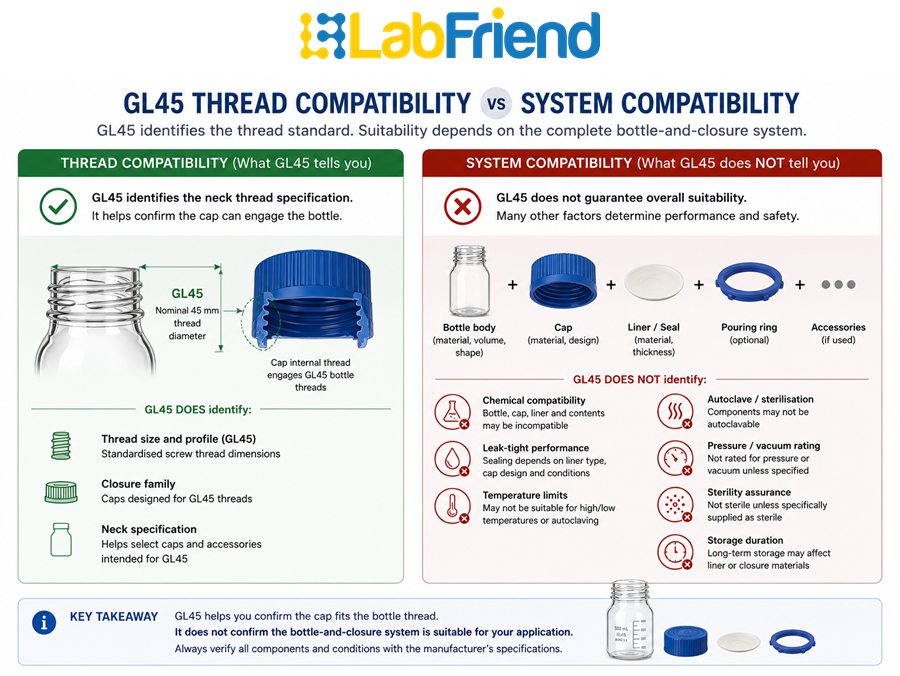
GL45 tells you about the thread or neck format. It is useful because it helps laboratories identify bottles and caps intended to work within a common screw-thread system. However, GL45 does not describe every feature that determines whether the bottle is suitable for use.
It does not tell you whether the cap material is suitable for the reagent. It does not confirm whether the liner or seal is compatible with the stored substance. It does not prove that the closure is leakproof under your conditions. It does not confirm temperature, autoclave, pressure, vacuum or sterile use. It also does not mean all accessories, pouring rings or replacement caps are automatically suitable.
A better way to think about GL45 is this:
GL45 can help you identify a possible bottle-and-cap family, but it is not a complete compatibility statement.
That distinction is important. If the laboratory is simply replacing a cap for a routine storage bottle, the first question is whether the replacement is genuinely specified for that bottle and workflow. If the laboratory is buying bottles for chemical storage, the check needs to go further and include chemical compatibility, closure material, liner suitability and storage conditions.
For reagent-specific storage guidance, LabFriend UK’s How to Select Laboratory Reagent Bottles for Chemical Storage explains how bottle material, closure, storage duration and compatibility checks should be considered together.
The bottle-and-cap system
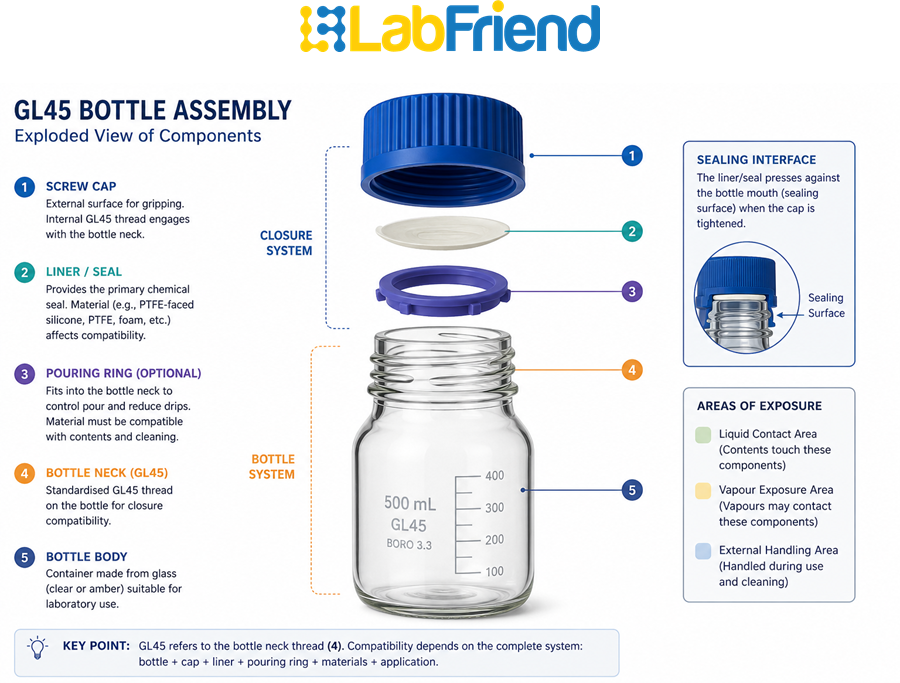
A laboratory bottle should be assessed as a system, not as a bottle body alone. In a GL45 setup, the relevant parts may include the bottle body, the neck thread, the screw cap, the liner or seal, the pouring ring (a fitted insert that controls dispensing flow) and any accessories used with the bottle.
Each part can influence suitability. The bottle material may be appropriate, but the cap may not be. The cap may fit the thread, but the liner may not be suitable for the contents. A pouring ring may help with dispensing, but it may not be appropriate for every liquid or cleaning process. Bottle-top dispensers and pipette pumps that connect via a GL45 thread should also be checked for chemical compatibility and pressure rating before use, since they introduce an additional component into the closure system. A bottle may be suitable for routine room-temperature storage, but the closure may not be suitable for autoclaving.
|
Component |
What to check |
|
Bottle body |
Material (commonly borosilicate glass or plastics such as PP, HDPE or PTFE), volume, clear or amber format, temperature limits and intended use |
|
Neck/thread |
Correct GL thread format and manufacturer specification |
|
Cap |
Cap material (commonly polypropylene, PBT or phenolic resin), fit, supplied status and replacement availability |
|
Liner/seal |
Material (such as PTFE-faced, silicone or EPDM), compatibility with contents, storage duration and closure requirements |
|
Pouring ring |
Fit, material, dispensing use and cleaning suitability |
|
Accessories |
Compatibility with the specific bottle and workflow |
|
Product code |
Needed for accurate repeat ordering |
The key point is that a GL45 bottle should not be assessed by thread alone. The complete system should match the application.
Why caps that fit may still be unsuitable
A cap that screws onto a bottle is not automatically the right cap. This is one of the most common misunderstandings with GL45 bottle systems.
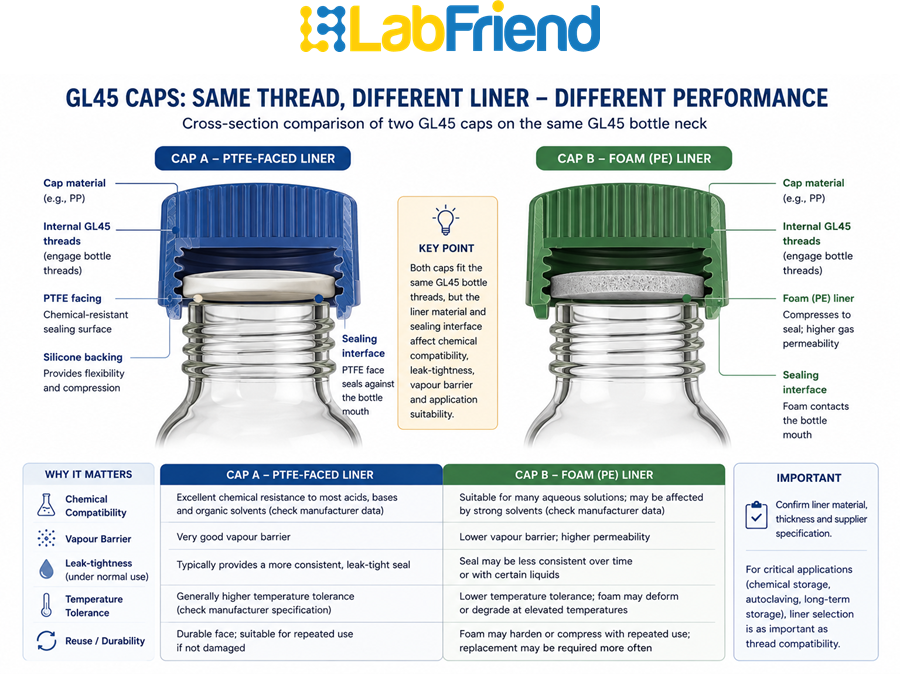
The cap may have a different material from the original. It may include a different liner or no liner at all. It may be suitable for dry storage but not for a particular liquid. It may be acceptable for room-temperature storage but not for autoclaving. It may seal differently from the original closure. It may not be intended for repeated opening and closing in the same workflow.
This is why replacement caps should be treated carefully. If the laboratory has an existing approved bottle system, the safest approach is to reorder the original cap or a manufacturer-confirmed compatible replacement. If an alternative cap is being considered, scientists should check the product data and confirm that the cap, liner and bottle combination matches the intended use.
For routine bottle and vessel comparison, LabFriend UK’s laboratory vessels category can support broader product discovery. Where the application is reagent-led, the more specific route is laboratory reagent bottles.
GL45 in reagent bottle workflows
GL45 is often encountered in reagent bottle workflows because many laboratory reagent bottles use screw-cap systems. In those workflows, the closure is part of the storage decision.
A reagent bottle may be used for prepared solutions, buffers, acids, bases, solvents, stains, indicators or routine laboratory chemicals. The cap and liner can be exposed to vapours, splashes or direct contact depending on fill level, handling and storage position. This means the closure should be checked alongside the bottle material.
If the bottle is used for chemical storage, scientists should confirm the reagent identity, concentration, storage duration, storage temperature and closure requirements. A borosilicate glass bottle with a GL45 thread may be suitable for some laboratory uses but unsuitable for others — for example, standard GL45 bottles are not rated for positive pressure or vacuum use unless specifically designed and tested for that purpose, often requiring reinforced glass or plastic and a vented or pressure-rated cap. A plastic cap may be practical in one workflow but not appropriate in another. A liner may help with sealing in one context but be incompatible in another.
The correct question is not simply, “Is this GL45?” The better question is:
Is this complete bottle, cap and liner system suitable for the contents and workflow?
For reagent storage, compare laboratory reagent bottles by material, volume, cap/thread, closure and clear or amber format before selecting or reordering.
Chemical compatibility and closure material checks
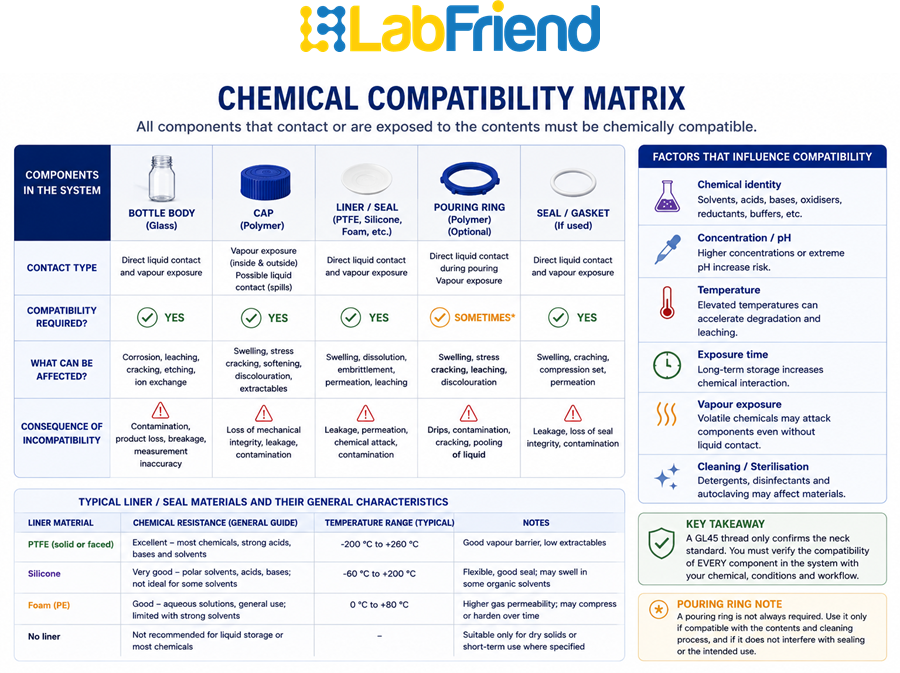
Chemical compatibility is not determined by the bottle body alone. The cap, liner, seal and accessories may also matter.
A laboratory might correctly identify a suitable bottle material but overlook the closure. That can create issues where the stored chemical produces vapour, where the bottle is handled frequently, or where the cap or liner is exposed during pouring, storage or cleaning. Compatibility depends on the chemical identity, concentration, temperature, exposure duration and storage conditions — for example, hydrofluoric acid is not compatible with glass bottles regardless of cap type, and some plastics are unsuitable for chlorinated or aromatic solvents.
Scientists should check manufacturer documentation where compatibility is important. If a reagent, solvent or prepared solution is involved, the SDS (Safety Data Sheet), COSHH (Control of Substances Hazardous to Health) assessment and local laboratory procedure may also influence the storage requirement.
This is especially important when replacing caps. A cap may share the same thread format but differ in material, liner or sealing behaviour. If the original closure was part of an approved storage setup, changing it should be treated as a specification change rather than a simple accessory purchase.
Autoclaving, temperature and cleaning considerations
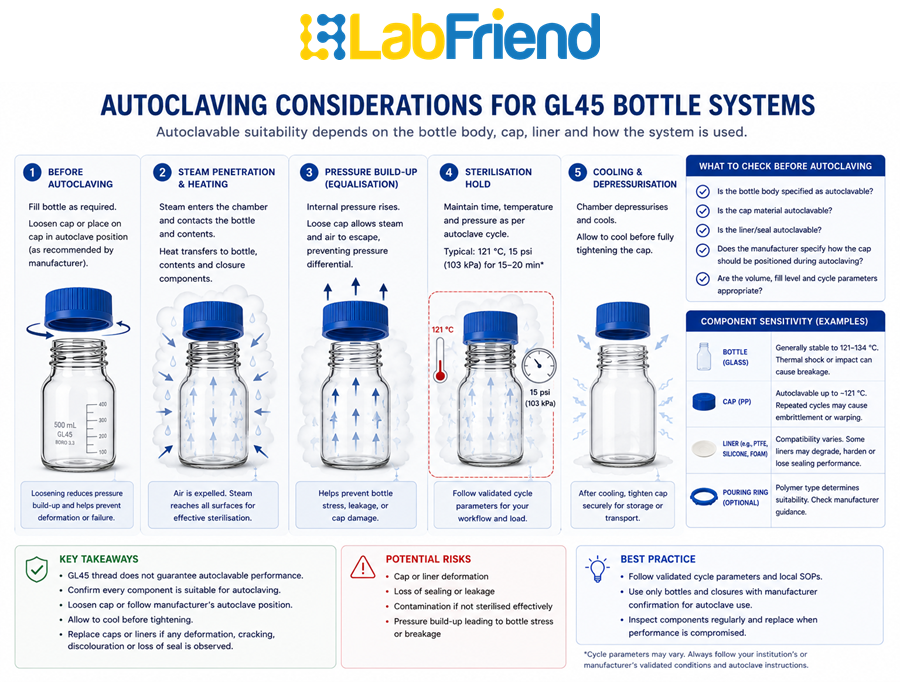
GL45 does not automatically mean autoclavable. Autoclave suitability must be confirmed for the bottle and the closure system together, including the temperature and cycle time each component has been validated for (commonly around 121°C).
This point is important because laboratories may reuse bottles or clean them between applications. A glass bottle may tolerate certain temperature conditions where specified, but the cap, liner, pouring ring or accessory may not. A plastic cap may deform, loosen or become unsuitable under conditions that the bottle body can tolerate. Repeated autoclave cycles may also have different implications from a single cycle, depending on the product.
Sterility and autoclavability should also be separated. A bottle supplied sterile is not automatically autoclavable. An autoclavable bottle is not automatically supplied sterile. Neither claim follows from GL45 thread type. Where sterility is required, the sterilisation method (for example gamma irradiation or autoclaving) and the sterility assurance level should be confirmed in the product documentation.
For any workflow involving heat, cleaning, sterilisation or contamination-sensitive use, scientists should check the full product documentation. Do not rely on visual similarity or thread type alone.
Replacement caps, accessories and repeat-order control
GL45 cap and accessory problems often appear during reordering. A laboratory may have a bottle in use, but the original product code may be missing. Someone may try to replace only the cap, source a cheaper accessory, or reorder a similar-looking closure from a previous supplier.
This is where repeat-order control becomes important. Scientists should record the bottle product code, cap product code where separate, thread type, liner or seal details, cap material, volume and any accessory used. For QA/QC-controlled workflows, the batch or lot number of the bottle and cap should also be recorded to support traceability. If the cap is supplied with the bottle, that should also be recorded.
For shared laboratories, this avoids confusion between similar bottle systems. For QA/QC or method-sensitive workflows, it helps prevent uncontrolled changes. For procurement, it reduces the risk of mismatched reorders.
Where a match is uncertain, contact LabFriend UK for support with bottle and cap requirements before placing a repeat order.
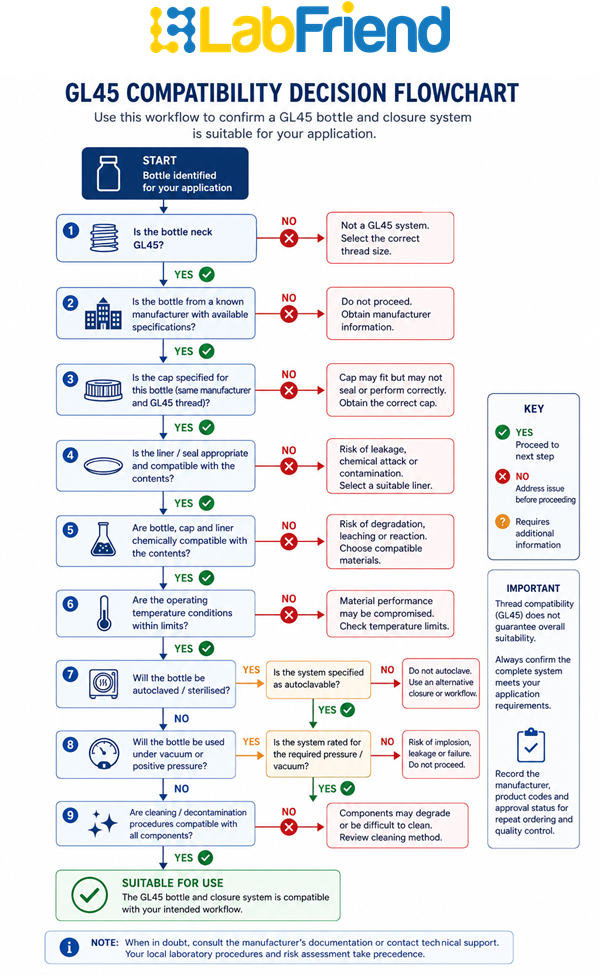
Practical GL45 compatibility checklist
Use this checklist before buying, using or reordering GL45 bottles and caps.
|
Check |
Why it matters |
|
Is the bottle actually GL45? |
Prevents selecting the wrong cap or accessory |
|
Is the cap specified for that bottle? |
Avoids assuming all caps are interchangeable |
|
Is the cap supplied with the bottle? |
Prevents incomplete orders |
|
What is the cap material? |
May affect chemical, temperature or handling suitability |
|
Is there a liner or seal? |
May affect leakage, evaporation or compatibility |
|
Is a pouring ring included? |
May affect dispensing and cleaning |
|
Is the system used for chemical storage? |
Requires reagent and compatibility checks |
|
Is autoclaving required? |
Bottle and cap must both be specified as suitable |
|
Is sterility required? |
Sterility must be confirmed separately |
|
Is a replacement cap being ordered? |
Product-code matching against the original bottle and cap becomes important |
|
Are accessories being added? |
Accessory compatibility must be confirmed |
|
Is a bottle-top dispenser or pump being used? |
Requires separate chemical compatibility and pressure-rating checks |
|
Is the product code recorded? |
Supports accurate repeat ordering |
This checklist should support the technical review. It does not replace product documentation.
What this article does not solve
This article explains GL45 thread and cap compatibility checks. It does not confirm that a specific bottle, cap or closure system is suitable for your exact workflow.
GL45 does not automatically confirm:
- chemical compatibility
- cap or liner compatibility
- leakproof performance
- pressure suitability
- vacuum suitability
- autoclave suitability
- sterile status
- DNase-free status
- RNase-free status
- pyrogen-free status
- endotoxin-controlled status
- certification
- method suitability
- accessory compatibility
Those checks must be confirmed through product documentation, manufacturer information, laboratory requirements and local procedures.
Relevant LabFriend category pathways
For GL45-related reagent bottle workflows, the most relevant commercial route is LabFriend UK’s laboratory reagent bottles. Use this route when comparing bottles by material, volume, cap/thread and clear or amber format.
For broader bottle and vessel comparison, use laboratory vessels. Where the bottle or cap match is unclear, or where a replacement cap or accessory needs checking, contact LabFriend UK before ordering.
FAQs
What does GL45 mean on a laboratory bottle?
GL45 refers to a DIN-based screw-thread designation for laboratory bottles: “GL” identifies the thread system and “45” is the nominal outside neck-thread diameter in millimetres. It helps identify the type of screw cap or closure that may be compatible with the bottle, but it does not confirm full system suitability.
Are all GL45 caps interchangeable?
No. GL45 caps may share a thread format, but cap material, liner, seal, closure design, manufacturer specification and workflow suitability can differ. Caps should be checked against the specific bottle and application.
Do GL45 caps fit all GL45 bottles?
A GL45 cap may physically screw onto a GL45 bottle, but that does not mean it is suitable for the stored substance, temperature, cleaning process, closure requirement or laboratory workflow.
Does GL45 mean a bottle is leakproof?
No. GL45 does not automatically mean leakproof. Leak resistance depends on the complete bottle and cap system, including closure design, liner, seal, tightening, storage conditions and product specification.
Does GL45 mean a bottle is autoclavable?
No. Autoclave suitability must be confirmed for both the bottle and the closure system. Thread type alone does not confirm autoclave suitability.
Can I use any GL45 cap for chemical storage?
No. For chemical storage, check the bottle body, cap material, liner, seal, reagent identity, concentration, storage duration and product documentation.
Are all GL45 caps suitable for pressurised or vacuum applications?
No. Standard GL45 bottles and caps are not rated for positive pressure or vacuum use unless specifically designed and tested for that purpose. Pressure- or vacuum-rated systems typically require reinforced bottle construction and a vented or pressure-rated cap, and this should be confirmed in the product documentation before use.
What should I check before replacing a GL45 cap?
Check the original bottle specification, cap material, liner or seal, thread type, manufacturer compatibility, product code and intended workflow. If the cap is part of an approved system, avoid uncontrolled substitutions.
Is GL45 the same as GL thread compatibility?
GL45 is one GL thread size. It does not represent all GL threads — GL25 and GL32 are other common sizes used on smaller laboratory bottles. The exact thread size and product specification should be checked before selecting caps or accessories.
Conclusion
GL45 is useful because it helps identify a common laboratory bottle thread format, but it is not a complete compatibility guarantee. A cap that screws onto a bottle may still be unsuitable for the reagent, temperature, cleaning process, closure requirement or repeat-use workflow.
Scientists should treat GL45 as one part of the complete container system. The bottle body, thread, cap, liner, seal, pouring ring, material, accessories and product code should all be checked together.
For reagent bottle workflows, compare LabFriend UK’s laboratory reagent bottles. For broader bottle systems, review laboratory vessels. Where a bottle or cap match is uncertain, contact LabFriend UK before ordering.
Compare GL45 bottle and cap options with LabFriend UK
Confirm the bottle thread, cap material, liner, closure requirement, reagent compatibility and workflow conditions first. Then compare LabFriend UK’s laboratory reagent bottles or contact LabFriend UK for help matching bottle and cap requirements.
Written by: Donal O’Sullivan, BSc, Co-Founder and Sales Director, LabFriend UK. Donal brings deep chemistry-led technical expertise across analytical chemistry, biochemistry, environmental monitoring, laboratory instrumentation, consumables and scientific product selection.
Reviewed by: Michael Anderson, MBA, Founder and Managing Director, LabFriend UK. Michael reviews LabFriend UK content for customer relevance, commercial accuracy, operational practicality and alignment with LabFriend UK’s laboratory supply model.
Related Stories

Laboratory Bottle Selection for Lab Managers - Standardising Everyday Storage and Handling
Learn how UK lab managers can standardise laboratory bottle selection by material, volume, mouth style, closure, sterility, compatibility and reorder requirements to reduce stockouts and simplify repeat purchasing.

Glass vs Plastic Laboratory Bottles - Which Should UK Labs Choose
Glass vs Plastic Laboratory Bottles - Which Should UK Labs Choose

Laboratory Bottle Materials Explained - Borosilicate Glass - Amber Glass - HDPE - LDPE and PP
Laboratory Bottle Materials Explained - Borosilicate Glass - Amber Glass - HDPE - LDPE and PP

How to Select Laboratory Reagent Bottles for Chemical Storage
How to Select Laboratory Reagent Bottles for Chemical Storage