Laboratory Bottle Volume Selection Guide - Choosing the Right Size for Storage, Handling and Workflow
27 mins read
Laboratory Bottle Volume Selection Guide - Choosing the Right Size for Storage, Handling and Workflow
By Donal O’Sullivan, BSc. Reviewed by Michael Anderson, MBA.
Quick answer
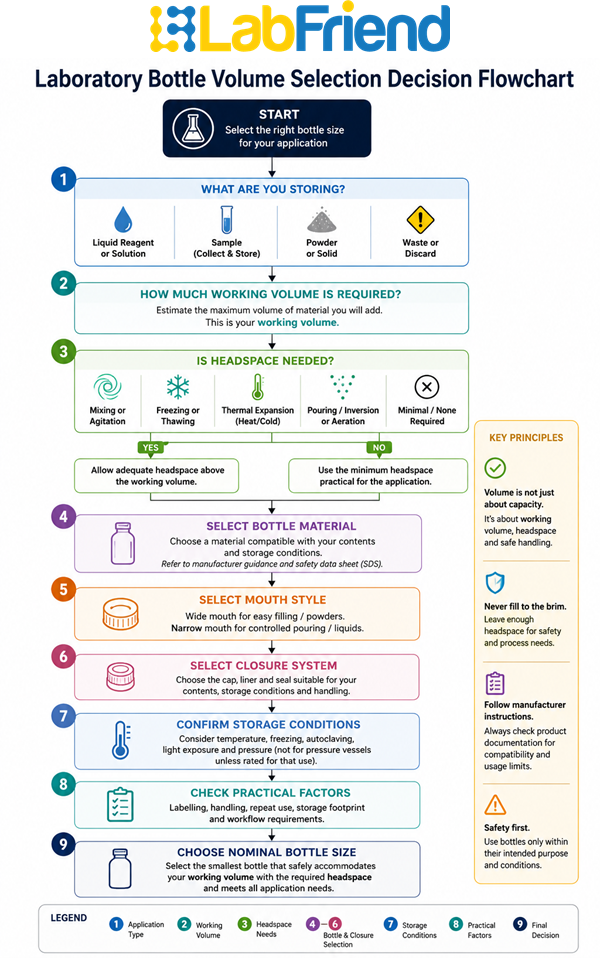
The right laboratory bottle volume should be selected from the usable working volume, not from nominal capacity alone. Scientists should consider what will be stored, how much working volume is needed, whether headspace is required, how the bottle will be filled, mixed, poured, stored, labelled, cleaned, heated, cooled or reused, and whether the closure system remains suitable for the workflow.
A 500ml bottle, for example, is not always the correct choice for storing exactly 500ml of liquid. Some workflows need headspace for mixing, thermal expansion, freezing or safe handling. Others need a smaller bottle to reduce unused air space, improve labelling control or make repeated handling easier. The best size is the bottle that fits the workflow safely and practically.
For wider selection guidance, read LabFriend UK’s Laboratory Bottles: Selection Guide for UK Laboratories. Once the working volume, headspace and handling requirement are clear, you can compare LabFriend UK’s laboratory vessels by size, material, mouth style and closure format.
Why nominal capacity is not the same as working volume
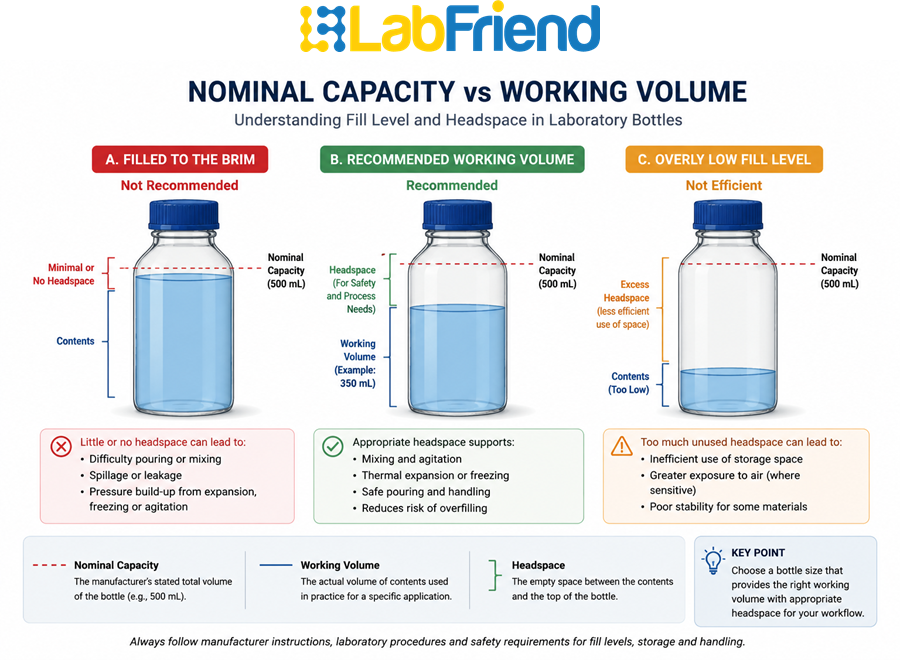
Laboratory bottles are usually described by nominal capacity: 100ml, 250ml, 500ml, 1 litre and so on. That is useful for product selection, but it does not always describe the volume that should be used in a real workflow.
The working volume is the amount the laboratory can practically and appropriately place in the bottle for that application. It may be lower than the nominal capacity because the bottle needs headspace, because the user needs room to mix contents, because the liquid may expand, because the bottle will be frozen, because it will be autoclaved under specified conditions, or because the bottle must be handled, poured and labelled safely.
This distinction matters. A bottle filled too close to nominal capacity may be harder to pour, harder to mix, more prone to spillage and less practical to handle. In some workflows, insufficient headspace can create safety or quality concerns. In others, an oversized bottle may create unnecessary storage bulk, excess dead space, poor visibility of small volumes or inefficient use of fridge, freezer or cupboard space.
The starting question should not be, “What is the largest volume I can fit into this bottle?” It should be, “What bottle size gives the right working volume for this workflow?”
Start with the application and contents
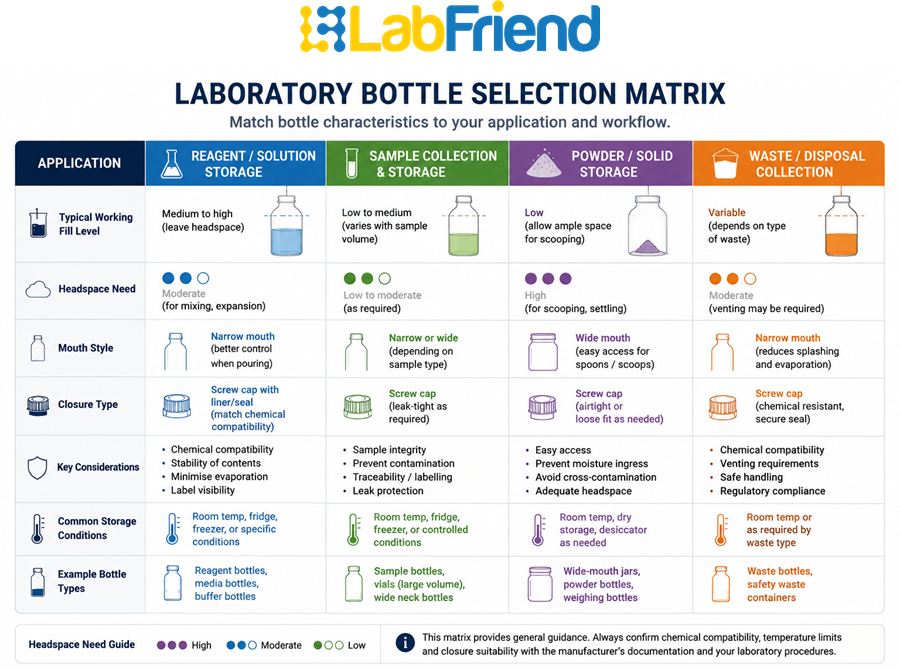
Bottle volume should begin with the application. A bottle used for prepared reagent storage has different practical requirements from a bottle used for short-term sample holding, powder storage, waste collection, field transport, buffer preparation or aliquot storage.
Where samples or reagents are transported off-site, additional packaging requirements (such as UN-rated packaging for hazardous materials) may apply and should be checked separately from bottle volume selection.
The contents also matter. Liquids, powders, granules, viscous materials and samples do not behave in the same way. A liquid may need space for shaking or inversion. A powder may need a wider opening and enough space for scooping. A sample bottle may need a volume that matches collection, labelling and traceability requirements. A reagent bottle may need a size that supports expected consumption without encouraging excessive storage time.
A good size choice therefore reflects both the material in the bottle and the way the user handles it. In practical laboratory work, the right answer is often a compromise between capacity, headspace, handling, storage footprint and repeat availability.
Where the bottle is for reagent storage or prepared solutions, LabFriend UK’s laboratory reagent bottles are the most relevant product route. If the stored contents are chemically sensitive or the workflow is controlled, the technical guide to selecting laboratory reagent bottles for chemical storage should be used alongside this volume guide.
Working volume, headspace and fill-level considerations
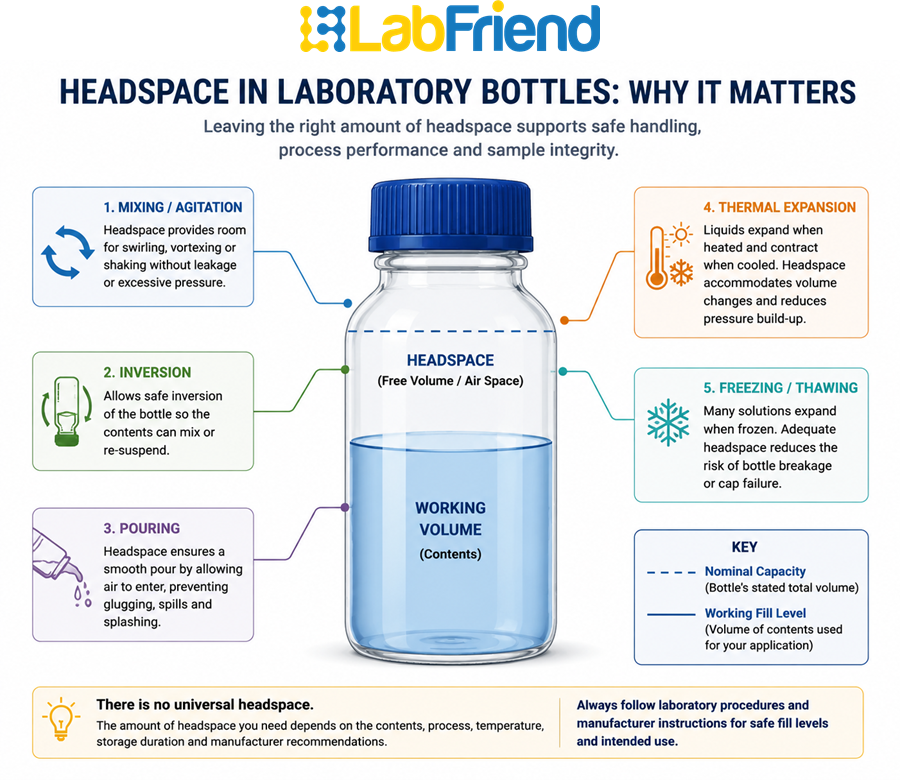
Headspace is the space left between the contents and the top of the bottle. It is one of the most important reasons not to select bottle size from nominal capacity alone.
Some workflows need headspace for mixing, shaking, inversion, expansion or safer pouring. Other workflows may benefit from minimising excess headspace, especially where small sample volumes need to be stored, identified or handled consistently. The correct amount of headspace depends on the contents, storage conditions and laboratory procedure. As a general starting point, headspace in the region of 10–20% of nominal capacity is commonly used to allow for mixing or expansion, though the specific requirement should always be confirmed against manufacturer guidance and local procedure.
|
Volume-selection factor |
Why it matters |
|
Working fill volume |
Determines how much usable material the bottle must hold in practice |
|
Headspace |
Supports mixing, expansion, pouring and handling where required |
|
Contents |
Liquids, powders, solids and viscous materials need different handling space |
|
Storage duration |
Longer storage may increase the importance of closure and headspace decisions |
|
Temperature exposure |
Heating, cooling, freezing or autoclaving may require specific fill-level controls |
|
Handling weight |
Larger filled bottles can be harder to lift, pour and control; as a guide, a litre of water weighs approximately 1 kg, so filled bottle weight scales directly with volume |
|
Closure system |
Cap, liner and seal suitability (for example PTFE-faced, silicone or pulp liners) should be checked alongside fill level |
|
Storage location |
Bench, fridge, freezer, cupboard and rack space can influence practical size |
This table should be used as a thinking tool, not as a universal rule. Manufacturer instructions, laboratory procedures and local safety requirements should always take priority where they define fill level or handling limits. Laboratory staff who are unfamiliar with a specific procedure should check with a supervisor or the relevant SOP before changing from an established bottle size.
Choosing size for reagent storage and prepared solutions
For reagent storage and prepared solutions, bottle volume should reflect how the reagent will actually be used. A bottle that is too small may require frequent refilling or repeated preparation. A bottle that is too large may be heavy, inefficient to store, harder to pour, or unsuitable if the contents should not be stored for long periods.
Scientists should consider the typical batch size, expected consumption rate, storage duration and whether the reagent needs to be poured, dispensed, mixed or protected from light. The closure system also matters. A larger bottle may place different demands on cap handling, pouring control and storage stability.
As a practical example, a frequently used buffer prepared in batches of around 400–800ml may be easier to manage in a 500ml or 1 litre bottle that balances preparation efficiency with safe handling. A less frequently used reagent may be better stored in a smaller bottle to avoid unnecessary storage volume. A light-sensitive reagent may require an amber format, but the size decision should still account for working volume, headspace and handling.
Once those requirements are defined, compare laboratory reagent bottles by volume, material, cap/thread and clear or amber format.
Choosing size for samples, powders and solids
Sample storage often requires a different size logic from reagent storage. The goal is usually to protect identification, containment, handling and traceability. A bottle should be large enough to hold the sample comfortably, but not so large that the sample is difficult to retrieve, label, inspect or store.
For powders, granules and solids, the mouth style becomes especially important. A small nominal volume with a narrow opening may be awkward if the user needs to add or remove material with a spatula, scoop or funnel. In those cases, a slightly larger or wider-mouth format may be more practical than simply choosing the smallest bottle that can contain the material.
The same principle applies to viscous materials or materials that leave residue. The user may need enough access for filling, emptying or cleaning. A bottle that looks efficient by volume may be inefficient in real use if the opening makes the workflow slow or messy.
Where controlled pouring of liquids matters, narrow-mouth laboratory bottles may be useful. Where filling, access, powders, solids or cleaning are more important, wide-mouth laboratory bottles may be the better comparison route.
Bottle size, mouth style and handling practicality
Bottle volume cannot be separated from mouth style. A 500ml narrow-mouth bottle and a 500ml wide-mouth bottle may have the same nominal capacity, but they can behave very differently in use.
Narrow-mouth bottles can support controlled pouring and reduce the chance of splashing during liquid transfer, depending on the contents and handling technique. Wide-mouth bottles can make filling, adding solids, retrieving contents and cleaning easier. The best choice depends on how the bottle will be used, not just what it holds.
Handling also changes with size. A 1 litre bottle may be efficient for storage but less convenient for repeated one-handed pouring. A smaller bottle may be easier to handle at the bench but require more frequent refilling. A square bottle may improve storage density but may not suit every pouring or handling preference.
Scientists should think about the physical workflow: who will lift the bottle, where it will be stored, how often it will be opened, whether it must be poured accurately, whether gloves are worn, whether the label remains readable, and whether the closure can be handled comfortably.
Storage footprint: bench, fridge, freezer, cupboard and rack fit
A bottle size that works on paper may not work well in the storage location. Laboratory space is often limited, and bottle dimensions can matter as much as nominal volume.
Benches, chemical cabinets, fridges, freezers, shelves, racks and mobile trolleys all impose practical constraints. A tall bottle may not fit where a shorter bottle would. A round bottle may waste space in a crowded fridge. A square bottle may improve storage density and labelling visibility, but it must still be suitable for the contents and closure requirements.
For laboratories storing multiple bottles of the same material or reagent, footprint can become a workflow issue. Several smaller bottles may be easier to distribute across benches or teams. Fewer larger bottles may reduce product count but increase handling burden. The right choice depends on how the laboratory actually works.
Where storage efficiency and labelling are important, square laboratory bottles may be useful to compare after the technical requirement is clear.
For larger bottles or hazardous contents, secondary containment such as a spill tray or bunded cabinet may be required by local safety procedures, and this can also influence which bottle size and shape is practical for a given storage location.
Temperature, freezing and autoclaving caveats
Temperature exposure is one of the most important areas where bottle volume and headspace need careful thought.
If a bottle will be cooled, frozen, heated or autoclaved, the user should follow the manufacturer’s instructions for fill level, cap handling and suitability. Freezing can involve expansion, and insufficient headspace may cause problems, including cracking in glass bottles or deformation in plastic bottles if the fill level is too high. Autoclaving can involve temperature, pressure and venting considerations, and suitability must be confirmed for the bottle and closure system together. Caps are often loosened or vented rather than fully sealed during the cycle, in line with manufacturer instructions and local autoclave procedures.
The bottle size alone does not confirm temperature suitability. A 500ml bottle is not automatically suitable for freezing simply because it has spare capacity. A glass bottle is not automatically suitable for autoclaving in every configuration. A plastic bottle is not automatically suitable for cold storage or heat exposure. Plastic bottles such as HDPE or LDPE can also be permeable to some gases and solvent vapours over long storage periods, which may affect suitability for volatile or moisture-sensitive contents. Cap material, liner, closure, fill volume and manufacturer instructions all matter.
Standard laboratory bottles should not be used as pressure or vacuum vessels unless the specific system is rated for that application. They should also not be used for sealed heating, gas-generating reactions or pressure transfer unless the manufacturer specifically permits that use.
This is an area where caution protects both the user and the laboratory. When temperature exposure is part of the workflow, size selection should be checked alongside material and closure suitability.
Labelling, traceability and repeat-use considerations
A bottle must be large enough not only to hold the contents but also to support clear identification. Labelling area, label durability, visibility and traceability can all affect size choice.
Small bottles can be practical for limited-volume samples, but they may offer less label space. Larger bottles may be easier to label but harder to store or handle. Square formats may support label visibility in some storage layouts. Clear bottles may make contents easier to inspect, while amber formats may be selected where reduced light exposure is required. Amber glass reduces exposure to ultraviolet and some visible wavelengths, but the level of protection needed should be validated for the specific substance and method.
Repeat use also matters. If a laboratory repeatedly uses the same bottle size for a standard solution, buffer or sample type, recording the product code and specification can reduce future selection errors. This should be framed as practical workflow control, not procurement administration. The user benefits because the next order is more likely to match the bottle that already works.
Where bottles are reused, cleaning and decontamination procedures should be validated for the previous and intended contents, and the bottle should be inspected for damage, staining or degradation before reuse.
Common mistakes when choosing laboratory bottle size
The following patterns account for many of the avoidable bottle-size errors seen in day-to-day laboratory practice.
One common mistake is selecting the nominal capacity to match the exact liquid volume. If the workflow needs headspace, mixing or temperature tolerance, the working volume should be lower than the nominal capacity.
Another mistake is choosing the largest practical bottle to reduce purchase frequency. Larger bottles can be useful, but they may be heavier, harder to pour, harder to store and less suitable for some workflows.
A third mistake is ignoring mouth style. A bottle that is large enough may still be awkward if the opening is wrong for powders, viscous materials, filling or cleaning.
A fourth mistake is treating graduations as accurate measurement marks. Bottle graduations should generally be treated as approximate unless the manufacturer specifies otherwise, since moulded or blown graduation marks typically carry wider tolerances than dedicated volumetric glassware. Use appropriate volumetric equipment where measurement accuracy matters.
The final mistake is separating volume from closure suitability. A bottle may have the right nominal size but the wrong cap, liner or closure system for the contents or storage conditions.
What this article does not solve
This guide helps scientists and researchers choose a practical laboratory bottle volume. It does not confirm that a specific bottle is chemically compatible, sterile, certified, autoclavable, freezer-safe, pressure-rated, vacuum-rated or suitable for a regulated method.
Those checks must be confirmed through product documentation, manufacturer instructions, SDS, COSHH assessment (the UK’s Control of Substances Hazardous to Health risk assessment), method requirements and local procedures.
Bottle volume is one part of the selection decision. The final choice should also consider material, mouth style, cap/thread, liner, seal, storage temperature, light sensitivity, documentation requirements and repeat-order availability.
What to check before buying
Before selecting a bottle size, check the workflow rather than starting from a preferred nominal capacity.
|
Check |
Question to ask |
|
Application |
Is the bottle for reagent storage, sample storage, powders, solids, prepared solutions or general use? |
|
Working volume |
How much material will normally be placed in the bottle? |
|
Headspace |
Is space needed for mixing, pouring, freezing, expansion or autoclaving? |
|
Contents |
Are the contents liquid, solid, powder, viscous, volatile, light-sensitive or chemically sensitive? |
|
Mouth style |
Is controlled pouring, filling access, scooping or cleaning more important? |
|
Closure |
Does the cap, liner or seal need to meet a specific requirement? |
|
Storage location |
Will the bottle fit the bench, fridge, freezer, cupboard, rack or cabinet? |
|
Temperature exposure |
Will the bottle be cooled, frozen, heated or autoclaved? |
|
Labelling |
Is there enough space for clear identification and traceability? |
|
Repeat use |
Should the product code and size be recorded for future ordering? |
This checklist should support selection, but it should not replace product documentation where specific suitability claims are required.
Where to compare bottle options once the size requirement is clear
Once the working volume, headspace and handling requirement are clear, the next step is to compare bottle options that match the workflow.
For broad bottle-size comparison, start with LabFriend UK’s laboratory vessels. If the requirement is reagent storage or prepared solutions, compare laboratory reagent bottles by size, material, cap/thread and clear or amber format.
If controlled pouring is important, review narrow-mouth laboratory bottles. If filling access, powders, solids or easier cleaning are more important, review wide-mouth laboratory bottles. Where storage footprint and labelling efficiency matter, compare square laboratory bottles.
If the correct size, material or closure combination is uncertain, contact LabFriend UK for support before ordering. The correct sequence is simple: confirm the working requirement, compare suitable options, then request support or a quote where needed.
FAQs
How do I choose the right laboratory bottle size?
Choose the bottle size from the working volume, required headspace, contents, mouth style, handling workflow, storage location, temperature exposure and closure requirement. Do not rely on nominal capacity alone.
Is nominal bottle capacity the same as working volume?
No. Nominal capacity describes the bottle size, but the practical working volume may be lower. Many workflows need headspace for mixing, expansion, freezing, autoclaving, pouring or safer handling.
How much headspace should I leave in a laboratory bottle?
The required headspace depends on the contents and workflow. Mixing, freezing, thermal expansion, autoclaving or easier pouring may require additional headspace. Follow manufacturer instructions and local procedures where they define fill levels.
What size reagent bottle should I choose?
Choose a reagent bottle size based on preparation volume, expected consumption, storage duration, handling, headspace, material, closure and clear or amber requirements. Avoid choosing a larger bottle only to reduce purchase frequency.
When should I choose a 250ml, 500ml or 1 litre bottle?
A smaller bottle may be easier to handle and suitable for lower-volume or less frequently used contents. A 500ml bottle can be a practical general size for many workflows. A 1 litre bottle may suit larger-volume preparation or storage, but only where handling, storage and closure requirements are suitable.
Does bottle volume matter for freezing?
Yes. Freezing may involve expansion, so headspace and product suitability matter. The bottle material, closure and manufacturer guidance should be checked before freezing.
Does bottle volume matter for autoclaving?
Yes. Autoclaving can involve fill-level, venting, temperature and closure considerations. Follow manufacturer instructions and confirm that both bottle and closure are suitable for the intended autoclave conditions.
Should I choose a larger laboratory bottle to save cost?
Not automatically. Larger bottles may reduce the number of units purchased, but they can be heavier, harder to pour, harder to store and less suitable for some contents. Total workflow suitability matters more than unit count.
How does mouth style affect bottle volume selection?
Mouth style affects filling, pouring, scooping, cleaning and user handling. A narrow-mouth bottle may suit controlled pouring, while a wide-mouth bottle may be more practical for powders, solids, viscous materials or easier access.
Are laboratory bottle graduations accurate for measurement?
Bottle graduations should usually be treated as approximate unless the manufacturer specifies measurement accuracy. Use appropriate volumetric equipment where accurate measurement is required.
Can a laboratory bottle be reused for a different reagent or sample?
Only if the bottle has been cleaned, decontaminated and confirmed compatible with the new contents. Residue, staining or chemical incompatibility from a previous use can affect the safety, purity or accuracy of the new application.
Conclusion
Laboratory bottle volume selection is a workflow decision. Nominal capacity is useful, but it is not the same as the correct working volume. Scientists should consider contents, headspace, handling, storage footprint, mouth style, closure system, temperature exposure, labelling and repeat use before selecting a size.
The best bottle size is the one that supports the work safely and practically. A larger bottle is not automatically more economical. A smaller bottle is not automatically easier. The right choice depends on the way the bottle will be filled, stored, handled and reused.
Once the size requirement is clear, compare LabFriend UK’s laboratory vessels, laboratory reagent bottles, narrow-mouth bottles, wide-mouth bottles or square bottles, depending on the workflow.
Browse laboratory bottle sizes with LabFriend UK
Confirm the working volume, headspace, contents, storage location, mouth style and closure requirement first. Then compare LabFriend UK’s laboratory vessels or laboratory reagent bottles by size, material, format and closure. If the correct size or closure combination is unclear, contact LabFriend UK for support before ordering
Read more from LabFriend UK
- Laboratory Bottles: Selection Guide for UK Laboratories
- How to Select Laboratory Reagent Bottles for Chemical Storage
Written by: Donal O’Sullivan, BSc, Co-Founder and Sales Director, LabFriend UK. Donal brings deep chemistry-led technical expertise across analytical chemistry, biochemistry, environmental monitoring, laboratory instrumentation, consumables and scientific product selection.
Reviewed by: Michael Anderson, MBA, Founder and Managing Director, LabFriend UK. Michael reviews LabFriend UK content for customer relevance, commercial accuracy, operational practicality and alignment with LabFriend UK’s laboratory supply model.
Frequently asked questions
Delivery times vary by product and supplier. Each product page shows current stock levels and the expected lead time, and we confirm this when you place your order. Most items arrive within 2 to 3 weeks. Specialised items can take longer if they are not in stock. If you need something by a certain date, contact us and we’ll check for you.
Yes. Register for a commercial account and, once it’s approved, you will be able to process orders via PO Once you have a commercial account, you can directly email your purchase orders
Add products to your cart and click Get a Quote. You’ll get a formal quote instantly, ready to send to your email address. For bulk orders or custom requirements, send us your product list and we’ll reply with itemized pricing.
If your item is faulty, not as described or sent in error, let us know within 14 days of delivery and we’ll arrange a return. Change of mind returns are only accepted if the item is unused and in its original packaging. A restocking fee will apply and you pay the return freight. Read our full Returns Policy for details.
Yes, prices are shown including GST by default. Use the Prices Inc. GST toggle at the top of the page to view prices without GST.