

Share :
Choosing the Best Syringe Filters for UHPLC Applications
Updated On 07/29/2026

Helping UK laboratories maximise UHPLC performance through informed syringe filter selection
Ultra-high-performance liquid chromatography (UHPLC) enables laboratories to achieve high-resolution separations, shorter run times and sensitive analytical measurements. Those benefits depend on a tightly controlled fluidic system, fine-particle analytical columns and consistent sample preparation.
UHPLC systems are less tolerant of particulate contamination than conventional liquid chromatography workflows, operating at substantially higher system backpressures than conventional HPLC. Fine particles introduced with a sample can contribute to increasing backpressure, restricted flow, blocked inlet frits, reduced column efficiency and avoidable instrument maintenance. Syringe filtration is therefore not simply a routine preparation step. It is a practical means of protecting the chromatographic system and improving the consistency of analytical results.
For a broader introduction to filtration formats, membrane technologies and selection principles, see The Ultimate Guide to Laboratory Filtration for UK Laboratories.
Laboratories that require a wider overview of syringe filter construction, pore sizes and applications can also refer to The Ultimate Syringe Filter Guide: Pore Size, Membranes and Applications.
This guide focuses specifically on the requirements of UHPLC sample preparation. It explains why membrane chemistry matters, how pore size and filter diameter influence performance, and what laboratories should assess before adopting a syringe filter within a routine or validated analytical method.
Why UHPLC places greater demands on sample filtration
UHPLC applies the same fundamental separation principles as conventional HPLC, but its operating conditions make effective sample preparation particularly important.
UHPLC columns commonly use smaller stationary-phase particles (typically sub-2 µm) to achieve high chromatographic efficiency. The narrower flow pathways within these packed beds are more vulnerable to obstruction by particulate material. A particle that might cause limited disruption in a less demanding chromatographic system can contribute to a noticeable pressure increase or deterioration in performance within a UHPLC method.
The system’s reduced internal volume also increases its sensitivity to contamination. Low-volume tubing, injector components and column inlet frits support efficient separations, but they leave less tolerance for suspended solids, precipitated material or debris introduced during sample preparation.
As contamination accumulates, laboratories may observe:
- gradually increasing system pressure;
- unstable or restricted flow;
- deteriorating peak shape;
- changing retention behaviour;
- reduced column efficiency;
- blocked guard columns or inlet frits;
- premature analytical column replacement; and
- additional instrument cleaning or maintenance.
These effects may not appear immediately. Small amounts of particulate contamination can accumulate across a series of injections, making the underlying cause difficult to identify. The laboratory may initially suspect the pump, mobile phase, column chemistry or method conditions when the actual problem originates in inconsistent sample clarification.
Routine syringe filtration helps reduce this risk before the sample enters the instrument.
Laboratories comparing filtration requirements across both chromatographic platforms can review Best Syringe Filters for HPLC and UHPLC Sample Preparation.
Filtration supports the complete UHPLC flow path
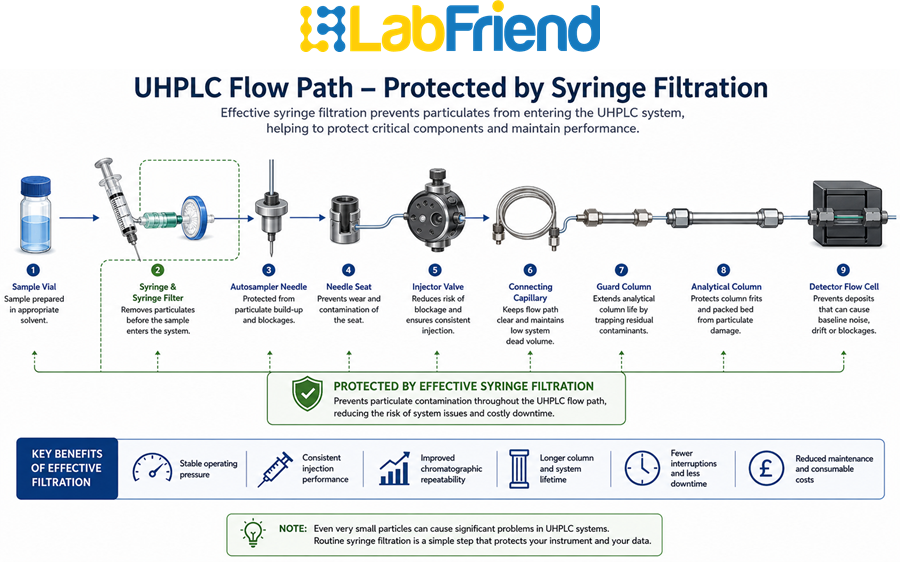
Syringe filters are frequently selected to protect the analytical column, but their role extends across the complete UHPLC flow path.
Removing suspended particles before injection can help protect:
- autosampler needles;
- needle seats;
- injector valves;
- connecting capillaries;
- in-line filters;
- guard columns;
- analytical column frits;
- analytical columns; and
- detector flow cells.
Contamination affecting any of these components can disrupt routine operation. A blocked column may be the most visible consequence, but restricted tubing, contaminated injector components or deposits within the flow path can also create recurring analytical problems.
Effective filtration can therefore support:
- more stable operating pressure;
- consistent injection performance;
- longer column life;
- fewer unplanned interruptions;
- improved chromatographic repeatability; and
- more predictable consumable expenditure.
The value of filtration should not be assessed solely against the cost of an individual syringe filter. It should be considered against the wider cost of failed injections, repeat sample preparation, analyst time, instrument downtime, troubleshooting and premature column replacement.
For laboratories operating multiple UHPLC systems or processing large daily sample volumes, even a modest reduction in preventable contamination can produce a meaningful operational benefit.
Filtration is part of method control
A syringe filter can influence the composition of the sample that reaches the UHPLC system. Selection should therefore form part of the analytical method rather than being treated as an interchangeable purchasing decision.
The laboratory should define, where relevant:
- membrane material;
- pore size;
- filter diameter;
- housing material;
- sterile or non-sterile status;
- prefiltration requirements;
- acceptable extractables;
- analyte recovery criteria;
- sample discard volume;
- maximum sample volume per filter; and
- syringe or fitting compatibility (for example, Luer-lock versus Luer-slip).
Where a method is validated, replacing one syringe filter with another may require technical assessment. Two filters carrying the same nominal pore size may behave differently because of differences in membrane chemistry, effective filtration area, housing construction, hold-up volume, extractables or analyte binding.
The appropriate level of change control depends on the method, regulatory environment and analytical risk. However, laboratories should avoid assuming that filters are equivalent solely because their external dimensions and pore-size labels are similar.
A defensible selection process should demonstrate that the chosen filter:
- is chemically compatible with the sample and solvent system;
- retains relevant particulate contamination;
- does not introduce unacceptable extractables;
- does not significantly adsorb the target analyte;
- provides sufficient throughput for the sample volume; and
- produces repeatable results under the intended method conditions.
Membrane chemistry is often more important than pore size
One of the most common syringe-filter selection errors is to focus on pore size while treating membrane material as a secondary consideration.
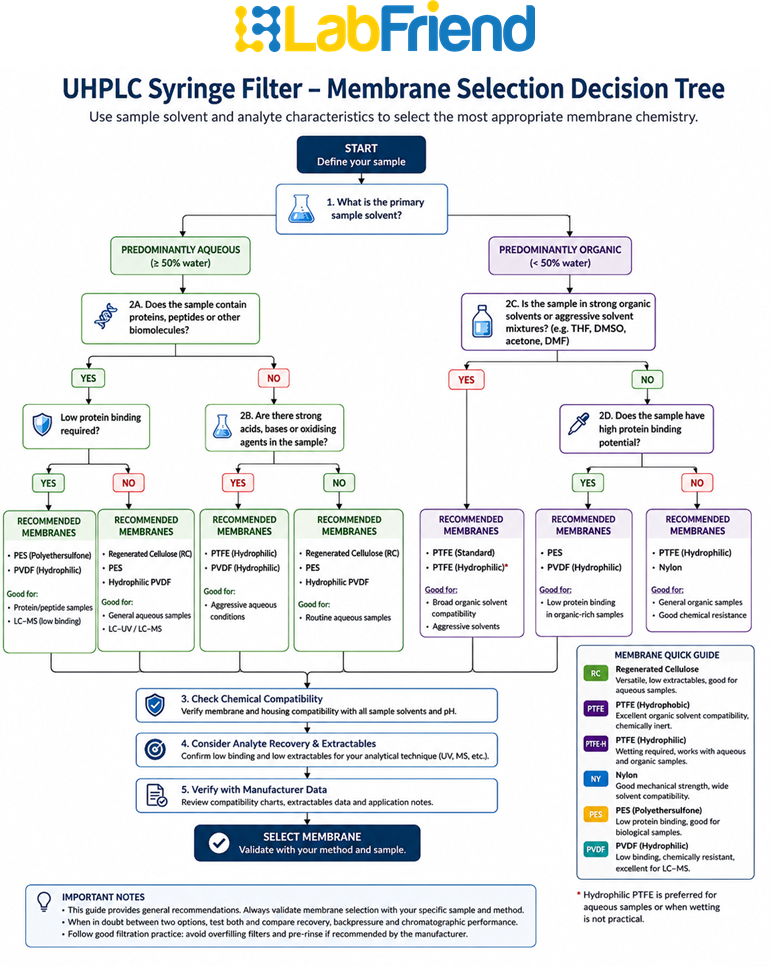
Pore size determines the approximate size range of particles the membrane is intended to retain. Membrane chemistry determines how the filter interacts with the solvent, sample matrix and analyte.
An unsuitable membrane can cause:
- swelling or degradation in contact with the solvent;
- slow or incomplete filtration;
- high resistance requiring greater manual force during filtration;
- adsorption of the target analyte;
- poor recovery at low analyte concentrations;
- unwanted extractables;
- interference with chromatographic detection; or
- loss of method reproducibility.
The best membrane for a UHPLC application is therefore not simply the membrane with the smallest pore size. It is the membrane that provides the required particle retention while remaining compatible with the complete analytical system.
The laboratory should evaluate three relationships together:
Membrane-to-solvent compatibility
The membrane must tolerate the sample diluent and any organic solvents, acids, bases or additives present in the formulation.
A membrane that performs well with an aqueous buffer may be unsuitable for a sample containing a high proportion of acetonitrile, methanol, tetrahydrofuran or another aggressive solvent. Chemical incompatibility may damage the membrane, affect flow or introduce substances into the filtrate.
Manufacturer compatibility data should be reviewed for the actual solvent composition and concentration used in the method.
Membrane-to-analyte interaction
Some analytes can adsorb onto membrane surfaces. This is particularly important where:
- the analyte concentration is low;
- the available sample volume is limited;
- the compound is hydrophobic;
- proteins or peptides are being analysed;
- quantitative recovery is critical; or
- the method has narrow acceptance criteria.
Apparent sample loss may not be caused by the analytical instrument. It may occur during filtration if the analyte binds to the membrane or filter housing.
Filter suitability should therefore be demonstrated using recovery testing under representative method conditions.
Membrane-to-detection compatibility
A filter can be chemically resistant yet still be unsuitable for a sensitive UHPLC method.
Extractable substances originating from the membrane, housing, adhesives or manufacturing process may produce additional peaks, elevated background response or interference at the analytical wavelength or mass-to-charge ratio of interest.
This risk becomes more important in:
- gradient UHPLC methods;
- trace analysis;
- LC-MS (liquid chromatography–mass spectrometry) applications;
- impurity profiling;
- extractables and leachables studies; and
- methods using highly sensitive detectors.
Where background interference would affect interpretation, laboratories should consider filter cleanliness and extractables alongside chemical compatibility and particle retention.
The principal membrane options for UHPLC
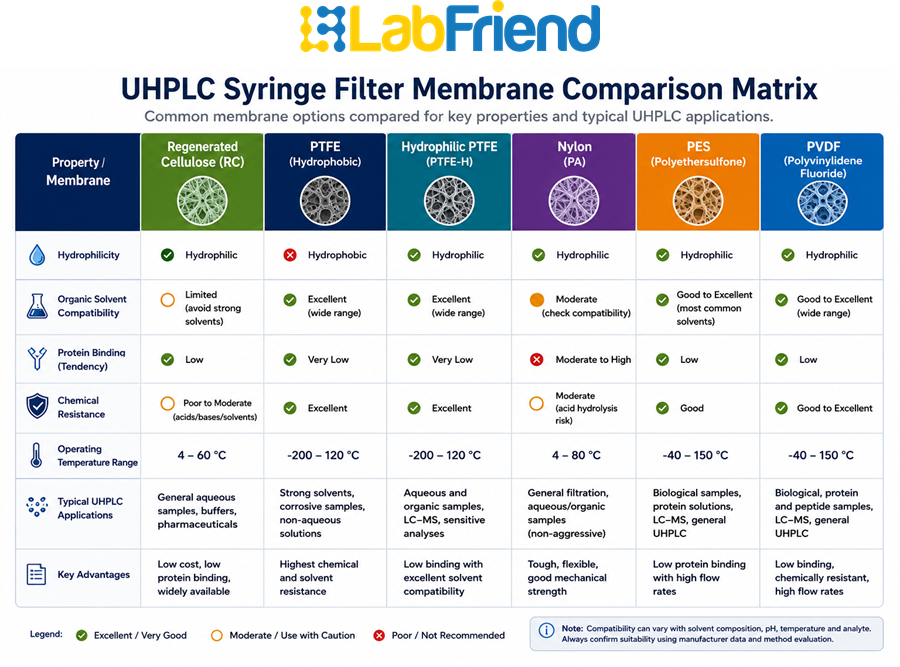
Several membrane materials are commonly considered for UHPLC sample preparation. No single membrane is universally suitable for every application.
Regenerated cellulose
Regenerated cellulose is frequently selected for analytical sample preparation because it combines hydrophilic behaviour, broad compatibility with aqueous and many mixed aqueous-organic solvent systems, and generally low nonspecific binding.
It may be suitable for:
- aqueous samples;
- mixed aqueous-organic samples;
- routine HPLC and UHPLC preparation;
- protein-sensitive applications; and
- laboratories processing varied sample types.
Its versatility makes regenerated cellulose a useful starting point where a laboratory handles multiple mobile-phase and sample compositions. Suitability must still be confirmed for the exact solvent system and analyte.
PTFE
Polytetrafluoroethylene membranes are widely used for organic solvents and chemically aggressive samples.
They may be appropriate for:
- solvent-rich samples;
- non-aqueous sample preparation;
- aggressive chemical matrices; and
- applications requiring broad chemical resistance.
Standard PTFE is hydrophobic. Predominantly aqueous samples may not pass readily unless the membrane is pre-wetted or a hydrophilic PTFE variant is selected.
The laboratory should therefore verify whether the product uses standard hydrophobic PTFE or a modified hydrophilic membrane rather than relying only on the membrane abbreviation.
Nylon
Nylon membranes are mechanically strong and compatible with many aqueous and organic solutions. They are often used for routine analytical filtration where broad general-purpose performance is required.
However, nylon can exhibit higher nonspecific binding than lower-binding alternatives such as PES or PVDF. It may therefore require particular assessment for proteins, peptides and low-concentration analytes.
Compatibility with strongly acidic samples and some aggressive solvents should also be verified before use.
Polyethersulfone
Polyethersulfone is hydrophilic and is commonly associated with high flow rates and relatively low protein binding.
It may be considered for:
- aqueous samples;
- biological samples;
- protein-containing solutions;
- buffers; and
- applications requiring efficient flow.
Its compatibility with high concentrations of organic solvent may be more limited than membranes designed primarily for aggressive solvent systems. The complete sample composition should therefore be checked before selection.
PVDF
Polyvinylidene fluoride membranes are available in hydrophobic and hydrophilic forms and are often considered for low-binding biological and analytical applications.
They may be useful where:
- protein recovery matters;
- biological samples are being prepared;
- low nonspecific binding is required; or
- the solvent system falls within the manufacturer’s compatibility range.
As with PTFE, the laboratory should confirm whether the selected PVDF membrane is hydrophobic or hydrophilic because this affects its behaviour with aqueous samples.
Selecting the Correct Pore Size for UHPLC Sample Preparation
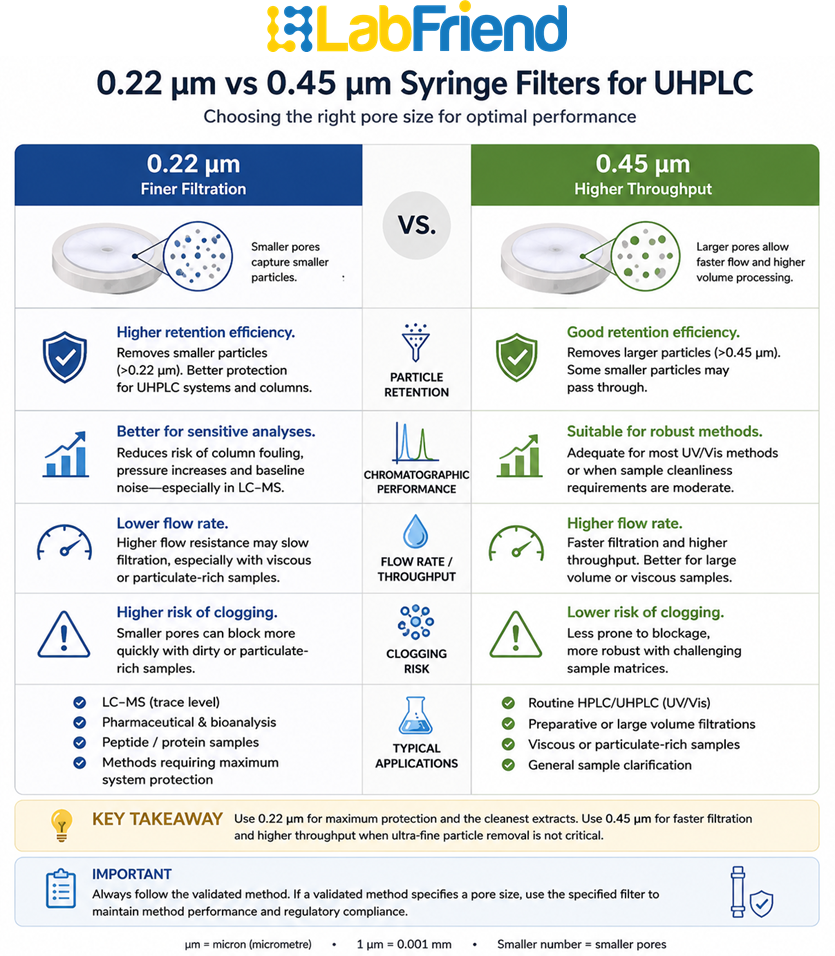
Selecting the appropriate membrane material is only part of the decision-making process. The pore size of the syringe filter also plays an important role in balancing effective particulate removal with acceptable sample throughput.
For UHPLC applications, laboratories most commonly choose either 0.22 µm or 0.45 µm syringe filters. Both are widely used, but each is suited to different analytical requirements.
For a more detailed comparison of these pore sizes, including their effect on analytical performance and sample preparation, see 0.22 µm vs 0.45 µm Syringe Filters – When Should You Use Each?
When to Choose a 0.22 µm Syringe Filter
A 0.22 µm membrane provides finer particle retention and is commonly selected when laboratories wish to minimise the risk of particulate contamination entering highly sensitive UHPLC systems. It is also the pore size generally recognised as sterilising-grade in many pharmacopoeial and GMP-controlled methods.
Typical applications include:
- UHPLC methods using sub-2 µm particle columns.
- High-sensitivity analytical methods.
- LC-MS sample preparation.
- Pharmaceutical quality control.
- Environmental trace analysis.
- Samples containing very fine suspended particles.
The finer membrane can help maintain stable system pressure while reducing the likelihood of particulate accumulation within column inlet frits and narrow-bore capillary tubing.
However, laboratories should recognise that finer membranes generally produce higher flow resistance. Highly viscous or particulate-rich samples may therefore filter more slowly and may require greater manual pressure during filtration.
When a 0.45 µm Syringe Filter May Be Appropriate
A 0.45 µm membrane remains entirely suitable for many chromatographic applications.
It is often selected where:
- the analytical method specifies 0.45 µm filtration;
- sample viscosity is relatively high;
- particulate loading is moderate;
- filtration speed is important; or
- conventional HPLC and UHPLC methods are both supported within the same laboratory workflow.
Because the membrane offers lower resistance to flow, filtration can often be completed more quickly while still removing the larger particles most likely to interfere with chromatographic performance.
The choice should always follow the validated analytical method where one exists. Laboratories should avoid changing pore size simply to improve filtration speed without considering its potential impact on method performance.
Choosing the Correct Syringe Filter Diameter
Pore size is only one aspect of filter performance. Filter diameter also influences filtration efficiency, throughput and sample recovery.
The membrane area increases as filter diameter increases, allowing larger sample volumes to pass through with lower resistance.
Typical laboratory guidance is shown below.
|
Filter Diameter |
Typical Sample Volume |
Typical Applications |
|
4 mm |
Less than 1 mL |
Small analytical samples and limited-volume preparations |
|
13 mm |
Approximately 1–10 mL |
Routine UHPLC sample preparation |
|
25 mm |
Approximately 10–100 mL |
Larger sample volumes and higher particulate loading |
|
33 mm |
Greater than 100 mL |
High-volume clarification before further processing |
These values are intended as practical guidance rather than fixed limits. Sample viscosity, particulate loading and membrane type all influence actual filtration performance.
Selecting an unnecessarily small filter for a relatively large sample volume may:
- increase filtration time;
- require greater manual force;
- increase the likelihood of membrane blockage; and
- reduce overall laboratory efficiency.
Conversely, selecting an excessively large filter for a very small sample volume may increase hold-up volume (the volume of sample retained within the filter and unavailable for collection) and unnecessary consumable costs.
The most appropriate diameter balances filtration efficiency with economical sample processing.
Solvent Compatibility Should Never Be Assumed
One of the most significant causes of syringe filter selection errors is assuming that all membrane materials are suitable for every solvent system.
In practice, solvent compatibility should always be confirmed before introducing a filter into routine laboratory use.
Many UHPLC methods employ mobile phases or sample diluents containing:
- methanol;
- acetonitrile;
- tetrahydrofuran (THF);
- dimethyl sulfoxide (DMSO);
- acetone;
- buffered aqueous solutions;
- dilute acids; or
- dilute alkaline solutions.
Each solvent interacts differently with membrane materials.
For example, a membrane that performs exceptionally well with aqueous buffers may not be appropriate for aggressive organic solvents, while a membrane optimised for solvent resistance may not be ideal for predominantly aqueous biological samples.
Laboratories should therefore verify:
- membrane chemical compatibility;
- housing compatibility;
- operating temperature limits;
- sample pH;
- solvent concentration; and
- manufacturer recommendations.
Compatibility should always be confirmed using the actual sample composition rather than the mobile phase alone.
Low Extractables Matter in UHPLC
Modern UHPLC instruments are capable of detecting extremely low concentrations of analytes.
Consequently, even very small quantities of substances released from filtration materials may influence chromatographic performance.
Potential sources of extractables include:
- membrane materials;
- housing polymers;
- manufacturing residues;
- wetting agents; and
- processing additives.
Although high-quality laboratory syringe filters are manufactured to minimise extractables, laboratories performing highly sensitive analyses should consider this characteristic during product evaluation.
Low-extractable filters may be particularly beneficial for:
- LC-MS methods;
- pharmaceutical impurity profiling;
- environmental contaminant analysis;
- forensic toxicology;
- food safety testing; and
- analytical methods operating close to detection limits.
Where regulatory methods apply, filter suitability should be demonstrated during method development or validation.
Should Syringe Filters Be Pre-Rinsed?
Whether a syringe filter requires pre-rinsing depends upon the analytical application and manufacturer recommendations.
Many modern analytical syringe filters are designed for direct use without extensive preparation.
However, some laboratories choose to discard the initial portion of filtrate to:
- condition the membrane;
- minimise potential extractables;
- improve analytical consistency; or
- support validated analytical procedures.
Where analytical recovery is critical, any pre-rinse procedure should be incorporated into the validated sample preparation protocol and applied consistently.
Common Mistakes When Selecting UHPLC Syringe Filters
Several recurring selection errors continue to reduce analytical performance in laboratories.
These include:
- choosing membrane material solely on availability;
- selecting pore size without considering the analytical method;
- ignoring solvent compatibility;
- overlooking analyte adsorption;
- selecting an unsuitable filter diameter;
- using non-validated alternatives during regulated analyses;
- assuming all membranes perform identically; and
- focusing exclusively on purchase price rather than total analytical cost.
Avoiding these common mistakes can improve method robustness while reducing avoidable maintenance and troubleshooting.
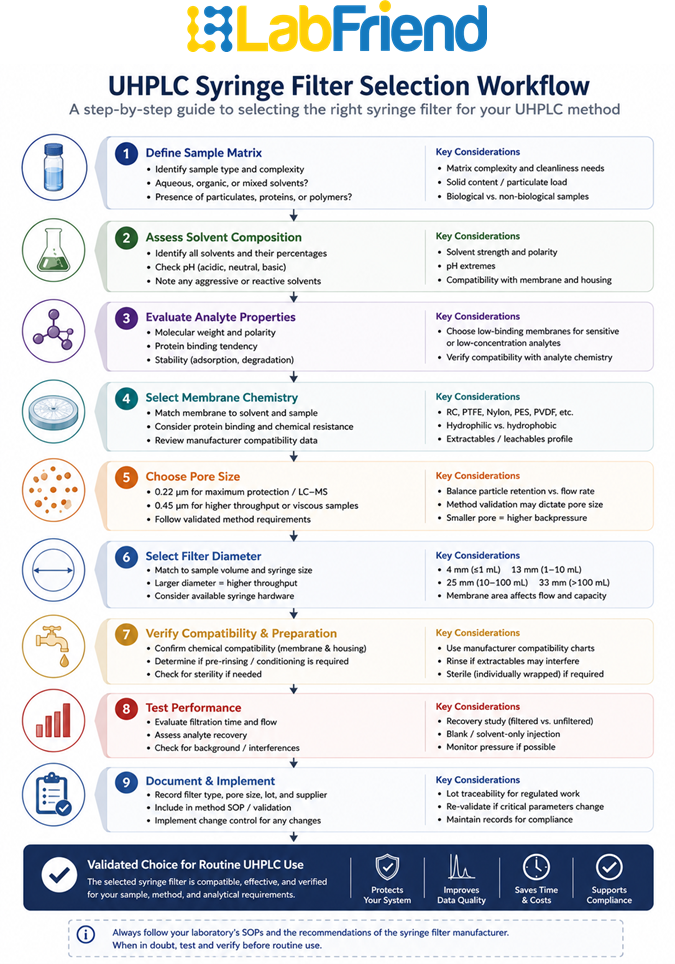
Selecting the Right Syringe Filter for Your UHPLC Method
Successful UHPLC sample preparation depends on balancing several technical factors rather than optimising any single characteristic.
Before selecting a syringe filter, laboratories should consider:
- the sample matrix;
- solvent composition;
- analyte chemistry;
- membrane compatibility;
- pore size;
- filter diameter;
- sample volume;
- analytical sensitivity;
- regulatory requirements; and
- validated method specifications.
Taking a systematic approach helps laboratories protect valuable UHPLC instrumentation while maintaining reproducible analytical performance and extending the service life of chromatographic consumables.
The final part of this guide provides practical product selection guidance, recommends suitable syringe filter families for common UHPLC applications and explains how laboratories can match membrane chemistry to their analytical workflow with confidence.
Recommended Syringe Filter Options for Common UHPLC Applications
Selecting the correct syringe filter is not about identifying a single product that suits every analytical method. The most appropriate choice depends on the chemistry of the sample, the solvent system, the analytical technique and the performance requirements of the method.
The table below provides practical guidance for selecting an appropriate membrane family for common UHPLC applications. Final selection should always be verified against the analytical method, solvent compatibility data and manufacturer recommendations.
|
UHPLC Application |
Typical Membrane Choice |
Selection Considerations |
|
General aqueous UHPLC analysis |
Regenerated Cellulose (RC) |
Broad compatibility, low non-specific binding and suitable for many routine analytical applications. |
|
High organic solvent content |
PTFE |
Excellent chemical resistance for aggressive organic solvents. Confirm whether hydrophobic or hydrophilic PTFE is required. |
|
Protein and biological samples |
Polyethersulfone (PES) or PVDF |
Often selected where low protein binding and good sample recovery are important. |
|
General analytical laboratories |
Nylon |
Suitable for many routine laboratory applications where compatible with the sample chemistry. |
|
LC-MS sample preparation |
Low extractable membrane with appropriate solvent compatibility |
Minimise background interference while maintaining high analyte recovery. |
|
Pharmaceutical QC |
Membrane specified within the validated analytical method |
Method compliance should always take precedence over general selection guidance. |
No single membrane material is universally superior. The objective is always to select the membrane that best matches the analytical application rather than attempting to standardise on one filter type for every laboratory workflow.
Product Selection Considerations Beyond Membrane Material
Once the appropriate membrane chemistry has been identified, laboratories should also confirm that the selected syringe filter meets the practical requirements of the analytical method.
These include:
- the correct pore size;
- suitable filter diameter for the sample volume;
- appropriate housing material;
- acceptable chemical compatibility;
- low extractables where required;
- appropriate analyte recovery;
- compatibility with the solvent system;
- manufacturer quality documentation where required; and
- consistent product availability.
Reliable supply is often overlooked during product selection. For laboratories operating regulated environments or high-throughput analytical facilities, maintaining continuity of supply can be just as important as the technical specification of the filter itself.
Building a Consistent Laboratory Filtration Strategy
Many laboratories purchase syringe filters on a project-by-project basis, often selecting different products for different analysts or departments.
While this may appear convenient, it can introduce unnecessary variation into analytical workflows.
A more robust approach is to establish a documented filtration strategy that defines:
- approved membrane materials;
- preferred pore sizes;
- standard filter diameters;
- approved manufacturers;
- validation requirements;
- application-specific exceptions; and
- purchasing standards.
Standardisation offers several benefits.
Laboratories can reduce variation between analysts, simplify purchasing, improve stock management and make method transfer between laboratories more straightforward.
Where multiple UHPLC systems operate within the same facility, standardising appropriate syringe filters can also simplify staff training and improve consistency across analytical teams.
Supporting Method Development and Method Validation
Syringe filtration should be considered during analytical method development rather than being introduced after chromatography has been optimised.
Evaluating filtration during development allows laboratories to determine whether the selected membrane influences:
- analyte recovery;
- chromatographic peak shape;
- baseline stability;
- detector response;
- reproducibility;
- sample preparation time; or
- overall method robustness.
Where regulated methods are validated, syringe filter selection should form part of the documented analytical procedure.
Changes to membrane chemistry, pore size or manufacturer should be assessed through the laboratory's established change control procedures to determine whether additional verification or revalidation is required.
Taking this structured approach reduces the likelihood of introducing avoidable analytical variation later in the life of the method.
Why Quality Matters When Choosing Syringe Filters
Although syringe filters are relatively inexpensive consumables, their influence on analytical performance is significant.
Poor-quality filters may contribute to:
- inconsistent flow characteristics;
- variable membrane performance;
- increased extractables;
- inconsistent analyte recovery;
- premature blockage; or
- unnecessary repeat analysis.
Selecting high-quality laboratory syringe filters from established manufacturers helps laboratories improve consistency while reducing the risk of preventable analytical problems.
When evaluating suppliers, laboratories should consider not only the product specification but also:
- technical documentation;
- manufacturing quality;
- batch consistency;
- regulatory support;
- product traceability; and
- long-term supply reliability.
These factors often contribute more to successful routine laboratory operation than small differences in purchase price.
How LabFriend Supports UHPLC Laboratories
Selecting the right syringe filter is not always straightforward, particularly where complex solvent systems, sensitive analytical methods or regulated environments are involved.
LabFriend supports UK laboratories by combining a comprehensive laboratory consumables portfolio with practical technical guidance to help laboratories identify products that are appropriate for their analytical applications.
Whether you are selecting filters for pharmaceutical quality control, environmental analysis, food testing, academic research or routine analytical chemistry, choosing the correct membrane material, pore size and filter diameter can help improve method robustness while protecting valuable UHPLC instrumentation.
If your laboratory is reviewing an existing analytical method or developing a new UHPLC workflow, our team can help you identify suitable syringe filter options based on your sample chemistry, solvent system and analytical requirements.
Recommended Syringe Filter Options for UHPLC Applications
Selecting the most appropriate syringe filter for UHPLC analysis depends on the characteristics of the sample, the solvent system and the analytical method rather than choosing a single "best" filter. The summary below distils the more detailed guidance provided earlier in this guide into a quick-reference format.
The table below provides general guidance on selecting an appropriate membrane for common UHPLC applications. Final product selection should always be confirmed against your validated analytical method, solvent compatibility requirements and manufacturer recommendations.
|
UHPLC Application |
Recommended Membrane |
Why It Is Commonly Selected |
|
Routine aqueous UHPLC analysis |
Regenerated Cellulose (RC) |
Low non-specific binding, excellent compatibility with aqueous samples and many mixed solvent systems. |
|
Samples containing high levels of organic solvents |
PTFE |
Excellent chemical resistance to many aggressive organic solvents used during sample preparation. Confirm whether hydrophobic or hydrophilic PTFE is required. |
|
Protein and biological samples |
Polyethersulfone (PES) or PVDF |
Frequently selected where low protein binding and high sample recovery are important. |
|
General analytical laboratory applications |
Nylon |
Suitable for many routine analytical applications where chemically compatible with the sample. |
|
LC-MS sample preparation |
Low extractable membranes |
Helps minimise background interference while maintaining analytical sensitivity. |
|
Pharmaceutical QC |
Membrane specified within the validated analytical method |
Method compliance should always take precedence over general application guidance. |
No membrane material is universally suitable for every UHPLC application. Selecting the correct syringe filter requires consideration of membrane chemistry, pore size, solvent compatibility, sample composition and the performance requirements of the analytical method.
Where validated analytical methods specify a particular membrane type, pore size or manufacturer, these requirements should always take precedence over general application guidance.
Explore Our Syringe Filter Range
LabFriend supplies a comprehensive range of syringe filters suitable for UHPLC, HPLC and general laboratory sample preparation, including membranes designed for aqueous samples, aggressive organic solvents, biological applications and routine analytical workflows.
Browse our complete range of Syringe Filters to compare membrane materials, pore sizes, diameters and pack sizes before selecting the most appropriate option for your application.
Browse the LabFriend Syringe Filter Range
Need Help Selecting the Right Syringe Filter?
If you are unsure which syringe filter is most appropriate for your UHPLC application, the LabFriend technical team can help you identify suitable options based on:
- sample chemistry;
- solvent composition;
- analytical technique;
- required pore size;
- membrane compatibility;
- sample volume; and
- regulatory or validated method requirements.
Whether you are developing a new UHPLC method or reviewing an existing workflow, we can help you select syringe filters that support reliable analytical performance while protecting valuable chromatography instrumentation Contact Us | LabFriend UK
Further Reading
To continue exploring laboratory filtration and chromatographic sample preparation, the following resources provide additional technical guidance:
- The Ultimate Guide to Laboratory Filtration for UK Laboratories
- The Ultimate Syringe Filter Guide: Pore Size, Membranes and Applications
- 0.22 µm vs 0.45 µm Syringe Filters – When Should You Use Each?
- Best Syringe Filters for HPLC and UHPLC Sample Preparation
- Choosing the Right Syringe Filter for Organic Solvents
- Complete Guide to Chromatography Consumables
These related publications are designed to help laboratories build a comprehensive understanding of filtration principles, membrane technologies and chromatographic sample preparation while supporting informed purchasing decisions.
Conclusion
Choosing the best syringe filter for UHPLC applications involves considerably more than selecting a membrane with the smallest pore size.
An effective selection process considers membrane chemistry, pore size, solvent compatibility, analyte recovery, filter diameter, extractables and validated method requirements as part of an integrated sample preparation strategy.
By adopting a structured approach to syringe filter selection, laboratories can reduce particulate contamination, improve chromatographic consistency, extend the service life of UHPLC instrumentation and maintain confidence in analytical results.
Thoughtful syringe filtration is a relatively small step within the analytical workflow, but it delivers significant benefits for method robustness, instrument protection and long-term laboratory efficiency.
Written by: Donal O’Sullivan, BSc, Co-Founder and Sales Director, LabFriend UK. Donal brings deep chemistry-led technical expertise across analytical chemistry, biochemistry, environmental monitoring, laboratory instrumentation, consumables and scientific product selection.
Reviewed by: Michael Anderson, MBA, Founder and Managing Director, LabFriend UK. Michael reviews LabFriend UK content for customer relevance, commercial accuracy, operational practicality and alignment with LabFriend UK’s laboratory supply model.
Related Stories

Extractables and Leachables in Analytical Filtration Explained
Extractables and Leachables in Analytical Filtration Explained

How Lab Managers Can Standardise Centrifuge Tube Purchasing Without Increasing Technical Risk
How Lab Managers Can Standardise Centrifuge Tube Purchasing Without Increasing Technical Risk

Low Protein Binding Membranes Explained for Laboratory Filtration
Low Protein Binding Membranes Explained for Laboratory Filtration

Choosing Tube Racks for 15mL and 50mL Centrifuge Tubes
Choosing Tube Racks for 15mL and 50mL Centrifuge Tubes