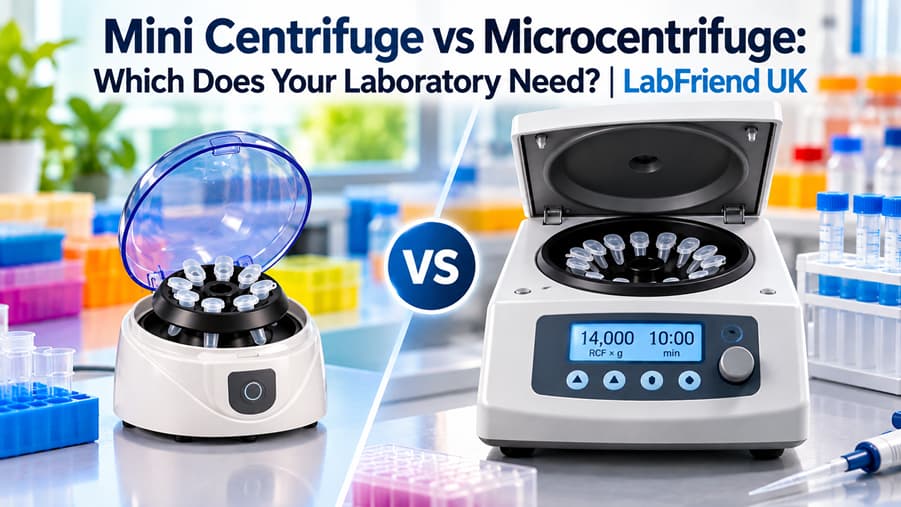
Mini Centrifuge vs Microcentrifuge: Which Does Your Laboratory Need?
37 mins read
Mini Centrifuge vs Microcentrifuge: Which Does Your Laboratory Need?
By Donal O’Sullivan, BSc. Reviewed by Michael Anderson, MBA.
A mini centrifuge is generally suited to brief, routine
spin-down tasks, while a microcentrifuge is usually the better choice when a
laboratory procedure requires a defined relative centrifugal force (RCF),
controlled run conditions or greater sample-processing capability. The right choice depends on what the centrifugation step
must achieve. A quick spin to collect droplets at the bottom of a tube is
different from a procedure that specifies the force and duration needed to
separate or recover sample components. |
Key Takeaways
- Choose
by application, not terminology. Mini centrifuges commonly support
quick-spin tasks; microcentrifuges generally offer more control and higher
centrifugal forces.
- RCF
matters more than RPM alone. Centrifugal force depends on rotational speed
and rotor radius.
- Check
tube compatibility. A tube that physically fits a rotor is not necessarily
approved for use in it.
- Consider
the controls your method requires. Adjustable force, timed operation,
capacity and temperature requirements can determine whether an instrument
is suitable.
- Do
not assume one class is universally better. A compact mini centrifuge may
be sufficient for routine spin-downs, while defined separation procedures
may require a suitably specified microcentrifuge.
What Is a Mini Centrifuge?
A mini centrifuge is a compact laboratory centrifuge
commonly designed for small-volume tubes and short, straightforward
centrifugation tasks.
Many models are intended for quick-spin applications, where
the aim is to collect liquid from the tube walls or cap into the bottom of the
tube. This can be useful when preparing small-volume samples for subsequent
handling.
Typical applications include:
- Collecting
droplets after pipetting, mixing or brief sample handling.
- Bringing
liquid from the walls or cap of a microtube to the bottom.
- Performing
short spin-down steps during routine molecular biology preparation, where
the instrument is suitable for the procedure.
Mini centrifuges are often straightforward to operate. Some
use simple lid-operated start and stop functions, while others provide timers
or additional speed controls.
Their compact footprint can be useful where bench space is
limited or several workstations need access to basic centrifugation.
However, mini does not automatically mean low speed or low
performance. Some compact instruments have capabilities that overlap with
larger microcentrifuges. Equally, a small instrument should not be assumed
suitable for a specified separation merely because it can rotate the required
tube.
The manufacturer's maximum RCF, supported rotors, tube
compatibility and operating controls determine what the instrument can safely
and reliably do.
What Is a Microcentrifuge?
A microcentrifuge is a laboratory centrifuge designed
primarily for small-volume sample tubes, commonly used where controlled
centrifugation is needed.
Compared with basic quick-spin mini centrifuges, many
microcentrifuges provide a wider range of operating conditions, including
adjustable speed or RCF and timed runs. Depending on the model, they may also
offer greater tube capacity, different rotor configurations and temperature
control.
Microcentrifuges are used across molecular biology,
biochemistry and other laboratory workflows. Suitable models may support
procedures such as:
- Collecting
pellets or precipitated material from small-volume samples.
- Separating
sample components under specified centrifugation conditions.
- Processing
samples during nucleic acid or protein preparation.
- Performing
repeated centrifugation steps where consistent operating settings are
important.
These applications do not mean that every microcentrifuge is
suitable for every procedure. Required RCF, duration, temperature, tube type
and sample characteristics must all be considered.
For example, a method that specifies a particular
centrifugal force and temperature cannot be satisfied simply by selecting an
instrument described as a microcentrifuge. The chosen instrument must be
capable of delivering the required conditions with an appropriate rotor and
tube combination.
Mini Centrifuge vs Microcentrifuge: Technical Differences
The following table compares common characteristics of basic
mini centrifuges with more fully featured microcentrifuges. These are typical
distinctions, not fixed specifications applying to every model.

|
Feature |
Mini centrifuge |
Microcentrifuge |
|
Primary purpose |
Commonly used for quick-spin and routine liquid collection |
Commonly used for controlled small-volume centrifugation
and separation |
|
Centrifugal force |
Often more limited, although some models overlap with
microcentrifuge performance |
Often capable of higher RCF, depending on model and rotor |
|
Speed and RCF adjustment |
May have fixed speed or limited adjustment |
Often provides adjustable speed or RCF |
|
Run-time control |
May use lid-operated or simple timed operation |
Commonly offers programmable or adjustable run duration |
|
Tube compatibility |
Usually supports a limited selection of small tubes or
strips |
May support a wider range of microtube formats and rotor
configurations |
|
Sample capacity |
Often relatively small |
Varies considerably; some models process more tubes per
run |
|
Temperature control |
Generally not refrigerated |
Refrigerated versions are available |
|
Bench space |
Usually compact |
Often larger, although compact models are available |
|
Typical selection priority |
Convenience for short spin-down tasks |
Meeting specified separation conditions and workflow
requirements |
Why RCF Is More Useful Than RPM
Centrifuge specifications frequently list rotational speed
in revolutions per minute (RPM). However, RPM does not tell you the centrifugal
force applied to a sample.
Relative centrifugal force (RCF) expresses the centrifugal
acceleration relative to Earth's gravitational acceleration, commonly written
as × g. It depends on both rotational speed and the distance from the axis of
rotation.
Two centrifuges operating at the same RPM can therefore
produce different RCF values if their rotor geometries differ.

This matters when comparing mini centrifuges with
microcentrifuges. A headline RPM figure should not be treated as evidence that
two instruments will perform the same separation.
Where a laboratory method specifies RCF, confirm that the
instrument can achieve the required force with the intended rotor, tubes and
any adapters. Published maximum RCF values may apply to a particular rotor
configuration, and the force experienced by the sample depends on its radial
position. Check the manufacturer's rotor-specific specifications rather than
relying solely on the instrument's headline maximum RCF. For further
explanation, see Understanding RCF, RPM and Rotor Compatibility for Centrifuge Tubes.
Tube Compatibility Is Equally Important
Both equipment classes may accept familiar microtube
formats, but compatibility is more than a question of whether a tube fits into
a rotor opening.
The instrument, rotor, adapters and tubes must be suitable
for the intended operating conditions.
Check the manufacturer's guidance for:
- Approved
tube types, sizes and materials.
- Rotor
and adapter compatibility.
- Permitted
centrifugal force for the tube and rotor combination.
- Tube
closure and filling requirements where relevant.
A tube may be suitable for a low-force spin-down but not for
a higher-force separation. Likewise, a rotor adapter must be approved for the
particular instrument and application.
Do not assume that visually similar tubes, rotors or
adapters are interchangeable.
How the Differences Affect Laboratory Workflows
The most useful way to compare the two equipment classes is
to consider the result required from the centrifugation step.

Quick-Spin Tasks During Sample Preparation
A laboratory may need to collect droplets from the cap or
walls of a microtube after mixing, brief vortexing or pipetting.
For this type of task, a suitable mini centrifuge can be
convenient. The operation is brief, the equipment is compact and the workflow
may not require a precisely specified centrifugal force.
This is common in routine molecular biology preparation,
including some PCR-related handling steps.
However, a quick spin is not automatically a substitute for
a method-defined centrifugation step. If the procedure specifies an RCF and
duration, the instrument must meet those requirements regardless of its size.
Separation and Pellet Formation
Some laboratory procedures require centrifugal force to
separate components or collect material into a pellet.
Examples include particular precipitation, extraction or
sample-processing steps.
The required separation depends on factors such as particle
characteristics, sample properties, centrifugal force and run duration. A mini
centrifuge may not deliver the necessary conditions, even if it accommodates
the correct tube.
A suitably specified microcentrifuge is generally the more
appropriate starting point when the method requires controlled, higher-force
centrifugation.
The important distinction is not whether the instrument can
visibly move material towards the bottom of the tube. It is whether the
instrument can perform the required procedure under the specified conditions.
Repeated or Time-Sensitive Processing
When a procedure involves multiple centrifugation steps,
operating controls can become more important.
For example, a laboratory processing several batches may
benefit from an instrument that allows the operator to select a defined RCF and
run time.
These controls can help operators apply the same settings
consistently, although reproducibility also depends on the method, sample
handling, rotor configuration and instrument condition.
Capacity matters too. A mini centrifuge may be convenient
for occasional individual samples but less efficient when many tubes must be
processed.
A microcentrifuge with an appropriate rotor capacity may
reduce the number of separate runs. That advantage depends on the actual number
of tubes supported and the workflow's processing requirements.
Temperature-Sensitive Samples
Some centrifugation procedures specify
temperature-controlled operation because sample stability or separation
performance depends on temperature.
In these circumstances, a refrigerated microcentrifuge may
be necessary.
Refrigeration should not be treated as a standard feature of
every microcentrifuge, and a refrigerated instrument does not automatically
maintain every sample at an exact target temperature throughout the procedure.
Where temperature matters, assess the instrument's stated
capabilities alongside the method requirements.
For routine quick-spin tasks without a defined temperature
requirement, refrigeration may offer no meaningful benefit.
Which Type Should Your Laboratory Choose?
The appropriate choice becomes clearer when the intended
application is matched to the required equipment capability.

|
Laboratory requirement |
More appropriate starting point |
Why |
|
Briefly collect droplets from tube walls or caps |
Mini centrifuge |
A suitable quick-spin instrument may provide all the
required functionality |
|
Perform a method with specified RCF and run duration |
Microcentrifuge |
Adjustable operating conditions are commonly available |
|
Process occasional small batches of compatible microtubes |
Mini centrifuge |
Compact equipment may be sufficient where force and
controls meet the task |
|
Perform repeated separation or pelleting steps |
Microcentrifuge |
Controlled force, duration and appropriate rotor capacity
may be important |
|
Process larger batches of small-volume tubes |
Microcentrifuge |
A suitable higher-capacity rotor may improve workflow
efficiency |
|
Centrifuge samples under specified temperature conditions |
Suitable temperature-controlled microcentrifuge |
The instrument must meet the method's temperature
requirements |
These recommendations describe typical starting points, not
absolute rules. A particular mini centrifuge may offer capabilities normally
associated with microcentrifuges, while an entry-level microcentrifuge may lack
a feature needed for a specialist procedure.
When a Mini Centrifuge Is Likely to Be Sufficient
A mini centrifuge may be a practical choice when the
laboratory mainly needs to collect small quantities of liquid after routine
sample handling.
It is particularly worth considering where:
- Centrifugation
is brief and straightforward.
- The
procedure does not require operating conditions beyond the instrument's
capabilities.
- Sample
numbers are relatively small.
- Bench
space and ease of operation are important.
- The
supported tube formats match the laboratory's requirements.
In this situation, purchasing a more sophisticated
instrument may add cost and complexity without materially improving the task.
When a Microcentrifuge Is the Better Choice
A microcentrifuge becomes more attractive when the
laboratory requires controlled centrifugation rather than occasional quick-spin
operation.
It is particularly relevant where:
- The
method specifies a centrifugal force and run duration.
- Samples
require a defined separation or pelleting procedure.
- Different
workflows require adjustable operating settings.
- More
samples must be processed in each run.
- Temperature-controlled
operation is required and an appropriate refrigerated model is available.
The chosen model must still meet the complete method
requirements. Selecting the equipment class is the first decision, not
confirmation that a particular instrument is suitable.
Cost, Capability and Practical Trade-Offs
Mini centrifuges are often positioned as simpler instruments
for routine laboratory tasks. Their smaller size and more limited control
options can make them economical where advanced centrifugation capability is
unnecessary.
Microcentrifuges may involve greater initial expenditure,
particularly where higher RCF, increased capacity, refrigeration or additional
operating controls are required.
However, price alone does not establish which option offers
better value.
A lower-cost mini centrifuge is poor value if it cannot
perform the required procedure. Equally, buying a more capable microcentrifuge
solely for occasional droplet collection may represent unnecessary expenditure.
Consider the practical balance between:
- Capability:
Can the instrument achieve the required centrifugation conditions?
- Frequency:
How often will the laboratory use it?
- Capacity:
How many samples need to be processed together?
- Usability:
Are the operating controls appropriate for the users and procedures?
- Flexibility:
Is there a realistic need to accommodate additional established workflows?
The best choice is the instrument that meets the
laboratory's requirements without introducing unnecessary complexity.
What to Confirm Before Selecting an Instrument
Once the laboratory has identified the appropriate equipment
class, confirm a small number of essential points against the manufacturer's
documentation.
- Required
RCF: Can the instrument achieve the centrifugal force specified by the
procedure with the intended rotor?
- Tube
and rotor compatibility: Are the required tubes, closures and any adapters
approved for the intended conditions?
- Operating
controls: Does the instrument provide the speed or RCF adjustment, timing
and other controls the procedure needs?
- Capacity:
Can the rotor accommodate the required number of samples without creating
unnecessary processing delays?
- Temperature
and safety requirements: Does the model meet the procedure's temperature
requirements and provide the necessary safety features? Confirm the
manufacturer's rotor-loading and balancing instructions, lid interlock
arrangements and any sample-containment requirements. Where samples
present a biological or aerosol-exposure risk, check whether an
appropriate sealed rotor or other manufacturer-approved containment
arrangement is available.
- Sample
compatibility: Are the tubes, closures, rotor and any adapters suitable
for the samples being processed? Where samples contain solvents, corrosive
substances or other potentially damaging chemicals, check the
manufacturer's material compatibility and permitted-use guidance.
Compatibility with the tube material alone does not establish
compatibility with the complete centrifugation system.
For a method-defined procedure, check these requirements
before selecting an instrument on price or convenience.
Conclusion: Choose the Centrifuge That Matches the Task
The practical difference between a mini centrifuge and a
microcentrifuge is usually the level of centrifugation capability and control
required by the laboratory.
A suitable mini centrifuge can be an efficient solution for
routine quick-spin tasks. A microcentrifuge is generally the stronger option
where methods require defined centrifugal force, controlled run conditions or
greater sample-processing capability.
Neither name guarantees a particular performance level.
Confirm the instrument's specifications, rotor and tube compatibility, and
method suitability before purchasing.
If your workflow requires controlled small-volume
centrifugation, explore LabFriend UK's laboratory microcentrifuges to identify instruments whose specifications match your
requirements.
Frequently Asked Questions
What is the main difference between a mini centrifuge and
a microcentrifuge?
A mini centrifuge is commonly used for brief quick-spin
tasks, while a microcentrifuge generally provides more control over centrifugal
force and run duration for small-volume laboratory procedures. However, the
names are not governed by universal performance limits. Compare the actual RCF,
rotor capacity, tube compatibility and operating controls before choosing.
Can a mini centrifuge replace a microcentrifuge?
A mini centrifuge can replace a microcentrifuge for a
particular task only if it meets all the procedure's requirements, including
centrifugal force, duration, tube compatibility and any relevant temperature
conditions. It may be suitable for routine droplet collection but unsuitable
for a defined separation or pelleting procedure.
Is a microcentrifuge always faster than a mini
centrifuge?
No. Microcentrifuges often provide higher maximum
centrifugal forces than basic mini centrifuges, but there is considerable
variation between models. Maximum RPM alone is not a reliable comparison
because the RCF produced also depends on rotor radius. Compare published
performance specifications rather than assuming one equipment class is always
faster or more powerful.
Can both types of centrifuge use the same microcentrifuge
tubes?
Some mini centrifuges and microcentrifuges support the same
nominal tube sizes, but that does not establish compatibility. Tube material,
design, closure, rotor geometry, adapters and maximum permitted RCF must be
suitable for the intended procedure. Follow the relevant tube and instrument
manufacturers' instructions.
Do I need a refrigerated microcentrifuge?
A refrigerated microcentrifuge is appropriate when the
laboratory procedure requires controlled low-temperature centrifugation and the
selected instrument can meet that requirement. Many routine quick-spin tasks do
not require refrigeration. Temperature-sensitive applications should be
assessed against the method and sample requirements rather than assuming
refrigeration is always necessary.
Read More
·
Understanding RCF, RPM and Rotor Compatibility for Centrifuge Tubes — Understand why
centrifugal force, rotor geometry and tube compatibility matter when comparing
centrifuges.
Explore More
·
Laboratory Microcentrifuges — Explore microcentrifuges and assess available
instruments against your laboratory's requirements.
Written by: Donal O’Sullivan, BSc, Co-Founder and Sales Director, LabFriend UK. Donal brings deep chemistry-led technical expertise across analytical chemistry, biochemistry, environmental monitoring, laboratory instrumentation, consumables and scientific product selection.
Reviewed by: Michael Anderson, MBA, Founder and Managing Director, LabFriend UK. Michael reviews LabFriend UK content for customer relevance, commercial accuracy, operational practicality and alignment with LabFriend UK’s laboratory supply model.
Frequently asked questions
Delivery times vary by product and supplier. Each product page shows current stock levels and the expected lead time, and we confirm this when you place your order. Most items arrive within 2 to 3 weeks. Specialised items can take longer if they are not in stock. If you need something by a certain date, contact us and we’ll check for you.
Yes. Register for a commercial account and, once it’s approved, you will be able to process orders via PO Once you have a commercial account, you can directly email your purchase orders
Add products to your cart and click Get a Quote. You’ll get a formal quote instantly, ready to send to your email address. For bulk orders or custom requirements, send us your product list and we’ll reply with itemized pricing.
If your item is faulty, not as described or sent in error, let us know within 14 days of delivery and we’ll arrange a return. Change of mind returns are only accepted if the item is unused and in its original packaging. A restocking fee will apply and you pay the return freight. Read our full Returns Policy for details.
Yes, prices are shown including GST by default. Use the Prices Inc. GST toggle at the top of the page to view prices without GST.