

Share :
Why HPLC Columns Become Blocked - and How Proper Filtration Prevents It
Updated On 08/28/2026

By Donal O’Sullivan, BSc. Reviewed by Michael Anderson, MBA.
Quick answer: Rising HPLC backpressure is often blamed on the analytical column, but it can originate anywhere in the flow path. Diagnose the location and cause first, then apply appropriate sample filtration as one preventive control among several — not as a universal fix.
HPLC column blockage is rarely a problem a laboratory wants to discover halfway through an analytical sequence. Increasing backpressure can interrupt runs, consume troubleshooting time and, when contamination reaches the column, contribute to shortened column life and avoidable replacement costs.
Particulate contamination is one important cause. Suspended material carried in inadequately prepared samples can accumulate at restrictive points in the chromatographic flow path, including the column inlet frit. As material builds up, resistance to mobile-phase flow can increase and system pressure may rise.
But there is an important qualification:
Increasing HPLC backpressure is a symptom, not a diagnosis.
Not every pressure increase is caused by an unfiltered sample, and not every apparent column blockage originates in the analytical column. Restrictions elsewhere in the HPLC system, precipitation, contamination, guard-column problems and method or mobile-phase issues may produce similar symptoms.
Good troubleshooting therefore starts by determining where the restriction is occurring and what is causing it. Appropriate filtration then becomes an important preventive control for particulate-related problems rather than a universal cure for HPLC backpressure.
For a broader introduction to membrane selection, pore size and analytical filtration principles, see the Ultimate Guide to Laboratory Filtration for UK Laboratories.
Why HPLC Column Protection Matters
Modern HPLC methods depend on tightly controlled flow through a packed analytical column. That precision makes the chromatographic system sensitive to contamination introduced during routine sample preparation. Conventional HPLC systems typically operate up to around 400 bar, while UHPLC systems are commonly rated to 1,000–1,300 bar; “abnormal” pressure is therefore relative to the established baseline for the specific system and method, not a fixed absolute value.
A single visibly dirty sample may present an obvious risk. More difficult to recognise is the cumulative effect of small amounts of particulate material introduced over tens, hundreds or thousands of injections.
Each injection can add another small particulate burden to the system.
Initially, there may be no obvious effect. Over time, however, contamination can contribute to increasing flow resistance and deterioration in chromatographic performance. Current LabFriend HPLC/UHPLC guidance identifies particulate accumulation in areas such as guard columns, inlet frits (the porous disc at the column head that retains the packing material), column heads and tubing restrictions as potential contributors to increased system pressure.
For a QA/QC laboratory, the consequence is not simply the price of a replacement column.
An unexpected chromatography problem can also mean:
- interrupted analytical sequences;
- troubleshooting and investigation time;
- repeat sample preparation;
- repeat injections;
- delayed results;
- additional solvent and consumable use;
- reduced instrument availability; and
- in severe cases, an automatic system shutdown on reaching the pressure limit, which can stress pump seals and check valves.
That is why filtration should be considered part of an instrument and column protection strategy, rather than merely a low-value sample-preparation step.
What Does a “Blocked HPLC Column” Actually Mean?
The phrase blocked column is used quite loosely in laboratories.
In practice, a pressure increase can result when resistance develops somewhere along the chromatographic flow path. The analytical column is one possible location, but it is not the only one.
At the head of a packed HPLC column, the inlet frit performs an important function. It retains the stationary-phase packing (the material inside the column that separates sample components) while allowing mobile phase and dissolved sample components to enter the column. Frit porosity is typically in the region of 0.5–2 µm — coarser than a 0.22 µm or 0.45 µm syringe filter membrane — which is why appropriately filtered samples can still protect the frit from particulate accumulation.
Particulate contamination that reaches this restrictive area can accumulate over time.
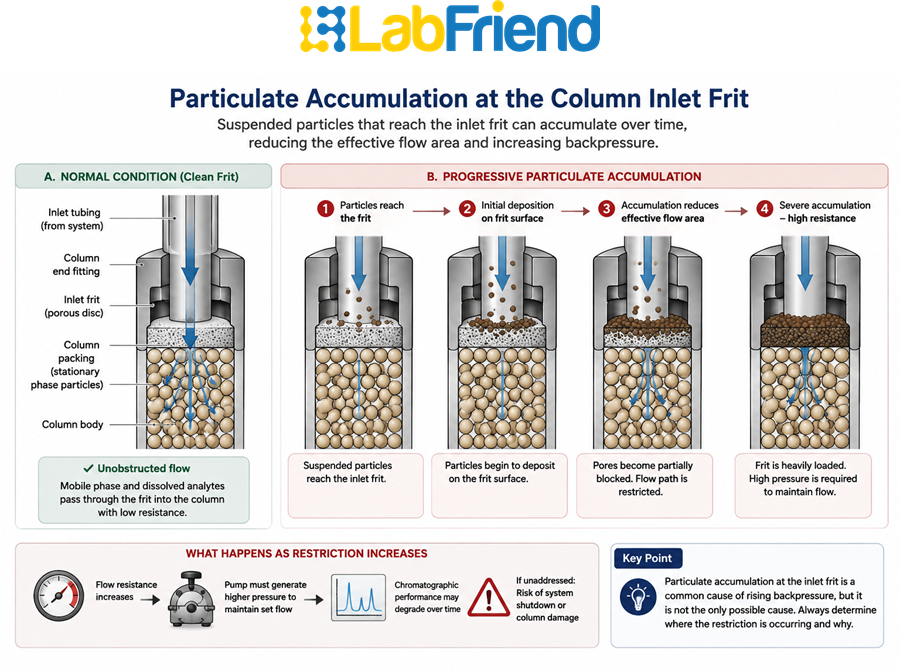
As the effective flow path becomes more restricted, greater pressure is required to maintain the specified flow rate. A laboratory may therefore observe increasing operating pressure even though the column remains capable of producing apparently acceptable chromatography in the early stages of the problem.
This gradual development is one reason particulate-related problems can be difficult to recognise.
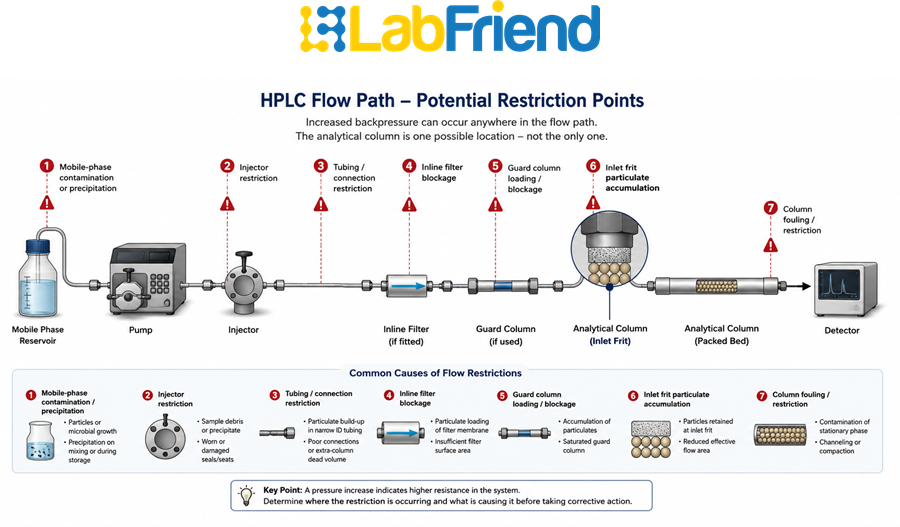
The relationship may look like this:
particulate contamination enters the system → material accumulates at restrictive points → resistance to flow increases → operating pressure rises → analytical performance or system availability may eventually be affected
However, that sequence is only one possible explanation for rising pressure.
Rising Backpressure Is a Symptom, Not a Diagnosis
When system pressure increases unexpectedly, it is tempting to blame the analytical column immediately.
That can lead to unnecessary column replacement.
A more disciplined troubleshooting approach asks:
Where in the flow path does the pressure restriction actually occur?
Potential sources can include:
|
Possible source |
What may be happening |
|
Sample contamination |
Particulates introduced during sample preparation accumulate in the flow path |
|
Column inlet/frit |
Contamination or precipitated material increases resistance |
|
Guard column |
A short protective cartridge upstream of the analytical column; the guard device becomes loaded or restricted |
|
Tubing/connections |
A restriction develops elsewhere in the flow path |
|
Mobile phase |
Particulates or precipitation contribute to restriction |
|
Sample chemistry |
Material precipitates when sample and mobile phase interact |
|
Wider system issue |
The apparent “column problem” originates elsewhere |
This is why laboratories should avoid treating filtration as the answer to every backpressure event.
If pressure remains abnormal even when the column is removed from the relevant flow path, for example, that strongly suggests the investigation needs to look elsewhere. Conversely, a substantial change associated with a particular component can help narrow the investigation.
The exact troubleshooting procedure should follow the instrument and column manufacturers' instructions and the laboratory's approved SOPs.
How Particulate Contamination Reaches an HPLC Column
Samples that appear visually clear are not necessarily free from particles capable of causing problems in a chromatographic system.
Particulate material can originate from many stages of sample preparation, including:
- incomplete dissolution;
- precipitated sample components;
- extraction procedures;
- environmental contamination;
- sample matrices (the non-target material surrounding the analyte, e.g. tissue, soil or formulation components);
- container or closure debris, including septum coring from repeated needle penetration;
- suspended solids; and
- preparation steps that leave fine insoluble material behind.
Some particles may be obvious. Others are too small to be easily recognised by eye.
Once injected, material that is not dissolved in the mobile phase travels into the chromatographic flow path. Depending on particle size, system design and any protective devices in use, particulate matter may be retained before the analytical bed or accumulate at other restrictive points.
This is where sample filtration provides its principal protective function:
It removes appropriate particulate material before the sample enters the chromatography system.
That reduces the particulate burden presented to the injector, guard column and analytical column.
It does not make the sample chemically compatible with the method, prevent every form of precipitation or eliminate all possible causes of column fouling. But it addresses a significant and preventable source of physical contamination.
Why Filtration Problems Often Develop Gradually
One of the challenges for QA/QC laboratories is that poor sample-preparation practice may not produce an immediate failure.
An unfiltered or inadequately filtered sample may run without an obvious pressure alarm.
The next sample may also run successfully.
This can create the impression that filtration is unnecessary.
The problem is that particulate loading can be cumulative. Small amounts of material entering the system repeatedly can progressively increase contamination. LabFriend's existing HPLC/UHPLC guidance similarly notes that consequences of poor filtration may develop gradually rather than appearing immediately.
This makes preventive practice particularly important in laboratories running:
- high sample volumes;
- long analytical sequences;
- routine QC methods;
- repeated batches;
- matrix-heavy samples; or
- multiple instruments using standardised methods.
The absence of an immediate failure is not evidence that particulate control has no value.
Sample Filtration Is Preventive, Not Corrective
This distinction is fundamental.
Filtering tomorrow's samples does not necessarily remove contamination already accumulated within today's HPLC system.
Once a restriction has developed, the laboratory needs to identify its location and determine an appropriate corrective action in accordance with the equipment and column manufacturer's guidance.
Sample filtration operates primarily upstream of the problem.
Its purpose is to reduce the amount of particulate material reaching the chromatographic system in the first place.
That makes filtration analogous to other preventive controls used throughout analytical laboratories: the value comes from reducing the probability and frequency of avoidable problems rather than repairing damage after it has occurred.
Sample Filtration Is Only One Part of Particulate Control
Focusing exclusively on syringe filtration can also create a blind spot.
The sample is not the only liquid entering an HPLC system.
The mobile phase itself needs appropriate preparation and handling — commonly including filtration through a 0.45 µm or 0.22 µm membrane and adequate degassing before use. Contamination can also be introduced through solvents, containers, preparation procedures and environmental exposure.
Precipitation presents another challenge. A sample may initially appear clear but become less soluble when mixed with the mobile phase or when solvent conditions change.
In such cases, filtering the original sample does not necessarily prevent later precipitation.
Effective column protection therefore requires laboratories to consider:
sample preparation + filtration + mobile-phase quality + sample/mobile-phase compatibility + system cleanliness + appropriate protective devices
rather than relying on a syringe filter as a single defence against every source of contamination.
How Proper Sample Filtration Protects the Column
When filtration is appropriate to the analytical method, it reduces the number and size of suspended particles introduced during injection.
This can help:
- reduce particulate loading at the column inlet;
- reduce contamination of protective frits;
- support more stable system pressure;
- protect downstream components;
- improve consistency between analysts;
- reduce avoidable troubleshooting; and
- support longer useful column life.
The important phrase is appropriate to the analytical method.
Filtration itself can introduce analytical problems if the wrong membrane, pore size or device is selected. A membrane may be incompatible with the solvent, adsorb the analyte (bind it to the membrane surface, reducing recovery) or introduce extractables that interfere with detection.
When the troubleshooting process establishes that routine sample filtration should form part of the preventive workflow, the next step is to select a technically appropriate device. See Best Syringe Filters for HPLC and UHPLC Sample Preparation for the detailed membrane and application-selection guidance.
Should Every HPLC Sample Be Filtered?
There is no responsible universal rule stating that every sample in every HPLC method must be filtered in exactly the same way.
The correct requirement depends on factors such as:
- the validated analytical method;
- column characteristics;
- sample matrix;
- sample-preparation procedure;
- expected particulate loading;
- chromatography mode;
- instrument configuration; and
- manufacturer recommendations.
For established regulated methods, the approved method and laboratory SOP take precedence over generic advice.
During method development, filtration should be assessed as part of the complete sample-preparation process. The laboratory needs to establish not only whether the filter removes particulates, but also whether it preserves analyte recovery and avoids introducing analytical interference.
This is why “filter everything with the smallest pore size available” is not good chromatography practice.
Why Smaller Pore Size Is Not Automatically Better
A smaller pore size retains finer particulate material, but that does not automatically make it the optimum choice for every HPLC workflow. It is also worth noting that stated pore ratings are nominal rather than absolute: they describe the size at which a membrane reliably retains a specified proportion of particles, not a strict cutoff below which nothing can pass.
Finer filtration may also:
- reduce filtration speed;
- increase the force required for manual filtration;
- block more quickly with particulate-rich samples; and
- add no useful benefit where the validated method does not require the finer specification.
For many routine HPLC clarification applications, 0.45 µm filtration remains appropriate, while 0.22 µm filtration may be selected where finer particulate control is required by the method, column or application. In some laboratory contexts, 0.22 µm is also associated with “sterilising-grade” filtration terminology, though sterilising-grade validation involves specific microbial-retention testing beyond simple particulate clarification. LabFriend's current filtration guidance makes the same application-dependent distinction rather than treating 0.22 µm as universally superior.
The detailed comparison belongs to the dedicated guide 0.22 µm vs 0.45 µm Syringe Filters: When Should You Use Each?.
The key principle is simpler:
Use the pore size required by the method and protection strategy—not the smallest pore size simply because it appears more protective.
The First Practical Lesson
When an HPLC laboratory experiences recurring backpressure, the right first question is not:
“Which new column should we buy?”
Nor is it:
“Should we change every sample to 0.22 µm filtration?”
The better question is:
“Where is the restriction occurring, what is introducing it, and which preventive control addresses that cause?”
If particulate contamination from sample preparation is contributing to the problem, appropriate filtration can be one of the simplest and most repeatable controls available.
But it works best when implemented as part of a defined chromatography workflow rather than introduced reactively after a column has already become restricted.
Diagnosing HPLC Backpressure Before Blaming the Column
When HPLC pressure begins to rise, replacing the analytical column immediately can be an expensive way to troubleshoot the problem.
The better approach is systematic isolation.
The objective is to determine where resistance has increased within the flow path before deciding why it has happened. A restriction upstream of the column can produce an apparent pressure problem without the analytical column being responsible. Equally, contamination of a guard column or inlet frit can increase pressure while other parts of the system remain unaffected.
For a QA/QC laboratory, this distinction matters because the corrective action depends on the location of the restriction.
A column contaminated with particulate material requires a different response from blocked tubing, a restricted guard column or precipitation elsewhere in the system.
The exact diagnostic procedure should always follow the instrument and column manufacturers' instructions and the laboratory's approved SOPs. However, the underlying troubleshooting principle remains consistent:
Locate the restriction first. Investigate its cause second. Apply the appropriate corrective and preventive action third.
This prevents sample filtration from being prescribed automatically for a problem it may not solve.
Where Can an HPLC Flow Restriction Occur?
The analytical column is only one component within the pressurised flow path.
Depending on system configuration, increased resistance may arise around:
- solvent or mobile-phase pathways;
- injector components, such as a worn needle seat or rotor seal;
- tubing and connections;
- inline filters;
- guard columns;
- column inlet frits;
- the analytical column itself; or
- downstream components.
The location matters.
If particulate material repeatedly reaches a guard column, for example, that device may perform exactly the protective function for which it was installed: capturing contamination before it reaches the more valuable analytical column.
Replacing the guard cartridge may restore performance, but if the underlying source of contamination is not investigated, the same problem may simply recur.
That turns a troubleshooting event into a process-control question:
Why is sufficient contamination reaching the chromatography system to cause repeated restriction?
Sample preparation and filtration should form part of that investigation.
A Practical Troubleshooting Logic
A useful diagnostic framework is to consider the behaviour of the system rather than relying on one symptom alone. Fluctuating or noisy pressure readings, as distinct from a sustained rise, more often point to entrained air or inadequate mobile-phase degassing than to particulate accumulation, and warrant a different first check.
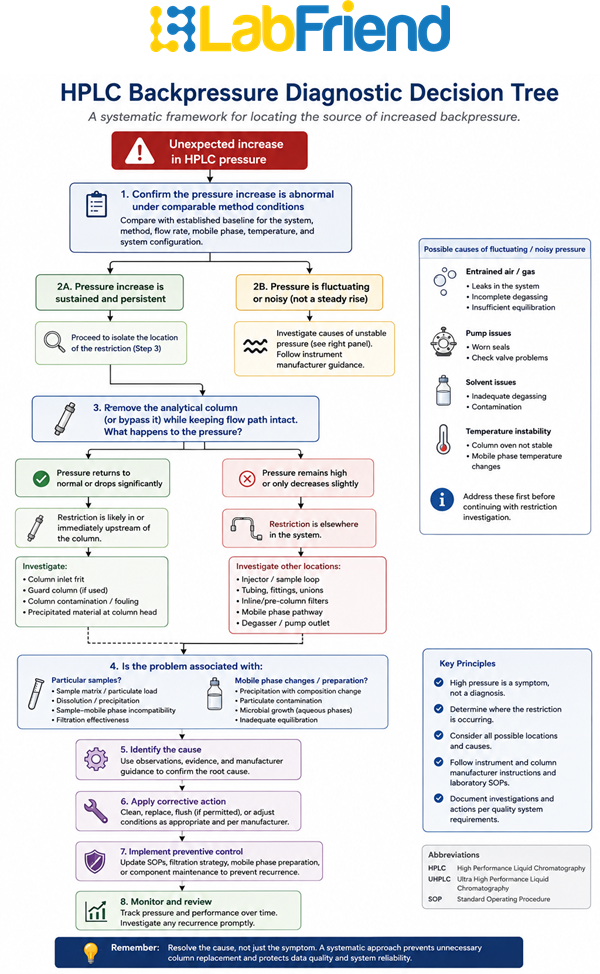
|
Observation |
Possible interpretation |
Investigation direction |
|
Pressure gradually increases over many injections |
Progressive particulate or matrix accumulation may be occurring |
Review sample preparation, filtration, guard column and column inlet |
|
Pressure rises suddenly |
Acute restriction, precipitation or another system problem may have occurred |
Isolate affected components systematically |
|
Guard column replacement reduces pressure |
Restriction may have accumulated in the protective device |
Investigate why contamination is reaching it |
|
Pressure remains high when the analytical column is removed |
Column is unlikely to be the only source of restriction |
Investigate upstream/downstream system components as appropriate |
|
Pressure increase occurs with particular sample types |
Matrix or sample-preparation issue may be contributing |
Review dissolution, precipitation and filtration |
|
Pressure changes after mobile-phase preparation |
Mobile-phase composition, contamination or precipitation may be relevant; incomplete column re-equilibration after a method or solvent change can also produce a similar, transient effect |
Review preparation and compatibility |
These observations are diagnostic clues, not definitive diagnoses. They should be interpreted alongside instrument behaviour, chromatographic performance, the analytical method and manufacturer guidance.
Distinguishing Particulate Blockage From Column Fouling
“Blocked” and “fouled” are sometimes used interchangeably in laboratory conversation, but separating the concepts can improve troubleshooting.
Particulate blockage involves physical material contributing to restriction within the flow path, commonly at a frit, protective device or other restrictive location.
Column fouling can be broader. Sample components may interact with or accumulate on the stationary phase and affect chromatographic behaviour even where there is no simple physical plug at the inlet — commonly through strongly retained matrix components such as proteins or lipids binding irreversibly to reversed-phase media.
A laboratory might therefore experience:
- increasing pressure;
- altered peak shape;
- retention changes;
- reduced efficiency;
- carryover; or
- combinations of these symptoms.
Sample filtration is particularly valuable for controlling suspended particulate contamination.
It does not necessarily remove dissolved compounds responsible for stationary-phase fouling.
This distinction prevents a common mistake: assuming that because a sample passed through a syringe filter, it cannot subsequently contribute to column deterioration.
Filtration removes material according to the characteristics of the filtration process. It does not make every sample chromatographically benign.
Precipitation Can Defeat Otherwise Good Filtration Practice
Another important troubleshooting scenario occurs when the sample is clear when filtered but subsequently precipitates.
Suppose a sample is dissolved in a solvent system in which all components remain soluble. The sample is filtered correctly and appears particle-free.
After injection, however, the sample encounters a mobile phase with substantially different solvent strength, pH or composition — for example, an increase in organic content during a gradient run, or a mismatch in pH or ionic strength, can reduce the solubility of polar or ionic sample components. Some sample components may no longer remain soluble.
In that situation, particulate material can form after filtration.
The original syringe filtration step cannot remove particles that did not yet exist.
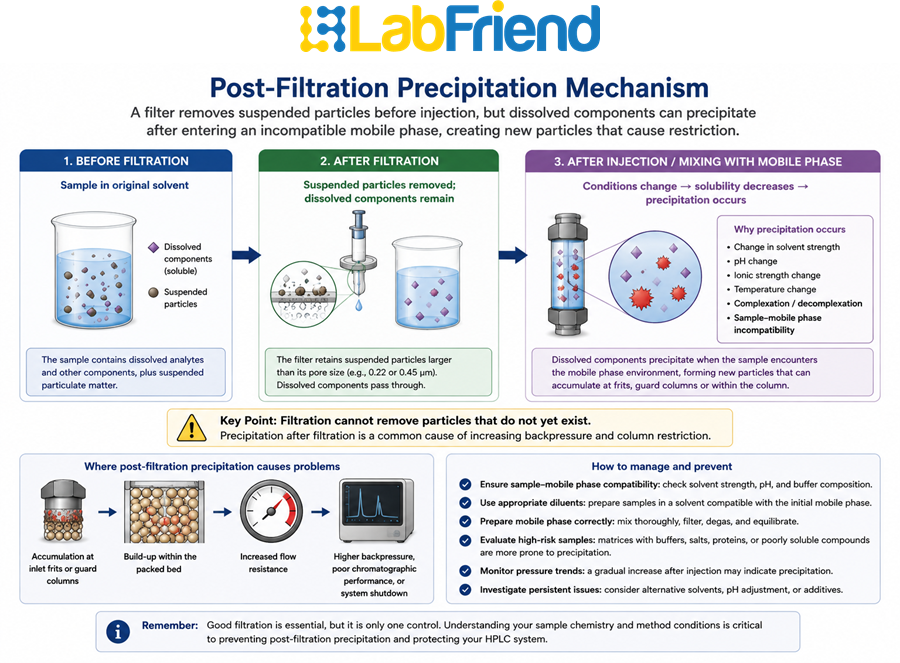
This is why persistent restriction associated with a particular method or sample matrix should trigger consideration of:
- sample solvent;
- mobile-phase composition;
- pH;
- buffer concentration;
- sample concentration; and
- potential incompatibilities that could promote precipitation.
Appropriate filtration remains important, but the root cause may lie in sample/mobile-phase compatibility rather than filtration failure.
The Role of Guard Columns in Column Protection
Guard columns provide another layer of protection upstream of the analytical column, distinct from in-line or pre-column filters: a guard column contains a short bed of stationary phase chemically similar to the analytical column, while an in-line filter is a physical screen with no retentive chemistry of its own.
Their role is to intercept contamination or strongly retained material before it reaches the main analytical bed. In applications where challenging matrices are analysed routinely, this can help protect a more expensive analytical column.
But a guard column should not become an excuse for poor sample preparation.
If large amounts of particulate contamination are routinely introduced, the guard column may become restricted more rapidly, increasing consumable use and system intervention.
A more effective strategy considers the protective measures as complementary:
appropriate sample preparation → appropriate filtration → guard/pre-column protection where required → analytical column
Each stage has a different role.
For a high-throughput QA/QC laboratory, the objective is not simply to move the contamination from an analytical column into a cheaper component. It is to reduce unnecessary contamination entering the system in the first place.
Prefiltration for Difficult Samples
Some samples contain enough particulate matter that direct filtration through a fine final membrane becomes difficult.
Symptoms may include:
- rapidly blocked syringe filters;
- excessive manual pressure;
- very slow filtration;
- inconsistent filtrate volumes; or
- analysts using multiple filters for a single preparation.
Selecting a finer membrane does not necessarily solve this problem. It can make it worse.
Where the analytical method permits it, a staged preparation approach may be more appropriate. Coarser clarification or another suitable sample-preparation step can reduce the particulate load before final filtration.
The principle is similar to protecting the HPLC column itself:
Do not ask the finest filtration stage to carry an unnecessary particulate burden if an appropriate upstream step can remove it first.
Any change to a validated sample-preparation method, however, must be assessed through the laboratory's appropriate method-control and validation procedures.
Filtration Can Introduce Its Own Analytical Errors
A filter that protects the column but changes the sample is not a successful sample-preparation solution.
Syringe-filter selection therefore needs to consider more than particle retention.
Potential problems include:
Analyte adsorption
The membrane may retain some of the analyte, particularly where concentration is low or the analyte interacts strongly with the membrane.
Chemical incompatibility
Sample solvents may attack or alter an unsuitable membrane or housing material. Extremes of pH or high buffer concentrations can also degrade some membrane chemistries over time, even where the solvent itself is nominally compatible.
Extractables
Materials originating from the filtration device can enter the filtrate and potentially create interfering signals. Common sources include plasticisers, antioxidants and surfactants used in membrane or housing manufacture; these are particularly relevant to LC-MS work, where trace-level extractables can suppress or enhance ionisation and distort quantitation.
Insufficient flushing or unsuitable handling
The way the filtration device is used can influence recovery and contamination.
Inappropriate pore size
Using a pore size that does not match the method or protection requirement can provide inadequate particulate control or introduce unnecessary filtration resistance.
This is why Article #17 treats filter selection as a specialist hand-off rather than attempting to duplicate the buying guidance already established elsewhere in the filtration cluster.
For membrane compatibility, solvent considerations and HPLC/UHPLC filter selection, refer to Best Syringe Filters for HPLC and UHPLC Sample Preparation.
Why 0.22 µm Is Not Automatically the Correct Answer
When laboratories experience column problems, moving from 0.45 µm to 0.22 µm filtration can appear to be an obvious corrective action.
Sometimes finer filtration may be appropriate.
But the decision should be supported by the analytical method and the characteristics of the chromatography rather than by the assumption that smaller is always better.
Pore-size selection needs to consider the required level of particulate control alongside practical factors such as:
- sample particulate loading;
- filtration speed;
- filter capacity;
- sample volume;
- validated method requirements; and
- column/system recommendations.
A finer filter that repeatedly blocks during sample preparation can create a different operational problem without addressing the actual cause of the HPLC pressure increase.
The dedicated guide 0.22 µm vs 0.45 µm Syringe Filters: When Should You Use Each? covers that pore-size decision in detail.
For the present troubleshooting problem, the governing principle remains:
Select filtration according to the method and the particulate-control requirement, not simply according to the smallest available pore size.
Common Filtration Mistakes That Can Still Expose an HPLC Column
Even laboratories that routinely filter samples can experience preventable particulate problems if the filtration process itself is inconsistent.
Filtering only visibly dirty samples
A sample does not need to appear cloudy to contain particles relevant to an HPLC flow path. Selective filtration based solely on visual appearance can therefore create inconsistent sample preparation.
Using whatever syringe filter is available
Filters with the same nominal pore size may use different membrane materials and have different compatibility or binding characteristics. Convenience is not a technical specification.
Changing filter type without assessing the method
A seemingly minor consumable substitution can affect analyte recovery, extractables or filtration behaviour.
Applying excessive force to a blocked filter
A rapidly fouling syringe filter is information about the sample. Simply increasing manual force does not address why the device is blocking and may create an inconsistent preparation process.
Allowing filtration practice to vary between analysts
If one analyst filters every sample according to the method while another treats filtration as optional, the chromatography system receives inconsistent particulate loading.
For QA/QC environments, repeatability of sample preparation is part of repeatability of the analytical workflow.
Building Filtration Into the SOP
Where filtration is required by the method, the strongest preventive approach is to specify it clearly rather than leaving individual analysts to make ad hoc decisions.
A controlled sample-preparation procedure may define:
- approved filter membrane;
- pore size;
- filter dimensions where relevant;
- sample volume;
- required conditioning or discard volume where validated;
- filtration technique;
- permitted product alternatives; and
- change-control requirements.
This converts filtration from a purchasing choice into a controlled analytical process.
It also makes procurement more reliable. If the laboratory knows the technically approved specification, purchasing teams can maintain suitable stock and avoid emergency substitutions when a preferred filter is unavailable.
Repeated Filter or Column Blockage Is a Process Signal
A laboratory that repeatedly blocks syringe filters, guard columns or analytical columns should not treat each occurrence as an isolated consumable failure.
Repetition suggests that the workflow deserves investigation.
Questions worth asking include:
- Has the sample matrix changed?
- Has sample concentration increased?
- Is dissolution complete?
- Is precipitation occurring?
- Has the filtration specification changed?
- Are analysts following the same procedure?
- Has a filter or membrane been substituted?
- Is the mobile phase being prepared consistently?
- Is the guard column being replaced unusually frequently?
- Is pressure deterioration associated with one method, product or sample type?
This moves the laboratory from reactive replacement towards root-cause prevention.
For a QA/QC Manager, that shift is particularly valuable because recurring chromatography problems consume much more than columns. They consume analyst time, instrument capacity and confidence in the analytical process.
A Preventive HPLC Column-Protection Workflow
A practical routine can be summarised as follows:
- Understand the sample matrix
Identify particulate, solubility and compatibility risks. - Follow the validated preparation method
Do not introduce filtration changes casually. - Use an appropriate filtration specification
Select membrane and pore size for the method rather than convenience. - Control mobile-phase preparation
Sample filtration cannot compensate for contamination introduced elsewhere. - Use complementary protection where appropriate
Guard columns or other protective devices may provide an additional barrier. Storing columns in a manufacturer-recommended solvent and flushing the system appropriately at start-up and shutdown also reduces the risk of contamination or precipitation-related restriction unrelated to sample filtration. - Monitor pressure trends
A gradual change can provide an earlier warning than waiting for a pressure-limit failure. - Investigate recurring restriction
Repeated blockage should trigger root-cause analysis rather than repeated component replacement.
The value of this framework is consistency. No individual step guarantees that an HPLC column will never become restricted, but together they reduce avoidable particulate exposure and make abnormal behaviour easier to diagnose.
What Proper Filtration Will Not Fix
A technically credible column-protection strategy needs to be explicit about the limits of filtration.
Proper sample filtration will not necessarily correct:
- contamination already accumulated in the column;
- precipitation occurring after filtration;
- chemically incompatible sample/mobile-phase combinations;
- strongly retained dissolved matrix components;
- blocked tubing elsewhere in the system;
- injector or valve restrictions;
- inappropriate mobile-phase preparation;
- column damage;
- incorrect method conditions; or
- other instrument faults.
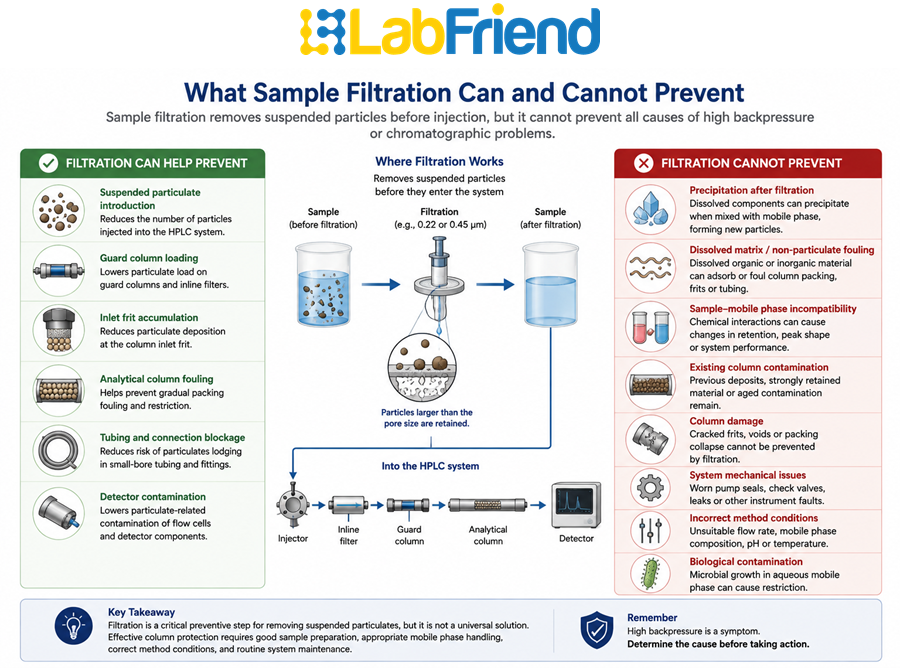
This is why the title of this article should be interpreted carefully.
Proper filtration helps prevent particulate-related, preventable column restriction. It is not a universal remedy for every HPLC pressure or performance problem.
That distinction is important both technically and commercially. The objective should be to help laboratories purchase and use filtration products where they genuinely solve a defined problem—not to attribute unrelated chromatography faults to the absence of a consumable.
From Troubleshooting to Prevention
Once a laboratory establishes that particulate contamination is contributing to recurring HPLC restrictions, the next question is not simply which filter to order.
The stronger question is:
How do we make appropriate particulate control repeatable across every relevant sample, analyst and instrument?
That requires the laboratory to connect method requirements, filtration specifications, analyst practice, stock availability and troubleshooting data.
When those elements are aligned, filtration stops being an incidental sample-preparation purchase and becomes part of the laboratory's routine column-protection strategy.
Turning HPLC Column Protection Into a Repeatable QA/QC Process
For a QA/QC laboratory, the objective is not simply to solve one blocked-column incident. The greater value comes from reducing the likelihood that the same preventable problem occurs repeatedly.
That requires moving from reactive troubleshooting to a controlled column-protection strategy.
If investigation shows that particulate contamination is contributing to recurring restrictions, filtration should become a defined part of the analytical workflow rather than something individual analysts apply according to preference. The laboratory should understand what is being filtered, why filtration is required, which specification has been demonstrated to work and how changes to that specification will be controlled.
This is particularly important in laboratories running repetitive methods. A small inconsistency repeated across hundreds of sample preparations can become much more significant than an isolated error.
The strongest approach therefore combines method control, appropriate filtration, analyst consistency, suitable stock availability and pressure-trend monitoring.
A QA/QC Framework for Preventing Particulate-Related Column Problems
A practical prevention programme can be organised around five areas.
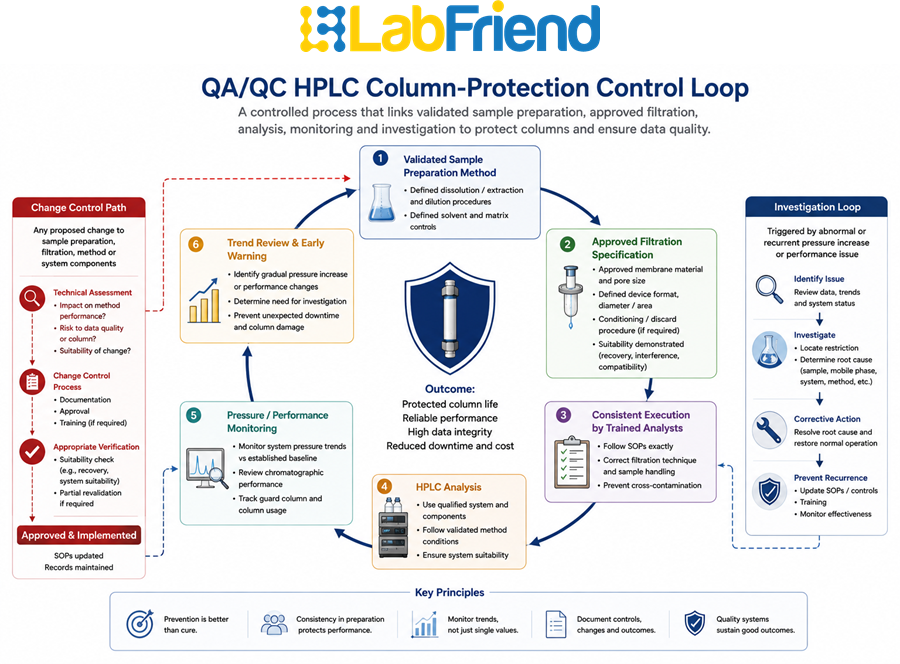
1. Control the Sample-Preparation Method
Where filtration forms part of an established analytical method, the procedure should define it clearly enough for different analysts to prepare samples consistently.
The specification may need to identify membrane chemistry, pore size, filter format and any validated conditioning or discard requirements.
The objective is not to create unnecessary procedural detail. It is to control those filtration variables capable of affecting either particulate removal or analytical recovery.
2. Standardise Approved Filtration Products
Repeatedly purchasing different filters simply because their catalogue descriptions appear similar introduces avoidable variability.
Two syringe filters can share the same diameter and nominal pore size while differing in membrane chemistry, housing material, binding behaviour, extractables and application suitability.
Where practical, QA/QC laboratories should establish approved filtration specifications for recurring methods and define how alternative products are assessed before substitution.
3. Monitor HPLC Pressure Trends
Pressure monitoring can provide useful early evidence of developing restrictions.
Rather than waiting until the instrument reaches a pressure limit or an analytical sequence fails, laboratories can investigate unexpected changes against the normal behaviour of the established method.
A gradual pressure increase does not prove particulate contamination, but it provides a useful trigger for investigation. Maintaining a simple pressure-trend log against method and column identity makes this comparison practical and supports later root-cause investigations.
4. Investigate Repeated Consumable Failure
Repeated blockage of syringe filters, guard columns or column inlet frits should be treated as information.
If the same problem occurs regularly, repeatedly replacing the affected consumable may address the immediate symptom without correcting the underlying process.
5. Control Changes
Changes to sample preparation, filter specification, sample solvent or other method variables should be assessed according to the laboratory's quality system.
This is particularly important where the analytical procedure is validated.
Column Protection Should Be Considered as a System
One of the central lessons from HPLC troubleshooting is that no single consumable protects the analytical column in isolation.
Effective protection can involve several complementary controls:
appropriate sample preparation → particulate control → suitable filtration → clean mobile phase → guard/pre-column protection where required → controlled chromatography conditions
The relative importance of each depends on the application.
For relatively clean standards, particulate loading may be low. For complex extracted samples, environmental matrices or formulations containing insoluble material, sample preparation may require considerably more attention.
This is why a standard rule such as “all HPLC samples should use the same syringe filter” is rarely an adequate laboratory strategy.
Standardisation is valuable when it standardises a technically appropriate process. It becomes counterproductive when it forces materially different samples through a single filtration specification regardless of compatibility or analytical requirements.
What to Check Before Purchasing HPLC Sample Filters
Once filtration has been identified as an appropriate column-protection measure, product selection should begin with the analytical method rather than price or availability alone.
Laboratories should consider the following factors.
|
Requirement |
Why it matters |
|
Membrane chemistry |
Determines compatibility with sample solvents and can influence analyte binding |
|
Pore size |
Determines the level of particulate removal and should reflect method requirements |
|
Filter diameter / area |
Influences capacity, hold-up volume (the volume of sample retained within the filter and unavailable for injection) and practical throughput |
|
Sample volume |
Helps determine an appropriate device format and size |
|
Sample matrix |
Influences particulate loading and risk of premature filter blockage |
|
Analyte recovery |
Important where adsorption to the membrane could affect reported results |
|
Extractables |
Potentially relevant to sensitive analytical detection |
|
Housing compatibility |
Device materials must tolerate the sample solvent and conditions |
|
Method status |
Validated methods may restrict substitutions or require formal assessment |
These considerations reinforce why filtration products should not be treated as interchangeable solely because the nominal pore size matches.
Detailed product-selection guidance belongs to Best Syringe Filters for HPLC and UHPLC Sample Preparation, while the dedicated 0.22 µm vs 0.45 µm Syringe Filters: When Should You Use Each? guide addresses pore-size selection in greater depth.
Standardisation Can Reduce More Than Consumable Complexity
For laboratories processing significant numbers of HPLC samples, filtration standardisation can deliver benefits beyond easier purchasing.
An approved specification can help ensure that:
- analysts use the same filtration approach for the same method;
- suitable products are available when required;
- emergency substitutions are reduced;
- method transfer between analysts or sites is more consistent;
- filtration-related troubleshooting becomes easier; and
- purchasing teams can consolidate predictable repeat demand.
This is commercially important because the cheapest filter on an individual purchase order is not necessarily the lowest-cost filtration strategy.
A filter that is unsuitable for the sample may introduce analyte loss or interference. A filter that blocks repeatedly may increase preparation time and consumption. Inconsistent filtration may also make it harder to identify whether recurring chromatography problems originate in the sample-preparation process.
The appropriate objective is therefore controlled total workflow performance, not simply minimum unit price.
For LabFriend, this also creates a natural opportunity to support customers beyond an initial consumables purchase. Once a laboratory has established technically appropriate filtration specifications, those requirements can become predictable repeat purchasing rather than a series of unrelated spot orders.
When Should a Laboratory Review Its Filtration Practice?
Filtration practice should not need to be reconsidered after every analytical run. However, certain events provide a sensible reason for review.
These include:
- recurring increases in HPLC backpressure;
- repeated guard-column restriction;
- unexpectedly short column life;
- changes in sample matrix;
- introduction of a new analytical column or method;
- changes to sample solvent;
- repeated syringe-filter blockage;
- unexplained analyte-recovery problems;
- replacement or discontinuation of an existing filtration product; or
- recurring analyst-to-analyst variation in sample preparation.
The purpose of the review is not to assume that filtration is responsible. It is to determine whether filtration remains technically appropriate within the wider analytical workflow.
When Filtration Is Not the Answer
A good troubleshooting article should help laboratories recognise when not to purchase another filtration product.
If investigation shows that the pressure restriction originates elsewhere in the HPLC system, changing syringe filters is unlikely to resolve the problem.
Likewise, filtration cannot correct inappropriate chromatography conditions, repair a damaged column or prevent a dissolved sample component from fouling a stationary phase simply because the component passed through the membrane.
If precipitation occurs only after the filtered sample encounters the mobile phase, the solution may require changes to sample preparation or method conditions rather than finer filtration.
The correct commercial recommendation in those situations is not “use more filtration”. It is to identify the actual source of the problem.
That distinction protects technical credibility and ultimately supports better purchasing decisions.
HPLC Column Blockage: A Practical Decision Framework
When recurring backpressure or apparent column blockage occurs, the following sequence provides a useful starting point.
Backpressure has increased
↓
Confirm the change is abnormal for the established method
↓
Systematically identify where the additional restriction occurs
↓
Determine whether particulate contamination is a credible contributor
↓
If yes: investigate its source
Sample?
Mobile phase?
Precipitation?
Guard column?
Sample-preparation inconsistency?
↓
Review whether the current filtration specification adequately controls the identified particulate risk
↓
Verify membrane compatibility, pore size and analytical recovery
↓
Standardise the corrected workflow where appropriate
↓
Monitor whether the problem recurs
This framework deliberately puts diagnosis before product selection.
That is the key difference between preventive chromatography practice and simply responding to every pressure problem by replacing consumables.
Frequently Asked Questions
Why does HPLC column backpressure increase?
Increasing HPLC backpressure means resistance to flow has increased somewhere within the chromatographic system. Potential causes include particulate accumulation, restricted frits or protective devices, precipitation, contamination, tubing restrictions and other system or method-related problems.
The pressure increase should therefore be investigated systematically rather than automatically attributed to the analytical column.
Can unfiltered samples block an HPLC column?
They can contribute to particulate-related restriction.
Suspended material introduced with samples can accumulate at restrictive points such as guard devices or the column inlet frit. The effect may be gradual because small amounts of particulate contamination can accumulate across repeated injections.
Appropriate filtration reduces this particulate burden before injection.
Does filtering samples prevent HPLC columns from blocking?
Filtration can help prevent particulate-related restrictions when the filtration method is appropriate for the sample and chromatography.
It cannot prevent every cause of HPLC backpressure or column deterioration. Precipitation after filtration, dissolved matrix fouling, system restrictions and other problems require different corrective measures.
Should I use a 0.22 µm or 0.45 µm syringe filter for HPLC?
The appropriate pore size depends on the analytical method, column, sample and required level of particulate control.
A smaller pore size should not automatically be regarded as better. The validated method and relevant manufacturer recommendations should govern the final specification.
For detailed guidance, see 0.22 µm vs 0.45 µm Syringe Filters: When Should You Use Each?.
Can I use the same syringe filter for every HPLC method?
Not necessarily.
Different samples and solvent systems can require different membrane characteristics. An appropriate filter should provide the required particulate control while remaining chemically compatible and maintaining acceptable analyte recovery.
Why does my syringe filter keep blocking?
Repeated blockage usually indicates that the membrane is receiving more particulate material than it can conveniently accommodate for the chosen filter area and pore size.
Possible responses include investigating incomplete dissolution, sample precipitation or high particulate loading and, where the analytical method permits, evaluating an appropriate upstream clarification strategy or different filter configuration.
Simply applying greater pressure does not address the underlying cause.
Can a syringe filter affect HPLC results?
Yes.
An unsuitable filter can potentially influence analyte recovery through adsorption, chemical incompatibility or extractables. Filter selection should therefore be evaluated as part of sample preparation rather than considered solely as an instrument-protection step.
Do guard columns remove the need for sample filtration?
No.
Guard columns and sample filtration perform complementary protective roles. A guard column can protect the analytical column from contamination reaching the chromatographic flow path, while appropriate sample filtration reduces the particulate burden entering that flow path in the first place.
Reducing HPLC Downtime Starts Before Injection
When a column becomes restricted, the visible problem occurs inside the chromatography system. The cause may have entered much earlier in the workflow.
That is why effective column protection begins during sample and mobile-phase preparation.
For QA/QC laboratories, the strongest strategy is not to assume every pressure problem is caused by particulates. It is to establish a repeatable process for diagnosing abnormal backpressure, identify when particulate contamination is contributing, and then control that contamination consistently.
Where sample filtration is appropriate, the filter should be treated as part of the analytical method rather than an incidental accessory.
Correct membrane selection protects the integrity of the sample. Appropriate pore-size selection controls the required particulate burden. Consistent analyst practice makes that protection repeatable. Monitoring pressure behaviour then helps the laboratory identify when something has changed.
Together, those controls can reduce avoidable interruptions and help protect valuable chromatography columns without overstating what filtration can achieve.
Choosing HPLC Filtration Products
Once the laboratory has established that sample filtration is an appropriate preventive control, the next step is to define the correct product specification.
LabFriend supports HPLC and UHPLC sample-preparation workflows across membrane materials, pore sizes and filtration formats. Product selection should follow the technical requirements of the method rather than begin with a preferred membrane or the smallest available pore size.
For detailed selection guidance, use Best Syringe Filters for HPLC and UHPLC Sample Preparation.
Common Filtration Mistakes in Analytical Laboratories and How to Avoid Them | LabFriend UK
Conclusion
HPLC columns can become restricted when particulate material accumulates at the inlet frit or elsewhere within the chromatographic flow path, but increasing backpressure should never be treated as proof that poor sample filtration is responsible.
The correct response is diagnosis first.
Laboratories should establish whether the pressure increase is genuinely abnormal, identify where the additional resistance is occurring and investigate its cause. Where particulate contamination from sample preparation is contributing, appropriate filtration provides a practical preventive control by reducing the particulate burden entering the chromatography system.
That does not mean using the finest filter available for every sample. Membrane chemistry, pore size, sample matrix, analyte recovery and method requirements all need to be considered together.
Nor does filtration replace good mobile-phase preparation, appropriate guard-column use, compatible sample chemistry or systematic HPLC troubleshooting.
For QA/QC laboratories, the greatest benefit comes from making those principles repeatable:
diagnose the restriction → identify the contamination source → select the appropriate control → validate the filtration specification where required → standardise the workflow → monitor recurrence.
That turns filtration from a disposable accessory into part of a deliberate HPLC column-protection strategy—helping laboratories reduce preventable particulate loading, improve consistency and minimise avoidable chromatography downtime.
Read More
Continue exploring HPLC sample preparation and laboratory filtration:
- Best Syringe Filters for HPLC and UHPLC Sample Preparation
- 0.22 µm vs 0.45 µm Syringe Filters: When Should You Use Each?
- The Ultimate Guide to Laboratory Filtration for UK Laboratories
Written by: Donal O’Sullivan, BSc, Co-Founder and Sales Director, LabFriend UK. Donal brings deep chemistry-led technical expertise across analytical chemistry, biochemistry, environmental monitoring, laboratory instrumentation, consumables and scientific product selection.
Reviewed by: Michael Anderson, MBA, Founder and Managing Director, LabFriend UK. Michael reviews LabFriend UK content for customer relevance, commercial accuracy, operational practicality and alignment with LabFriend UK’s laboratory supply model.
Related Stories

Extractables and Leachables in Analytical Filtration Explained
Extractables and Leachables in Analytical Filtration Explained

How Lab Managers Can Standardise Centrifuge Tube Purchasing Without Increasing Technical Risk
How Lab Managers Can Standardise Centrifuge Tube Purchasing Without Increasing Technical Risk

Low Protein Binding Membranes Explained for Laboratory Filtration
Low Protein Binding Membranes Explained for Laboratory Filtration

Choosing Tube Racks for 15mL and 50mL Centrifuge Tubes
Choosing Tube Racks for 15mL and 50mL Centrifuge Tubes