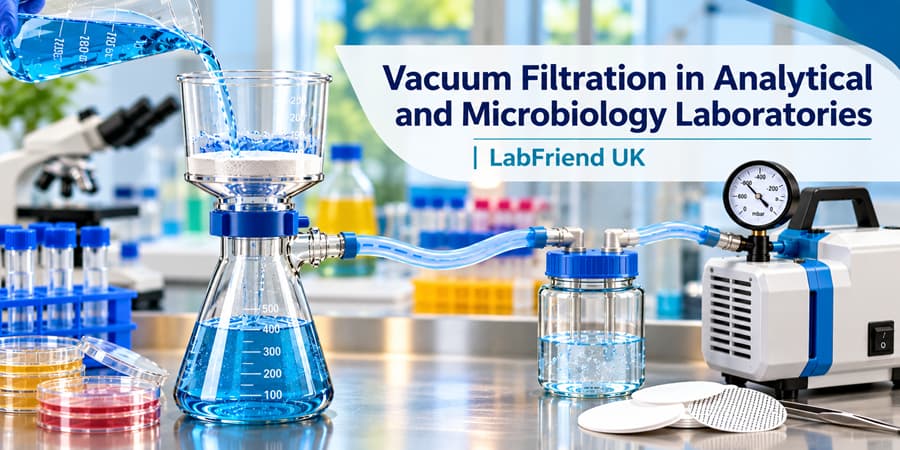
Vacuum Filtration in Analytical and Microbiology Laboratories
22 mins read
Vacuum Filtration in Analytical and Microbiology Laboratories
By Donal O’Sullivan, BSc. Reviewed by Michael Anderson, MBA.
Vacuum filtration can make routine laboratory filtration
faster and more practical, particularly when processing volumes or particulate
loads make gravity filtration inefficient. But applying a stronger vacuum is
not, by itself, a filtration strategy. The filter medium, filtration area,
holder or filtration unit, receiving vessel, vacuum source and connections all
need to work as a complete system. |
Key Takeaways
- Define
what the filtration step needs to achieve before selecting
equipment.
- Vacuum
provides the pressure differential that drives filtration; it does not
determine particle retention, sterility, chemical compatibility or
analytical suitability.
- Treat
the filter medium, filtration area, holder or filtration unit, receiving
vessel, vacuum source and connections as a complete filtration system.
- Match
filtration area and format to the volume, particulate loading and
required throughput rather than assuming that stronger vacuum will
solve poor flow.
- Check
the compatibility and operating limits of all relevant sample-contacting
and vacuum-system components.
- In
analytical work, consider whether removing particulate material could
alter the fraction of the sample that is subsequently measured.
- Once a suitable setup has been established, defining the important equipment and operating requirements can improve consistency between routine filtration runs.
Where Vacuum Filtration Fits in the Laboratory
Filtration separates material by passing a liquid or gas
through a filter medium that retains material according to the characteristics
of that medium and the process.
In vacuum filtration, reduced pressure on the downstream
side of the filter creates a pressure differential that helps move liquid
through the filter. This can make filtration more practical where gravity alone
would be too slow for the required workflow.
The technique can be useful across different laboratory
activities. An analytical laboratory may need to separate suspended solids from
a liquid before a defined downstream procedure. A microbiology laboratory may
use vacuum-driven filtration where a membrane or other filter medium forms part
of a specific sample-processing workflow.
Those applications should not be treated as technically
identical. The purpose of filtration, the material being processed and the
required downstream result determine what filter medium and system are
appropriate.
For broader guidance on filtration approaches and selection
principles, see the Ultimate Guide to Laboratory Filtration for UK Laboratories.
A Practical Vacuum Filtration Workflow
A useful sequence is:

Following this sequence helps prevent equipment choice from
driving the technical decision backwards.
1. Define the Filtration Objective
Start with the required outcome.
Depending on the application, filtration may be intended to:
- remove
suspended particulate material;
- collect
particulate material on a filter for subsequent examination;
- separate
solids from a liquid phase;
- prepare
a liquid for a defined downstream analytical step;
- process
a sample through a membrane as part of a microbiology workflow; or
- achieve
another clearly defined separation.
The filtration objective determines what needs to be
retained and what needs to pass through the filter.
This distinction is particularly important in analytical
laboratories. If an analyte is associated with suspended material, removing
that material can alter the fraction presented to the subsequent analytical
method. A clear filtrate is therefore not automatically a more appropriate
analytical sample.
The laboratory should first establish what fraction or
material the method requires and then decide whether vacuum filtration is
suitable for producing it.
2. Characterise the Material Being Filtered
The behaviour of a vacuum filtration system depends partly
on the material passing through it.
Relevant characteristics can include:
- sample
or liquid composition;
- solvent
conditions;
- pH
or other chemically relevant conditions;
- volume;
- quantity
and nature of suspended material;
- expected
particulate loading;
- viscosity;
- temperature
where relevant; and
- sensitivity
to contamination, adsorption or other interactions with sample-contacting
surfaces.
Particulate loading deserves particular attention. A filter
can initially provide acceptable flow but progressively become more resistant
as retained material accumulates.
Increasing vacuum is not necessarily the correct response.
The filtration area, filter medium, particulate capacity or overall filtration
approach may need reconsideration instead.
3. Establish the Required Filter Performance
Vacuum drives the process, but the filter medium performs
the separation.

Selection therefore still depends on characteristics such as
the required retention behaviour, material compatibility and the intended
downstream use of the filtrate or retained material.
The article's focus is the complete vacuum workflow rather
than detailed membrane or filter-paper selection. Where specialist filter
selection is required, it should be addressed separately rather than assuming
that one medium is appropriate for all vacuum filtration applications.
For example, a filter used to collect particulate material
for examination may have a different purpose from one used to prepare a liquid
for subsequent analysis.
Similarly, microbiology applications can have specific
requirements that go beyond simply producing a visually clear filtrate. Vacuum
filtration should not be assumed to provide sterilising filtration merely
because a particular membrane pore size is used. Where sterilising filtration
is required, use a filter with manufacturer-supported sterilising-grade
performance and establish that the filtration process is suitable for the
product, process conditions and intended application, including any validation
or integrity-testing requirements that apply to that workflow.
4. Select the Filtration Format and Effective Area
Once the required separation is understood, consider how the
filter will be incorporated into the vacuum system.
Depending on the application, the laboratory may use a
reusable filter holder, funnel arrangement, filtration flask, membrane-based
filtration assembly or another purpose-designed vacuum filtration device.
The appropriate format depends on factors including:
- sample
volume;
- effective
filtration area;
- particulate
loading;
- required
collection of filtrate or retained material;
- practical
throughput;
- compatibility
with the liquid;
- cleaning
or single-use requirements where applicable; and
- how
the filtration step connects with the rest of the laboratory workflow.
Effective filtration area can materially affect practical
performance. If too little area is available for a high particulate load,
resistance may increase rapidly and filtration can become slow or impractical.
Conversely, selecting equipment substantially larger than
required does not automatically improve the process. The filtration format
should fit the scale and purpose of the work.
5. Check Compatibility and Operating Limits
Chemical compatibility must be considered for the actual
conditions of use.
The filter medium is important, but it is not the only
material that may contact the sample. Depending on the system, the liquid may
also contact a funnel or housing, seals, tubing, connectors and the receiving
vessel.
Where compatibility needs detailed evaluation, see How UK Laboratories Can Validate Filtration Membrane Chemical Compatibility.
The vacuum side of the system also has operating
requirements. Components should be used within their manufacturer-specified
limits, including applicable vacuum, pressure, temperature and
chemical-resistance conditions. Where the sample can generate volatile,
corrosive or hazardous vapours, assess the suitability of the vacuum source,
any required trapping or vapour-control measures, and the safe handling of pump
exhaust.
A laboratory should not assume that a vessel, holder or
connection is suitable for vacuum merely because it can be physically assembled
into the system.
6. Configure the Complete Vacuum Filtration System
A vacuum filtration workflow is only as appropriate as the
complete setup.

|
System element |
What to establish |
Why it matters |
|
Filter medium |
Required separation and application suitability |
Determines what is retained and what passes through |
|
Filtration area and format |
Appropriate area and device type for the volume and
particulate load |
Influences capacity and practical throughput |
|
Holder or filtration unit |
Compatibility with the filter and process |
Supports correct positioning, sealing and operation |
|
Receiving vessel |
Suitability for the liquid and intended vacuum conditions |
Provides appropriate filtrate collection |
|
Vacuum source |
Suitable vacuum capability for the intended system |
Provides the pressure differential driving filtration |
|
Tubing and connections |
Appropriate materials, dimensions and secure connections |
Helps maintain the required vacuum and system integrity |
The individual components should be considered together
rather than selected independently.
For laboratories building or replacing the vacuum source
within such a system, LabFriend UK provides a range of laboratory
vacuum pumps for filtration workflows.
The pump should still be selected around the requirements of
the complete filtration setup rather than simply choosing the highest available
vacuum specification.
7. Manage Flow, Blockage and Loss of Vacuum
A well-configured system should provide practical filtration
without requiring the operator to compensate continually for avoidable
problems.

Filtration becomes progressively slower
A common cause is increasing resistance as particulate
material accumulates on or within the filter.
Consider whether:
- the
particulate load is higher than expected;
- the
available filtration area is appropriate;
- the
filter medium is suitable for the application; or
- a
different workflow is needed for heavily loaded material.
Simply increasing vacuum may not address the underlying
cause and may exceed the operating limits of the filter or other system
components.
Little or no vacuum develops
Check the complete vacuum path.
Loose tubing, poor seals, unsuitable connections or leaks
around the filtration assembly can prevent the required pressure differential
from developing even when the pump itself is functioning.
Filtration is slow from the beginning
The selected filter medium, effective filtration area,
liquid characteristics or vacuum arrangement may not be appropriate for the
process.
Rather than treating slow flow as a pump problem
automatically, review the complete system.
Liquid approaches the vacuum source
The system should be configured to prevent liquid from being
drawn into the vacuum source or vacuum line. Where liquid carryover is
possible, use an appropriate trap or other protective arrangement between the
filtration assembly and the vacuum source. Additional protection may be
required for volatile, corrosive, hazardous or biologically contaminated
materials. Select the protective configuration for the material being filtered
and the vacuum system in use, and follow the equipment manufacturer’s operating
instructions.
8. Consider Contamination and Sample Integrity
Vacuum filtration is a sample-contact process.
In analytical work, the filtration system can potentially
affect the material subsequently measured through mechanisms such as
adsorption, removal of particulate-associated material, extractables or other
contamination from sample-contacting components.
The significance depends on the analytical method and
sample. It should therefore be assessed according to the requirements of the
application rather than assumed to be negligible or universally important.
Microbiology workflows can have different
contamination-control requirements. Where the objective involves microbial
retention or maintaining sterility, those requirements need to be established
independently. A vacuum source does not turn an otherwise unsuitable filtration
setup into a sterilising process.
This distinction keeps the equipment decision subordinate to
the actual laboratory method.
9. Establish a Repeatable Routine Setup
Once a vacuum filtration arrangement has been shown to be
suitable for a routine application, define the characteristics that need to
remain controlled.
These may include:
- filtration
objective;
- approved
filter medium or required filter specification;
- filtration
area and device format;
- receiving
vessel;
- vacuum
source;
- applied
vacuum or pressure differential where it materially affects filtration
performance;
- tubing
and connection arrangement;
- relevant
operating limits;
- sample
volume or loading conditions; and
- any
application-specific contamination or handling controls.
The level of control should reflect the importance of the
filtration step.
For routine testing laboratories, the objective is not
unnecessary complexity. It is to avoid repeatedly rebuilding the filtration
decision or making apparently minor equipment substitutions that could
materially change the process.
Choosing Vacuum Filtration Equipment as a Complete System
Vacuum filtration works best when the laboratory treats it
as a defined workflow rather than a collection of interchangeable components.
Start with what the filtration step needs to achieve.
Establish what must be retained and what must pass through the filter.
Characterise the liquid and particulate load. Then select the filter,
filtration area, holder or unit, receiving vessel, vacuum source and
connections around those requirements.
Only after technical suitability has been established should
the laboratory optimise the setup for routine throughput and convenience.
LabFriend UK offers laboratory vacuum pumps for filtration and other laboratory vacuum applications. For
microbiology-specific workflows, you can also browse microbiology filtration equipment. Individual products should be checked
against the technical and operating requirements of the particular application.
Frequently Asked Questions
What is vacuum filtration used for in laboratories?
Vacuum filtration uses a pressure differential to help move
liquid through a filter medium. Laboratories can use it for applications
including particulate removal, solid-liquid separation, collection of retained
material and defined analytical or microbiology sample-processing workflows.
Is vacuum filtration faster than gravity filtration?
Vacuum can increase the pressure differential driving
filtration, but practical filtration rate also depends on the filter medium,
filtration area, liquid characteristics and particulate loading. A poorly
selected or blocked filter may remain slow even when vacuum is applied.
What equipment is needed for laboratory vacuum
filtration?
A typical setup requires an appropriate filter medium and
holder or filtration unit, a suitable receiving vessel, a vacuum source and
compatible tubing or connections. The exact configuration depends on the
filtration objective, sample, volume and operating requirements.
Why does vacuum filtration become slow or stop?
Filtration commonly slows as retained particulate material
increases resistance through the filter. Insufficient filtration area,
unsuitable filter selection, liquid characteristics or problems with the vacuum
system can also contribute, so the complete setup should be reviewed rather
than automatically increasing vacuum.
Can vacuum filtration sterilise a liquid?
Vacuum itself does not sterilise a liquid. Where sterilising
filtration is required, use a filter with manufacturer-supported
sterilising-grade performance and establish that the filtration process is
suitable for the product, process conditions and intended application,
including any validation or integrity-testing requirements that apply to that
workflow.
How do I choose a vacuum pump for filtration?
Choose the vacuum source as part of the complete filtration
system. Consider the required vacuum level and flow capacity, compatibility
with the process, appropriate connections and the operating limits of the
filtration equipment and vacuum source. Do not select a pump solely by its
maximum vacuum specification.
Read More
- The Ultimate Guide to Laboratory Filtration for UK Laboratories
- How UK Laboratories Can Validate Filtration Membrane Chemical Compatibility
Explore More
Written by: Donal O’Sullivan, BSc, Co-Founder and Sales Director, LabFriend UK. Donal brings deep chemistry-led technical expertise across analytical chemistry, biochemistry, environmental monitoring, laboratory instrumentation, consumables and scientific product selection.
Reviewed by: Michael Anderson, MBA, Founder and Managing Director, LabFriend UK. Michael reviews LabFriend UK content for customer relevance, commercial accuracy, operational practicality and alignment with LabFriend UK’s laboratory supply model.
Frequently asked questions
Delivery times vary by product and supplier. Each product page shows current stock levels and the expected lead time, and we confirm this when you place your order. Most items arrive within 2 to 3 weeks. Specialised items can take longer if they are not in stock. If you need something by a certain date, contact us and we’ll check for you.
Yes. Register for a commercial account and, once it’s approved, you will be able to process orders via PO Once you have a commercial account, you can directly email your purchase orders
Add products to your cart and click Get a Quote. You’ll get a formal quote instantly, ready to send to your email address. For bulk orders or custom requirements, send us your product list and we’ll reply with itemized pricing.
If your item is faulty, not as described or sent in error, let us know within 14 days of delivery and we’ll arrange a return. Change of mind returns are only accepted if the item is unused and in its original packaging. A restocking fee will apply and you pay the return freight. Read our full Returns Policy for details.
Yes, prices are shown including GST by default. Use the Prices Inc. GST toggle at the top of the page to view prices without GST.