

Share :
Sterile Filtration Explained - Choosing the Correct Membrane and Pore Size
Updated On 08/19/2026

By Donal O’Sullivan, BSc. Reviewed by Michael Anderson, MBA.
Sterile filtration is sometimes reduced to a simple purchasing rule: choose a 0.22 µm membrane and filter the solution. For routine laboratory work, that shortcut can be misleading. This guide is written for scientists, laboratory managers and procurement teams who need to specify, approve or purchase sterile-filtration consumables with confidence.
A successful sterile filtration workflow depends on more than nominal pore size. The laboratory also needs to consider the purpose of the filtration step, the retention claims associated with the complete filter product, membrane chemistry, sample composition, protein binding, chemical compatibility, filtration volume, throughput and the way the filtered solution will subsequently be handled.
The practical starting point is therefore not simply:
“Which pore size should I use?”
It is:
“What must this filtration process achieve, and which complete filtration product is appropriately specified for that requirement?”
For laboratories needing a broader foundation before focusing specifically on sterile filtration, The Ultimate Guide to Laboratory Filtration for UK Laboratories explains the main filtration principles, membrane families and laboratory workflows that sit behind this decision.
This guide assumes that the laboratory has already established that sterile filtration is required. It therefore does not repeat the clarification-versus-sterile workflow decision covered in our article Sterilising-Grade Filtration vs Clarification Filtration - What's the Difference? Instead, it focuses on the next stage: selecting an appropriate membrane, pore size and filtration format for the sterile filtration application.
What Is Sterile Filtration Designed to Achieve?
Sterile filtration is used where a liquid needs to be processed through a filtration system intended to provide an appropriate level of microbiological retention without relying on heat or another terminal sterilisation process.
This is particularly useful for solutions whose properties could be altered by elevated temperatures, such as certain:
- culture media;
- biological buffers;
- protein-containing solutions;
- pharmaceutical preparations;
- research reagents; and
- other heat-sensitive laboratory solutions.
The filtration step physically retains microorganisms according to the characteristics and validated performance of the filtration system while allowing the liquid phase to pass through.
That description is deliberately more precise than saying that a filter simply “makes a solution sterile”.
The outcome depends on the complete process. Even where an appropriately specified filter is used, subsequent contamination can occur through poor aseptic technique, contaminated receiving vessels, inappropriate connections or handling after filtration.
Sterile filtration should therefore be treated as one controlled component within the laboratory's wider contamination-control process rather than as an isolated characteristic of the membrane.
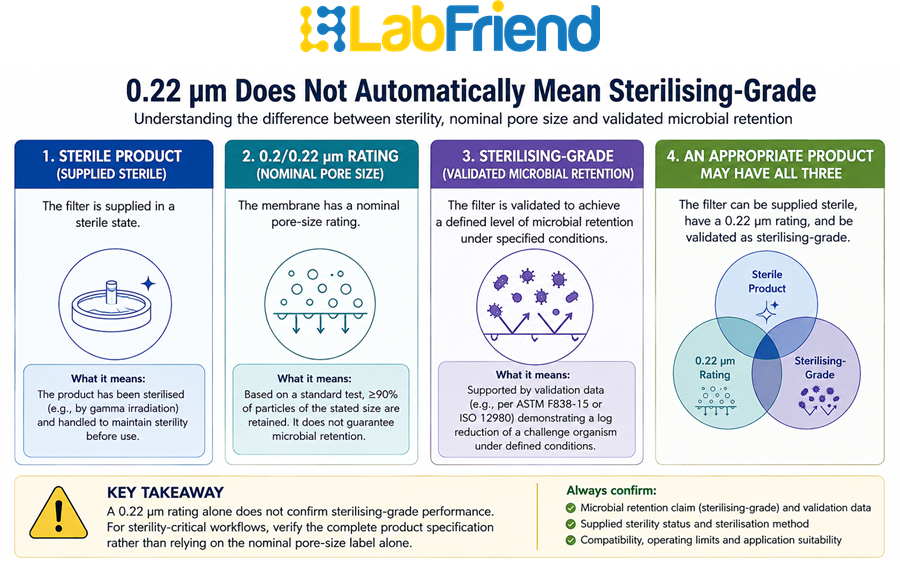
Sterile, Sterilising-Grade and 0.22 µm Are Not the Same Thing
One of the most important distinctions for laboratory buyers is the difference between:
a sterile filter,
a filter with a particular pore-size rating, and
a product supported for sterilising-grade filtration.
These descriptions address different characteristics.
A filter described as sterile has itself been supplied in a sterile condition according to the manufacturer's stated specification, typically achieved through gamma irradiation or ethylene oxide (EtO) sterilisation validated to a defined sterility assurance level (SAL).
A pore-size designation such as 0.22 µm describes a nominal rating derived from the membrane's pore-size distribution and bubble-point characteristics, rather than a single literal pore diameter.
A sterilising-grade claim relates to demonstrated microbial retention performance under defined bacterial-challenge test conditions, such as those described in ASTM F838.
Those concepts may occur together in the same product, but one should not be inferred automatically from another.
For example, selecting a filter labelled 0.22 µm does not, by itself, establish that the product is sterile, that it carries an appropriate bacterial-retention claim or that the complete process will deliver a sterile filtrate.
This is particularly important when laboratories are standardising products across different workflows. Two apparently similar 0.22 µm filters may differ materially in:
- membrane chemistry;
- sterility status;
- validated retention performance;
- housing construction;
- intended application;
- documentation; and
- manufacturer specifications.
The practical rule is simple:
For sterility-critical workflows, verify the complete product specification rather than relying on the nominal pore-size label alone.
Why 0.2 µm and 0.22 µm Filters Are Commonly Associated With Sterile Filtration
Fine membrane filtration in the approximate 0.2–0.22 µm range is widely used for sterilising-grade liquid filtration because appropriately designed and validated products at these ratings can provide the microbial retention required for many laboratory applications, typically demonstrated through bacterial-challenge testing against Brevundimonas diminuta at a defined minimum challenge level.
However, the significance of 0.2 or 0.22 µm should be understood within the context of the product and process rather than treated as an absolute rule.
A laboratory may encounter products described as:
- 0.20 µm;
- 0.2 µm;
- 0.22 µm; or
- other closely related ratings.
The laboratory should follow the requirements of its method, SOP (Standard Operating Procedure), manufacturer's documentation and validation programme rather than assuming that nominally similar pore-size descriptions are automatically interchangeable.
Pore size also has practical consequences for the filtration process. Finer filtration generally creates greater resistance to flow than coarser clarification filtration and can become progressively more difficult as particulate loading increases, because the finer pore rating restricts the available flow path and increases the differential pressure needed to maintain throughput.
Where a solution contains significant suspended material, a laboratory may therefore need to address clarification or prefiltration before the final sterile-filtration step rather than forcing the entire particulate load through the final membrane.
For a detailed discussion of pore-size selection rather than sterile-filtration implementation, see 0.22 µm vs 0.45 µm Syringe Filters: When Should You Use Each?.
Membrane Chemistry Matters as Much as Pore Size
Once the required filtration performance has been established, membrane chemistry becomes one of the most important product-selection decisions.
A membrane is not simply a physical barrier containing microscopic pores. Its surface chemistry determines how it interacts with the liquid passing through it.
Depending on the application, membrane selection can influence:
- chemical compatibility;
- wetting behaviour;
- flow rate;
- nonspecific protein binding;
- analyte recovery;
- extractables;
- throughput; and
- overall filtration performance.
This is why selecting a membrane solely because it is available in a 0.22 µm format is poor practice.
A membrane that is well suited to an aqueous biological solution may be inappropriate for an aggressive solvent. Conversely, a membrane selected primarily for solvent resistance may not provide the low-binding behaviour required for a protein-containing solution.
The correct sequence is therefore:
Define the filtration requirement → understand the sample → select compatible membrane chemistry → verify pore size and product performance → confirm the filtration format.
That sequence prevents the membrane specification from becoming disconnected from the actual laboratory workflow.
PES Membranes for Aqueous and Biological Sterile Filtration
Polyethersulfone, usually abbreviated to PES, is an important membrane material in biological and aqueous filtration.
PES membranes are hydrophilic and are commonly considered where laboratories require efficient filtration of aqueous solutions, and, unlike some other membrane chemistries, PES is inherently hydrophilic without requiring surface treatment. Their combination of good flow characteristics and relatively low protein binding makes them relevant to many biological workflows.
Typical applications may include filtration of:
- aqueous buffers;
- biological solutions;
- media;
- protein-containing preparations; and
- other compatible water-based laboratory solutions.
However, the correct conclusion is not:
“PES is the best sterile filtration membrane.”
The correct conclusion is:
PES is a useful starting point for many aqueous and biological sterile-filtration applications where its properties match the sample and the complete filter product provides the required performance and documentation.
That qualification matters.
A laboratory should still confirm:
- sample composition;
- pH;
- temperature;
- membrane compatibility;
- protein or biomolecule binding requirements;
- required flow rate;
- volume;
- sterility status; and
- the retention and application claims associated with the complete filter.
This approach keeps technical suitability ahead of product preference.
When Other Membrane Chemistries May Be More Appropriate
PES is not universally appropriate.
Different sample chemistries can favour different membranes, and sterile filtration should not be standardised around a single polymer unless the laboratory has demonstrated that it meets all relevant workflows.
For example, other hydrophilic membrane materials may be considered where their binding characteristics, compatibility or application profile better match the solution being filtered, such as cellulose acetate or nylon membranes. More chemically resistant membrane technologies may also be required where solvent composition moves beyond the operating envelope of a typical aqueous biological membrane. PTFE membranes, for example, offer broader chemical resistance and are frequently used where aggressive solvents fall outside the compatibility range of hydrophilic membranes such as PES.
The key question is therefore not:
“Which membrane is generally best?”
but:
“Which membrane provides the required filtration performance without compromising this particular sample?”
That distinction becomes especially important in laboratories processing multiple media formulations, buffers, reagents or development samples under a common procurement programme.
Standardisation can reduce purchasing complexity, but technical suitability must remain the governing criterion.
Membrane Selection Should Start With the Sample
Before specifying a sterile filter, the laboratory should characterise the liquid that will contact the membrane.
At minimum, this should include consideration of:
|
Sample characteristic |
Why it matters |
|
Predominantly aqueous or solvent-containing |
Influences membrane compatibility and wetting |
|
Protein or biomolecule content |
May make low nonspecific binding important |
|
Particulate loading |
Influences fouling, prefiltration and throughput |
|
Viscosity |
Affects filtration pressure and flow |
|
pH and chemical composition |
May affect membrane and housing compatibility |
|
Required final volume |
Influences filter area and format |
|
Sensitivity to contamination or extractables |
May influence product-quality requirements, including endotoxin or pyrogen specifications for biological and pharmaceutical applications |
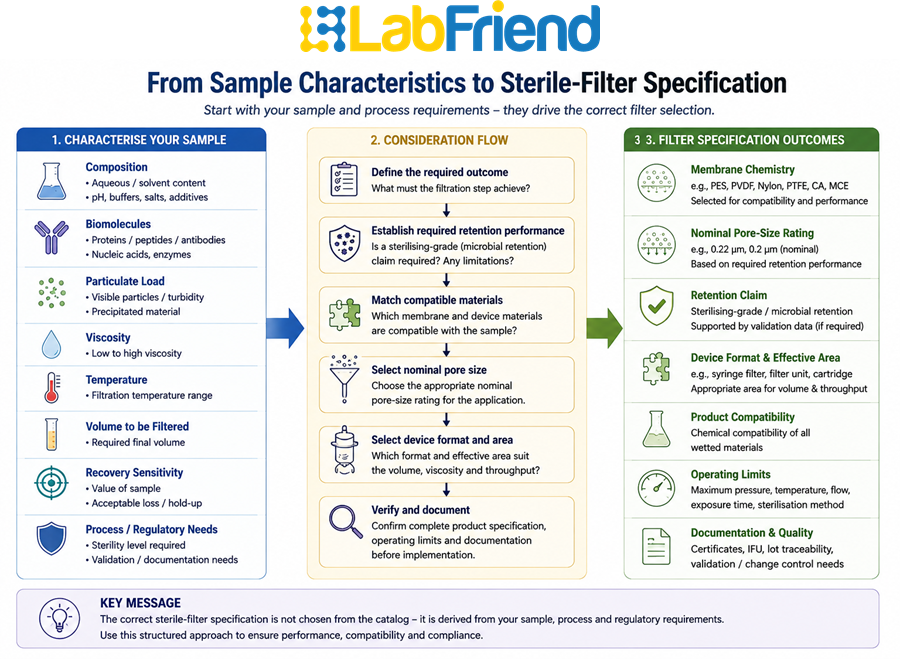
This is one reason why “sterile filtration membrane” should be treated as an application category rather than a single product specification.
The membrane needs to be selected as part of the complete workflow.
Selecting Membrane and Pore Size Together
Membrane chemistry and pore size are sometimes treated as two separate purchasing decisions:
- choose the membrane;
- choose 0.22 µm.
In practice, they should be considered together.
A theoretically suitable membrane may still be inappropriate if the available product does not carry the required retention or sterility specification. Equally, an appropriately rated pore size cannot compensate for membrane incompatibility with the sample.
The selection process therefore needs to ask two questions simultaneously:
Does this membrane interact appropriately with the sample?
and
Does this complete filter product provide the required filtration performance for the workflow?
Only when both answers are satisfactory should the laboratory progress towards implementation.
A Practical Principle for Laboratory Buyers
When reviewing sterile-filtration products, avoid reducing the purchasing specification to:
“0.22 µm PES filter.”
That description may be too broad to control the actual laboratory requirement.
A more useful specification considers:
membrane + pore size + sterility status + retention performance + format + sample compatibility + documentation.
This creates a much stronger basis for supplier comparison, laboratory standardisation and future change control.
It also helps prevent superficially similar products being substituted without assessing whether they genuinely meet the requirements of the workflow.
Protein Binding, Chemical Compatibility and Sample Recovery
Once the laboratory has established the required filtration performance and selected a suitable membrane family, the next question is whether that membrane will interact appropriately with the sample.
This matters because sterile filtration is not simply a matter of retaining microorganisms. The filtration step should also preserve the composition and usefulness of the liquid being processed.
For protein-containing and biological solutions, nonspecific binding can be particularly important. If proteins, peptides or other biomolecules adsorb to the membrane surface, the filtrate may no longer reflect the intended composition of the original solution. The effect can be especially significant where:
- sample concentration is low;
- the target biomolecule is valuable;
- recovery is critical;
- the sample volume is limited; or
- the downstream process is sensitive to concentration changes.
This is one reason why membranes such as PES are often considered for biological applications: relatively low protein binding can be advantageous where sample recovery matters. However, the suitability of a specific filter still depends on the complete product specification and the characteristics of the liquid being filtered.
The laboratory should therefore evaluate filtration as a balance between retention performance and sample preservation.
Chemical Compatibility Must Be Verified, Not Assumed
A membrane that performs well in an aqueous buffer may behave very differently in the presence of solvents, acids, bases or formulation additives.
Chemical incompatibility can lead to:
- membrane swelling;
- loss of mechanical integrity;
- reduced flow;
- release of extractables into the filtrate;
- altered retention behaviour; or
- failure of the filtration device.
For that reason, membrane selection should always be assessed against the actual sample composition, not against a simplified description such as “aqueous solution”.
For example, a biological buffer may still contain:
- salts;
- detergents;
- preservatives;
- alcohols;
- surfactants;
- reducing agents;
- pH modifiers; or
- other additives.
These components can influence membrane and housing compatibility.
Manufacturer chemical-compatibility information should therefore be reviewed for the specific formulation and operating conditions before implementation.
Sample Volume Influences Filter Format
One of the most common practical errors in sterile filtration is selecting the membrane chemistry correctly but choosing an unsuitable filter format for the required sample volume.
A syringe filter may be highly effective for small laboratory volumes, but it is not automatically the best choice for processing tens or hundreds of millilitres of sterile solution.
As volume increases, the laboratory should consider:
- total membrane surface area;
- expected filtration time;
- allowable operating pressure;
- sample viscosity;
- particulate loading; and
- risk of premature blockage.
A larger filtration area generally improves throughput and reduces the pressure required to move a given volume through the membrane.
This is why sterile filtration exists across multiple formats rather than one universal device type.
Syringe Filters vs Larger-Volume Filtration Formats
The appropriate filtration format depends on both volume and workflow.
Sterile Syringe Filters
Sterile syringe filters are commonly used for:
- small sample volumes;
- analytical preparation;
- sterile filtration of aliquots;
- reagent preparation;
- low-volume biological solutions; and
- applications where precise manual control is useful.
They are convenient, compact and well suited to small-scale laboratory work.
Bottle-Top and Vacuum Filtration Systems
Larger-volume sterile filtration often benefits from bottle-top or vacuum-based filtration formats because they provide substantially greater membrane area.
These systems may be appropriate for:
- culture media;
- large buffer volumes;
- biological reagents;
- routine laboratory media preparation; and
- other applications where processing volume makes repeated syringe filtration inefficient.
Why Filter Area Matters
Filter diameter and membrane area influence the practical performance of any filtration device.
A larger membrane area provides more surface through which liquid can pass. This usually offers two operational advantages:
- greater filtration capacity before the membrane becomes blocked; and
- lower resistance for a given flow requirement.
The effect becomes particularly important where samples contain particulate material or are relatively viscous.
A very small filter may be technically compatible with the sample yet still be operationally inefficient because the available membrane area is insufficient for the intended volume.
This illustrates an important point:
Sterile-filter selection is not complete when membrane chemistry and pore size have been chosen.
The filter format must also be appropriate for the physical workload.
Particulate Loading and the Role of Prefiltration
Sterilising-grade membranes are fine filters. If a solution contains substantial suspended matter, that particulate load can quickly foul the final membrane.
This may result in:
- very slow filtration;
- excessive manual force;
- premature blockage;
- reduced process consistency; or
- inability to complete the required volume through a single device.
Where particulate loading is high, clarification or prefiltration may be appropriate before the final sterilising-grade filtration step.
This does not mean that clarification replaces sterile filtration.
Instead, the two processes can be used sequentially:
clarification or prefiltration → final sterilising-grade filtration
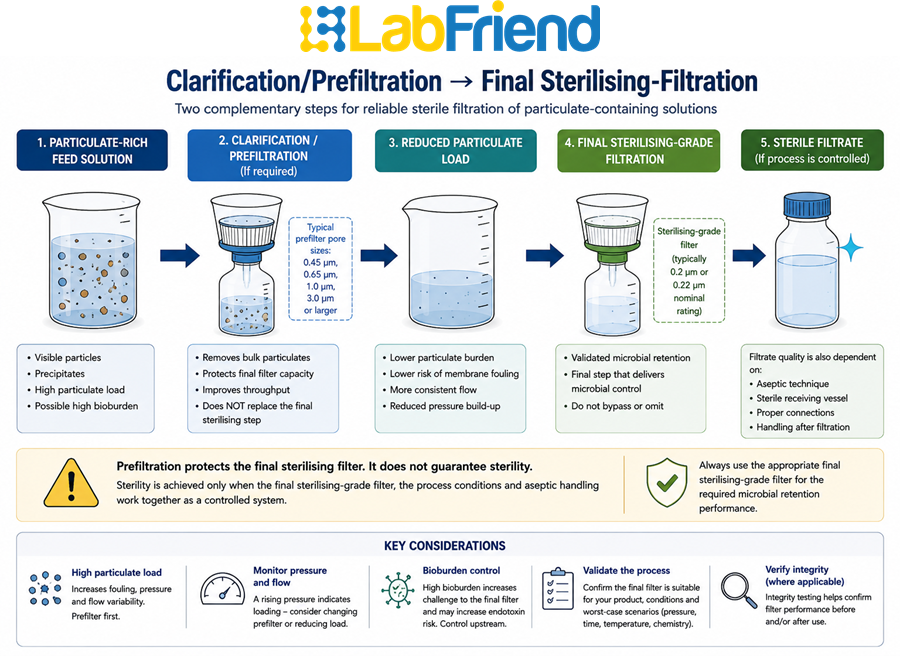
The purpose of the earlier step is to reduce the particulate burden so that the final membrane can perform its intended microbiological-retention function more effectively.
Throughput Is a Technical Requirement, Not Just a Convenience
Flow rate is sometimes treated as a matter of user preference, but in routine laboratory operations it can become a genuine process requirement.
Slow filtration can affect:
- staff productivity;
- sample handling time;
- process scheduling;
- consistency between analysts; and
- the practical feasibility of processing larger volumes.
However, higher flow should never be pursued by compromising the required filtration performance.
The objective is to choose a membrane and format that deliver acceptable throughput while still meeting the technical requirements of the sterile-filtration process.
This may involve selecting:
- a larger membrane area;
- an appropriate prefilter;
- a lower-binding membrane;
- a more suitable device format; or
- a product specifically designed for the intended throughput.
A Practical Selection Matrix
The following matrix brings together the factors discussed so far.
|
Application Requirement |
Practical Selection Consideration |
|
Small sterile aliquots |
Sterile syringe filter may be appropriate |
|
Larger volumes |
Consider bottle-top or larger-area filtration formats |
|
Protein-containing solution |
Evaluate low-binding membrane options |
|
High particulate loading |
Consider clarification/prefiltration before the final sterile step |
|
Aqueous biological solution |
PES may be a useful candidate where compatible |
|
Solvent-containing formulation |
Verify membrane and housing chemical compatibility |
|
High-throughput routine use |
Prioritise membrane area, flow and consistency |
|
Regulated or validated process |
Confirm product documentation, claims and change-control requirements |
This framework should be used as a starting point rather than a substitute for product-specific verification.
Common Sterile-Filtration Selection Mistakes
Several recurring mistakes can undermine otherwise well-designed filtration workflows.
Mistake 1: Selecting by Pore Size Alone
Choosing “0.22 µm” without checking membrane compatibility, sterility status, retention performance or intended use is an incomplete specification.
Mistake 2: Assuming One Membrane Fits Every Application
PES may be well suited to many aqueous biological solutions, but that does not make it universally appropriate.
Mistake 3: Ignoring Sample Volume
A technically correct membrane in an undersized device can create unnecessary blockage, slow filtration and inconsistent throughput.
Mistake 4: Treating Clarification and Sterile Filtration as Alternatives
Where a sample contains substantial particulates, clarification may be needed before the sterile filtration step rather than instead of it.
Mistake 5: Ignoring Product Documentation
For sterility-critical workflows, laboratories should verify the claims and specifications of the complete filtration device rather than relying on generic assumptions about membrane material or pore size.
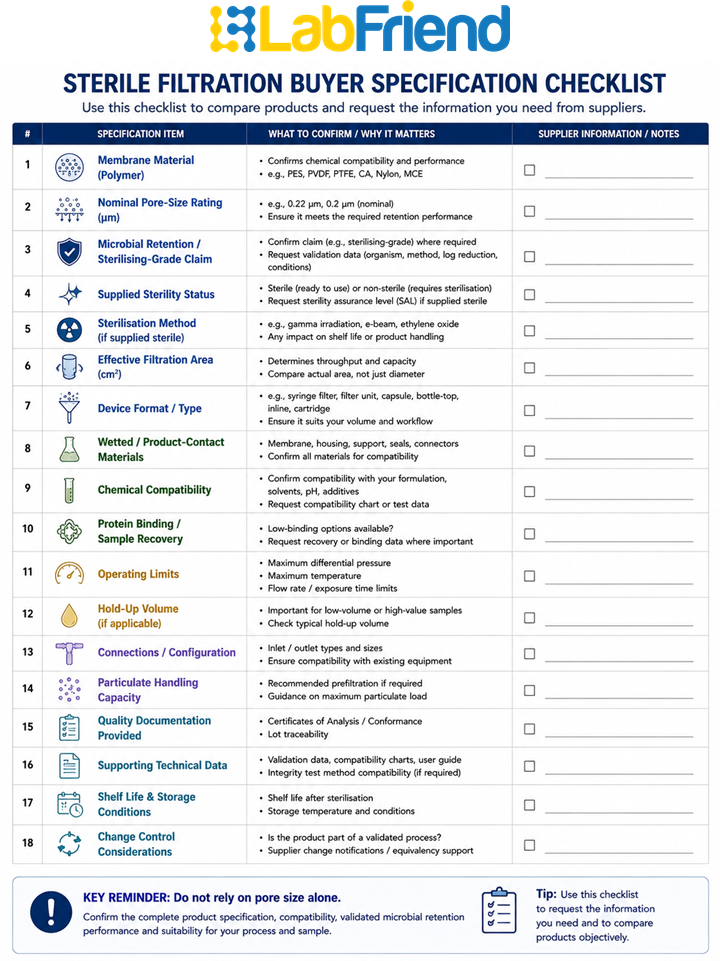
What to Check Before Purchase
Before purchasing a filter for sterile filtration, the laboratory should confirm:
- intended filtration objective;
- complete product sterility status;
- sterilising-grade or bacterial-retention claims where required;
- membrane material;
- nominal pore size;
- chemical compatibility;
- protein-binding characteristics;
- filter area;
- sample volume;
- expected throughput;
- housing compatibility;
- manufacturer documentation; and
- any validation or change-control requirements associated with the workflow.
For regulated laboratories, switching between seemingly similar products may require documented assessment. Procurement efficiency is valuable, but it should not replace technical suitability.
How to Verify a Filter Before Standardising It
Where a laboratory intends to standardise one filter across multiple teams or applications, it is sensible to verify performance under representative working conditions.
This may include reviewing:
- sample recovery;
- filtration time;
- flow consistency;
- compatibility;
- visible fouling;
- filter integrity testing, such as bubble-point or diffusive-flow testing, where applicable to the product and application;
- process robustness; and
- relevant manufacturer documentation.
The purpose is not to create unnecessary complexity. It is to ensure that the product selected for routine use is genuinely suitable for the way the laboratory intends to use it.
A Useful Procurement Principle
A strong purchasing specification should describe the functional requirement, not just a catalogue shorthand.
Instead of:
“Buy 0.22 µm PES filters.”
a more robust specification might require:
A sterile filtration device with an appropriate membrane, nominal pore size, validated retention performance, suitable format, acceptable compatibility and supporting documentation for the intended workflow.
That wording makes supplier comparison more meaningful and reduces the risk of substituting superficially similar products that do not actually meet the same technical requirement.
Bringing the Selection Process Together
The most reliable way to choose a sterile-filtration product is to treat selection as a sequence of technical decisions rather than beginning with a familiar membrane or pore size.
A laboratory should first establish what the filtration process must achieve. It should then consider the composition of the solution, the required retention performance, membrane compatibility, binding behaviour, volume, throughput and filtration format. Only after those requirements are understood should individual products be compared.
This approach avoids one of the most common problems in sterile filtration: specifying a filter too narrowly at the outset.
A requirement such as “0.22 µm PES” may describe two useful product characteristics, but it does not necessarily define the complete filtration requirement. A more robust specification considers the membrane, nominal pore size, retention claims, sterility status, device format, chemical compatibility and documentation together.
That distinction becomes increasingly important when a laboratory standardises filtration consumables across multiple departments or introduces an alternative supplier.
A Practical Sterile-Filtration Selection Framework
The following framework can be used as a practical starting point.
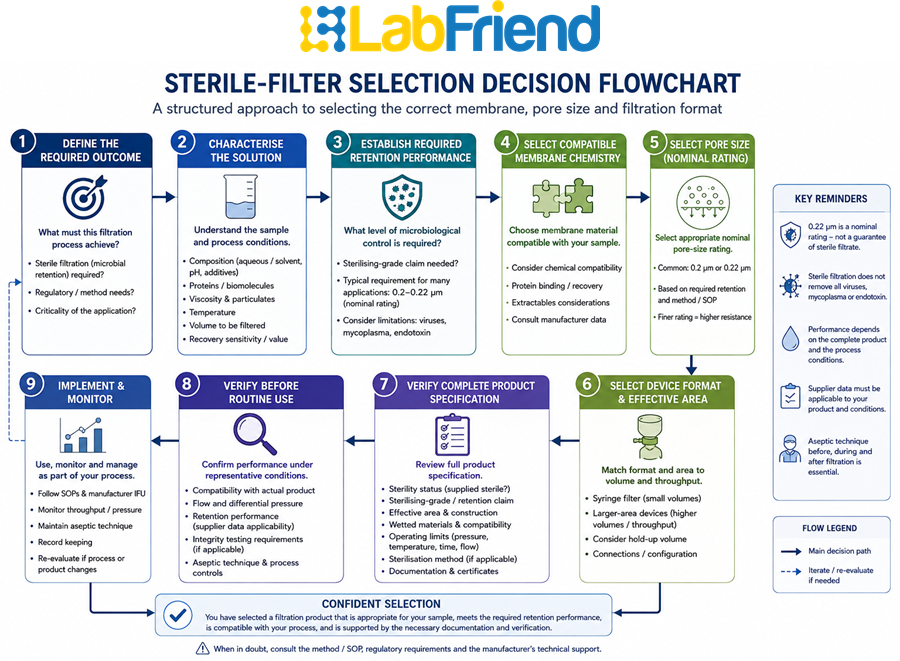
Step 1 – Define the Required Outcome
Confirm that the application genuinely requires sterile filtration rather than clarification alone.
Where the decision between clarification and sterilising-grade filtration has not yet been made, that workflow decision should be resolved before membrane selection begins.
Step 2 – Characterise the Solution
Consider:
- aqueous or solvent-containing composition;
- proteins or other biomolecules;
- pH;
- additives;
- viscosity;
- particulate loading; and
- sensitivity to adsorption or contamination.
These factors help determine which membrane families are technically suitable.
Step 3 – Establish the Required Filtration Performance
Review the method, SOP and manufacturer documentation to determine the required:
- pore-size specification;
- retention performance;
- sterility status; and
- supporting validation or quality documentation.
Avoid assuming that nominal pore size alone defines the required performance.
Step 4 – Select Compatible Membrane Chemistry
Choose a membrane that is compatible with the sample and appropriate for the required recovery, flow and binding characteristics.
For many aqueous biological workflows, PES may be a strong candidate because of its hydrophilic behaviour and relatively low protein binding. Other membrane technologies may be preferable where the solution chemistry or application requirements differ.
Step 5 – Select the Appropriate Device Format
Match the device to:
- sample volume;
- required membrane area;
- expected particulate loading;
- throughput; and
- operating method.
Small volumes may be well suited to syringe filters, while larger sterile-filtration workflows may require bottle-top or other larger-area formats.
Step 6 – Verify Before Routine Use
Where the application is critical, regulated or being standardised across multiple users, review product documentation and confirm performance under representative conditions before routine implementation.
Sterile Filtration Selection Matrix
|
Requirement |
What to Consider |
|
Small aqueous sterile aliquot |
Sterile syringe filter with suitable membrane and verified retention specification |
|
Protein-containing biological solution |
Low-binding membrane characteristics may be important |
|
Larger-volume sterile preparation |
Larger membrane area or bottle-top filtration may improve throughput |
|
High particulate loading |
Clarification or prefiltration may be required before final sterile filtration |
|
Solvent-containing formulation |
Verify membrane and housing compatibility |
|
Regulated workflow |
Confirm documentation, change control and validated product requirements |
|
Routine multi-user workflow |
Standardisation may improve consistency where technical suitability is demonstrated |
The matrix is intended to support decision-making, not replace product-specific verification.
Application Example: Small-Volume Biological Reagent
Consider a laboratory preparing a small volume of an aqueous biological reagent that cannot be heat sterilised.
The solution contains a protein component, so excessive nonspecific binding could affect recovery. The volume is relatively small, making a syringe-filter format operationally practical.
In this situation, the laboratory might consider a low-binding hydrophilic membrane such as PES, provided the complete filter product meets the required sterile-filtration specification and is compatible with the formulation.
The important point is that the decision is not being made because PES is inherently “best”. It is being considered because its characteristics may align well with the sample and workflow.
Key outcome: A low-binding hydrophilic membrane in a syringe format, chosen for the sample rather than habit.
Application Example: Larger-Volume Aqueous Preparation
A second laboratory needs to sterile-filter a substantially larger volume of an aqueous preparation.
Using multiple small syringe filters may be technically possible but operationally inefficient. The laboratory should therefore consider membrane area and format in addition to membrane chemistry.
A larger-area filtration device may:
- reduce filtration time;
- improve throughput;
- reduce repeated handling;
- simplify the process; and
- provide a more practical route for routine preparation.
Key outcome: Membrane area and format matter as much as chemistry once volume increases.
Application Example: Particulate-Rich Solution
A solution that requires sterile filtration also contains considerable visible or microscopic particulate matter.
Attempting to pass the complete particulate load directly through the final fine membrane may cause rapid blockage and poor throughput.
A staged process may therefore be appropriate:
clarification or prefiltration → final sterile filtration
The first stage reduces particulate loading. The second provides the required final filtration performance.
This illustrates why clarification and sterile filtration are not necessarily competing workflows. In some processes, they are complementary steps with different purposes.
Key outcome: Prefiltration protects the final sterilising-grade membrane rather than replacing it.
Common Questions About Sterile Filtration
Is a 0.22 µm filter automatically a sterilising-grade filter?
No. Nominal pore size is only one characteristic of the filter.
For sterility-critical applications, laboratories should verify the complete product specification, including relevant retention claims, sterility status, intended use and supporting manufacturer documentation.
Why is 0.22 µm commonly used?
Filters in the approximately 0.2–0.22 µm range are widely associated with sterilising-grade liquid filtration because appropriately designed and validated products can provide the microbial retention required for many laboratory applications, typically demonstrated through bacterial-challenge testing against Brevundimonas diminuta at a defined minimum challenge level.
The detailed choice between 0.22 µm and 0.45 µm for general filtration applications is covered in 0.22 µm vs 0.45 µm Syringe Filters: When Should You Use Each?.
Is PES always the best membrane for sterile filtration?
No.
PES is widely relevant to aqueous and biological filtration because of characteristics such as hydrophilicity and relatively low protein binding, but membrane suitability depends on the actual solution, operating conditions and complete product specification.
Can clarification filtration make a solution sterile?
Clarification and sterile filtration have different objectives.
Clarification primarily reduces particulate matter. It should not be assumed to provide the microbiological-retention performance required for a sterile-filtration process. Clarification filters typically use coarser pore ratings, often 0.45 µm or larger, which are not validated for bacterial retention in the way sterilising-grade 0.2–0.22 µm membranes are.
Do sterile filters guarantee a sterile final solution?
No individual filtration device should be treated as a guarantee of the entire process outcome.
The final result also depends on correct handling, downstream equipment, receiving vessels, aseptic technique and the controlled filtration process.
Should filter selection be part of method validation?
Where filtration affects a regulated, validated or otherwise critical process, changes to filter membrane, pore size, manufacturer or device specification may require technical assessment and potentially formal change-control activity. This should also align with the laboratory's formal quality system — for example EU GMP Annex 1 or applicable USP general chapters — so that filter selection is traceable within existing quality documentation.
The appropriate level of validation depends on the laboratory's quality system and application.
What Sterile Filtration Does Not Solve
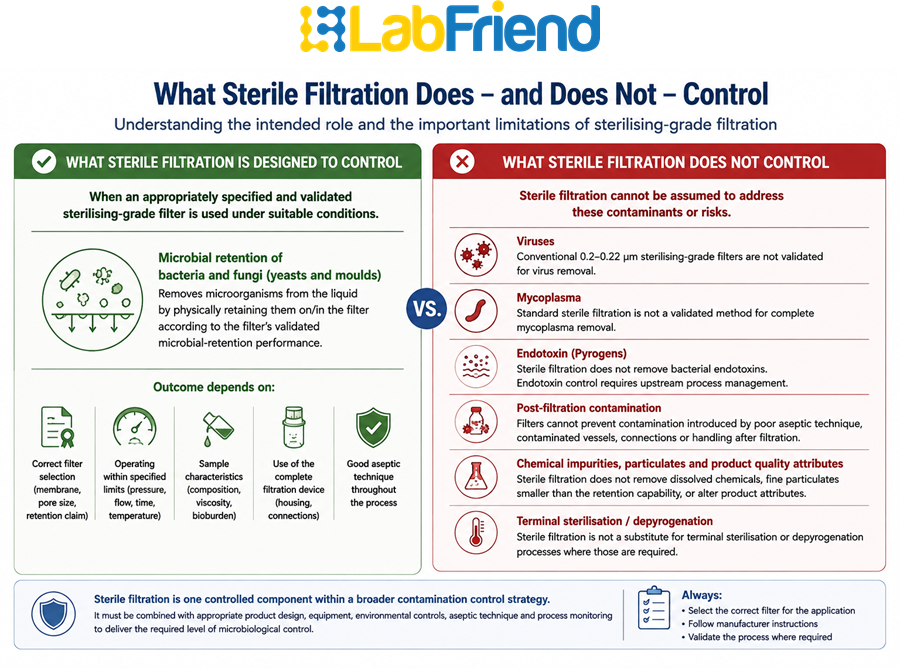
Correct membrane and pore-size selection does not remove the need for good aseptic practice.
A technically appropriate filter cannot compensate for:
- contaminated receiving containers;
- poor handling;
- unsuitable connectors;
- post-filtration exposure;
- incorrect storage;
- inadequate cleaning procedures; or
- other weaknesses elsewhere in the process.
Similarly, selecting a sterilising-grade filter does not automatically establish that every step before and after filtration is controlled.
The filter should therefore be treated as one component of a broader contamination-control strategy.
What to Check Before Switching Supplier or Product
Sterile-filtration consumables can appear interchangeable when the membrane abbreviation, diameter and nominal pore size are the same. That is not sufficient evidence of equivalence.
Before changing products, laboratories should consider:
- membrane material;
- nominal pore size;
- device dimensions;
- sterility status;
- retention claims;
- housing materials;
- chemical compatibility;
- protein-binding characteristics;
- filtration area;
- expected throughput;
- manufacturer documentation; and
- applicable validation requirements.
Where the process is regulated, switching consumables may require documented change control, equivalence assessment, verification or revalidation depending on the laboratory's quality system.
Procurement efficiency is valuable, but it should not replace technical suitability assessment.
Building a More Consistent Sterile-Filtration Strategy
For laboratories purchasing filtration consumables repeatedly, the greatest commercial and operational benefit often comes from standardising selection logic, rather than forcing every application onto one product.
A structured portfolio might define:
- approved small-volume sterile filters;
- preferred membranes for common aqueous workflows;
- larger-volume sterile filtration formats;
- approved products for protein-sensitive applications;
- application-specific exceptions; and
- documented criteria for approving alternatives.
This approach can reduce unnecessary product variation while preserving the technical flexibility required by different workflows.
It also gives laboratory procurement teams a stronger purchasing specification. Instead of comparing products solely on pack price, they can assess whether each alternative meets a clearly defined functional requirement.
Selecting Sterile Filtration Products From LabFriend
Once the membrane, pore-size and format requirements have been established, the next stage is product evaluation.
LabFriend's sterile-filtration portfolio is intended to support different laboratory workflows rather than promote one universal filter configuration.
The relevant commercial routes for this guide are:
Sterile Filters – for laboratories ready to explore products designed for sterile-filtration applications.
PES Filters – for workflows where PES membrane characteristics are technically appropriate.
No product should be selected solely because it appears within a membrane category; the technical specification of the individual product must still be checked against the intended application. Browse the range of filtration products on LabFriend.co.uk
Further Reading
For broader filtration principles and terminology, refer to The Ultimate Guide to Laboratory Filtration for UK Laboratories.
For detailed pore-size comparison, see 0.22 µm vs 0.45 µm Syringe Filters: When Should You Use Each?.
Sterilising-Grade Filtration vs Clarification Filtration - What's the Difference? owns the earlier workflow decision between clarification and sterile filtration.
Conclusion
Choosing a membrane and pore size for sterile filtration requires more than identifying a familiar 0.22 µm product.
A robust selection process starts by defining the required filtration outcome, then evaluates the solution chemistry, membrane compatibility, binding behaviour, pore-size requirement, retention claims, volume, throughput and device format together.
For many aqueous biological applications, PES can be a useful membrane candidate because its hydrophilic behaviour and relatively low protein binding align well with common laboratory requirements. But membrane chemistry alone does not define sterilising-grade performance, and no membrane should be assumed to suit every application.
Likewise, a nominal 0.22 µm pore size is important in many sterile-filtration workflows, but it should never be treated as a substitute for verifying the specification of the complete filter product.
The strongest laboratory approach is therefore:
define the application → characterise the sample → establish the required retention performance → select compatible membrane chemistry → select pore size and format → verify the complete product before routine use.
That process gives scientists, laboratory managers and procurement teams a much stronger basis for choosing sterile-filtration consumables, comparing suppliers and standardising products without compromising technical suitability.
Written by: Donal O’Sullivan, BSc, Co-Founder and Sales Director, LabFriend UK. Donal brings deep chemistry-led technical expertise across analytical chemistry, biochemistry, environmental monitoring, laboratory instrumentation, consumables and scientific product selection.
Reviewed by: Michael Anderson, MBA, Founder and Managing Director, LabFriend UK. Michael reviews LabFriend UK content for customer relevance, commercial accuracy, operational practicality and alignment with LabFriend UK’s laboratory supply model.
Related Stories

Filtration Best Practices for LC-MS and Trace Analytical Methods
Filtration Best Practices for LC-MS and Trace Analytical Methods

Centrifuge Tube Reorder Planning for High-Usage Laboratories
Centrifuge Tube Reorder Planning for High-Usage Laboratories

Extractables and Leachables in Analytical Filtration Explained
Extractables and Leachables in Analytical Filtration Explained

How Lab Managers Can Standardise Centrifuge Tube Purchasing Without Increasing Technical Risk
How Lab Managers Can Standardise Centrifuge Tube Purchasing Without Increasing Technical Risk