

Share :
Standardising Centrifuge Tubes for Molecular Biology Workflows in Growing Biotech Labs
Updated On 07/17/2026

By Donal O’Sullivan, BSc. Reviewed by Michael Anderson, MBA.
Opening answer
Growing biotech labs should standardise centrifuge tubes for molecular biology workflows by defining approved tube formats, required specifications, acceptable substitutes and repeat-order rules before purchasing becomes fragmented across teams. The aim is not to force every workflow into one tube type. The aim is to make routine purchasing more controlled while protecting technical suitability for PCR support, nucleic acid preparation, biological sample handling and repeat laboratory workflows.
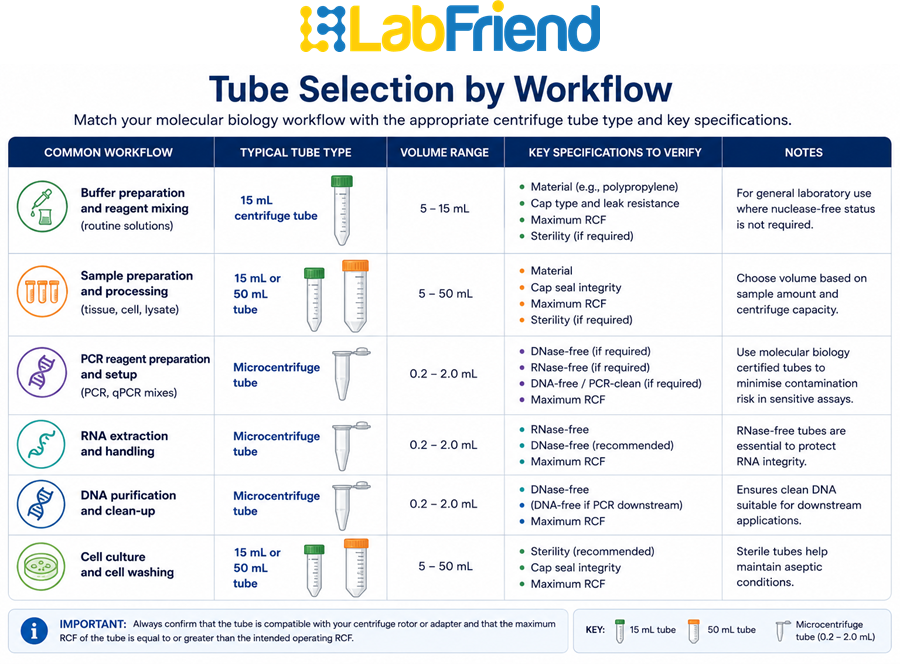
For most growing biotech labs, centrifuge tube standardisation should cover the key formats used regularly, such as microcentrifuge tubes, 15 mL centrifuge tubes and 50 mL centrifuge tubes. Each approved format should be linked to a defined workflow, required material, sterility or aseptic status, DNase/RNase requirement where relevant, RCF (relative centrifugal force) rating, rotor compatibility and documentation expectation.
Labs reviewing their approved tube set can start with LabFriend UK’s centrifuge tubes, then build a controlled purchasing model around the formats that genuinely fit their molecular biology workflows.
Why growing biotech labs need a standardisation process
Early-stage biotech purchasing is often practical and informal. A scientist needs tubes, someone finds a suitable product, and the lab reorders it when stock runs low. That can work when the team is small and the workflow is simple.
As the lab grows, the same informal approach starts to create risk. More scientists join. More projects run in parallel. PCR, qPCR, nucleic acid preparation, cell handling, sample preparation and buffer workflows become more frequent. Different teams may start buying similar tubes from different suppliers, or substituting products because the preferred option is unavailable.
At that point, centrifuge tubes stop being occasional consumables and become operational infrastructure. They affect workflow continuity, contamination-control expectations, repeat ordering, supplier switching and cost visibility.
The commercial problem is uncontrolled variation. The technical problem is uncontrolled substitution. A growing biotech lab needs to solve both.
The standardisation principle
The right principle is simple:
Standardise the purchasing route, not the science.
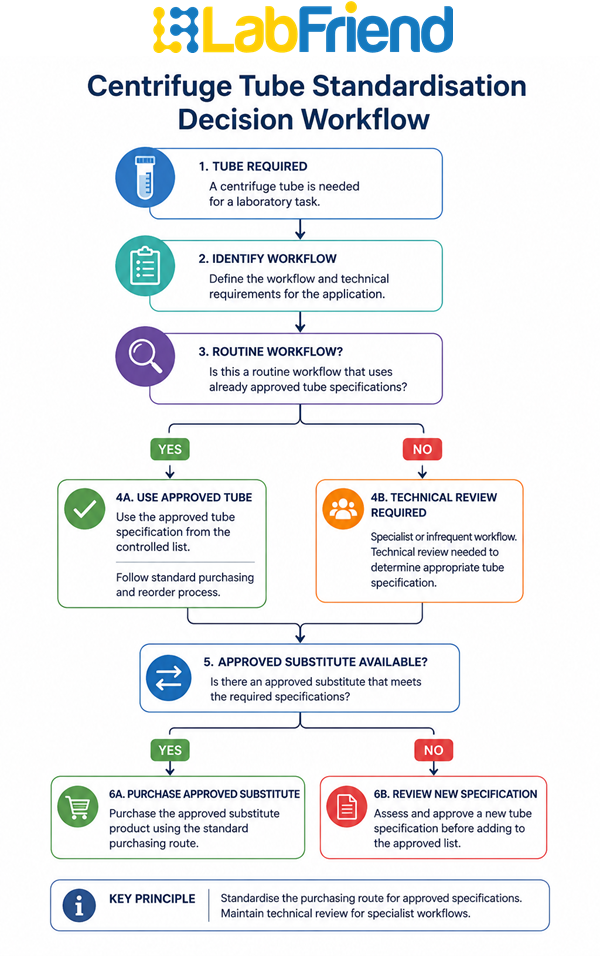
A biotech lab should not standardise centrifuge tubes so aggressively that technical users lose access to the formats their workflows require. It should standardise the routine, repeatable decisions that can be safely controlled.
That usually means approving a small set of core tube formats for routine use, while keeping specialist or method-sensitive requirements under technical review. A 15 mL polypropylene tube used for general buffer handling does not need to be treated the same way as a tube used near a PCR-sensitive workflow. Material choice also carries chemical-compatibility limits — polypropylene and other common tube plastics are not universally resistant to organic solvents, so any workflow involving solvent exposure should be checked against the manufacturer’s chemical compatibility data rather than assumed from tube volume or format alone. A 50 mL tube used for routine wash steps does not automatically replace a tube required for documented molecular biology preparation.
Standardisation should therefore start with workflow mapping. Once the lab knows which tubes are used where, it can decide which products can be consolidated, which must remain separate, and which substitutions need technical approval.
What should be standardised
Growing biotech labs should usually standardise the recurring tube formats that appear across multiple teams, benches or workflows. These are the products most likely to create unnecessary SKU (stock-keeping unit) growth if each team orders independently.
A sensible standardisation exercise should cover tube volume, material, cap type, contamination-control specification, packaging format, documentation, reorder route and approved substitutes. This does not mean every team uses exactly the same tube. It means the lab has an agreed basis for selection and reordering.
|
Standardisation area |
What the lab should define |
Why it matters |
|
Core tube formats |
Which microcentrifuge, 15 mL and 50 mL formats are approved |
Reduces uncontrolled SKU growth |
|
Workflow ownership |
Which workflows each tube can support |
Prevents unsuitable cross-use |
|
Technical specification |
Material, cap, RCF, sterility and purity claims |
Protects workflow suitability |
|
Approved substitutes |
Which products can replace the preferred item |
Reduces risky ad hoc switching |
|
Reorder route |
Who buys, when and from where |
Improves supply continuity |
|
Review point |
When the approved list should be reviewed |
Keeps purchasing aligned with growth |
The table should be treated as a working control tool, not a rigid procurement rule. It should help the lab make better decisions as workflows scale.
What should not be standardised too quickly
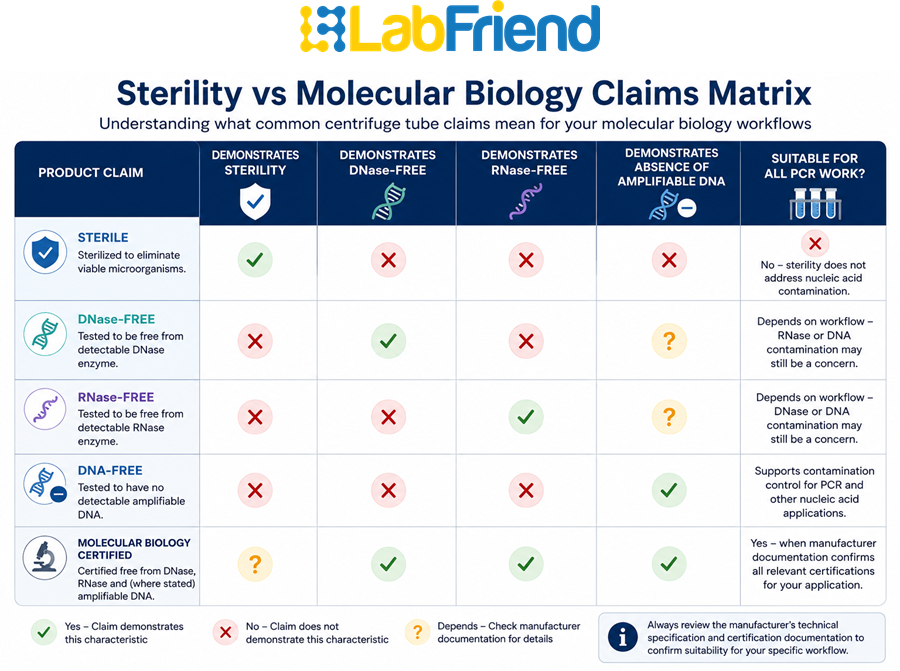
Some tube requirements should remain under technical control, especially where molecular biology sensitivity is involved. If a workflow requires DNase-free, RNase-free, DNA-free, PCR-clean, low-endotoxin, endotoxin-tested or non-pyrogenic status, the lab should not merge that requirement into a general “sterile tube” category.
Sterility is not the same as nuclease control. A sterile or aseptic tube may be suitable for some biological handling steps, but it should not be treated as DNase-free or RNase-free unless the product documentation explicitly supports that claim. This matters because common sterilisation methods, such as gamma irradiation or autoclaving, are validated to eliminate viable microorganisms but are not validated to remove residual nuclease activity, so sterile status and nuclease-free status must be confirmed independently. In this context, “sterile” refers to the absence of viable microorganisms, while “aseptic” refers to processing and packaging conditions designed to minimise contamination risk — the two terms are related but not interchangeable, which is why they are often listed together.
Similarly, RCF rating and rotor compatibility should not be assumed from volume. Two 50 mL tubes can differ in material, dimensions, cap design and maximum RCF. A product that fits one rotor or adapter may not be appropriate for another setup. RCF is generated by the rotor’s radius and rotation speed (RPM), not by the tube itself — the tube’s own RCF rating instead reflects the maximum force the tube can safely withstand without failure, which is why two tubes of the same volume can carry different ratings.
For technical users, the important question is whether a tube suits the workflow. For procurement, the important question is whether the approved product can be bought repeatedly and substituted safely. Standardisation only works when both questions are answered.
Molecular biology workflows need claim discipline
Molecular biology workflows are particularly sensitive to unclear product claims. In a busy biotech lab, words such as “sterile,” “clean,” “PCR suitable” or “molecular biology grade” can be used casually. That is risky. Unlike sterility or nuclease-free status, “molecular biology grade” is not a standardised or regulated designation, and its meaning can vary between suppliers, so the specific claims behind it should be confirmed rather than treated as a defined specification.
The lab should define which claims are actually required by each workflow. A general biological handling step may require sterile or aseptic tubes. An RNA workflow may require RNase-free consumables. A PCR-sensitive workflow may require DNA-free or PCR-clean products, depending on the method. Low-volume or dilute nucleic acid work may separately require low-binding (low-retention) tubes to reduce sample loss to the tube surface — this is a distinct claim from RNase-free or DNase-free status and should be checked on its own merits. These are different requirements and should be documented separately.
Where the workflow does not require a particular claim, procurement should avoid over-specifying unnecessarily. Where the workflow does require the claim, procurement should not substitute a product unless the claim is clearly supported.
This is the balance a growing biotech lab needs: avoid unnecessary cost and complexity, but do not weaken contamination-control discipline.
Approved tube list for a growing biotech lab
A practical approved tube list does not need to be complicated. It should be clear enough for scientists, lab managers and procurement to use consistently.
|
Approved item |
Typical role |
Control level |
|
Microcentrifuge tubes |
Small-volume molecular biology preparation |
Specification-led |
|
15 mL routine tubes |
Moderate-volume sample preparation and buffer handling |
Core repeat item |
|
15 mL sterile or aseptic tubes |
Contamination-sensitive biological workflows |
Controlled repeat item |
|
50 mL routine tubes |
Larger-volume preparation and wash steps |
Core repeat item |
|
50 mL sterile or aseptic tubes |
Larger biological workflows where required |
Controlled repeat item |
|
DNase/RNase-free formats |
Nucleic-acid-sensitive workflows |
Technical approval required |
|
Specialist high-RCF formats |
Higher-force centrifugation workflows |
Technical approval required |
The approved list should also state the preferred product, acceptable substitute, required specification, pack size, reorder point and technical owner. In a growing biotech lab, ownership matters. If nobody owns the approved list, informal substitution will return.
How to avoid uncontrolled substitution
Uncontrolled substitution is one of the most common risks in growing labs. It usually happens for practical reasons: the preferred product is unavailable, a new supplier offers a lower price, or a team orders an alternative because it looks similar.
That does not mean substitution is wrong. In many cases, switching supplier or product is sensible. The risk is switching without comparing the required specification. When a new approved list is introduced, the lab should also decide how to handle tube stock already on hand that falls outside the new list — for example, whether existing stock can be used until exhausted for non-critical workflows, or whether it should be phased out immediately for controlled or molecular-biology-sensitive workflows.
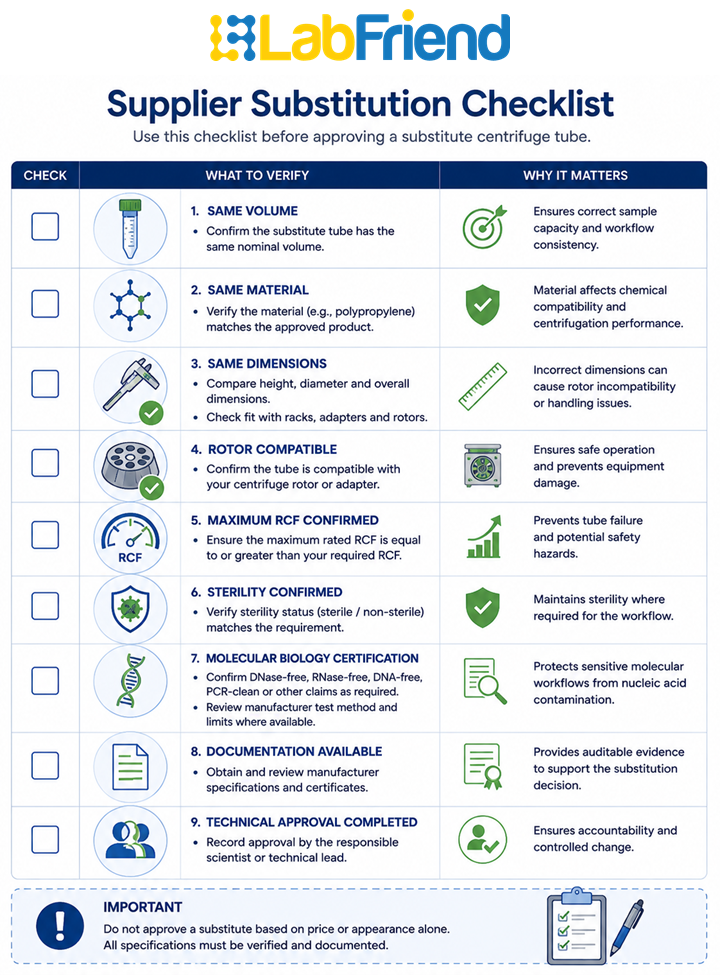
A candidate substitute should be compared against the accepted product for volume, material, dimensions, cap design, maximum RCF, sterility or aseptic status, nuclease-related claims, packaging and documentation. If the workflow is controlled by an SOP or quality requirement, the lab should also decide whether internal approval or change recording is required.
For centrifugation conditions, the lab should check product-specific RCF and rotor suitability rather than relying on nominal tube volume. For deeper technical background, read centrifuge tube RCF and rotor compatibility.
Supplier switching without increasing technical risk
Supplier switching can support growth. A biotech lab may need better availability, clearer pricing, easier repeat ordering, broader product range or more responsive service. These are valid commercial reasons to review suppliers.
However, supplier switching should not be treated as a purely purchasing-led exercise. It should involve the scientific lead or lab manager where workflow suitability matters.
A good supplier-switching process asks three questions. First, does the proposed product meet the workflow requirement? Second, can the product be reordered consistently? Third, does the lab need to document the change?
If the answer to the first question is uncertain, the switch should pause. Saving money on a tube is poor value if it creates uncertainty in a molecular biology workflow.
|
Switching question |
Why it matters |
|
Does the product meet the required specification? |
Protects scientific suitability |
|
Are sterility and purity claims explicit? |
Prevents claim assumptions |
|
Is RCF and rotor compatibility confirmed where needed? |
Reduces centrifugation risk |
|
Is documentation available if required? |
Supports controlled workflows |
|
Can the product be reordered reliably? |
Supports operational continuity |
|
Who approves the switch? |
Prevents informal substitution |
This approach keeps procurement flexible without allowing uncontrolled product drift.
Repeat ordering should preserve the accepted specification
Once a tube has been accepted for a recurring molecular biology workflow, repeat ordering should preserve the specification that made it acceptable. The reorder process should not simply search for the cheapest visually similar product each time.
This is where a supplier such as LabFriend UK can support the lab commercially. The first order creates a useful signal: the customer has a recurring consumables need. The follow-up conversation should identify whether the product is for routine molecular biology support, PCR preparation, sample handling, buffer preparation or another repeat workflow.
A good repeat-order setup should define the approved product, reorder quantity, expected usage rate, minimum stock level and substitute rule. Where a controlled workflow is involved, the repeat-order setup should also capture lot or batch traceability, so that any workflow issue can be investigated back to a specific supply batch. As the biotech lab grows, this prevents recurring consumables from becoming reactive purchases.
For broader repeat-use purchasing context, read Choosing 15mL and 50mL Centrifuge Tubes for High-Usage Laboratories.
Where LLG Labware alternatives can fit
LLG Labware alternatives may be useful where the required specification matches the workflow and the lab is seeking a practical value route for routine consumables. This is most relevant where the tube is used repeatedly, the specification is clear, and the lab wants to reduce purchasing cost or supplier fragmentation.
The important point is that value alternatives should be evaluated by specification, not by assumption. A lower-cost or easier-to-source product should not be treated as equivalent unless the lab has compared the relevant requirements.
For molecular biology workflows, this is especially important. If DNase-free, RNase-free, PCR-clean or endotoxin-related claims matter, they need to be explicit. If the workflow involves centrifugation, RCF and rotor compatibility need to be checked. If the workflow is part of a controlled method, documentation may be required.
LLG Labware can therefore sit within the standardisation process, but it should not bypass it.
How biotech labs should divide responsibility
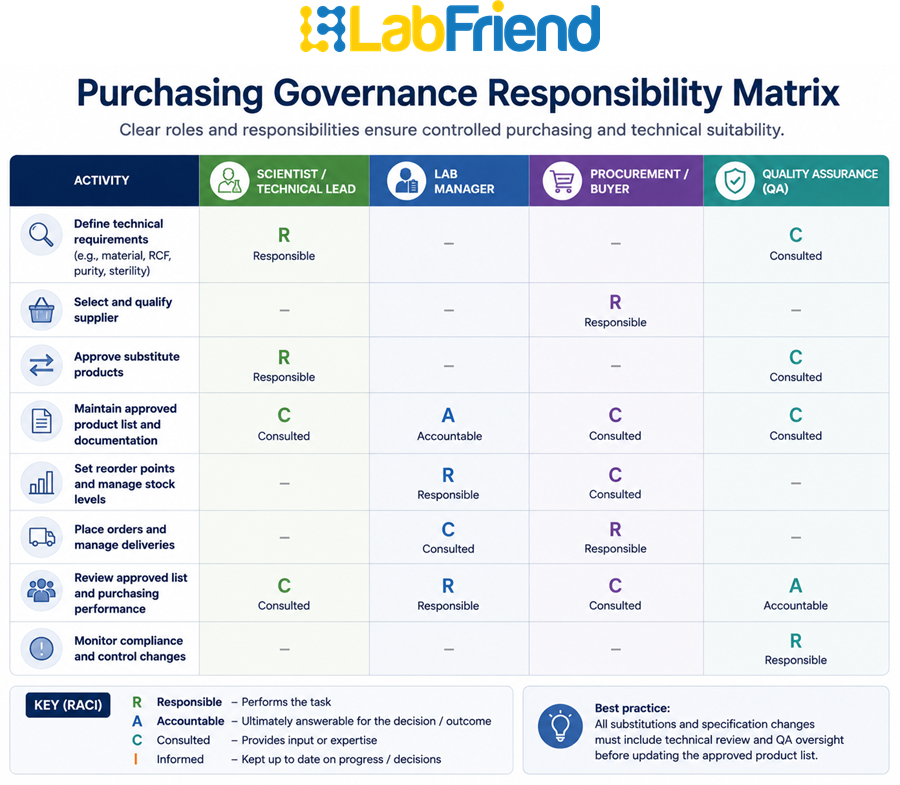
In a growing biotech lab, responsibility for centrifuge tube standardisation should not sit entirely with one person. Scientists understand workflow requirements. Lab managers understand usage patterns and stock control. Procurement understands supplier, price and ordering routes. QA (quality assurance) or technical leads understand documentation and change-control expectations where relevant.
The best operating model is shared but clear. Scientific users define what the tube must do. Procurement identifies suitable supply routes. The lab manager controls repeat ordering and stock levels. QA or a technical lead decides what evidence is needed when workflows are controlled or sensitive.
This prevents two common failure modes. The first is procurement choosing a cheaper product without enough technical review. The second is scientists ordering independently without visibility of cost, supply continuity or approved alternatives.
Common mistakes in biotech tube standardisation
Standardising too early
A biotech lab should not lock down every tube format before workflows are stable. Early standardisation should focus on recurring, low-risk items while leaving specialist workflows under technical review.
Standardising too broadly
A single “standard centrifuge tube” rarely fits all molecular biology workflows. Different volumes, claims and documentation requirements may still be needed.
Treating sterile as molecular biology suitable
Sterile or aseptic status may be useful, but it does not automatically confirm DNase-free, RNase-free, DNA-free or PCR-clean status.
Ignoring RCF and rotor compatibility
A tube selected for molecular biology handling may still be centrifuged. If so, product-specific RCF and rotor compatibility should be checked.
Allowing informal supplier switching
A substitute product should be compared against the accepted specification before it becomes part of routine purchasing.
Failing to review the approved list
As the lab grows, workflows change. The approved tube list should be reviewed when projects, volumes, assays or teams change.
What this article does not solve
This article helps growing biotech labs create a more controlled purchasing model for centrifuge tubes used in molecular biology workflows. It does not confirm that any specific tube is suitable for PCR, qPCR, RNA handling, DNA workflows, diagnostic use, clinical use, GMP use, cryogenic storage, chemical exposure or a laboratory’s internal method.
Those decisions must be made using product documentation, manufacturer information, internal procedures and workflow-specific technical review.
It also does not mean that standardisation should remove scientific judgement. Standardisation should make routine decisions easier, but it should never prevent a lab from using a specialist product where the workflow requires it.
Practical standardisation framework
A growing biotech lab can use a simple staged approach.
|
Stage |
Action |
Outcome |
|
1 |
Map where centrifuge tubes are used |
Understand actual demand |
|
2 |
Separate routine and specialist workflows |
Avoid over-standardising sensitive use cases |
|
3 |
Define required claims and specifications |
Protect technical suitability |
|
4 |
Create an approved product list |
Reduce uncontrolled variation |
|
5 |
Define substitute rules |
Control supplier switching |
|
6 |
Set reorder points |
Improve supply continuity |
|
7 |
Review as workflows grow |
Keep the system current |
This framework should remain practical. The aim is not to create unnecessary administration. The aim is to stop routine consumables from becoming a hidden operational risk.
Frequently asked questions
How should growing biotech labs standardise centrifuge tubes?
Growing biotech labs should standardise centrifuge tubes by mapping recurring workflows, defining required specifications, creating an approved product list, setting substitute rules and building repeat-order processes around accepted products.
Should a biotech lab reduce the number of centrifuge tube SKUs?
Yes, where workflows allow it. SKU reduction is useful when it removes unnecessary duplication, but it should not remove tube formats required for specific molecular biology, PCR, RNA or controlled workflows.
Are sterile centrifuge tubes suitable for molecular biology workflows?
They may be suitable for some biological handling steps, but sterility alone does not confirm DNase-free, RNase-free, DNA-free or PCR-clean status. Required claims must be checked in product documentation.
Can a growing biotech lab switch centrifuge tube supplier?
Yes, but the substitute product should be compared against the accepted specification. Volume, material, cap design, RCF rating, sterility or aseptic status, nuclease-related claims and documentation should be reviewed where relevant.
What should be included in an approved centrifuge tube list?
The list should include the preferred product, approved use case, required specification, acceptable substitute, pack size, reorder point, technical owner and review date.
Does a centrifuge tube need a Certificate of Analysis for molecular biology use?
Not always. A Certificate of Analysis or equivalent lot-specific documentation is typically required where a workflow is controlled by an SOP, quality system or regulatory expectation, and where claims such as DNase-free, RNase-free or endotoxin-tested status need to be verifiable for a specific batch. For routine, non-controlled use, supplier product documentation is usually sufficient.
Should procurement or scientists own tube standardisation?
Both should be involved. Scientists define workflow requirements, procurement manages supply routes, and lab managers or QA teams control repeat ordering and documentation where needed.
Are LLG Labware centrifuge tubes suitable for biotech workflows?
They may be suitable where the product specification matches the workflow. They should be evaluated by documented requirements rather than assumed to be equivalent to an existing product.
How often should the approved tube list be reviewed?
It should be reviewed when workflows change, new projects start, usage increases, stockouts occur, supplier routes change or users report technical issues.
What is the biggest risk when standardising centrifuge tubes?
The biggest risk is prioritising procurement simplicity over technical suitability. Standardisation should reduce avoidable variation without weakening workflow reliability.
Where should labs start?
Start with the most frequently used tube formats, then identify which are routine, which are workflow-specific and which require technical approval before substitution.
Conclusion
Growing biotech labs should treat centrifuge tubes as repeat workflow consumables, not as simple one-off purchases. As molecular biology work scales, informal buying can lead to unnecessary SKU growth, supplier fragmentation, uncontrolled substitution and uncertainty around technical suitability.
The right solution is controlled standardisation. Define the recurring tube formats, document the required specifications, agree acceptable substitutes, set reorder rules and review the approved list as workflows evolve.
This protects both the science and the purchasing process.
To start reviewing suitable formats, browse LabFriend UK’s centrifuge tubes. For broader category context, read the Complete Guide to Centrifuge Tubes.
Written by: Donal O’Sullivan, BSc, Co-Founder and Sales Director, LabFriend UK. Donal brings deep chemistry-led technical expertise across analytical chemistry, biochemistry, environmental monitoring, laboratory instrumentation, consumables and scientific product selection.
Reviewed by: Michael Anderson, MBA, Founder and Managing Director, LabFriend UK. Michael reviews LabFriend UK content for customer relevance, commercial accuracy, operational practicality and alignment with LabFriend UK’s laboratory supply model.
Related Stories

Complete Guide to Centrifuge Tubes
Complete Guide to Centrifuge Tubes

The Ultimate Guide to Laboratory Filtration for UK Laboratories
The Ultimate Guide to Laboratory Filtration for UK Laboratories

Polypropylene vs Polystyrene Centrifuge Tubes
Polypropylene vs Polystyrene Centrifuge Tubes: Which Is Best for Laboratory Workflows?

PTFE vs PES Syringe Filters: Which Membrane Should You Choose?
PTFE vs PES Syringe Filters: Differences, Solvent Compatibility and Laboratory Applications