

Share :
Laboratory Bottle Selection for Lab Managers - Standardising Everyday Storage and Handling
Updated On 07/17/2026

By Donal O’Sullivan, BSc. Reviewed by Michael Anderson, MBA.
Lab managers should standardise laboratory bottle selection by defining a core bottle range for routine workflows, including agreed materials, volumes, mouth styles, cap/thread types and reorder points. The aim is to reduce stockouts, avoid mismatched caps or unsuitable substitutions, simplify purchasing and make repeat ordering easier across the lab.
For most UK laboratories, the best approach is to build a practical bottle standardisation list covering reagent storage, liquid handling, powders or samples, sterile workflows and space-efficient storage. Each bottle type should be selected by application, compatibility, closure system and repeat availability — not volume or price alone.
Why This Matters to Lab Managers
Laboratory bottles are easy to overlook because they are routine consumables. But in a busy lab, poor bottle selection can create recurring operational problems:
- scientists order slightly different bottle types for similar work
- caps, closures or threads do not match previous bottles
- stockrooms carry too many near-duplicate SKUs
- bottles are reordered late or inconsistently
- users select bottles that are awkward to fill, pour, clean or label
- procurement struggles to compare equivalent products
- repeat workflows are disrupted by stockouts
For lab managers, the issue is not only whether one bottle is technically suitable. The bigger question is whether the lab has a repeatable bottle purchasing system.
A well-managed bottle range supports:
- consistent daily workflows
- easier stock control
- fewer urgent orders
- clearer product selection for staff
- better purchasing discipline
- faster quote requests
- reduced risk of unsuitable substitutions
- stronger repeat supply planning
For LabFriend UK’s target customers — CROs, independent testing laboratories, SME biotech companies and university research groups — this matters because these organisations often run recurring workflows, have multiple users ordering consumables, and value speed, availability, price transparency and reliable service.
Core Principle: Standardise by Workflow, Not by Product Name Alone
The most common mistake is to standardise only by product name or volume.
A lab might say, “We use 500 mL bottles,” but that does not define enough. A useful standard must also capture:
- bottle type
- material
- volume
- mouth style
- cap/thread type
- closure or liner requirements
- clear or amber format
- sterile or non-sterile requirement
- autoclavability where relevant
- pack size
- product code
- approved alternative, if suitable
- reorder trigger
A better standard would be:
500 mL clear borosilicate reagent bottle with compatible screw cap, suitable for routine reagent storage where chemical compatibility has been confirmed, ordered in agreed pack size with recorded product code and approved reorder route.
That level of detail reduces mistakes and makes repeat ordering easier.
A Practical Bottle Standardisation Model for Lab Managers
Lab managers do not need to standardise every bottle in the lab immediately. Start with the routine, high-use bottle types that are reordered most often or cause the most confusion.
Recommended Core Bottle Range
|
Bottle Group |
Typical Role in the Lab |
Why Standardise It |
|
Reagent bottles |
Prepared solutions, reagents, routine chemical storage |
Reduces variation in material, cap/thread and labelling |
|
Narrow-mouth bottles |
Routine liquid storage and controlled pouring |
Helps users select bottles suitable for liquids and reduced spillage |
|
Wide-mouth bottles |
Powders, solids, samples or easier filling |
Prevents users forcing unsuitable liquids/solids into narrow openings |
|
Square bottles |
Space-efficient storage in cupboards, fridges or stockrooms |
Improves storage density and organisation |
|
Sterile bottles or sterile bags |
Contamination-sensitive sampling or workflows |
Helps avoid confusion between sterile, non-sterile and autoclavable products |
|
Wash bottles |
Rinsing, dispensing or bench use |
Supports clear labelling and avoids inappropriate decanting |
|
Caps and closures |
Replacement caps, liners, seals and pouring rings |
Prevents mismatched reorders and leakage risks |
|
Larger-volume bottles or carboys |
Bulk liquid storage or larger-volume workflows |
Helps control handling, location and closure suitability |
This does not mean every lab needs every bottle group. The standard range should reflect actual workflows.
Where sterility is important, packaging configuration, sterility assurance claims and handling procedures should also be considered.
Step-by-Step Framework for Standardising Laboratory Bottle Selection
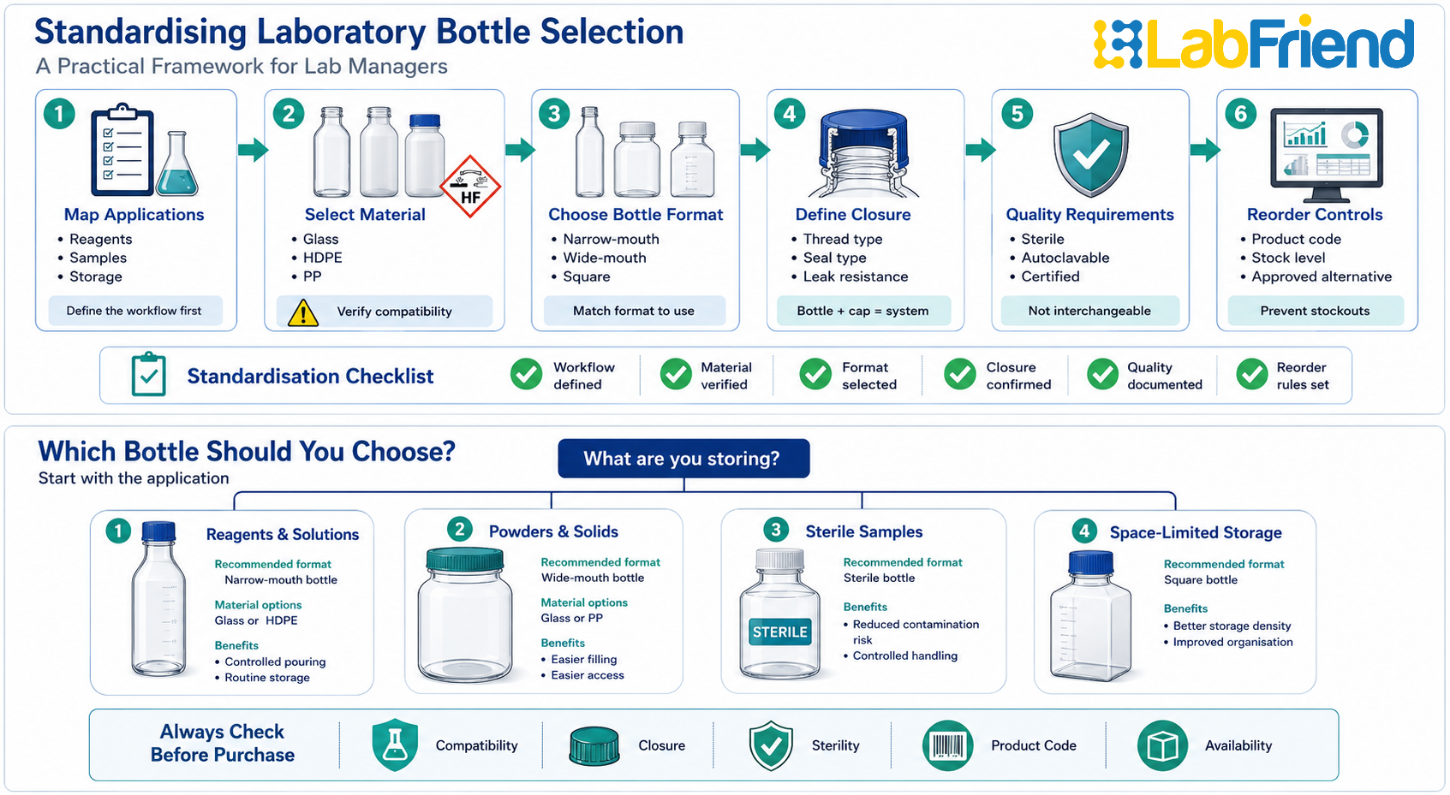
1. Map the Applications First
Start by listing the routine uses of bottles in your lab.
Common application groups include:
- reagent storage
- buffer or media preparation
- liquid storage
- powder or solid storage
- sample collection
- sample transport
- sterile sampling
- waste collection
- wash bottle dispensing
- cold storage or fridge storage
- teaching laboratory use
- trace or contamination-sensitive workflows
For each application, identify whether bottle choice affects safety, sample integrity, contamination risk, method suitability, required fill volume, available headspace or repeat workflow consistency.
Where bottles are used for sample transport, closure security, leak resistance and applicable transport requirements may need to be considered separately from routine storage applications.
2. Define the Material Requirement
Bottle material should be chosen according to both application requirements and chemical compatibility with the intended contents.
Common material groups include:
- borosilicate glass
- amber glass
- HDPE
- LDPE
- PP
Glass bottles are widely used for many laboratory reagents, but are unsuitable for hydrofluoric acid and may be unsuitable for prolonged storage of some strongly alkaline solutions.
As a lab manager, you do not need to personally validate every chemical compatibility decision, but the standard range should make it clear that users must check manufacturer specifications, SDS/COSHH requirements and compatibility with the intended substance or sample.
Chemical compatibility should always be verified using manufacturer compatibility data and relevant SDS/COSHH information.
3. Define the Mouth Style
The opening style affects usability.
|
Mouth Style |
Best Used For |
Operational Benefit |
|
Narrow-mouth |
Liquids and controlled pouring |
Helps reduce spillage and supports routine liquid workflows |
|
Wide-mouth |
Powders, solids, samples, easier filling |
Makes filling, emptying and cleaning easier |
|
Square bottle |
Space-saving storage |
Improves organisation and storage density |
Standardising mouth style prevents a common problem: users buying a bottle that has the correct volume but is awkward or unsuitable for the task.
4. Define Closure and Cap Requirements
Caps and closures are a frequent source of reorder errors.
For each standard bottle, record:
- thread type
- cap material
- liner or seal type if relevant
- pouring ring requirement if relevant
- autoclavability where specified
- pack size
- manufacturer or product code
Thread systems are not universally interchangeable between manufacturers, even when bottle volumes appear identical.
A chemically suitable bottle body does not automatically mean the cap, liner or seal is suitable. Lab managers should treat the bottle and closure as a complete container system.
Closure materials such as polypropylene caps, PTFE liners or elastomer seals may have different chemical resistance characteristics from the bottle body.
5. Define Sterile, Autoclavable or Certified Requirements
These terms should not be used interchangeably.
|
Requirement |
What It Means Operationally |
|
Sterile |
Supplied sterile where specified by the manufacturer |
|
Autoclavable |
Suitable for autoclaving only where the bottle and closure system are specified for that use |
|
Certified, validated or pre-cleaned |
Supplied with documented cleanliness, traceability or application-specific certification where required |
|
DNase/RNase-free |
Relevant to molecular biology workflows where nucleic acid degradation is a concern |
|
Endotoxin-tested or low-endotoxin |
Relevant to pyrogen-sensitive biological applications where documented endotoxin limits are required |
Lab managers should make these requirements explicit in the approved bottle list so procurement does not substitute incorrectly.
Autoclaving a non-sterile bottle does not automatically make it suitable for aseptic or regulated sterile applications.
6. Define Reorder Rules
For recurring bottle types, record:
- monthly or quarterly usage
- minimum stock level
- reorder quantity
- preferred supplier route
- approved product code
- approved substitute, if any
- user or team responsible
- quote route or account contact
This turns bottle buying from an ad hoc activity into a repeat supply process.
Standard Bottle Range Example for a Mid-Sized UK Lab
The following model can be adapted for CROs, testing labs, biotech labs and university research groups.
|
Bottle Category |
Standardised Decision |
Notes for Lab Managers |
|
Routine reagent bottle |
Clear or amber glass, defined volumes, agreed cap/thread |
Useful for repeat reagent workflows |
|
Liquid storage bottle |
Narrow-mouth format, agreed material and volume range |
Helps reduce spillage and ordering variation |
|
Powder/sample bottle |
Wide-mouth format, agreed material and closure |
Useful for solids, powders and easier access |
|
Space-saving storage bottle |
Square format where storage density matters |
Useful for stockrooms, fridges and organised sample storage |
|
Sterile sample container |
Sterile format where workflow requires it |
Keep separate from non-sterile bottle stock |
|
Wash bottle |
Defined material, nozzle and labelling approach |
Avoid ambiguous or poorly labelled dispensing bottles |
|
Replacement caps |
Matched to thread, bottle type and material |
Prevents mismatched reorders |
|
Larger-volume bottle or carboy |
Defined capacity and handling location |
Useful where bulk storage or larger workflows exist |
Comparison Table: Bottle Formats for Standardised Lab Operations
|
Bottle Type |
Best Operational Use |
Standardisation Value |
Common Purchasing Risk |
|
Prepared reagents and solutions |
Supports consistent storage and labelling |
Wrong cap/thread or unsuitable material |
|
|
Liquids and controlled pouring |
Reduces variation in routine liquid handling |
Poor fit for powders or solids |
|
|
Powders, solids, samples |
Easier filling and cleaning |
Selected when controlled pouring would be better |
|
|
Space-saving storage |
Improves stockroom and fridge organisation |
Rack/fridge fit not checked |
|
|
Contamination-sensitive workflows |
Avoids confusion with non-sterile stock |
Sterility documentation not checked |
|
|
Rinsing and dispensing |
Improves bench organisation and labelling |
Inappropriate solvent, unclear contents or contamination risk |
|
|
Replacement and reorder continuity |
Prevents leakage and mismatched parts |
Thread or liner compatibility not checked |
Wash bottles should be clearly labelled and dedicated where contamination-sensitive applications are involved.
Common Laboratory Bottle Standardisation Mistakes
Mistake 1: Standardising by Volume Only
A 500 mL bottle is not a complete specification. The material, cap/thread, mouth style, closure and application matter.
Mistake 2: Allowing Too Many Near-Duplicate SKUs
Multiple similar bottle types increase stockroom complexity and make reordering harder. Where possible, rationalise to a smaller number of approved bottle types.
Mistake 3: Treating Sterile and Autoclavable as the Same
A sterile bottle is supplied sterile where specified. An autoclavable bottle is suitable for autoclaving only where the manufacturer specifies the bottle and closure system for that use.
Autoclaving a non-sterile bottle does not automatically make it suitable for aseptic or regulated sterile applications.
Mistake 4: Forgetting Caps and Closures
Replacement caps, liners and seals must match the bottle system. Cap mismatch is one of the easiest ways to create leakage, evaporation or reorder problems.
Mistake 5: Substituting Without Checking Workflow Requirements
A lower-cost or more available alternative may be suitable for routine use, but not where the bottle is method-specified, validation-locked, client-approved or contamination-critical.
Mistake 6: Not Recording Reorder Information
If a bottle is used regularly, its product code, pack size and reorder trigger should be recorded. Otherwise, the lab repeats the same selection process every time stock runs low.
UK Laboratory Purchasing Considerations
For UK lab managers, bottle purchasing is rarely just a technical decision. It usually involves balancing workflow suitability, availability, cost control and procurement simplicity.
What to Standardise in the Purchasing Record
|
Field |
Why It Matters |
|
Bottle type |
Prevents confusion between reagent, storage, sample and wash bottles |
|
Material |
Supports compatibility and workflow suitability |
|
Volume |
Helps standardise stock levels and reorder quantities |
|
Mouth style |
Reduces wrong-format purchases |
|
Cap/thread type |
Prevents closure mismatch |
|
Sterility status |
Avoids substitution with unsuitable non-sterile products |
|
Autoclavability |
Prevents assumptions about temperature or sterilisation use |
|
Pack size |
Helps manage stock and cost |
|
Product code |
Makes repeat ordering faster |
|
Approved substitute |
Supports continuity if the first choice is unavailable |
|
Reorder point |
Reduces stockout risk |
Reorder Planning Box
For bottles used weekly or monthly, define:
- average monthly usage
- minimum stock level
- reorder quantity
- preferred product code
- acceptable substitute, if approved
- stock owner
- reorder route
- quote or account contact
This is especially useful for CROs, independent testing laboratories and biotech teams where bottle supply can affect active workflows.
.
Relevant LabFriend Product/Category Connection
LabFriend UK can support standardised bottle purchasing by helping laboratories compare bottle types, browse relevant categories and request quotes for repeat supply.
Relevant LabFriend category pathways include:
Laboratory Vessels for general bottle and vessel requirements
Laboratory Reagent Bottles for routine reagent and solution storage
Narrow-Mouth Bottles for controlled pouring and liquid storage
Wide-Mouth Bottles for powders, solids, samples and easier filling
Square Bottles for space-saving storage and stockroom organisation
Sterile Bottles and Bags for contamination-sensitive workflows
LLG Labware where suitable value alternatives may support routine supply
For standardised repeat purchasing, lab managers should consider requesting a quote that includes the exact product code, pack size, expected usage and any approved alternatives.
FAQs
How should a lab manager standardise laboratory bottle selection?
Start by grouping bottles by workflow, then define the bottle type, material, volume, mouth style, cap/thread, sterility or autoclavability requirements, pack size and reorder point for each recurring use.
What bottle types should most laboratories standardise first?
Most labs should start with routine reagent bottles, narrow-mouth liquid storage bottles, wide-mouth bottles for powders or samples, square bottles for storage efficiency, sterile containers where required, wash bottles and replacement caps or closures.
Why is cap and thread compatibility important?
A bottle body may be suitable for the application, but the wrong cap, liner, seal or thread can cause leakage, evaporation, contamination risk or reorder errors. The bottle and closure should be treated as a complete system.
Should lab managers standardise glass or plastic bottles?
It depends on the workflow. Glass may be preferred for visibility, many reagent storage applications and light protection for photosensitive materials where appropriate. Amber bottles reduce exposure to some wavelengths of light but do not prevent all degradation mechanisms.
Plastic may be useful where breakage resistance, lower weight or transport handling matters. For trace analytical, pharmaceutical or contamination-sensitive applications, extractables and leachables from plastic containers may also need to be evaluated. Compatibility must always be checked.
How can laboratories reduce bottle stockouts?
Labs can reduce stockouts by recording product codes, monthly usage, pack size, minimum stock levels, approved substitutes and reorder responsibility for commonly used bottle types.
Are sterile bottles and autoclavable bottles the same?
No. Sterile bottles are supplied sterile where specified. Autoclavable bottles are suitable for autoclaving only where the manufacturer specifies the bottle and closure system for that use. Autoclaving does not automatically make a bottle suitable for aseptic or regulated sterile applications.
When should a lab consider an alternative bottle supplier or product?
An alternative may be worth considering where the bottle is used routinely, the specification can be matched, the workflow is not validation-locked or client-approved, and the lab wants better value or more reliable repeat supply.
Conclusion
Laboratory bottle standardisation helps lab managers reduce stockouts, simplify purchasing and improve day-to-day workflow consistency.
The key is to standardise by application, material, format, closure and reorder requirement, not by volume alone. A practical bottle range should make it clear which bottles are used for reagents, liquids, powders, samples, sterile workflows and storage efficiency.
Once the standard range is agreed, the next step is to document product codes, pack sizes, approved alternatives and reorder points so bottle purchasing becomes faster, more reliable and easier to manage.
Standardising bottle supply across your lab?
LabFriend UK can help you compare laboratory bottle options, build a practical repeat supply list and request quotes for routine bottle categories.
Request a Quote for Repeat Bottle Supply
Browse Laboratory Bottles
For more information related to Laboratory Bottles see our article
Laboratory Bottles: Selection Guide for UK Laboratories
Written by: Donal O’Sullivan, BSc, Co-Founder and Sales Director, LabFriend UK. Donal brings deep chemistry-led technical expertise across analytical chemistry, biochemistry, environmental monitoring, laboratory instrumentation, consumables and scientific product selection.
Reviewed by: Michael Anderson, MBA, Founder and Managing Director, LabFriend UK. Michael reviews LabFriend UK content for customer relevance, commercial accuracy, operational practicality and alignment with LabFriend UK’s laboratory supply model.
Related Stories

Glass vs Plastic Laboratory Bottles - Which Should UK Labs Choose
Glass vs Plastic Laboratory Bottles - Which Should UK Labs Choose

Laboratory Bottle Materials Explained - Borosilicate Glass - Amber Glass - HDPE - LDPE and PP
Laboratory Bottle Materials Explained - Borosilicate Glass - Amber Glass - HDPE - LDPE and PP

How to Select Laboratory Reagent Bottles for Chemical Storage
How to Select Laboratory Reagent Bottles for Chemical Storage

Glass vs Plastic Laboratory Bottles for Procurement Teams: Balancing Cost, Risk and Suitability
Glass vs Plastic Laboratory Bottles for Procurement Teams: Balancing Cost, Risk and Suitability