HPLC Column Purchasing Checklist for QA-QC and Procurement Teams
21 mins read
HPLC Column Purchasing Checklist for QA/QC and Procurement Teams
By Donal O’Sullivan, BSc. Reviewed by Michael Anderson, MBA.
Substituting an HPLC column should start with the approved
method and complete column specification, not simply a description such as
“C18” or a matching column size. Before ordering an alternative, laboratories
should compare the characteristics that are relevant to the method, confirm the
exact product identity and documentation requirements, and determine whether
the proposed change requires technical approval, verification, change control
or validation work. |
Key Takeaways
- Start
with the approved method and existing column specification.
Procurement should not define a replacement from a shortened description
on a purchase request.
- “C18”
does not establish interchangeability. Columns with the same general
stationary-phase description can differ in characteristics that affect
chromatographic behaviour.
- Compare
the complete relevant specification. Stationary-phase characteristics,
dimensions, particle size, pore size where relevant, hardware and pressure
capability may all need consideration.
- Treat
an unassessed substitute as a potential alternative, not an equivalent.
Technical suitability should be established before price, availability or
supplier preference drives the decision.
- Check
the laboratory's own quality requirements before making a change.
Depending on the method and significance of the change, technical
assessment, documented change control, verification, validation or
revalidation may be required.
- Record
approved products and alternatives accurately. Manufacturer, product
code and critical specifications help prevent purchasing errors and
uncontrolled substitution.
Why HPLC Column Substitution Needs More Control Than a Product-Code Change
An HPLC column is part of the analytical method. Changing it
can therefore be different from replacing a routine consumable whose
performance is adequately defined by a small number of generic specifications.
Two columns can appear similar in a catalogue and still
differ in ways that influence retention, selectivity, efficiency, peak shape,
backpressure or other aspects of chromatographic performance. This matters
particularly in QA/QC laboratories where a method may already have defined
system-suitability criteria, documented operating conditions or formal change
controls.
The purchasing question should therefore be:
Does this proposed column satisfy the technical and
quality requirements of the method?
Only after that question has been answered should price,
availability, pack or purchasing convenience determine which approved option to
order.
For broader context on where columns sit within the
analytical consumables workflow, see The Complete Guide to Chromatography Consumables for UK Laboratories.
Start With the Approved Column Requirement
Before procurement evaluates a replacement, establish what
is actually approved or required.
A request such as:
“C18 HPLC column, 150 × 4.6 mm”
may be insufficient for controlled substitution.
The laboratory should instead work from the method,
controlled specification, approved product record or other appropriate
technical source. The level of detail required will depend on the method and
laboratory quality system, but the objective is the same: identify the
characteristics that must be preserved.
If the existing method specifies an exact manufacturer and
product code, that information is important. If alternatives have already been
technically assessed and approved, they should also be recorded clearly rather
than rediscovered during every purchasing cycle.
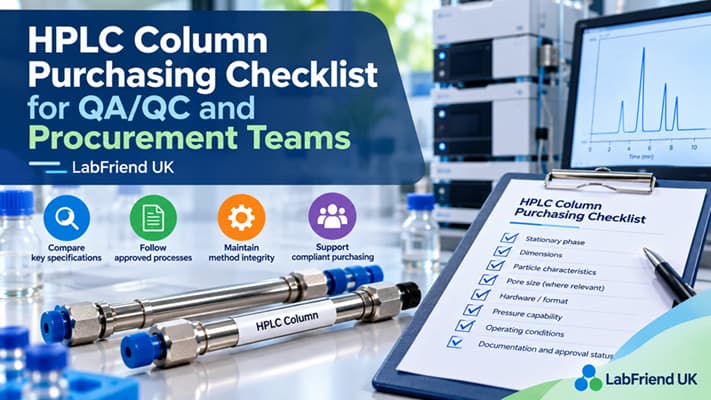
HPLC Column Purchasing and Substitution Checklist
Use the following checklist when placing a repeat order or
assessing a potential alternative.

|
Check |
What procurement should confirm |
Why it matters |
|
Method or application |
Which method or controlled workflow will use the column? |
Establishes the technical context for the purchase. |
|
Manufacturer |
Is a particular manufacturer specified or approved? |
A generic phase description does not necessarily define
the same chromatographic behaviour across manufacturers. |
|
Exact product/reference code |
Is the approved catalogue or product number recorded? |
Reduces ambiguity and repeat-order errors. |
|
Stationary phase |
What phase is specified, and are additional phase
characteristics relevant to the method? |
Labels such as C18 alone do not establish
interchangeability. |
|
Column dimensions |
Confirm length and internal diameter. |
Changes can affect chromatographic performance, run
conditions and method behaviour. |
|
Particle characteristics |
Confirm the specified particle size and, where relevant to
the approved method, particle morphology or technology. |
Particle size and particle design can influence
efficiency, backpressure and chromatographic performance. |
|
Pore size |
Confirm where it forms part of the relevant specification. |
Pore structure can be important, particularly in relation
to analyte size and stationary-phase behaviour. |
|
Column hardware / format |
Confirm relevant hardware, fittings and physical format. |
Mechanical and system compatibility must be maintained. |
|
Pressure capability |
Confirm suitability for the intended operating pressure
and system. |
HPLC and UHPLC products should not be assumed to be
interchangeable solely from their chemistry or dimensions. |
|
Operating conditions |
Confirm that the proposed column is suitable for the
method's specified temperature, mobile-phase composition and pH range where
these are relevant to column compatibility. |
A column with otherwise similar specifications may have
manufacturer-defined operating limits that are incompatible with the approved
method. |
|
Documentation |
Check the product specification and any documentation
required by the laboratory. |
Supports specification review, traceability and controlled
purchasing. |
|
Approval status |
Is this the approved product, an already approved
alternative or a new proposed substitute? |
Prevents purchasing convenience from becoming an
uncontrolled technical change. |
|
Change requirements |
Does the laboratory require technical review, change
control, verification or validation activity? |
The appropriate control depends on the method, the
proposed change and the laboratory's quality requirements. |
Not every method will require every characteristic in this
table to be treated as critical. The important point is to identify and
preserve the relevant approved specification, rather than assuming that
all columns sharing a short catalogue description will perform equivalently.
Why “C18” Does Not Mean Interchangeable
C18 is widely used in reversed-phase HPLC, but “C18” is
not a complete column specification.

Columns described as C18 can differ in their base material,
bonded-phase characteristics, endcapping, pore structure, particle
characteristics and other aspects of the stationary phase and hardware. These
differences can influence chromatographic behaviour.
That means a proposed C18 column should not be described as
an equivalent simply because it has the same nominal phase, dimensions
and particle size as the current column.
For procurement purposes, a better description is potential
alternative until the laboratory has established that the proposed product
is suitable for the method and has completed whatever approval process applies.
This distinction is especially useful when changing
suppliers. A lower price or better availability may justify evaluating an
alternative, but neither establishes technical suitability.
Approved Alternative or New Substitution?
One simple purchasing control is to distinguish between
three situations.
1. Exact repeat order
The manufacturer, product code and required specification
match the laboratory's approved purchasing record.
This should normally be the most straightforward case,
provided the product identity and current specification have not changed. Where
the manufacturer has notified the laboratory of a material product,
specification or manufacturing change, its potential effect on the approved
method should be assessed through the laboratory's applicable technical and
quality process before routine use.
2. Previously approved alternative
The laboratory has already assessed another column and
formally recorded it as acceptable for the relevant method or workflow.
Procurement can then use the approved-alternative record
according to the laboratory's normal controls rather than repeating the
technical decision each time.
3. New proposed alternative
The proposed column has not yet been approved for that
application.
Procurement should not convert apparent specification
similarity into technical approval. The proposal should be referred to the
appropriate laboratory authority for assessment before substitution.
This separation allows purchasing teams to investigate
availability and cost without taking ownership of the chromatographic decision.
Does Changing an HPLC Column Require Revalidation?
A change of HPLC column does not have one universal
revalidation requirement. The appropriate response depends on the method, the
nature and extent of the proposed change, applicable procedures and the
laboratory's quality or regulatory requirements.
A laboratory may need to consider whether the change falls
within adjustments permitted by the applicable method or procedure, whether the
alternative has previously been approved, whether documented change control is
required, and what verification, partial validation, validation or revalidation
work is necessary before routine use. Meeting permitted adjustment criteria
does not by itself establish that a different stationary-phase product is
chromatographically equivalent; the applicable method requirements and
system-suitability criteria must still be satisfied.
The important procurement control is therefore not to decide
independently that revalidation is—or is not—required. It is to identify a
proposed change before ordering and route it through the laboratory's
applicable technical and quality process.
Build a Controlled HPLC Column Reorder Record
Once a column or alternative has been approved, repeat
purchasing should become easier rather than requiring the same technical
discussion every time.
A practical reorder record can include:
- method,
application or internal reference;
- manufacturer;
- exact
product or catalogue code;
- stationary-phase
description and other critical phase characteristics where required;
- column
length and internal diameter;
- particle
size;
- pore
size where relevant;
- relevant
hardware or format information;
- specified
guard column, guard cartridge or other method-defined precolumn
configuration, where applicable;
- approved
alternative product codes;
- restrictions
or substitution rules;
- required
documentation;
- technical
approver or approval reference, where the laboratory's system requires it.

The objective is not to create unnecessary paperwork. It is
to ensure that the technical decision made by the laboratory survives the
transition into purchasing.
A controlled record is particularly valuable when the usual
product is unavailable. Procurement can immediately see whether an approved
alternative exists rather than accepting a supplier suggestion based on a
shortened product description.
Common HPLC Column Purchasing Mistakes
Several avoidable errors can weaken substitution control.
Ordering from a generic description. “C18 column” or
even “C18, 150 × 4.6 mm, 5 µm” may omit characteristics relevant to the method.
Assuming matching headline specifications establish
equivalence. Similar nominal specifications are a starting point for
comparison, not proof of equivalent chromatographic performance.
Allowing availability to determine suitability. An
available alternative can be worth assessing, but stock status does not
establish method suitability.
Using an old product code without checking product
identity. Where a manufacturer changes or supersedes a product, confirm
what has actually changed rather than assuming the new reference is technically
identical.
Failing to record approved alternatives. If technical
staff repeatedly reassess the same replacement because the approval was never
translated into a purchasing record, the laboratory loses much of the
operational benefit of the original assessment.
A Practical Procurement Decision

Before placing an HPLC column order, ask:
Is this the exact approved column?
If yes, verify the product reference and place the order
through the laboratory's normal purchasing controls.
If not, is it an already documented approved alternative?
If yes, follow the applicable purchasing and quality
controls for that approved alternative.
If neither applies, treat it as a new potential
alternative.
Compare the relevant specification, obtain the required
technical assessment, confirm that the applicable method and system-suitability
requirements can be met, and complete any required change-control, verification
or validation activities before treating it as an acceptable substitute.
This approach keeps the responsibilities clear: technical
and quality personnel determine what is suitable; procurement preserves that
decision through accurate purchasing and repeat ordering.
Laboratories with an established specification can browse HPLC columns and
compare available products against their approved requirements. Where
assistance is needed identifying a potential option against an existing
specification, contact LabFriend UK with the relevant column details. Identification of a
potential option does not establish suitability for a particular analytical
method; technical approval remains the responsibility of the laboratory under
its applicable procedures.
Frequently Asked Questions
Are all C18 HPLC columns interchangeable?
No. C18 describes a broad stationary-phase type, not a
complete HPLC column specification. C18 columns can differ in characteristics
such as base material, bonding and endcapping, pore and particle
characteristics, dimensions and hardware. These differences can influence
chromatographic behaviour. A proposed replacement should therefore be assessed
against the method's relevant requirements rather than assumed to be
interchangeable because both products are labelled C18.
Can procurement substitute an HPLC column with the same
dimensions and particle size?
Matching dimensions and particle size alone do not establish
that an HPLC column is a suitable substitute. The stationary phase and other
relevant column characteristics, system requirements and method controls may
also need comparison. Procurement should check whether the alternative is
already approved; if it is not, the proposed change should receive the
laboratory's required technical assessment before purchasing it as a
substitute.
Does changing HPLC column manufacturer require
revalidation?
Changing HPLC column manufacturer requires assessment
against the applicable method and laboratory quality requirements to determine
whether verification, partial validation, validation or revalidation is
necessary. A change that falls within permitted method adjustments does not by
itself establish that a different stationary-phase product is
chromatographically equivalent. The laboratory should confirm that applicable
method and system-suitability requirements are satisfied before routine
implementation.
What information should be recorded for repeat HPLC
column orders?
A repeat-order record should contain enough information to
identify the approved column unambiguously. This will commonly include
manufacturer, exact product or catalogue code, relevant stationary-phase
specification, dimensions, particle size and other method-critical
characteristics. Where applicable, record approved alternatives and
substitution restrictions as well. The appropriate detail depends on the method
and the laboratory's document-control requirements.
What should be checked before approving an alternative
HPLC column?
An alternative HPLC column should be compared with the
approved requirement across the characteristics relevant to the method. These
may include stationary-phase characteristics, dimensions, particle
characteristics, pore size, hardware, pressure capability and applicable
operating limits such as temperature, mobile-phase composition and pH range.
The laboratory should also determine whether technical approval, change
control, verification or validation activities are required before adopting the
alternative for routine use.
A Better Purchasing Process Starts With a Better Specification
HPLC column procurement becomes more reliable when
purchasing teams are not asked to make chromatographic judgements from
incomplete descriptions.
Define the approved requirement, record exact products and
approved alternatives, and treat new substitutions as technical changes until
their suitability has been established. That gives QA/QC teams greater control
over method continuity while allowing procurement to compare suppliers,
availability and price within technically acceptable boundaries.
Read More
Explore More
Written by: Donal O’Sullivan, BSc, Co-Founder and Sales Director, LabFriend UK. Donal brings deep chemistry-led technical expertise across analytical chemistry, biochemistry, environmental monitoring, laboratory instrumentation, consumables and scientific product selection.
Reviewed by: Michael Anderson, MBA, Founder and Managing Director, LabFriend UK. Michael reviews LabFriend UK content for customer relevance, commercial accuracy, operational practicality and alignment with LabFriend UK’s laboratory supply model.
Frequently asked questions
Delivery times vary by product and supplier. Each product page shows current stock levels and the expected lead time, and we confirm this when you place your order. Most items arrive within 2 to 3 weeks. Specialised items can take longer if they are not in stock. If you need something by a certain date, contact us and we’ll check for you.
Yes. Register for a commercial account and, once it’s approved, you will be able to process orders via PO Once you have a commercial account, you can directly email your purchase orders
Add products to your cart and click Get a Quote. You’ll get a formal quote instantly, ready to send to your email address. For bulk orders or custom requirements, send us your product list and we’ll reply with itemized pricing.
If your item is faulty, not as described or sent in error, let us know within 14 days of delivery and we’ll arrange a return. Change of mind returns are only accepted if the item is unused and in its original packaging. A restocking fee will apply and you pay the return freight. Read our full Returns Policy for details.
Yes, prices are shown including VAT by default. Use the Prices Inc. VAT toggle at the top of the page to view prices without VAT.