

Share :
Choosing Centrifuge Tubes for Cell Culture Workflows
Updated On 07/29/2026

By Donal O’Sullivan, BSc. Reviewed by Michael Anderson, MBA.
Quick Start
For cell culture workflows, centrifuge tubes should be chosen by workflow stage, tube volume, sterility or aseptic requirement, material, cap design, RCF rating, rotor compatibility and product documentation. A tube being 15mL, 50mL or sterile is not enough on its own. The tube must be suitable for the way it will be used in the laboratory.
In many cell culture workflows, 15mL centrifuge tubes are useful for smaller suspensions, wash steps, aliquots and moderate-volume handling. 50mL centrifuge tubes are often more practical for larger cell suspensions, media handling, larger wash volumes and workflows where using multiple smaller tubes would add unnecessary handling.
Laboratories comparing options can start with LabFriend UK’s centrifuge tubes, then narrow the choice by volume, material, sterility or aseptic status, RCF rating and workflow suitability. For broader tube selection guidance, read the Complete Guide to Centrifuge Tubes.
Why centrifuge tube selection matters in cell culture
Cell culture workflows are sensitive to contamination, handling consistency and sample loss. A centrifuge tube may look like a simple consumable, but it can influence how efficiently cells are pelleted, washed, resuspended, transferred and stored during routine laboratory work.
The wrong tube can create avoidable problems: it may be too small for the suspension volume, leading to unnecessary transfers, or larger than needed, increasing dead volume or making handling less efficient. A cap that is not convenient for repeated opening and closing can also slow the workflow, and a tube may be physically compatible with the bench workflow but still unsuitable for the centrifuge conditions.
There is also a contamination-control issue. Cell culture workflows often require sterile or aseptic consumables, but sterility is not the same as every other cleanliness or biological suitability claim. If a workflow requires endotoxin-related, pyrogen-related, DNase-free, RNase-free or other specific claims, those must be supported by product documentation. They should not be inferred from the word “sterile.”
The practical aim is to choose a tube that supports the cell culture step without adding technical risk, unnecessary handling or avoidable purchasing complexity.
Start with the workflow stage
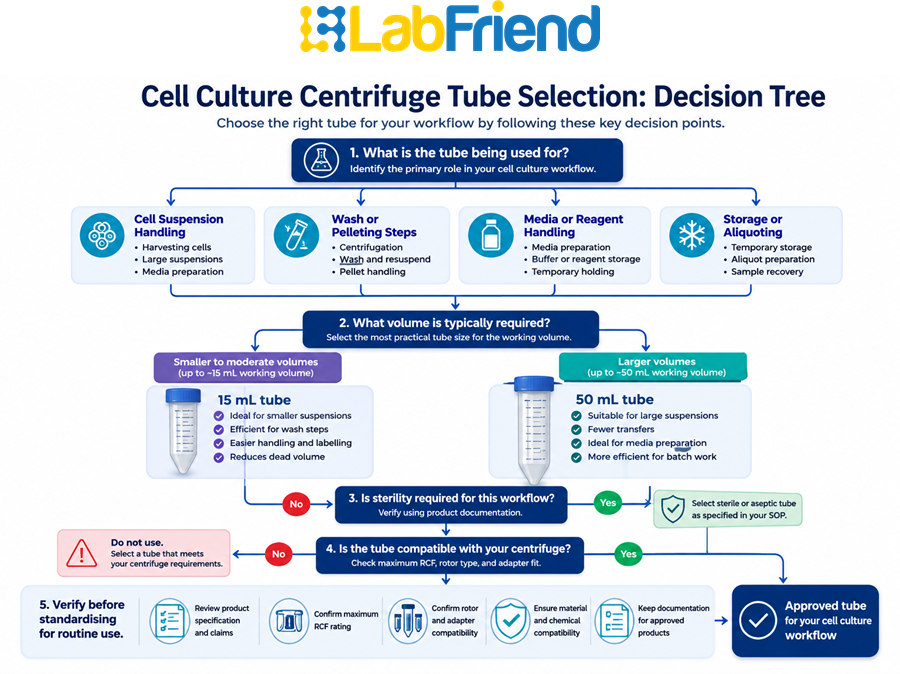
Cell culture workflows use centrifuge tubes in different ways. The right tube for a small wash step may not be the best tube for larger suspension handling or media preparation.
A scientist choosing tubes should first ask what the tube will do in the workflow:
- Is it being used for pelleting cells?
- Washing cells?
- Holding a cell suspension temporarily?
- Preparing or transferring media?
- Supporting a repeat passaging process?
- Moving material between benches?
Once the workflow role is clear, the tube specification becomes easier to define. Tube volume, sterility, cap type, RCF rating and documentation requirements should all follow from the workflow, not from habit or price alone. Where the tube will also be used to store cell pellets or aliquots at reduced or freezer temperatures, cold-temperature and freeze-thaw suitability should be confirmed as well.
|
Workflow stage |
Common tube consideration |
Main selection issue |
|
Smaller cell suspensions |
Often 15mL format |
Handling convenience and suitable working volume |
|
Larger suspensions |
Often 50mL format |
Capacity and fewer transfers |
|
Wash steps |
15mL or 50mL |
Pellet handling, fill volume and centrifuge compatibility |
|
Media or reagent handling |
15mL or 50mL |
Sterility or aseptic requirement and cap convenience |
|
Repeat routine workflows |
Approved tube format |
Consistency and reorder control |
|
Controlled or sensitive workflows |
Documented specification |
Claims must be product-specific |
This matrix should not be treated as a universal rule. It is a starting point for matching tube format to workflow behaviour.
Sterile, aseptic and contamination-control claims
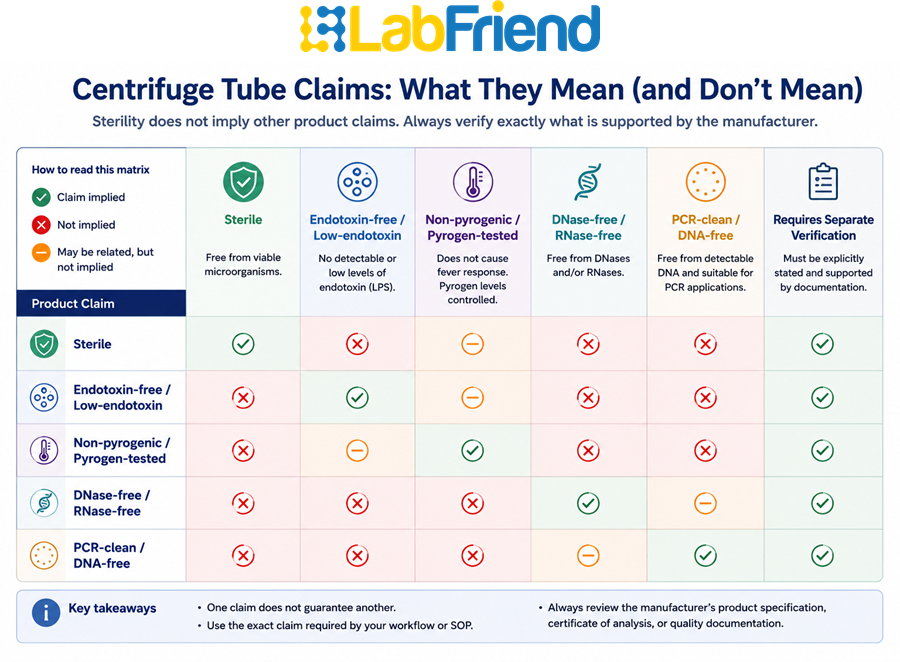
For cell culture, sterile or aseptic consumables are often important. However, the terminology needs to be handled carefully. Sterile and aseptic are not interchangeable: “sterile” typically means the product has been validated against a defined sterility standard, while “aseptic” refers to manufacture or handling under controlled conditions designed to minimise contamination. These describe different types of claim and should not be treated as synonyms.
A sterile or aseptic centrifuge tube may be suitable for many routine cell culture support steps where microbial contamination control is the main requirement. But the presence of a sterility or aseptic claim does not automatically confirm endotoxin-free, low-endotoxin, non-pyrogenic, pyrogen-tested, DNase-free, RNase-free, DNA-free or PCR-clean status.
Those are separate claims. If the laboratory’s workflow or Standard Operating Procedure (SOP) requires one of them, the product documentation should state it explicitly.
|
Claim |
What to check |
Why it matters |
|
Sterile |
Product documentation states sterile status |
Relevant where microbial contamination control is required |
|
Aseptic |
Product documentation states aseptic status |
Relevant where bioburden or contamination control during manufacture or handling is required |
|
Endotoxin-free / low-endotoxin |
Explicit endotoxin-related claim |
Relevant only where the workflow requires it |
|
Non-pyrogenic / pyrogen-tested |
Explicit pyrogen-related claim |
Relevant only where required by method or SOP |
|
DNase-free / RNase-free |
Explicit nuclease-related claim |
Relevant to cell culture workflows feeding into RNA extraction, transfection or other downstream molecular work, in addition to general molecular biology |
|
PCR-clean / DNA-free |
Explicit product claim |
Confirms absence of amplifiable DNA or nucleic acid contamination that could interfere with PCR; should not be inferred from sterility |
The safest approach is to use the exact claim supported by the product documentation. Do not translate one claim into another.
Choosing between 15mL and 50mL tubes
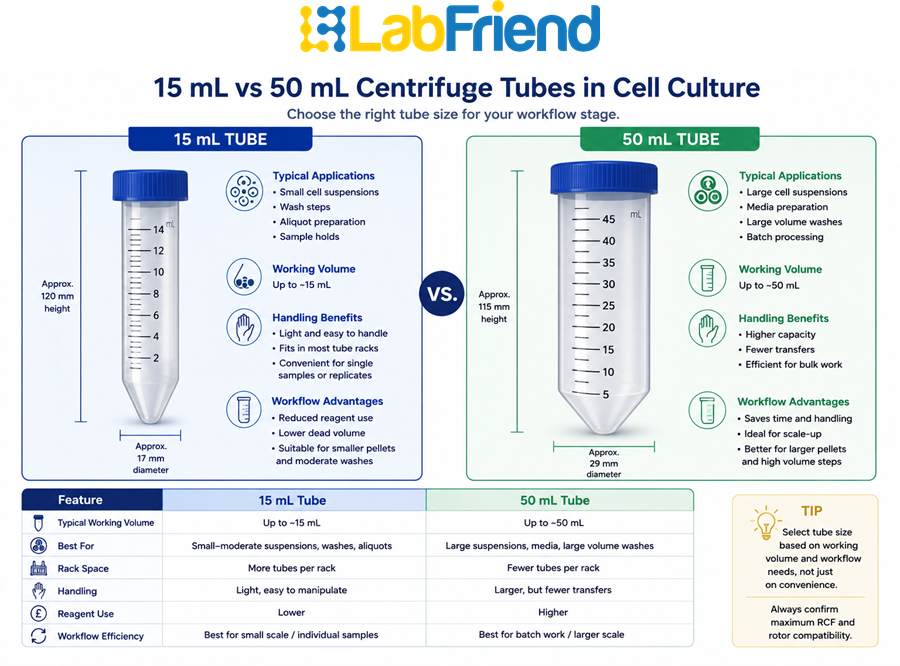
Both 15mL and 50mL centrifuge tubes are useful in cell culture environments. The question is not which size is “best.” The question is which size is appropriate for the workflow stage.
A 15mL tube is often practical when working with smaller volumes, smaller pellets or moderate wash steps. It can be easier to handle, label and store. It may also reduce dead volume where the sample volume is modest.
A 50mL tube is often more practical where the workflow involves larger cell suspensions, larger wash volumes, media handling or batch preparation. It can reduce the need to split material across multiple smaller tubes, which may reduce handling time and potential mix-ups.
A growing or high-usage laboratory may need both. The important point is to define where each format belongs so that routine ordering does not drift into uncontrolled product variation.
For broader repeat-use purchasing context, read Choosing 15mL and 50mL Centrifuge Tubes for High-Usage Laboratories.
RCF, rotor compatibility and cell pelleting
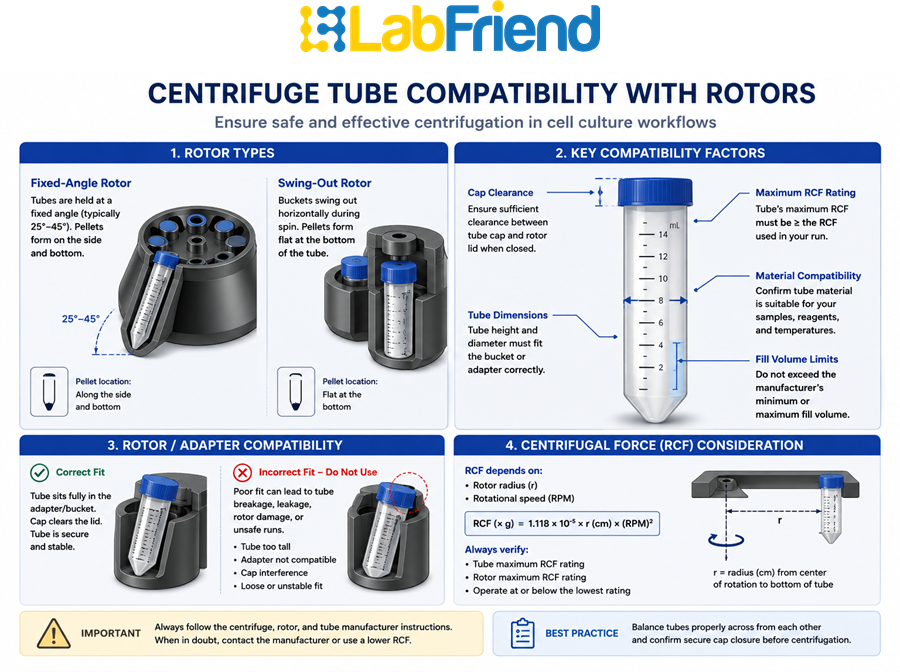
Cell culture workflows often include centrifugation steps, especially during pelleting, washing or harvesting. That means tube selection must include centrifuge compatibility, not just sterility and volume.
RCF, or relative centrifugal force, is product- and setup-dependent. It is determined by both rotational speed and rotor radius, so the same RPM can produce different RCF values depending on rotor radius, where radius is measured from the centre of rotation to the sample position rather than the tube’s own length. A tube that physically fits into a rotor is not automatically suitable for the intended centrifugation condition.
Before routine use, the laboratory should confirm the tube’s maximum rated RCF, the rotor type, adapter fit, cap clearance, fill conditions and temperature conditions where relevant. A tube’s stated maximum RCF assumes use with a compatible, tested rotor and adapter combination, so moving it into a different rotor can exceed its true safe operating limit even without exceeding the rotor’s own RPM rating. The check is especially important when switching supplier or moving a tube between different centrifuge setups.
For deeper technical guidance, read Understanding RCF, RPM and Rotor Compatibility for Centrifuge Tubes.
Cap design and handling practicality
Cell culture workflows often involve repeated handling. Tubes may be opened, closed, labelled, balanced, transferred between benches and placed into centrifuges. Cap design therefore matters.
A secure cap can help reduce leakage risk during handling and centrifugation, but the cap also needs to be practical for the workflow. Scientists should consider whether the closure is easy to use with gloved hands, whether it supports the required handling pattern, whether the cap design affects contamination-control practices, and whether it clears the rotor or bucket when used in the centrifuge. Because most cell culture handling takes place inside a biosafety cabinet or laminar flow hood, cap practicality should also be considered in that context, including one-handed opening and a minimal reach or footprint.
Graduations, writing areas and packaging format can also matter. Where a workflow relies on the tube’s printed graduations for volumetric accuracy, such as measuring media or reagent volumes, the graduation accuracy or tolerance stated in the product documentation should be checked, not just their presence. In a busy cell culture workflow, small usability differences can affect consistency, especially when the same tube is used repeatedly across multiple users.
Laboratories using automated liquid handlers or robotic systems should also confirm tube footprint and dimension compatibility with that equipment, alongside these manual-handling considerations. These practical features do not replace technical specification, but they should be considered before a tube becomes a routine standard item.
Material considerations
Polypropylene is commonly used for many centrifuge tube workflows, including biological sample preparation and routine laboratory handling. It is widely used because it offers a practical balance of durability and suitability for many common workflows when the product specification supports the use case, though it typically offers lower optical clarity than some alternative materials, which is worth considering where visual inspection of a cell pellet or suspension is part of the workflow.
However, material should not be treated as a complete specification. A polypropylene tube is not automatically suitable for every cell culture workflow, every centrifugation condition, every reagent, every temperature or every contamination-control requirement.
If the workflow involves specific media, additives, reagents, low-temperature conditions or chemical exposure, suitability should be checked using manufacturer documentation. If the workflow has quality or documentation requirements, the required evidence should be agreed before the tube is standardised. For more detailed information see our article Polypropylene vs Polystyrene Centrifuge Tubes
Documentation and repeat-use control
Once a centrifuge tube is accepted into a cell culture workflow, it may be reordered repeatedly. That makes documentation and product control important.
For routine research use, a product page or specification sheet may provide enough information for practical selection. For more controlled workflows, the laboratory may require additional documentation, such as datasheets, certificates, lot information or internal approval records. Where tubes feed directly into downstream instruments, such as automated cell counters or cap-piercing samplers, physical compatibility with that equipment should also be confirmed as part of the selection process.
The level of control should match the workflow risk. A tube used for general media handling may not need the same evidence as a tube used in a more controlled or sensitive process. The laboratory’s own SOPs and quality system should define what is required.
Evidence to check |
Why it matters |
|
Product specification |
Confirms volume, material, cap type and dimensions |
|
Sterility or aseptic claim |
Supports contamination-control decisions |
|
Endotoxin or pyrogen-related claim |
Required only where the workflow specifies it |
|
Maximum RCF |
Supports centrifugation suitability |
|
Rotor and adapter fit |
Reduces risk of poor support or cap interference |
|
Pack format |
Supports routine handling and storage |
|
Reorder route |
Prevents uncontrolled substitution |
This table is a decision aid, not a substitute for product review.
Supplier switching in cell culture workflows
Supplier switching can make sense when a laboratory needs better value, easier ordering, clearer pricing, broader availability or improved service. However, cell culture tube switching should be managed carefully.
A substitute product should not be accepted just because it has the same nominal volume or appears similar. It should be compared against the required specification for the workflow. This includes volume, material, cap design, sterility or aseptic status, RCF rating, dimensions, packaging and any additional claims required by the laboratory.
If the workflow is sensitive or controlled, the lab may also need user acceptance, technical sign-off or change-control review. That decision belongs to the laboratory and should follow internal procedures.
The key principle is simple: supplier switching should preserve the accepted specification, not just the product category.
Sample organisation and tube racks
Cell culture workflows often involve multiple samples, conditions, passage numbers, wash steps or tube formats. Good sample organisation helps reduce mix-ups and supports consistent handling.
Tube racks can support bench organisation, sample layout, transport between work areas and separation of 15mL and 50mL formats. They are not the main selection factor for the tube itself, but they are part of the practical workflow system.
Where laboratories are standardising both tubes and bench handling, LabFriend UK’s tube racks category can be a useful adjacent route.
Common mistakes in cell culture tube selection
Treating sterile as a complete suitability claim
Sterile or aseptic status is important where required, but it does not automatically confirm endotoxin-free, pyrogen-tested, non-pyrogenic, DNase-free, RNase-free or cell-culture-specific suitability.
Using one tube size for every step
A single tube format may simplify ordering, but it can create handling inefficiency. Smaller workflows may suit 15mL tubes, while larger suspensions and media handling may suit 50mL tubes.
Ignoring centrifuge conditions
A tube selected for sterile handling still needs to be suitable for the centrifugation step. RCF, rotor support, cap clearance and fill volume should be checked.
Switching products without technical comparison
Two tubes may look similar but differ in dimensions, cap design, material, sterility claim, RCF rating or documentation. Substitution should be based on evidence.
Overlooking repeat-use control
If a tube is used regularly, the laboratory should define the approved format, reorder route and acceptable substitute. Otherwise, small purchasing changes can accumulate into workflow inconsistency.
What this article does not solve
This article helps laboratories choose centrifuge tubes for cell culture workflows, but it does not confirm that any specific tube is suitable for all cell culture applications.
It does not confirm endotoxin-free status, pyrogen-free status, non-pyrogenic status, DNase-free status, RNase-free status, clinical suitability, diagnostic suitability, GMP suitability, cryogenic suitability, chemical compatibility or method validation for any specific product.
Those decisions must be made using product documentation, manufacturer information, internal SOPs and the laboratory’s own workflow requirements.
Practical selection framework
A practical tube selection process for cell culture workflows can be kept straightforward.
|
Step |
Action |
Outcome |
|
1 |
Define the workflow stage |
Clarifies whether the tube is for suspension, pelleting, washing, media handling or storage |
|
2 |
Choose the practical volume |
Determines whether 15mL, 50mL or another format is appropriate |
|
3 |
Confirm contamination-control requirements |
Separates sterile, aseptic, endotoxin, pyrogen and nuclease-related claims |
|
4 |
Check centrifuge suitability |
Confirms RCF, rotor fit, cap clearance and fill conditions |
|
5 |
Review documentation |
Supports technical confidence and repeat use |
|
6 |
Standardise only after suitability is confirmed |
Prevents unsuitable routine reordering |
The goal is not to overcomplicate routine tube purchasing. The goal is to make sure the selected tube genuinely fits the workflow.
Frequently asked questions
What centrifuge tubes should be used for cell culture?
Cell culture workflows commonly use 15mL and 50mL centrifuge tubes depending on sample volume, suspension size, wash steps and media handling. The tube should be selected by workflow requirement, sterility or aseptic status, material, RCF rating, cap design and documentation.
Are sterile centrifuge tubes enough for cell culture?
Sterile or aseptic tubes may be suitable for many cell culture support steps, but sterility alone does not confirm endotoxin-free, non-pyrogenic, DNase-free, RNase-free or cell-culture-specific suitability. Required claims should be checked in product documentation.
Should cell culture workflows use 15mL or 50mL centrifuge tubes?
Use 15mL tubes for smaller suspensions, moderate wash steps and easier handling. Use 50mL tubes for larger suspensions, media handling, larger wash volumes and workflows where multiple smaller tubes would add unnecessary handling.
Does RCF matter for cell culture centrifuge tubes?
Yes. If the tube will be centrifuged, the product-specific RCF rating, rotor compatibility, adapter fit, fill volume and cap clearance should be checked before routine use.
Are polypropylene tubes suitable for cell culture?
Polypropylene tubes are commonly used in many biological workflows, but material alone does not confirm suitability for every cell culture step. Sterility, documentation, RCF, cap design and any required biological claims should also be checked.
Do cell culture tubes need to be endotoxin-free or non-pyrogenic?
Only where the workflow, SOP or method requires those claims. Do not infer endotoxin-free or non-pyrogenic status from sterility unless product documentation explicitly states it.
Can I switch supplier for cell culture centrifuge tubes?
Yes, but the substitute should be compared against the accepted specification. Volume, material, cap design, sterility or aseptic status, RCF rating, documentation and user acceptance should be considered.
Should labs standardise cell culture centrifuge tubes?
Yes, where workflows are repeatable and technical requirements are clear. Standardisation can improve consistency and repeat ordering, but it should not remove specialist products required by specific workflows.
Are tube racks important for cell culture workflows?
They can be useful for organisation, transport and separating tube formats at the bench. Rack selection should match the tube formats and workflow layout used by the lab.
What is the biggest mistake when choosing centrifuge tubes for cell culture?
The biggest mistake is assuming suitability from volume or sterility alone. The tube should be checked against the workflow, contamination-control requirement, centrifugation conditions and product documentation.
Conclusion
Choosing centrifuge tubes for cell culture workflows is a technical and practical decision. The right tube must support the workflow stage, sample volume, sterile or aseptic handling requirement, centrifugation condition, cap design and repeat-use pattern.
For many laboratories, 15mL centrifuge tubes are useful for smaller suspensions and moderate handling steps, while 50mL centrifuge tubes are better for larger suspensions, media handling and larger-volume washes. Both formats may be needed in the same cell culture environment.
The safest approach is to select by documented suitability, not by volume or habit alone. Check the workflow, confirm the required claims, verify RCF and rotor compatibility, review documentation and standardise repeat use only after the tube has been accepted for the application.
To compare available options, browse LabFriend UK’s centrifuge tubes, or return to the Complete Guide to Centrifuge Tubes for broader selection guidance.
Written by: Donal O’Sullivan, BSc, Co-Founder and Sales Director, LabFriend UK. Donal brings deep chemistry-led technical expertise across analytical chemistry, biochemistry, environmental monitoring, laboratory instrumentation, consumables and scientific product selection.
Reviewed by: Michael Anderson, MBA, Founder and Managing Director, LabFriend UK. Michael reviews LabFriend UK content for customer relevance, commercial accuracy, operational practicality and alignment with LabFriend UK’s laboratory supply model.
Related Stories

Complete Guide to Centrifuge Tubes
Complete Guide to Centrifuge Tubes

The Ultimate Guide to Laboratory Filtration for UK Laboratories
The Ultimate Guide to Laboratory Filtration for UK Laboratories

Polypropylene vs Polystyrene Centrifuge Tubes
Polypropylene vs Polystyrene Centrifuge Tubes: Which Is Best for Laboratory Workflows?

PTFE vs PES Syringe Filters: Which Membrane Should You Choose?
PTFE vs PES Syringe Filters: Differences, Solvent Compatibility and Laboratory Applications