

Share :
Centrifuge Tubes for Cryogenic and Low-Temperature Storage What to Check Before Use
Updated On 08/17/2026

By Donal O’Sullivan, BSc. Reviewed by Michael Anderson, MBA.
Opening answer
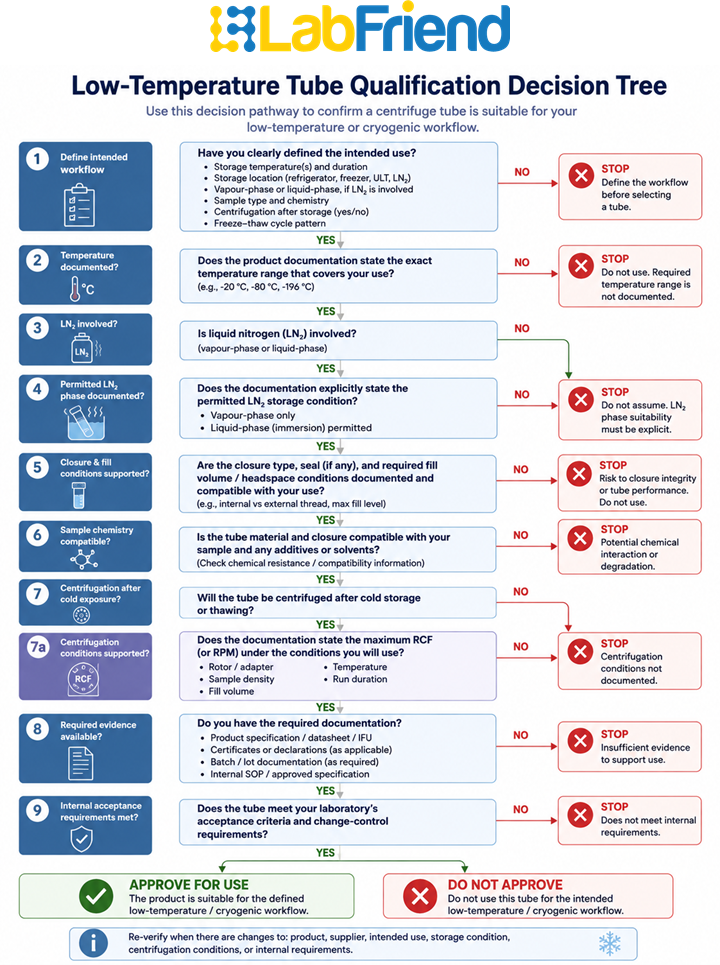
Centrifuge tubes should only be used for cryogenic, frozen or low-temperature storage when the product specification supports that use. Suitability should be checked against the intended storage temperature, exposure duration, tube material, cap or closure design, fill volume, freeze–thaw pattern, centrifugation conditions and manufacturer documentation.
A tube should not be assumed suitable for freezing, -80°C storage, liquid nitrogen exposure or cryogenic-adjacent workflows because it is polypropylene, 15 mL, 50 mL, sterile or commonly used in the laboratory. Temperature suitability is product-specific. In short: always check the product-specific documentation before assuming any tube is suitable for cold or cryogenic storage.
Laboratories comparing suitable formats can start with LabFriend UK’s centrifuge tubes, then narrow their selection by material, volume, temperature range, cap design, RCF rating and product documentation. For wider tube-selection context, read the Complete Guide to Centrifuge Tubes.
Why low-temperature suitability matters
Low-temperature workflows place different demands on laboratory tubes from routine room-temperature handling. A tube that performs well during everyday sample preparation may not behave the same way after freezing, ultra-low temperature storage or repeated freeze–thaw cycles.
At lower temperatures, materials may become stiffer, more brittle or less tolerant of mechanical stress. The temperature at which this becomes significant can vary by polymer grade and additive formulation, not just by material family. Caps and closures may behave differently. Sample expansion during freezing may increase pressure inside the tube. Labels, markings or writing areas may also become harder to use reliably if the tube is handled repeatedly in cold conditions.
The risk is not limited to tube cracking. Poor low-temperature suitability can lead to leakage, cap loosening, sample loss, contamination, difficult retrieval, poor labelling integrity or uncertainty about whether a stored sample remains usable.
For that reason, low-temperature storage should be treated as a suitability decision, not just a storage-location decision.
Refrigerated, frozen and cryogenic use are different
Laboratories often use the phrase “cold storage” loosely, but refrigerated storage, freezer storage, ultra-low temperature storage and cryogenic workflows are not the same. Each condition can place different demands on the tube.
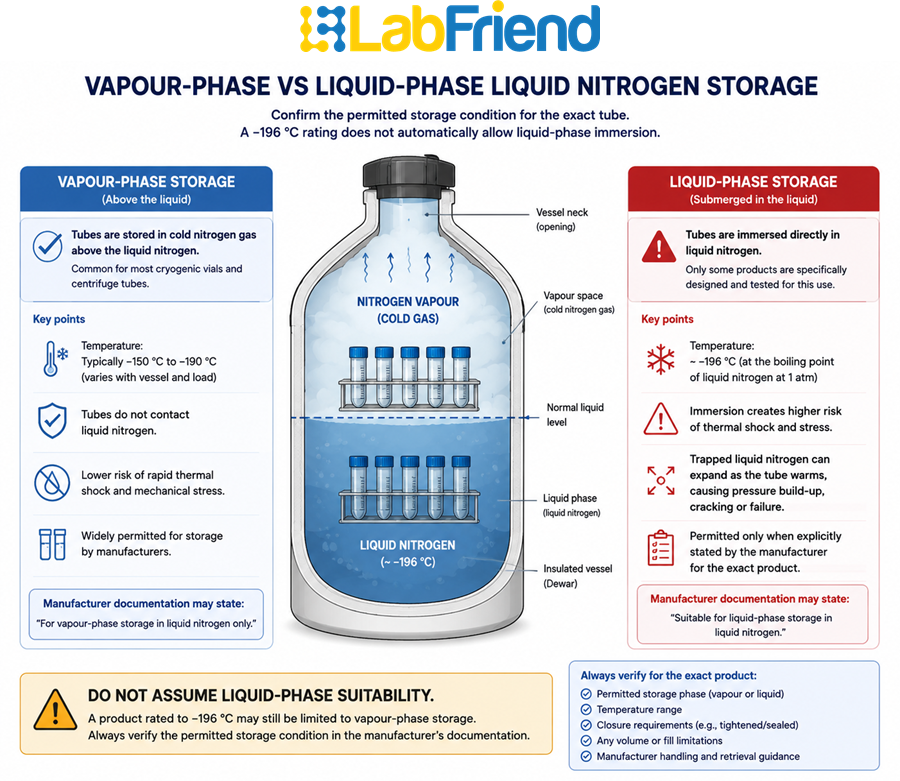
A tube suitable for refrigerated handling is not automatically suitable for -20°C storage. A tube suitable for short-term freezer exposure is not automatically suitable for -80°C storage. A tube suitable for ultra-low temperature storage is not automatically suitable for liquid nitrogen or vapour-phase cryogenic conditions. Mechanical ultra-low freezers, commonly operating around -80°C, are a materially different cold regime from liquid nitrogen storage, where vapour-phase means the tube is held in cold nitrogen gas above the liquid and liquid-phase means the tube is submerged directly in liquid nitrogen.
|
Use condition |
Typical suitability question |
Practical control |
|
Refrigerated handling |
Can the tube tolerate short-term cold handling or refrigerated centrifugation? |
Check temperature and centrifugation conditions |
|
-20°C freezer storage |
Is the tube documented for freezer storage at this temperature? |
Check product temperature range and closure design |
|
-80°C ultra-low storage |
Is the tube suitable for ultra-low temperature exposure and retrieval? |
Check product documentation and fill guidance |
|
Cryogenic-adjacent handling |
Is the tube near liquid nitrogen or cryogenic storage conditions? |
Do not assume suitability; check specific claims |
|
Liquid nitrogen workflows |
Is liquid nitrogen suitability explicitly supported? |
Use product-specific documentation only |
This distinction matters because the word “cryogenic” should not be used casually. Liquid nitrogen and cryogenic storage require product-specific confirmation. Placing a tube not rated for liquid-phase immersion directly into liquid nitrogen carries a documented risk: trapped liquid nitrogen can expand as the tube warms and cause it to crack or fail, which is part of why liquid-phase suitability must be explicitly confirmed rather than assumed.
Standard centrifuge tubes and cryotubes are not the same decision
Standard centrifuge tubes and cryotubes may both hold samples, but they are designed and specified for different use cases. A standard centrifuge tube is commonly selected for sample preparation, centrifugation, mixing, washing or temporary handling. A cryotube is generally selected for low-temperature or cryogenic sample storage where the product specification supports that use.
That does not mean every cryotube is suitable for every cryogenic workflow. It also does not mean every centrifuge tube is unsuitable for every low-temperature workflow. The correct answer depends on the documented product specification and the conditions of use.
A laboratory should therefore avoid two assumptions. The first is assuming that a standard centrifuge tube can be used in any freezer because it looks robust. The second is assuming that any tube called a cryotube is automatically suitable for liquid nitrogen, repeated freeze–thaw exposure or every sample type.
The safer question is: what does the product documentation explicitly support?
Material behaviour at low temperature
Material is an important part of low-temperature tube selection, but it is not enough on its own. Polypropylene, polycarbonate, PPCO (polypropylene copolymer) and other materials may appear in low-temperature product ranges, but suitability depends on the exact product, wall design, cap system, sample type, fill volume and temperature exposure.
Polypropylene is common in many laboratory tubes and cryotubes, but polypropylene should not be treated as universally freezer-suitable or cryogenic-suitable. Polycarbonate tubes may have documented temperature ranges in some product lines, but that still does not mean every polycarbonate tube is suitable for every low-temperature use.
At low temperature, the practical concern is how the whole tube system behaves: body, cap, thread, seal, fill level, sample expansion and handling method. A material may be acceptable under one condition and unsuitable under another.
Where low-temperature storage matters, the product-specific temperature range and manufacturer guidance should be checked before routine use.
Cap design, seal integrity and fill volume
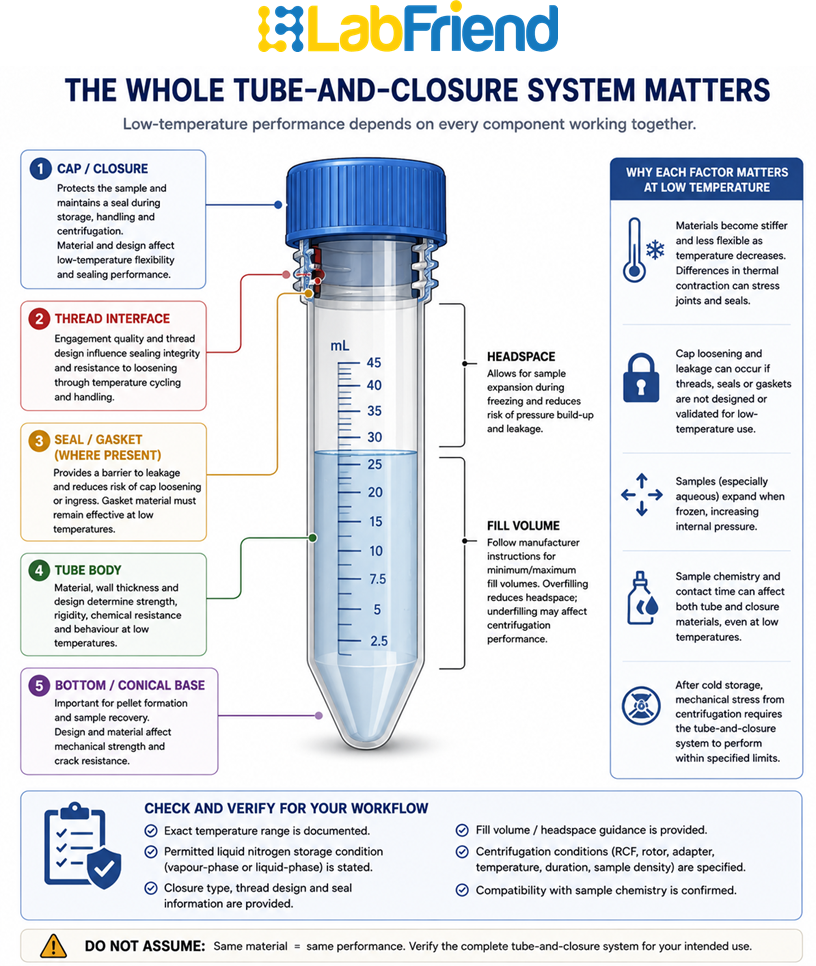
Cap and closure design are critical in low-temperature workflows. The cap may need to maintain closure after cooling, freezing, storage, retrieval and thawing. If the sample expands during freezing, the fill volume and available headspace may affect pressure inside the tube; aqueous-based samples generally expand as they freeze, which is the physical basis for headspace guidance.
Internal-thread and external-thread closures may behave differently depending on the tube design and workflow: internal-thread closures seal inside the tube neck, a recognised contamination-transfer consideration during handling, while external-thread closures seal outside it, so the two are not generally interchangeable for a given workflow. Gaskets, seals, screw threads and closure materials may also affect performance. The laboratory should not assume that the cap behaves exactly like the tube body material. Cap loosening can result from differential thermal contraction, where the cap and tube are made from different materials or tolerances, as well as from repeated thread wear, and the two mechanisms are worth distinguishing when assessing cap performance.
|
Feature to check |
Why it matters |
|
Cap type |
Affects closure security and handling |
|
Thread design |
May influence sealing, retrieval and contamination-control practice |
|
Seal or gasket |
May behave differently from the tube body material |
|
Fill volume |
Freezing expansion may increase stress |
|
Headspace |
May be needed depending on sample and storage condition |
|
Tube orientation |
Storage and retrieval handling can affect leakage risk |
|
Labelling area |
Cold handling may affect readability and sample tracking |
These are practical details, but they matter. In many low-temperature workflows, sample value is high and repeatability matters.
Freeze–thaw handling
Repeated freezing and thawing can add stress to samples and containers. A tube that is acceptable for a single short-term storage event may not necessarily be suitable for repeated freeze–thaw cycles.
The laboratory should consider how often the tube will be removed from storage, how quickly it will thaw, whether it will be refrozen, whether the sample expands or contracts, whether the cap will be opened repeatedly, and whether the tube will be centrifuged after thawing.
Freeze–thaw suitability should not be assumed from the tube material alone. If repeated freeze–thaw handling is part of the workflow, product documentation and internal SOPs should define what is acceptable.
This is especially important where samples are valuable, difficult to replace or connected to a repeat workflow. Some laboratories pre-cool or pre-chill a tube before sample loading to reduce thermal shock; where this practice is used, it should align with product guidance and internal SOPs.
Centrifugation after cold exposure
Low-temperature storage and centrifugation can interact. A tube may be frozen, thawed and then centrifuged, or it may be used in refrigerated centrifugation. In both cases, temperature exposure and mechanical stress should be considered together.
Centrifugation introduces force. If a tube has become more brittle, stressed or compromised through low-temperature exposure, the risk profile may change. Product-specific RCF (relative centrifugal force) rating, rotor compatibility, adapter support, fill volume, sample density and temperature guidance should all be checked where centrifugation follows cold exposure. Tube bottom geometry, such as round-bottom or conical designs, can also affect pellet recovery and rotor or adapter fit, and is worth checking alongside RCF and rotor compatibility.
A tube that physically fits a rotor is not automatically suitable for the workflow. RPM alone is not enough to confirm suitability either, because RCF depends on rotational speed and rotor radius together, not radius alone.
For more detail, read centrifuge tube RCF and rotor compatibility.
Chemical exposure and low temperature
Chemical compatibility and low-temperature suitability can overlap. A sample may contain solvents, buffers, cryoprotectants, salts, biological material or additives that affect tube suitability. Low temperature can also change material behaviour.
This article does not attempt to confirm chemical compatibility for specific reagents. Instead, the practical point is that temperature suitability should not be checked in isolation if the sample chemistry is relevant.
Where samples contain solvents, aggressive reagents, cryoprotectants or additives, the laboratory should review chemical compatibility and temperature suitability together. Tube body material, cap material, exposure time, sample concentration and storage temperature may all matter.
If chemical exposure is part of the workflow, the laboratory should use product-specific manufacturer guidance before routine storage or centrifugation.
Documentation to check before use
Low-temperature suitability should be supported by evidence. The required evidence depends on the workflow risk, sample value and internal laboratory requirements.
For routine cold handling, a product specification may be enough. For ultra-low storage, cryogenic-adjacent workflows or valuable long-term samples, more formal documentation may be needed.
|
Evidence source |
What it may support |
|
Product specification |
Material, volume, cap type, dimensions and pack format |
|
Temperature range |
Documented storage or use temperature |
|
Manufacturer datasheet |
Product limits and intended use conditions |
|
RCF rating |
Centrifugation suitability where relevant |
|
Cap / closure details |
Thread type, closure design and sealing information |
|
Certificate or declaration |
Specific claims where available |
|
Certificate of Analysis / batch documentation |
Batch-specific or lot-specific claims distinct from the general manufacturer datasheet |
|
Internal SOP |
Workflow-specific storage and handling requirements |
|
Substitution record |
Why an alternative product was accepted |
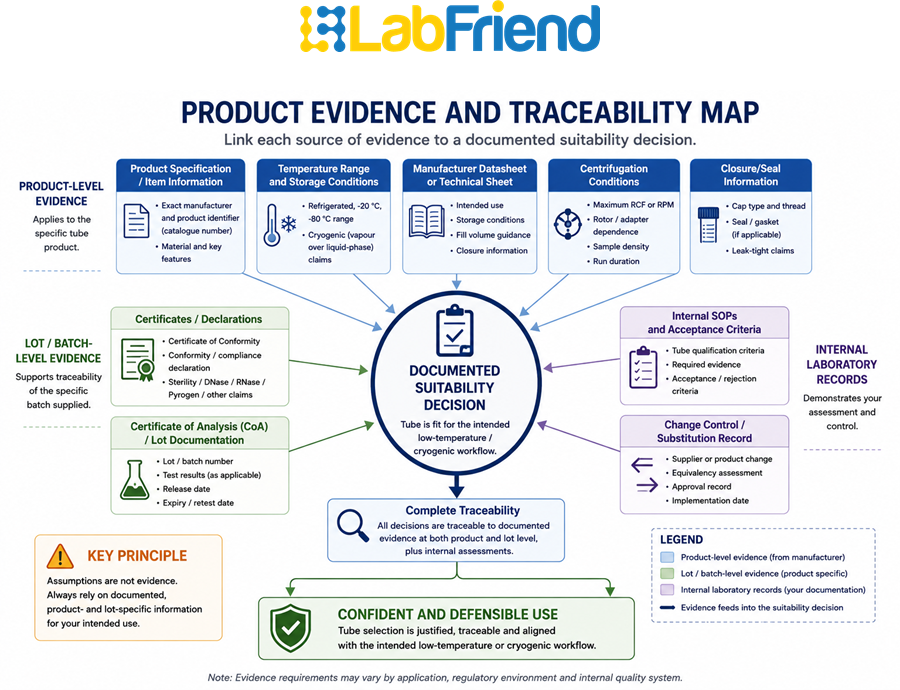
Not every tube will provide every document, and not every workflow needs the same level of evidence. The key is that suitability should be documented where it matters.
Product specifications should be read exactly
Product pages and datasheets can be very useful, but they should be read carefully. If a page states a temperature range, that range should be treated as product-specific. It should not be generalised to every tube of the same material or volume.
For example, a product page may state a defined temperature range and RCF rating for a particular 15 mL or 50 mL centrifuge tube. That information is useful for that product, but it does not automatically apply to all tubes in the category.
Likewise, a cryotube page may state low-temperature storage language, sterile status, thread type or pack format. Those details are useful, but the laboratory still needs to check whether the product matches the intended storage condition and sample workflow.
A good purchasing habit is to ask:
Which claim is explicitly stated, and which claim am I assuming?
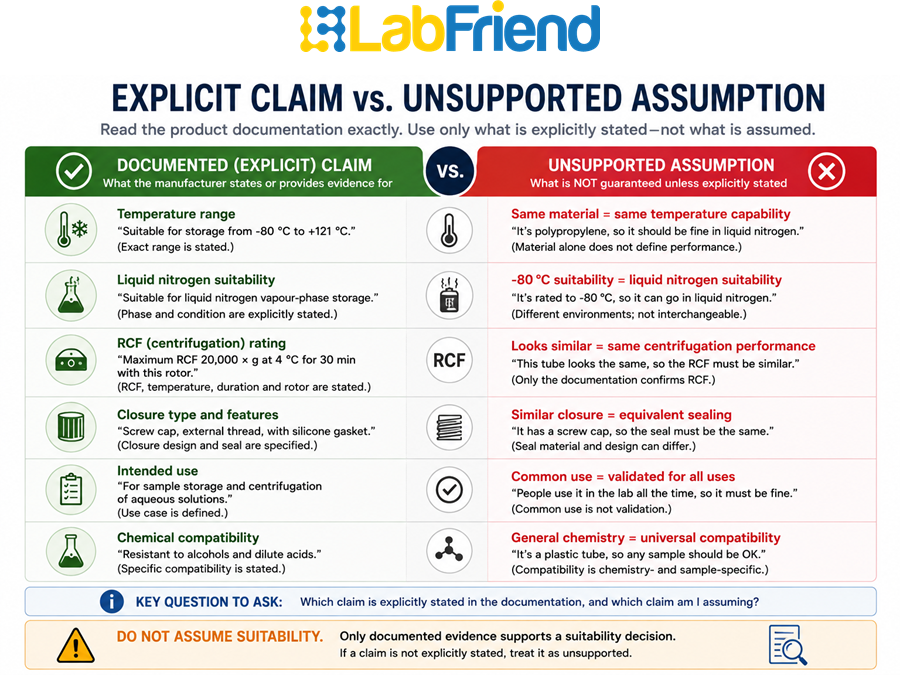
For example, a product page stating a defined temperature range and a specific cap type is an explicit claim. Assuming that the same tube is also liquid-nitrogen-safe, when the page does not say so, is an assumption rather than a stated claim.
Supplier switching and repeat ordering
Supplier switching can be useful when a laboratory needs better value, easier ordering, broader product range or more responsive service. However, where low-temperature suitability matters, substitution should be controlled.
A replacement tube should not be accepted because it looks similar, has the same nominal volume or uses the same broad material name. The substitute should be compared against the accepted specification: temperature range, cap design, fill guidance, RCF rating, material, documentation and intended use.
This is especially important where the tube is used repeatedly for frozen samples, valuable biological materials, project samples or controlled workflows. Once a product has been accepted for low-temperature use, repeat ordering should preserve the specification that made it acceptable.
For broader repeat-purchasing context, read high-usage centrifuge tube purchasing.
Cold-storage organisation
Low-temperature workflows often involve sample tracking, box organisation, rack compatibility and retrieval discipline. Even where the tube itself is suitable, poor storage organisation can increase handling time and sample risk.
Cold-storage accessories such as cryoboxes, racks and storage systems can help laboratories organise samples by project, date, batch, user or workflow. They do not replace tube suitability checks, but they can support better sample management. Colour-coded caps, printed labels or 2D-barcoded tubes are also commonly used to support sample tracking in cold-chain workflows.
Tube base design, such as self-standing or rack-only formats, can also affect freezer box and rack compatibility, and is worth checking alongside cap and closure suitability.
Where laboratories are reviewing cold-storage organisation as well as tube selection, LabFriend UK’s laboratory cooling equipment category can provide a broader starting point.
Common mistakes in low-temperature tube selection
Mistake: Assuming all centrifuge tubes can be frozen
Some tubes may be suitable for defined low-temperature conditions, but this should be confirmed from product documentation. Freezer use should not be assumed from volume, appearance or material alone.
Mistake: Treating cryotube as a universal claim
A cryotube may be designed for low-temperature storage, but liquid nitrogen suitability, vapour-phase suitability, fill conditions and cap performance should still be checked product by product.
Mistake: Ignoring fill volume and headspace
Freezing can change sample volume and internal stress. Fill level and headspace should be considered where freezing is part of the workflow.
Mistake: Checking temperature but not centrifugation
If the tube will be centrifuged after refrigeration, freezing or thawing, RCF, rotor fit, adapter support and fill conditions still matter.
Mistake: Switching supplier without preserving the accepted specification
A substitute tube should match the temperature, closure, material, RCF and documentation requirements of the accepted product.
What this article does not solve
This article supports low-temperature and cryogenic-adjacent tube selection, but it does not confirm that any specific tube is suitable for -20°C storage, -80°C storage, liquid nitrogen, vapour-phase cryogenic storage, repeated freeze–thaw cycles, cryogenic transport, clinical use, diagnostic use, GMP workflows, regulated methods, chemical exposure or long-term sample preservation.
Those decisions must be made using product documentation, manufacturer information, internal SOPs and the laboratory’s actual workflow requirements.
The article also does not replace specialist cryogenic storage guidance. Where liquid nitrogen or cryogenic systems are involved, laboratories should follow relevant equipment, product and safety instructions. This also means the article does not cover cryogenic shipping or transport container requirements, such as dry shippers or dry-vapour shippers, consistent with cryogenic transport being outside the scope noted above.
What to check before purchase
Before buying centrifuge tubes, cryotubes or related tube formats for low-temperature workflows, laboratories should confirm the following:
Work through each row below against the specific product's documentation before placing an order.
|
Check |
Decision question |
|
Storage temperature |
Is the tube documented for the intended temperature? |
|
Exposure duration |
Is the tube intended for short-term or longer-term storage? |
|
Tube material |
Is the material suitable for the temperature and workflow? |
|
Cap / closure |
Is the closure suitable for freezing, retrieval and handling? |
|
Fill volume |
Does the workflow allow suitable headspace? |
|
Freeze–thaw pattern |
Will repeated freezing and thawing occur? |
|
RCF rating |
Will the tube be centrifuged before or after cold exposure? |
|
Rotor compatibility |
Does the tube fit the rotor and adapter correctly? |
|
Sample type |
Could sample density, additives or chemistry affect suitability? |
|
Documentation |
Is suitability supported by manufacturer information? |
|
Substitute rule |
Would an alternative preserve the accepted specification? |
This checklist is a purchasing aid, not a universal suitability guarantee.
Frequently asked questions
Can centrifuge tubes be frozen?
Some centrifuge tubes may be suitable for defined freezer conditions, but suitability should be confirmed from product documentation. Do not assume a tube can be frozen because it is polypropylene, 15 mL or 50 mL.
Are centrifuge tubes suitable for cryogenic storage?
Standard centrifuge tubes should not be assumed suitable for cryogenic storage. Cryogenic or liquid nitrogen suitability must be explicitly supported by product-specific documentation, such as a manufacturer statement that explicitly confirms liquid nitrogen or vapour-phase compatibility.
Can 15 mL or 50 mL tubes be used at -80°C?
Only if the product specification supports that temperature and workflow. The laboratory should check temperature range, fill conditions, cap design, material and manufacturer guidance.
What is the difference between centrifuge tubes and cryotubes?
Centrifuge tubes are commonly used for sample preparation, centrifugation and handling. Cryotubes are generally selected for low-temperature storage where the product specification supports that use. Suitability still needs to be checked product by product.
Does cap design matter for frozen samples?
Yes. Cap design, thread type, seal material, closure fit and fill volume can all affect low-temperature handling and leakage risk.
Can tubes be centrifuged after freezing?
Only if the product and workflow support it. Cold exposure and centrifugation may combine mechanical stresses, so RCF, rotor fit, adapter support, fill volume and temperature guidance should be checked.
Are polypropylene tubes suitable for low-temperature storage?
Some polypropylene products may be suitable for defined low-temperature uses, but polypropylene as a material should not be treated as a universal suitability claim. Check the product specification.
Do freeze–thaw cycles matter?
Yes. Repeated freeze–thaw handling may affect tube performance, cap integrity and sample handling. Suitability should be assessed against the workflow and product guidance.
What documentation should be checked?
Check product specifications, temperature range, manufacturer datasheets, cap or closure information, RCF rating, certificates where relevant and internal SOP requirements.
What is the biggest mistake in low-temperature tube selection?
The biggest mistake is assuming suitability from tube format, material or appearance. Low-temperature suitability must be confirmed against the specific product and workflow.
Are glass tubes used for cryogenic storage?
Glass is used in some cryogenic contexts, but it behaves differently from plastic tubes under freeze–thaw stress and should be checked against its own product-specific documentation rather than assumed equivalent to plastic formats.
Conclusion
Centrifuge tubes for cryogenic and low-temperature storage should be selected through documented suitability, not assumption. The right tube depends on the storage temperature, exposure duration, material, cap design, fill volume, freeze–thaw pattern, sample type, centrifugation conditions and manufacturer guidance.
Standard centrifuge tubes, cryotubes and low-temperature storage products should not be treated as interchangeable. A tube may be appropriate for one cold workflow and unsuitable for another.
The safest purchasing approach is to confirm the product-specific temperature range, check closure and fill requirements, review RCF and rotor conditions where centrifugation is involved, and preserve the accepted specification during repeat ordering or supplier switching.
To compare available formats, browse LabFriend UK’s centrifuge tubes. For broader tube selection guidance, return to the Complete Guide to Centrifuge Tubes.
Read more from LabFriend UK:
- Complete Guide to Centrifuge Tubes
- Understanding RCF, RPM and Rotor Compatibility for Centrifuge Tubes
- Choosing 15mL and 50mL Centrifuge Tubes for High-Usage Laboratories
- Browse LabFriend UK Centrifuge Tubes
Written by: Donal O’Sullivan, BSc, Co-Founder and Sales Director, LabFriend UK. Donal brings deep chemistry-led technical expertise across analytical chemistry, biochemistry, environmental monitoring, laboratory instrumentation, consumables and scientific product selection.
Reviewed by: Michael Anderson, MBA, Founder and Managing Director, LabFriend UK. Michael reviews LabFriend UK content for customer relevance, commercial accuracy, operational practicality and alignment with LabFriend UK’s laboratory supply model.
Related Stories

Extractables and Leachables in Analytical Filtration Explained
Extractables and Leachables in Analytical Filtration Explained

How Lab Managers Can Standardise Centrifuge Tube Purchasing Without Increasing Technical Risk
How Lab Managers Can Standardise Centrifuge Tube Purchasing Without Increasing Technical Risk

Low Protein Binding Membranes Explained for Laboratory Filtration
Low Protein Binding Membranes Explained for Laboratory Filtration

Choosing Tube Racks for 15mL and 50mL Centrifuge Tubes
Choosing Tube Racks for 15mL and 50mL Centrifuge Tubes