Syringe Filter Membrane Compatibility for HPLC UHPLC and Chromatography Solvents
28 mins read
Syringe Filter Membrane Compatibility for HPLC UHPLC and Chromatography Solvents
By Donal O’Sullivan, BSc. Reviewed by Michael Anderson, MBA.
Choosing the correct syringe filter membrane for HPLC, UHPLC and chromatography sample preparation is not just a consumables decision. It can affect sample recovery, solvent compatibility, particulate control, background cleanliness, filtration speed and method reproducibility.
Many laboratories start by asking whether they need a 0.22 µm or 0.45 µm filter. Pore size matters, but it is only part of the decision. Pore size ratings such as 0.22 µm and 0.45 µm are typically nominal rather than absolute — they describe a validated retention efficiency at that size, not a guaranteed hard cut-off, so particles close to the rated size may still pass through in some cases. In many chromatography workflows, membrane chemistry is just as important. A filter with the right pore size but the wrong membrane can still create problems if it is incompatible with the solvent, binds (adsorbs) the analyte so less of it reaches the detector, contributes extractables (trace chemical compounds that can leach from the filter material into the sample), or behaves inconsistently with the sample matrix.
The practical question is not:
Which syringe filter membrane is best?
The better question is:
Which syringe filter membrane is suitable for this solvent system, this analyte, this detector, this sample matrix and this chromatography method?
This guide is part of LabFriend UK’s wider chromatography consumables content hub. For the full overview of HPLC, UHPLC, GC, SPE, TLC, vials, filters, columns and chromatography workflow consumables, read The Complete Guide to Chromatography Consumables for UK Laboratories.
LabFriend UK supplies chromatography sample preparation products, HPLC accessories and wider chromatography products for UK analytical laboratories.
Quick answer: which syringe filter membrane should I use for HPLC solvents?
In short: there is no default membrane — the right one depends on how several factors interact, covered below. There is no single syringe filter membrane that is best for every HPLC, UHPLC or chromatography solvent system. The right membrane depends on the solvent, analyte, sample matrix, detector sensitivity, pore size requirement and method conditions.
As a general starting point, PTFE is often considered for organic solvent-rich workflows, while hydrophilic membranes such as PES, nylon, PVDF or regenerated cellulose may be considered for aqueous or mixed aqueous-organic workflows depending on the method. However, these are only starting points. Final suitability should always be checked against manufacturer compatibility data and internal method requirements.
|
Membrane |
Typical consideration in chromatography |
Main caution |
|
PTFE |
Often considered for organic solvent-rich samples |
Hydrophobic PTFE may not wet easily with aqueous samples unless pre-wetted or specifically hydrophilic |
|
Hydrophilic PTFE |
May support broader aqueous / organic use where documented |
Check product-specific compatibility and extractables data |
|
Nylon |
Common in some HPLC sample preparation workflows |
May bind some analytes and is not universal for all solvents |
|
PES |
Often considered for aqueous sample preparation |
Not suitable for every organic solvent system |
|
PVDF |
May be useful where low binding is important |
Suitability depends on solvent, analyte and product specification |
|
Regenerated cellulose |
May support some aqueous and mixed-solvent workflows |
Confirm solvent compatibility and method suitability |
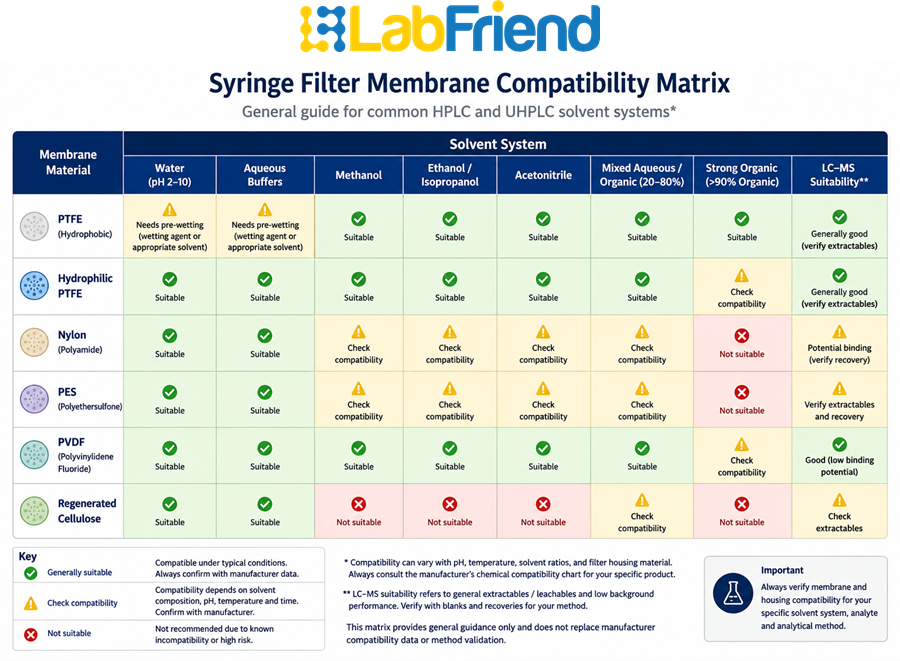
The safest approach is to select the membrane and pore size together, then record the approved specification for repeat purchasing.
Why membrane compatibility matters in chromatography
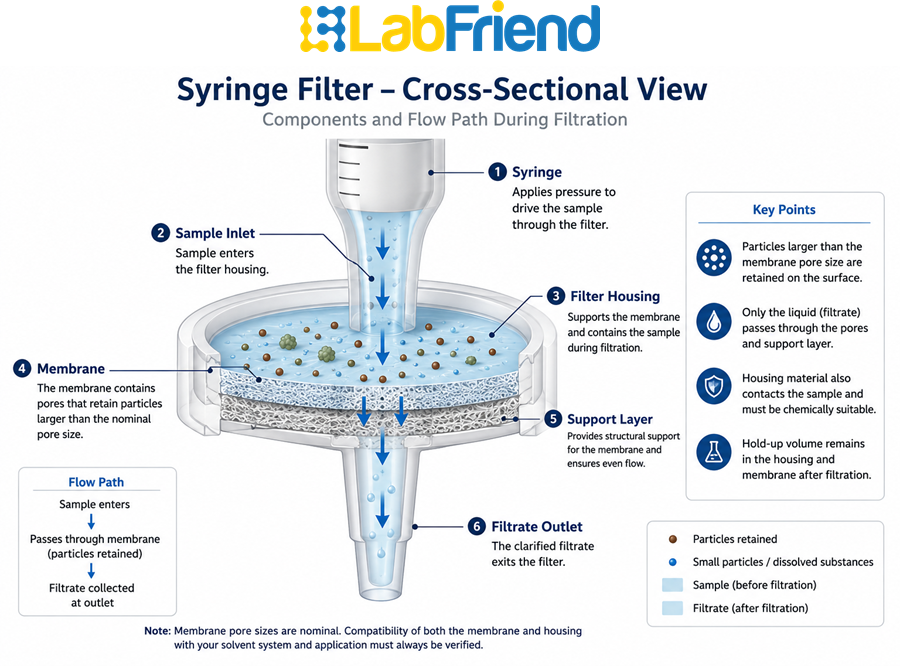
Syringe filters are often treated as simple particle-removal devices. In chromatography, they are more than that. They are sample-contact consumables.
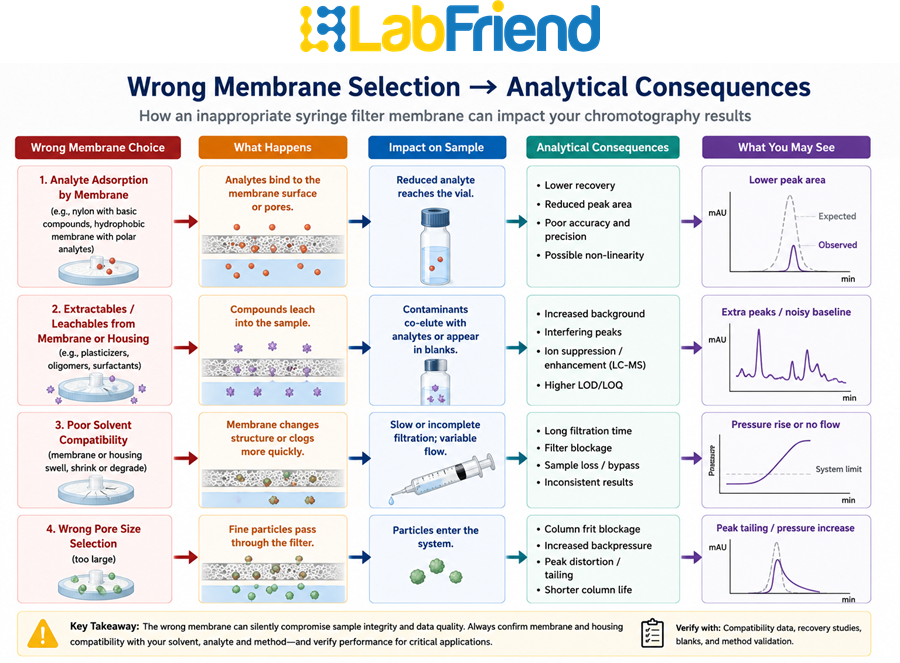
Before the sample reaches the vial, injector, column or detector, it may pass through the filter membrane and housing. During that contact, the filter can influence the sample in several ways. It can remove particulates, but it can also adsorb (bind onto its surface and retain) analytes, release extractables, interact with solvents, slow filtration, or introduce variability between samples if the wrong membrane is selected.
This is especially important in HPLC, UHPLC and LC-MS workflows because the filtration step sits close to the analytical result. A poor filter choice may not fail visibly. Instead, it may appear as reduced recovery, unexpected background, poor reproducibility, pressure issues or inconsistent peak response.
For routine workflows, membrane choice helps protect method consistency. For sensitive workflows, it can be method-critical.
This guide focuses on syringe filtration of samples before injection. Filtering the mobile phase or bulk solvent itself is a related but separate step, typically carried out by vacuum filtration through a larger membrane filter, and is not covered here.
LabFriend UK’s Ultimate Syringe Filter Guide provides broader guidance on pore size, membrane material and syringe filter applications.
Membrane chemistry can matter as much as pore size
Pore size describes the approximate size of particles the filter is designed to retain. Membrane chemistry describes how the filter material behaves when it contacts the sample and solvent.
It is worth noting that 0.22 µm is also the pore rating conventionally associated with bacterial retention in sterilising-grade filtration; this is a separate, formally validated claim from general particulate removal, and syringe filters used for sample preparation are not automatically sterilising-grade unless specifically validated and labelled as such.
Both matter.
A 0.22 µm filter may remove finer particles than a 0.45 µm filter, but if the membrane is not compatible with the solvent system, the filter may still be unsuitable. A 0.45 µm filter with the correct membrane may be more appropriate for a routine HPLC method than a finer filter with poor chemical compatibility.
This is why experienced laboratories do not specify syringe filters as simply “0.22 µm filters” or “HPLC filters.” They record the full specification: membrane, pore size, diameter, housing material, pack size, approved application and any substitution restrictions. Housing material is a separate compatibility check from the membrane itself: polypropylene housings are generally suitable for aqueous and moderately organic samples, while polycarbonate housings can be attacked by some organic solvents even when the membrane itself is resistant, so a chemically compatible membrane fitted to an incompatible housing can still fail.
For example, a repeat-order specification may need to capture:
|
Specification element |
Why it matters |
|
Membrane material |
Controls solvent compatibility, analyte interaction and recovery risk |
|
Pore size |
Controls particulate retention level |
|
Filter diameter |
Affects sample volume, hold-up volume and filtration speed |
|
Housing material |
May affect solvent compatibility and extractables risk |
|
Sterile / non-sterile status |
Relevant only where the workflow requires it |
|
Low-bind or low-extractables requirement |
Important for sensitive methods |
|
Approved alternatives |
Helps avoid stockouts without uncontrolled substitution |
This level of detail helps scientists choose correctly and helps procurement reorder without guesswork.
Filter diameter affects this specification because smaller-diameter filters generally have lower hold-up (dead) volume, which reduces sample loss with low-volume or precious samples, while larger-diameter filters offer greater effective filtration area for particulate-heavy or higher-volume samples.
The syringe itself is also part of this compatibility check. Luer lock fittings generally give a more secure connection than luer slip fittings when applying higher pressure through finer filters, and the syringe barrel material should be chemically compatible with the sample solvent in the same way as the filter membrane and housing.
Start with the solvent system
The solvent system is usually the first compatibility checkpoint. HPLC and UHPLC workflows may involve aqueous buffers, water, acetonitrile, methanol, mixed aqueous-organic mobile phases, acidic modifiers, basic modifiers or stronger organic solvents depending on the application.
A membrane that performs well in one solvent system may be unsuitable in another. Some membranes are more commonly associated with aqueous workflows, while others are commonly considered for organic solvent-rich samples. However, the precise compatibility depends on the product construction and manufacturer data.
This is where laboratories should be careful with generalised rules. It is tempting to say “PTFE for solvents” or “PES for aqueous samples,” but real methods are often more nuanced. A mixed solvent system, pH modifier, analyte class, detector type or trace-level requirement may change the decision.
The best practice is to check membrane compatibility against the actual solvent system used in the method, not against a generic application label.
PTFE syringe filters: useful for many organic solvent workflows, but not universal
PTFE is one of the best-known syringe filter membrane materials in chromatography sample preparation. It is often considered where samples contain organic solvents or solvent-rich mixtures.
The important distinction is that standard PTFE is hydrophobic. That means it does not naturally wet with water. In workflows involving aqueous samples, hydrophobic PTFE may not be suitable unless the product is specifically designed for that use, pre-wetted appropriately (commonly with methanol or ethanol before introducing the aqueous sample), or documented by the manufacturer as compatible with the intended workflow.
For organic solvent-rich HPLC sample preparation, PTFE can be a strong candidate, but it should not be treated as automatically correct. The solvent system, analyte, detector sensitivity, housing material and extractables profile still matter.
PTFE may be considered where:
- the sample is organic solvent-rich,
- the method requires chemical resistance,
- the analyte is not expected to be adversely affected by the membrane,
- manufacturer compatibility data supports the solvent system,
- and the workflow has been checked for recovery and background risk where needed.
The main mistake is using PTFE as a universal synonym for “HPLC-compatible.” It is better to treat it as a membrane option that may be highly useful in the right solvent environment, but still needs method-level confirmation.
Hydrophilic PTFE: useful where documented, but check the specific product
Hydrophilic PTFE filters are designed to address some of the handling limitations of hydrophobic PTFE in aqueous or mixed aqueous-organic workflows. They may be useful where a laboratory wants PTFE-related chemical resistance with improved wetting behaviour.
However, hydrophilic PTFE should still be selected by product documentation, not assumption. Different products may have different surface treatments, extractables profiles, solvent compatibility and intended applications.
For chromatography workflows, hydrophilic PTFE may be considered where the sample preparation method involves mixed solvent systems or where standard hydrophobic PTFE would be difficult to use. It may also be relevant where laboratories want to reduce the number of filter types in use, provided the method supports that decision.
The key point is that “hydrophilic” does not remove the need for compatibility checks. It simply changes the wetting behaviour and potential application range of the membrane.
Nylon syringe filters: common in HPLC, but analyte binding matters
Nylon syringe filters are widely used in many laboratory filtration workflows and may be considered for some HPLC sample preparation methods. Nylon can offer practical handling benefits and may be compatible with a range of aqueous and organic solvent mixtures depending on the product.
The caution with nylon is analyte interaction. Nylon can bind some compounds, particularly basic or polar analytes that interact with residual polar groups on the membrane surface through hydrogen bonding or ionic interactions. That may affect recovery and reproducibility. For trace analysis, low-level quantitation or recovery-sensitive methods, this needs to be reviewed carefully.
Nylon should not be selected simply because it is familiar or widely available. It should be selected because the solvent system, analyte behaviour, recovery requirements and method sensitivity support it.
A laboratory may find nylon perfectly suitable for one routine HPLC workflow and unsuitable for another. That is why membrane approval should be method-led rather than category-led.
PES syringe filters: often considered for aqueous workflows
PES, or polyethersulfone, is commonly considered for aqueous sample preparation workflows. It may be useful where laboratories need good flow characteristics and low protein-binding behaviour in relevant applications.
In chromatography, PES may be considered for aqueous or partly aqueous samples, but care is needed when organic solvent content increases, particularly with strong aprotic solvents such as DMSO, DMF or THF, which can attack PES membranes and housings. It should not be assumed to be compatible with every HPLC solvent mixture.
For scientists, the practical question is whether the PES filter is suitable for the actual mobile phase or sample solvent. If the method uses strong organic solvents, high organic proportions or aggressive solvent conditions, compatibility must be checked.
PES can be a useful membrane choice in the right workflow, but it should not be used as a general-purpose HPLC membrane without checking solvent and analyte suitability.
PVDF syringe filters: useful in some recovery-sensitive workflows
PVDF, or polyvinylidene fluoride, is often considered where low nonspecific protein binding is important, which makes it a common choice where binding behaviour and recovery of proteins or other biomolecules are a concern. It may be relevant for some biological, protein-containing or recovery-sensitive sample preparation workflows, depending on the solvent system and product specification.
For chromatography users, PVDF should be assessed carefully because membrane suitability depends on the analyte and solvent environment. A membrane that supports good recovery in one application may not be right for another.
PVDF can be useful where the laboratory is concerned about analyte loss, but it is not a universal low-binding solution for every chromatography method. Recovery testing may be needed where the method is sensitive or where quantitation is critical.
The safest position is to treat PVDF as a candidate membrane where recovery or binding risk is part of the selection criteria, not as a default replacement for PTFE, nylon or PES.
Regenerated cellulose syringe filters: useful in selected aqueous and mixed solvent workflows
Regenerated cellulose can be considered for some aqueous and mixed-solvent workflows, depending on the exact product and method. It may be useful where the laboratory needs a membrane option that supports good compatibility across certain chromatography sample preparation conditions.
The same caution applies: regenerated cellulose is not automatically suitable for every solvent or analyte. Method suitability, product documentation and recovery behaviour should be checked. Regenerated cellulose also has narrower chemical resistance than membranes such as PTFE or PVDF, and is generally unsuitable for strong acids, strong bases or aggressive organic solvents, so solvent compatibility should be confirmed before use rather than assumed from its aqueous performance.
In practical terms, regenerated cellulose may be worth considering where the method uses aqueous or mixed solvent systems and where analyte recovery, low background or compatibility requirements make other membranes less attractive.
For repeat workflows, any successful regenerated cellulose selection should be recorded clearly. Substituting to or from regenerated cellulose without review can change recovery, flow behaviour or background response.
LC-MS, extractables and background risk
This section is most relevant to LC-MS, LC-MS/MS and other trace-level methods; laboratories running routine HPLC-UV with straightforward matrices may find pore size and general membrane compatibility sufficient without further review. LC-MS and LC-MS/MS workflows can be more sensitive to background signals from consumables. A filter that performs acceptably in routine HPLC-UV may still contribute background or recovery issues in a trace-level LC-MS method. This is largely because mass spectrometric detection can respond to trace-level extractables and plasticisers that are far below the detection threshold of a UV detector, so a filter that appears clean by UV may still contribute background ions in MS.
This does not mean every LC-MS workflow requires a specialist filter. It means the laboratory should be more cautious when selecting or substituting filter membranes.
For LC-MS-sensitive work, consider:
- solvent compatibility,
- membrane extractables,
- housing extractables,
- blank response,
- analyte recovery,
- adsorption risk,
- whether the method has already approved a specific filter,
- and whether substitutions require technical review.
Where analytical sensitivity is critical, avoid assuming that two filters are equivalent because they share the same pore size. The membrane, housing, manufacturing quality and documented suitability can all matter.
Sample matrix and filtration behaviour
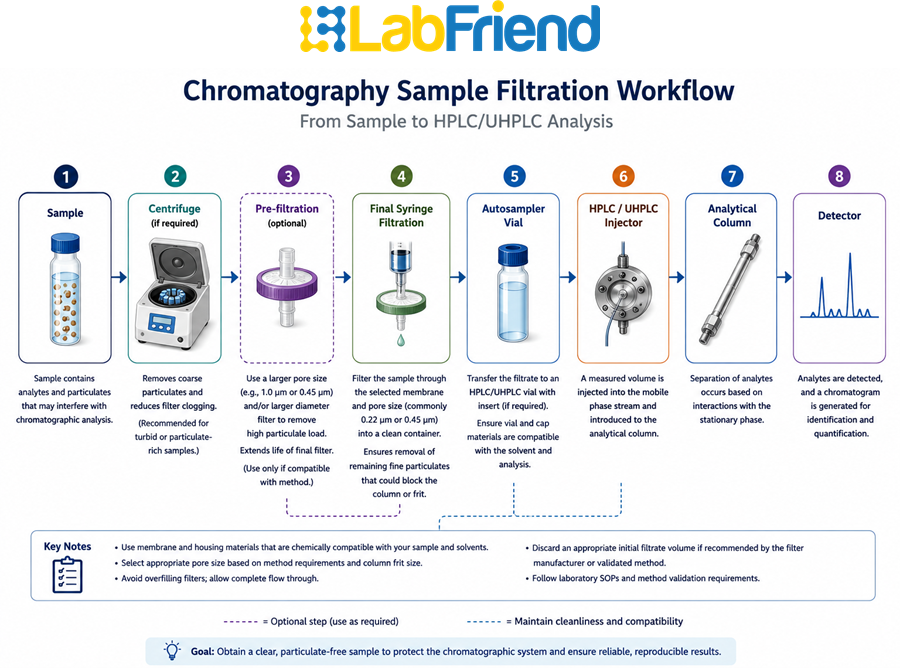
The sample matrix can make a technically suitable membrane difficult to use in practice. Dirty samples, viscous samples, precipitated material, biological matrices, environmental extracts, food samples and formulation samples may all behave differently during filtration.
A membrane that works well for a clean standard may clog quickly when used with a complex matrix. A filter that gives excellent recovery may be too slow for high-throughput use if the sample contains suspended solids. Slow filtration is not just an inconvenience: it can allow volatile solvents to evaporate and concentrate the sample, give unstable analytes more time to degrade before injection, and create a throughput bottleneck in CRO or QC settings processing large batches. A membrane that works with an aqueous sample may be unsuitable when the extraction solvent changes.
This is why method context matters. Laboratories should evaluate membrane choice alongside sample preparation steps such as centrifugation, dilution, pre-filtration, SPE cleanup or staged filtration where needed.
The aim is not just to pass the sample through the filter. The aim is to prepare the sample consistently without compromising the analytical result.
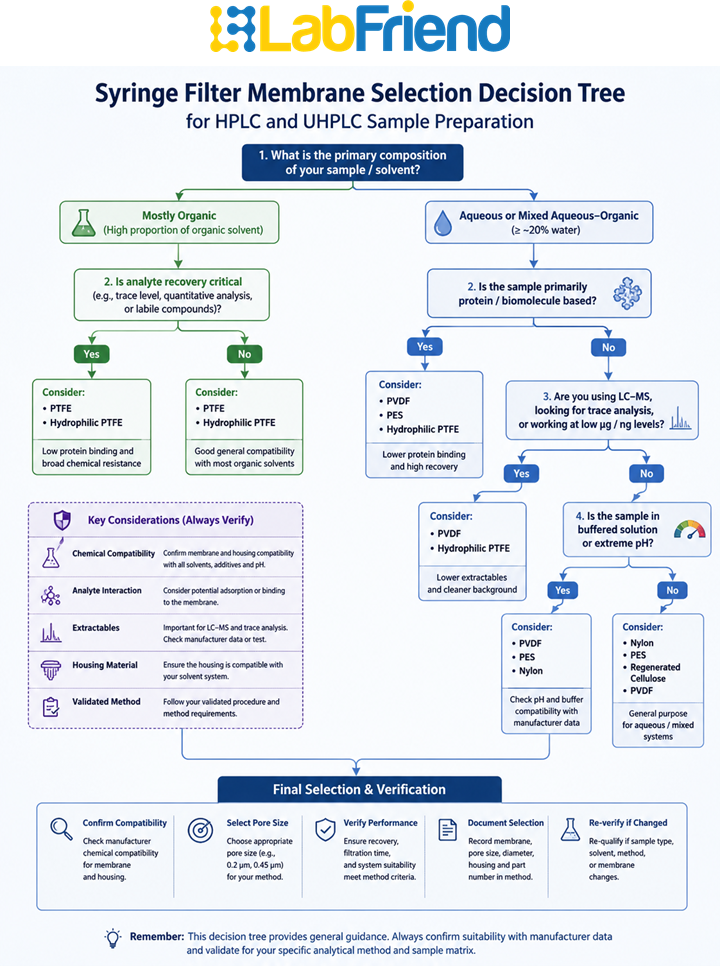
How to choose a syringe filter membrane for HPLC or UHPLC
A practical membrane selection process should begin with the method, not the catalogue.
First, identify the solvent system. Then confirm the analyte class, sample matrix, detector sensitivity and filtration purpose. Is the filter mainly protecting the column from particulates? Is recovery critical? Is the method LC-MS-sensitive? Is the sample organic solvent-rich, aqueous, buffered, acidic, basic or mixed?
Once those questions are clear, compare membrane options using manufacturer compatibility data and, where needed, method checks such as blanks, recovery tests or system suitability.
For routine HPLC workflows, this process may be quick. For UHPLC, LC-MS, regulated, client-specified or trace-level workflows, it may need more formal review.
The decision should result in a recorded specification, not just a one-off purchase.
Approved filter specifications for repeat purchasing
For repeat workflows, the approved syringe filter specification should be clear enough for both scientists and procurement teams to reorder accurately.
For validated or sensitive methods, it is also worth confirming lot-to-lot consistency with the supplier, and requesting a Certificate of Analysis or extractables data where the method's sensitivity warrants it, rather than assuming every batch of an approved product performs identically.
A good repeat-order record should include:
|
Field |
Example of what to record |
|
Application |
Routine HPLC, UHPLC, LC-MS, sample cleanup, solvent filtration |
|
Membrane |
PTFE, hydrophilic PTFE, nylon, PES, PVDF, regenerated cellulose |
|
Pore size |
0.22 µm, 0.45 µm or method-specific requirement |
|
Diameter |
13 mm, 25 mm or other required format |
|
Housing |
Material and compatibility restrictions where relevant |
|
Sample solvent |
Actual solvent or solvent mix used in the workflow |
|
Approval status |
Approved, restricted, no substitution, technical review required |
|
Approved alternatives |
Specific alternatives only, not generic substitutions |
|
Pack size |
Used for cost comparison and stock planning |
|
Reorder route |
LabFriend URL, SKU, quote reference or internal purchasing code |
This is especially useful for CROs, QA/QC laboratories, independent testing laboratories and SME biotech teams where filters are reordered frequently and method consistency matters.
LabFriend UK can support repeat-use sample preparation purchasing through its online catalogue and Contact Us route.
Common mistakes when selecting syringe filter membranes
The most common mistake is choosing by pore size alone. A 0.22 µm filter and a 0.45 µm filter may behave very differently, but two filters with the same pore size can also behave differently if the membrane chemistry is different.
Another common mistake is treating membrane names as universal compatibility labels. PTFE, nylon, PES, PVDF and regenerated cellulose are useful membrane categories, but product-specific construction and compatibility still matter.
A third mistake is overlooking analyte recovery. If the analyte binds to the membrane, the chromatogram may look clean but the result may still be wrong.
A fourth mistake is allowing procurement substitutions without technical review. A substitute filter may match the pore size and diameter but differ in membrane, housing, extractables, flow behaviour or recovery.
Where the method is a validated, pharmacopoeial or otherwise regulated procedure, for example under GMP or GLP, a filter substitution should go through the laboratory's formal method change-control process rather than being treated as a routine purchasing decision.
For chromatography workflows, filter changes should be treated as method-relevant changes where performance or reproducibility could be affected.
Final recommendation
For HPLC, UHPLC and chromatography solvent workflows, syringe filter membrane compatibility should be selected method by method.
Start with the solvent system. Then consider the analyte, sample matrix, pore size, detector sensitivity, recovery requirement, extractables risk and method restrictions. PTFE, hydrophilic PTFE, nylon, PES, PVDF and regenerated cellulose can all be useful in the right context, but none should be treated as universally suitable.
Once the correct filter is selected, record the full specification for repeat purchasing. That should include membrane, pore size, diameter, housing material, solvent compatibility, pack size, approved alternatives and substitution rules.
For broader chromatography consumables guidance, read The Complete Guide to Chromatography Consumables for UK Laboratories. For wider filter selection guidance, read the Ultimate Syringe Filter Guide.
Browse chromatography sample preparation products, explore HPLC accessories, or contact LabFriend UK for help matching repeat-use syringe filter specifications.
Frequently Asked Questions
Which syringe filter membrane is best for HPLC?
There is no single best syringe filter membrane for every HPLC method. The best choice depends on the solvent system, analyte, sample matrix, pore size, detector sensitivity and method requirements.
Is PTFE suitable for HPLC syringe filters?
PTFE may be suitable for many organic solvent-rich HPLC workflows, but it is not universal. Hydrophobic PTFE may not wet easily with aqueous samples unless the product is designed or prepared for that use. Always check compatibility data.
When should I use nylon syringe filters for HPLC?
Nylon syringe filters may be useful in some HPLC workflows, but they can interact with certain analytes. They should be selected only where solvent compatibility and recovery requirements support their use.
Are PES syringe filters suitable for organic solvents?
PES is often considered for aqueous sample preparation workflows, but it should not be assumed to be suitable for every organic solvent system. Check manufacturer compatibility data for the actual solvent mix.
What is PVDF used for in syringe filters?
PVDF may be considered where binding or recovery behaviour is important, depending on the analyte, solvent and method. It is not universally suitable for all chromatography applications.
Is regenerated cellulose suitable for HPLC sample preparation?
Regenerated cellulose may be suitable for selected aqueous or mixed-solvent workflows, depending on product documentation and method requirements. Suitability should be checked against the actual solvent system.
Does membrane material matter more than pore size?
Both matter. Pore size affects particulate retention, while membrane material affects solvent compatibility, analyte recovery, adsorption and extractables risk. They should be selected together.
Can I substitute one syringe filter membrane for another?
Only where the method allows it. Changing membrane material can affect recovery, flow rate, solvent compatibility, background response and reproducibility. Sensitive, validated or client-specified methods may require technical approval.
Where can I buy syringe filters for HPLC sample preparation?
LabFriend UK supplies chromatography sample preparation products and related HPLC accessories through its online platform. Laboratories can browse the relevant categories or contact LabFriend UK for support with repeat-use filter specifications.
Read more from LabFriend UK
- The Complete Guide to Chromatography Consumables for UK Laboratories
- The Ultimate Syringe Filter Guide: Pore Size, Membranes, and Applications
- Browse Chromatography Sample Preparation
- Browse HPLC Accessories
- Browse Chromatography Products
Written by: Donal O’Sullivan, BSc, Co-Founder and Sales Director, LabFriend UK. Donal brings deep chemistry-led technical expertise across analytical chemistry, biochemistry, environmental monitoring, laboratory instrumentation, consumables and scientific product selection.
Reviewed by: Michael Anderson, MBA, Founder and Managing Director, LabFriend UK. Michael reviews LabFriend UK content for customer relevance, commercial accuracy, operational practicality and alignment with LabFriend UK’s laboratory supply model.
Frequently asked questions
Delivery times vary by product and supplier. Each product page shows current stock levels and the expected lead time, and we confirm this when you place your order. Most items arrive within 2 to 3 weeks. Specialised items can take longer if they are not in stock. If you need something by a certain date, contact us and we’ll check for you.
Yes. Register for a commercial account and, once it’s approved, you will be able to process orders via PO Once you have a commercial account, you can directly email your purchase orders
Add products to your cart and click Get a Quote. You’ll get a formal quote instantly, ready to send to your email address. For bulk orders or custom requirements, send us your product list and we’ll reply with itemized pricing.
If your item is faulty, not as described or sent in error, let us know within 14 days of delivery and we’ll arrange a return. Change of mind returns are only accepted if the item is unused and in its original packaging. A restocking fee will apply and you pay the return freight. Read our full Returns Policy for details.
Yes, prices are shown including VAT by default. Use the Prices Inc. VAT toggle at the top of the page to view prices without VAT.