SPE Consumables Procurement Checklist for UK Analytical Laboratories
19 mins read
SPE Consumables Procurement Checklist for UK Analytical Laboratories
By Donal O’Sullivan, BSc. Reviewed by Michael Anderson, MBA.
Buying solid phase extraction consumables is not simply a
matter of matching a cartridge size or finding a product with a familiar
sorbent name. For procurement teams, the priority is to preserve the
laboratory's approved technical requirement when ordering, quoting or
considering an alternative. That means confirming the correct product identity,
sorbent specification, bed mass, device format and any other controlled
characteristics before purchase. |
Key Takeaways
- Buy
against an approved technical requirement rather than a generic product
description.
- Record
the manufacturer, product code, sorbent specification, bed mass and device
format where these are controlled.
- Do
not assume products with the same nominal sorbent are technically
equivalent.
- Separate
pack size and purchasing quantity from the technical specification of the
SPE device.
- Treat
substitutes as candidate alternatives until the appropriate technical
approval has been completed.
- If the approved product is unavailable, escalate the substitution decision rather than changing specification for price or availability alone.
Why SPE Procurement Needs More Control Than a Simple Product Match
Solid phase extraction is used to isolate, clean up or
concentrate analytes before further analysis. The performance of an SPE
procedure can depend on the characteristics of the consumable used.
From a procurement perspective, that creates a
straightforward risk: an item that looks commercially similar may not
necessarily be a suitable technical replacement.
The laboratory may have selected a particular:
- sorbent
chemistry;
- sorbent
mass;
- cartridge
or plate format;
- reservoir
volume;
- manufacturer
or product family;
- construction
or configuration;
- processing
format.
Those characteristics should not be changed casually during
purchasing.
The scientific reasons behind the specification are covered
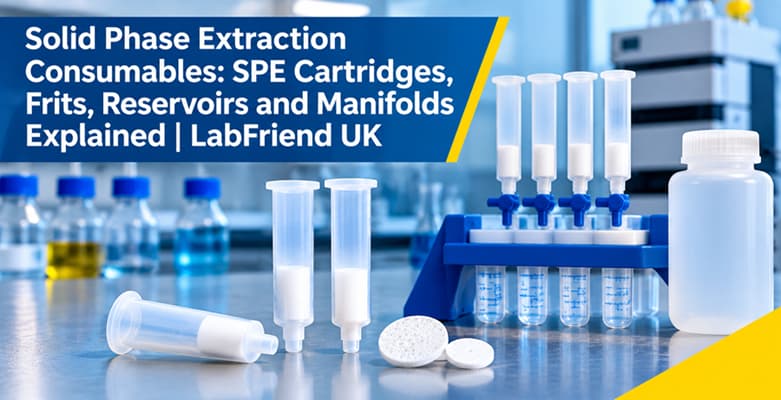
in more detail in Solid Phase Extraction Consumables: SPE Cartridges, Frits, Reservoirs and ManifoldsExplained.
For procurement, the key principle is simpler: preserve
the approved requirement unless the laboratory has authorised a change.
What Procurement Should Have Before Placing an SPE Order
A purchase request should contain enough information to
identify the required SPE consumable without relying on memory, shorthand or
assumptions.
The exact fields will vary by laboratory, but the following
are commonly important.
Manufacturer and product code
Where the laboratory has approved a specific product, record
the manufacturer and the manufacturer's product code.
Supplier catalogue references can be useful, but they should
not automatically replace the underlying product identity. The same
manufactured item may sometimes appear under different supplier references,
while products with similar descriptions may come from different manufacturers
and should not be assumed identical.
A purchasing record should therefore make clear what product
has actually been approved.
Sorbent specification
The sorbent is a core part of an SPE device.
Examples may include reversed-phase, normal-phase,
ion-exchange or mixed-mode materials, but procurement does not need to
determine which chemistry is scientifically appropriate.
The important control is to preserve the approved sorbent
specification.
A description such as "C18 SPE cartridge" may not,
by itself, be sufficient to establish that another C18 product is an acceptable
substitute. Nominally similar sorbents can differ in characteristics that may
influence retention or recovery.
Bed mass
SPE cartridges are commonly offered with different
quantities of sorbent.
If the laboratory has approved a particular bed mass, that
value should be retained in the purchasing record.
Do not assume that a larger or smaller bed mass is
automatically an acceptable alternative. A different sorbent quantity can alter
how the device behaves within an established SPE procedure.
Device format
Procurement should distinguish between the physical formats
specified by the laboratory, such as:
- individual
SPE cartridges;
- well-plate
formats;
- larger
reservoir formats;
- other
application-specific devices.
A cartridge should not be replaced by a plate, or vice
versa, simply because the sorbent description appears similar.
Format can affect sample handling, processing equipment and
laboratory workflow.
Cartridge or reservoir size
Where the approved method specifies a particular cartridge
or reservoir size, record it separately from bed mass.
The two values describe different characteristics.
A cartridge volume should not be treated as another way of
expressing sorbent mass, and matching one does not establish that the other is
correct.
Pack quantity and order unit
Pack quantity is commercially important, but it is not the
same as the technical specification.
For example, a laboratory may use the same approved
cartridge in packs of different quantities. Procurement should distinguish:
What the product is from and how many units are being bought.
Keeping those fields separate makes quote comparison and
repeat ordering easier.
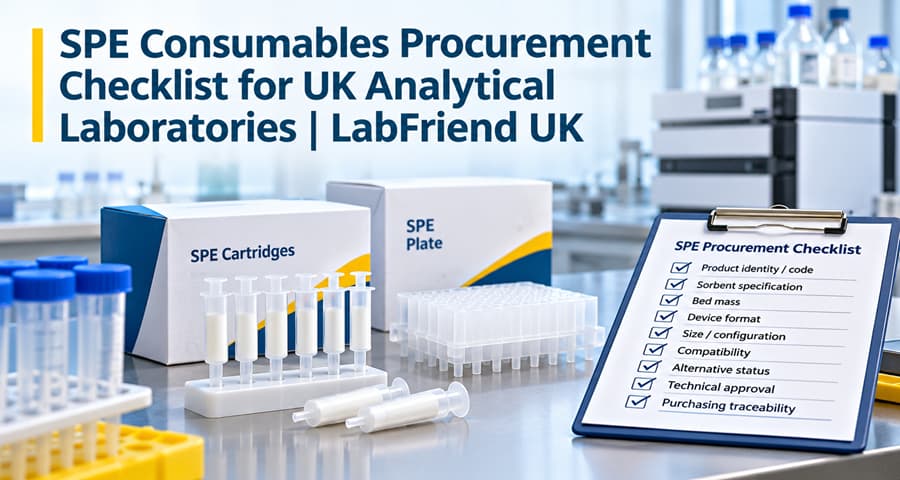
A Practical SPE Procurement Checklist
Before ordering, procurement should be able to answer the
following questions.

|
Check |
What to confirm |
|
Product identity |
Manufacturer and approved product code |
|
Sorbent |
Approved sorbent specification |
|
Bed mass |
Correct sorbent mass for the approved use |
|
Format |
Cartridge, plate or other approved format |
|
Size |
Cartridge/reservoir size where relevant |
|
Pack quantity |
Commercial pack size and number of packs required |
|
Processing compatibility |
Any required compatibility with manifold or processing
equipment |
|
Alternative status |
Whether the proposed product is the approved item or an
approved alternative |
|
Technical approval |
Whether any proposed substitute has been accepted by the
appropriate technical authority |
|
Purchasing traceability |
Whether the order can be linked back to the controlled
specification or approved product record |
The purpose of the checklist is not to make procurement
responsible for SPE method development. It is to ensure that the commercial
order accurately reflects the laboratory's technical decision.
Approved Product Versus Approved Alternative
An important procurement distinction is the difference
between:
- the
approved primary product;
- an
approved alternative;
- a
potential alternative that has not yet been approved.

These categories should not be treated as interchangeable.
A product may look suitable from its catalogue description
without having been assessed for the laboratory's actual procedure.
For example, a potential alternative may have:
- the
same nominal sorbent type;
- the
same stated bed mass;
- a
similar cartridge volume;
- a
comparable physical appearance.
That still does not prove analytical equivalence.
Where an alternative has already been technically assessed
and approved, procurement should confirm that the approval applies to the
current method, instrument, sample conditions and other relevant workflow
requirements before following the approved purchasing route. An alternative
approved for one application should not automatically be treated as approved
for every use.
Where that approval does not exist, the substitute should be
escalated for technical review rather than ordered as if it were equivalent.
What Should Be Checked Before Accepting a Substitute?
Before a substitute is accepted, procurement should first
confirm whether the laboratory already has an approved-alternative record.
If not, the technical team may need to assess whether the
proposed product is appropriate for the specific method or application.
The extent of that assessment should reflect the
significance of the change and the laboratory's applicable quality
requirements. For an established validated, transferred, compendial or
client-controlled method, a proposed SPE substitution may also require formal
change control and appropriate verification that method performance remains
acceptable before routine use.
Procurement should avoid making the decision on the basis
of:
- price
alone;
- availability
alone;
- identical-looking
catalogue descriptions;
- matching
nominal sorbent names;
- matching
bed mass alone;
- supplier
claims that are not supported by the laboratory's required approval
process.

A lower price is commercially useful only if the alternative
remains suitable for the intended work.
What If the Approved SPE Product Is Unavailable?
Availability problems create one of the strongest pressures
to substitute.
If the approved product is out of stock, discontinued or
subject to a long lead time, procurement should identify the issue early and
determine whether an approved alternative already exists.
A manufacturer-designated replacement or successor product
should also be treated as a proposed change unless the laboratory has already
established that it is acceptable for the relevant workflow. A new catalogue
reference, revised product description or supplier recommendation does not by
itself demonstrate that the replacement is technically equivalent to the
previously approved SPE device.

A practical escalation sequence is:
- Confirm
that the required product and product code are correct.
- Check
whether the laboratory already has an approved alternative.
- If
not, identify candidate alternatives without treating them as approved.
- Obtain
the relevant technical information for review.
- Route
the decision to the appropriate laboratory authority.
- Purchase
the alternative only after the required approval has been completed.
This avoids turning a supply problem into an uncontrolled
method change.
Avoid Common SPE Procurement Errors
Ordering by generic description
Descriptions such as "C18 cartridge" or "500
mg SPE cartridge" may not contain enough information to identify the
approved product.
Use the controlled product specification where available.
Treating the cheapest item as an equivalent replacement
Price comparison should come after technical suitability has
been established.
Confusing bed mass with cartridge size
These are separate product characteristics and should be
recorded separately where both matter.
Assuming physical fit proves suitability
A cartridge that fits the available manifold is not
necessarily suitable for the analytical method.
Replacing a manufacturer code with an internal supplier code
Supplier codes can help purchasing, but they should not
obscure the underlying product identity.
Letting temporary substitutions become permanent
An emergency purchase should not automatically become the
new standard product without the appropriate review and approval.
How SPE Procurement Supports Repeat Ordering
Once the laboratory has clearly defined the approved SPE
specification, repeat ordering becomes easier.
A controlled record can help procurement avoid:
- repeated
clarification requests;
- accidental
product switching;
- duplicate
catalogue records;
- incomplete
quote requests;
- urgent
last-minute substitutions.
Where the wider requirement is to manage reorder points,
minimum stock and recurring chromatography consumables across the laboratory,
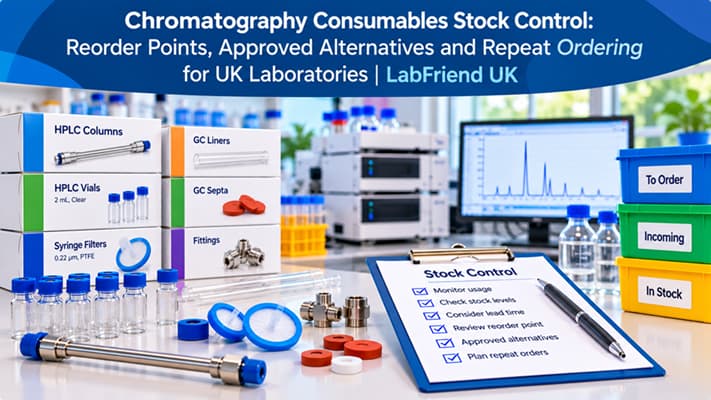
see Chromatography Consumables Stock Control: Reorder Points, Approved Alternatives and RepeatOrdering for UK Laboratories.
For broader context across chromatography consumable
families, the Complete Guide to Chromatography Consumables for UK Laboratories provides the wider
category framework.
What Information Should Be Included in an SPE Quote Request?
A clear quote request reduces the risk of comparing products
that are not technically equivalent.
Where known, include:
- manufacturer;
- product
code;
- sorbent
specification;
- bed
mass;
- device
format;
- cartridge
or reservoir size;
- pack
quantity;
- required
quantity;
- whether
alternatives may be considered;
- whether
any proposed alternative requires technical approval.
If the laboratory is requesting a like-for-like quotation,
say so explicitly.
If alternatives may be considered, the request should make
clear that technical acceptance remains subject to laboratory approval.
Procurement teams can browse SPE cartridges available from LabFriend UK using the approved specification as the
starting point.
Frequently Asked Questions
What should procurement check before buying SPE
consumables?
Procurement should confirm the approved manufacturer or
product identity, sorbent specification, bed mass, device format and any other
controlled characteristics before placing an SPE order. Pack quantity and price
should be checked separately from the technical specification.
Can two SPE cartridges with the same sorbent be treated
as equivalent?
Two SPE cartridges with the same nominal sorbent should not
be treated as technically equivalent on that basis alone. Other product
characteristics may differ, and any substitution should follow the laboratory's
applicable technical approval process.
Is matching bed mass enough when choosing an alternative
SPE cartridge?
Matching bed mass alone is not enough to establish that an
alternative SPE cartridge is suitable. Sorbent characteristics, device
construction, format and other specifications may also affect performance, so
an alternative should be assessed against the complete approved requirement.
What should procurement do if the approved SPE cartridge
is unavailable?
Procurement should check whether an approved alternative
already exists and, if not, escalate potential substitutes for technical
review. Availability alone should not be used to justify an uncontrolled change
to the SPE specification.
Should the supplier product code be recorded on the
purchase record?
Yes. A supplier product code can be recorded where it helps
purchasing, but procurement should also retain enough information to identify
the underlying approved product accurately. Where relevant, this includes the
manufacturer and manufacturer's product code rather than relying solely on a
reseller reference.
Keep the Technical Requirement Intact Through Purchasing
SPE procurement is most reliable when purchasing records
reflect the laboratory's approved technical decision.
Procurement does not need to become the technical owner of
sorbent selection, recovery optimisation or method development. It does need
enough controlled information to distinguish the correct product from a
commercially similar one.
By preserving product identity, sorbent specification, bed
mass, format and technical-approval status, laboratories can make repeat
purchasing more consistent while reducing the risk of unplanned substitutions.
Where the requirement is already defined, browse solid phase extraction cartridges or use LabFriend UK's quotation process to request
pricing against the approved SPE specification.
Read More
- Solid Phase Extraction Consumables: SPE Cartridges, Frits, Reservoirs and Manifolds Explained
- Chromatography Consumables Stock Control: Reorder Points, Approved Alternatives and Repeat Ordering for UK Laboratories
- The Complete Guide to Chromatography Consumables for UK Laboratories
Explore More
- Browse Solid Phase Extraction (SPE) Cartridges
- Browse Chromatography Sample Preparation Products
- Contact LabFriend UK About an SPE Procurement Requirement
Written by: Donal O’Sullivan, BSc, Co-Founder and Sales Director, LabFriend UK. Donal brings deep chemistry-led technical expertise across analytical chemistry, biochemistry, environmental monitoring, laboratory instrumentation, consumables and scientific product selection.
Reviewed by: Michael Anderson, MBA, Founder and Managing Director, LabFriend UK. Michael reviews LabFriend UK content for customer relevance, commercial accuracy, operational practicality and alignment with LabFriend UK’s laboratory supply model.
Frequently asked questions
Delivery times vary by product and supplier. Each product page shows current stock levels and the expected lead time, and we confirm this when you place your order. Most items arrive within 2 to 3 weeks. Specialised items can take longer if they are not in stock. If you need something by a certain date, contact us and we’ll check for you.
Yes. Register for a commercial account and, once it’s approved, you will be able to process orders via PO Once you have a commercial account, you can directly email your purchase orders
Add products to your cart and click Get a Quote. You’ll get a formal quote instantly, ready to send to your email address. For bulk orders or custom requirements, send us your product list and we’ll reply with itemized pricing.
If your item is faulty, not as described or sent in error, let us know within 14 days of delivery and we’ll arrange a return. Change of mind returns are only accepted if the item is unused and in its original packaging. A restocking fee will apply and you pay the return freight. Read our full Returns Policy for details.
Yes, prices are shown including VAT by default. Use the Prices Inc. VAT toggle at the top of the page to view prices without VAT.