

Share :
RC vs PES Membranes for Protein and Biological Samples
Updated On 09/07/2026

By Donal O’Sullivan, BSc. Reviewed by Michael Anderson, MBA.
For protein-containing and biological samples, regenerated cellulose (RC) and polyethersulfone (PES) are both important filtration membrane technologies, but they should not be treated as interchangeable—or ranked using a simple rule that one is always better than the other.
Both membrane families can be relevant where low nonspecific protein binding (protein sticking to the filter itself, rather than being retained for a chemical or size-based reason) and good sample recovery matter. The better choice depends on the specific filter product, sample composition, filtration purpose, compatibility requirements and acceptable level of analyte loss.
This guidance is intended for lab scientists selecting a filter, QA and procurement staff specifying and documenting it, and SME biotech buyers managing budget and supply.
As a practical starting point, RC is particularly attractive where a laboratory needs low adsorption together with broad compatibility across aqueous and mixed aqueous-organic samples. PES is widely used for aqueous and biological filtration and can offer low protein binding and high flow rates in suitable product formats. Current LabFriend guidance reflects these general application differences.
The important qualification is that the membrane abbreviation on the box does not tell you everything about how a filter will behave with a valuable biological sample.
For laboratories concerned about protein recovery, the correct question is therefore not simply:
“Is RC or PES better?”
It is:
“Which specific RC or PES filter provides the compatibility, low unwanted binding and filtration performance required for this sample and method?”
That distinction is the basis of a more reliable filtration decision.
For the wider principles governing membrane, pore-size and application selection, see the Ultimate Guide to Laboratory Filtration for UK Laboratories.
Why Membrane Choice Matters for Protein and Biological Samples
With many routine laboratory samples, filtration is primarily considered a particulate-removal step.
Protein-containing samples introduce another concern.
The filter membrane itself creates a surface with which proteins and other biomolecules can interact. If material adsorbs to that surface during filtration, some of the target analyte may remain associated with the filter rather than passing into the collected filtrate.
For a relatively concentrated preparation where only clarification is required, a small amount of nonspecific interaction may have little practical effect.
For a low-concentration protein, limited-volume sample or valuable biological preparation, the same interaction can become much more important.
The laboratory may have only a small amount of material available, and the concentration subsequently measured in the filtrate can be influenced by losses occurring during sample preparation.
This is why low protein binding is a meaningful membrane-selection characteristic.
But it is also why the phrase needs to be used carefully.
Low Protein Binding Does Not Mean Zero Protein Binding
A membrane described as low protein binding should not be interpreted as a membrane that cannot adsorb any protein under any circumstances.
Protein–surface interactions are influenced by more than the polymer name.
The observed behaviour can depend on the protein or biomolecule, its concentration, the formulation or buffer, pH, ionic environment, membrane surface, filter construction, contact time and the amount of membrane area contacted by the sample.
Two important conclusions follow.
First, a membrane family that is commonly regarded as low binding can still require application-specific evaluation when recovery is critical.
Second, protein binding and overall sample recovery are related, but they are not identical measurements.
A laboratory therefore needs to think beyond a catalogue description of “low binding” when the filtered material is valuable or the downstream result is sensitive to sample loss.
Protein Binding and Biological Sample Recovery Are Not the Same Thing
Suppose a laboratory introduces a known quantity of protein into a syringe-filter workflow (a single-use membrane filter attached to a syringe for point-of-use filtration).
This article's examples focus on syringe filters, though the underlying membrane-selection principles also apply to other formats, such as vacuum or centrifugal filtration devices.
The amount eventually collected can potentially be influenced by several mechanisms:
sample introduced → interaction with filter/device → membrane adsorption + device hold-up + filtration losses → sample recovered
Here, “filtration losses” refers to handling or transfer losses, such as incomplete sample transfer during processing, distinct from adsorption and hold-up.
Membrane adsorption is therefore one contributor to recovery, not necessarily the only one.
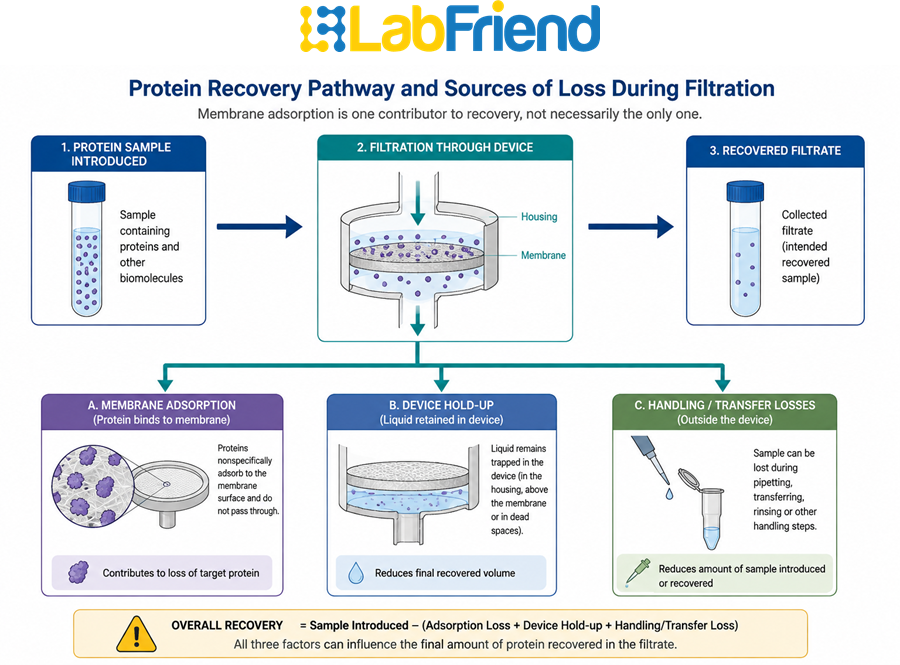
Filter diameter and membrane area can matter. Device construction and hold-up volume (the liquid retained inside the filter housing after filtration) can matter. Sample volume can matter. The way the filter is conditioned and used may also matter where the validated procedure specifies these factors.
This distinction becomes particularly important with small-volume biological samples.
Imagine two filtration processes using membranes with similarly favourable protein-binding characteristics. If one device exposes a very small sample to substantially more membrane area or retains appreciably more liquid within the housing, the final recovered sample volumes may differ even though the membrane polymer alone does not explain the difference.
The correct objective is therefore not simply:
choose a low-binding membrane.
It is:
Select and evaluate a filtration device that delivers acceptable recovery for the actual biological workflow.
What Is a Regenerated Cellulose Membrane?
Regenerated cellulose is a hydrophilic cellulose-based membrane widely used across analytical and biological filtration.
Its importance comes from a useful combination of properties rather than one single characteristic.
Current LabFriend guidance identifies RC with hydrophilic behaviour, low protein binding, broad compatibility and suitability for protein-sensitive applications, while also highlighting its usefulness for mixed aqueous-organic samples.
This broad compatibility can be especially useful in laboratories where biological or analytical workflows do not remain exclusively aqueous.
For example, a laboratory may handle:
- aqueous buffers;
- protein-containing solutions;
- biological extracts;
- analytical samples containing an organic component; and
- chromatography preparations using mixed aqueous-organic solvents.
A membrane capable of supporting several technically compatible workflows can simplify filtration standardisation.
That does not mean RC is universally compatible with every chemical or biological formulation. Compatibility should still be verified against the specific product specification and sample.
For a deeper explanation of RC technology and its broader laboratory applications, see Why Regenerated Cellulose (RC) Membranes are The Universal Standard for Lab Filtration.
Why RC Is Relevant to Protein Filtration
For protein-containing samples, RC's attraction is the combination of hydrophilicity and relatively low nonspecific adsorption.
A hydrophilic membrane readily interacts with aqueous solutions, making it suitable for many buffer-based laboratory workflows without the aqueous wetting difficulties associated with conventional hydrophobic membranes.
Low unwanted adsorption is then important because the purpose of the filtration step is generally to remove unwanted material—not the protein the laboratory is trying to recover.
The combination can make RC a useful starting point where:
- sample recovery matters;
- the solution is aqueous;
- mixed aqueous-organic compatibility is required;
- the workflow crosses biological and analytical applications; or
- a laboratory wants to investigate whether one membrane technology can support several validated workflows.
This mixed aqueous-organic compatibility generally applies to weaker or moderate organic solvents, such as alcohols, rather than aggressive organics like strong acids or chlorinated solvents that can degrade cellulose-based membranes, so it should be confirmed against the specification of the actual product.
The last point has procurement implications.
If a laboratory can technically validate the same RC filter specification across several appropriate methods, purchasing and inventory can potentially be simplified.
But standardisation should be the result of technical suitability, not the reason for ignoring differences between applications.
What Is a PES Membrane?
Polyethersulfone, or PES, is a synthetic membrane technology widely associated with aqueous and biological filtration.
Current LabFriend guidance identifies PES membranes generally with low protein binding, high flow rates, aqueous compatibility and biological applications, including cell culture and buffer-related workflows.
These characteristics explain why PES is prominent in biotechnology and life-science filtration.
For a laboratory routinely handling water-based biological solutions, an appropriate PES filter can therefore be a logical membrane to evaluate.
However, this is where product-specific checking becomes important.
Membrane treatments, device designs and manufacturer specifications can differ. PES is inherently more hydrophobic than RC and is typically rendered usable for aqueous filtration through a surfactant or wetting treatment; residual surfactant can be a relevant consideration for some sensitive protein assays. A generic statement about the PES membrane family should never override the technical documentation for the particular filter being purchased.
The correct sequence is:
PES appears suitable at membrane-family level → check the specific product specification → confirm sample compatibility → assess recovery/performance where required → approve for routine use.
Why PES Is Relevant to Biological Workflows
PES is particularly associated with applications where aqueous filtration, throughput and biological compatibility are important.
Depending on the particular product, applications can include filtration of:
- aqueous biological samples;
- buffers;
- cell-culture-related solutions;
- protein-containing preparations; and
- other water-based laboratory solutions.
High flow characteristics can also be operationally valuable where laboratories process larger volumes or require efficient filtration.
Achievable flow rate is governed primarily by pore size, membrane thickness and device format, not by PES chemistry alone.
But “high flow” and “low protein binding” should not be treated as automatic evidence that a particular PES device is superior for a specific protein.
If sample recovery is analytically important, the relevant question remains whether the complete filter device performs acceptably with the actual sample.
RC vs PES: The Core Difference for the Buyer
For the SME biotech buyer, the RC-versus-PES decision becomes clearer when it is framed around workflow rather than membrane marketing.
Read each row against your own sample and workflow rather than looking for an overall winner across the table.
|
Decision factor |
RC |
PES |
|
Aqueous biological samples |
Commonly suitable where product compatibility is confirmed |
Commonly used and an important starting option |
|
Protein-sensitive applications |
Low-binding characteristics can make RC attractive |
Low-binding PES products are widely used in biological workflows |
|
Mixed aqueous-organic samples |
A particular strength of RC where chemically compatible |
Verify solvent compatibility carefully for the specific product |
|
High-throughput aqueous filtration |
Product dependent |
PES is often valued for high flow |
|
Sample recovery |
Evaluate with the actual protein/sample |
Evaluate with the actual protein/sample |
|
Standardisation across varied analytical workflows |
Broad compatibility can make RC attractive |
Particularly strong where workflows are predominantly aqueous/biological |
|
Final selection |
Product specification + sample validation |
Product specification + sample validation |
The table provides a starting point—not a universal ranking.
A laboratory filtering a valuable protein in an aqueous buffer may find both membrane families technically plausible.
A laboratory handling a protein-containing sample with a significant organic-solvent component may find RC's broader mixed-solvent compatibility particularly relevant.
A biotechnology workflow focused on aqueous media or buffers and high throughput may have different reasons for evaluating PES.
The sample determines the decision.
The Most Important RC vs PES Selection Question: What Is in the Sample?
Membrane selection should begin with sample composition.
Calling something a “protein sample” tells us that protein recovery may matter, but it does not adequately describe the liquid being filtered.
The sample may also contain:
- salts;
- buffers;
- surfactants;
- preservatives;
- organic solvents;
- formulation excipients;
- cellular material;
- particulate matter; or
- other biological components.
Each can influence filtration behaviour or compatibility.
This is why choosing PES simply because a sample contains protein—or choosing RC simply because low adsorption is required—is too simplistic.
The laboratory should establish both:
What needs to pass through the membrane?
and
What needs to be retained?
That distinction is fundamental to successful biological filtration.
Aqueous Protein Samples
For predominantly aqueous protein solutions, both appropriate RC and PES products may warrant consideration.
PES is widely used in aqueous biological workflows and is commonly selected where low protein binding and good flow are desirable. RC also offers hydrophilic behaviour and low adsorption and can be highly relevant where recovery is important.
At this point, generic membrane descriptions may no longer be enough to choose between them.
The decision may need to move to:
- the specific protein;
- concentration;
- sample volume;
- device size;
- required pore size;
- filter construction;
- manufacturer performance data; and
- recovery testing.
This is precisely why a product comparison should not manufacture a winner where the application determines the outcome.
Mixed Aqueous-Organic Biological Samples
RC becomes particularly interesting where a biological or analytical sample contains both aqueous and organic components.
Current LabFriend guidance consistently positions RC as useful across aqueous and mixed aqueous-organic systems, while stressing that compatibility still needs to be confirmed for the actual solvent conditions.
That broader compatibility can make RC attractive where a laboratory wants to avoid switching membrane technologies unnecessarily between related workflows.
PES may remain suitable for particular formulations, but the exact solvent compatibility of the specific PES product should be checked rather than inferred from its use in aqueous biological filtration.
The governing rule is straightforward:
Chemical compatibility comes before protein-binding preference.
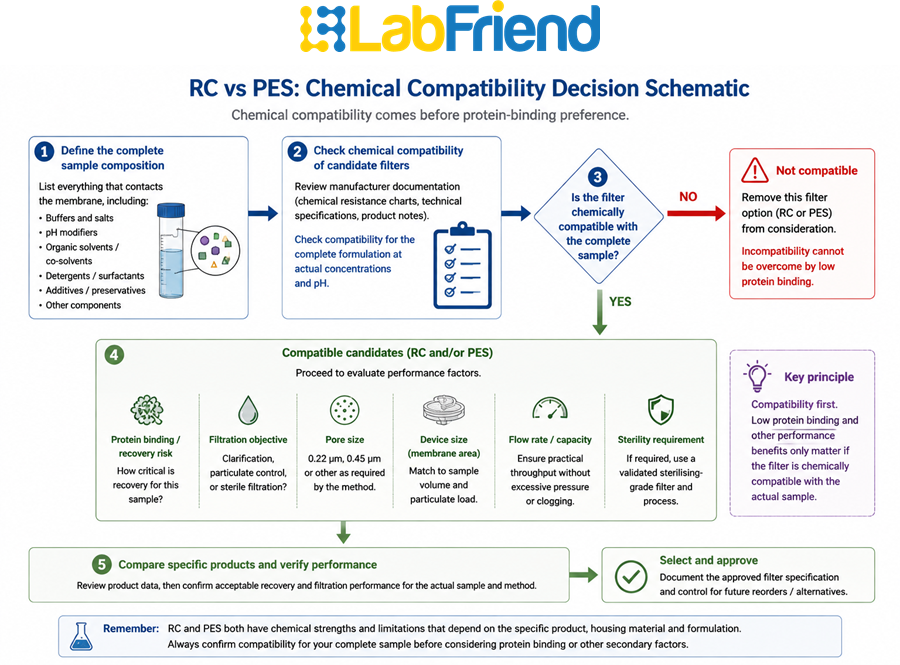
A nominally low-binding membrane that is unsuitable for the sample chemistry is not the correct filter.
Why Protein Concentration Changes the Importance of Binding
The lower the amount of target material available, the more consequential unwanted losses can become.
This does not mean that every low-concentration protein will behave badly with a particular filter. It means the laboratory has less room to assume that adsorption is analytically irrelevant.
Consider two conceptual situations.
A laboratory is clarifying a relatively concentrated protein preparation and has ample sample available. A small absolute loss may have limited practical consequence.
Another laboratory has a small-volume, low-concentration biological sample intended for quantitative downstream analysis. Even modest loss during preparation may become more important relative to the amount available.
The membrane decision therefore needs to consider the value and analytical sensitivity of the sample, not just whether the liquid contains protein.
This is also why manufacturer claims such as “low protein binding” are best treated as selection evidence, not as a substitute for method-specific recovery assessment when the result matters.
Membrane Area and Sample Volume Matter Too
Filter diameter is sometimes treated as a convenience decision: small filter for small sample, larger filter for larger sample.
For recovery-sensitive samples, there is another consideration.
Increasing filter diameter generally increases available membrane area. Greater area can improve capacity and throughput, particularly with particulate-containing samples, but it also increases the surface with which the sample may interact.
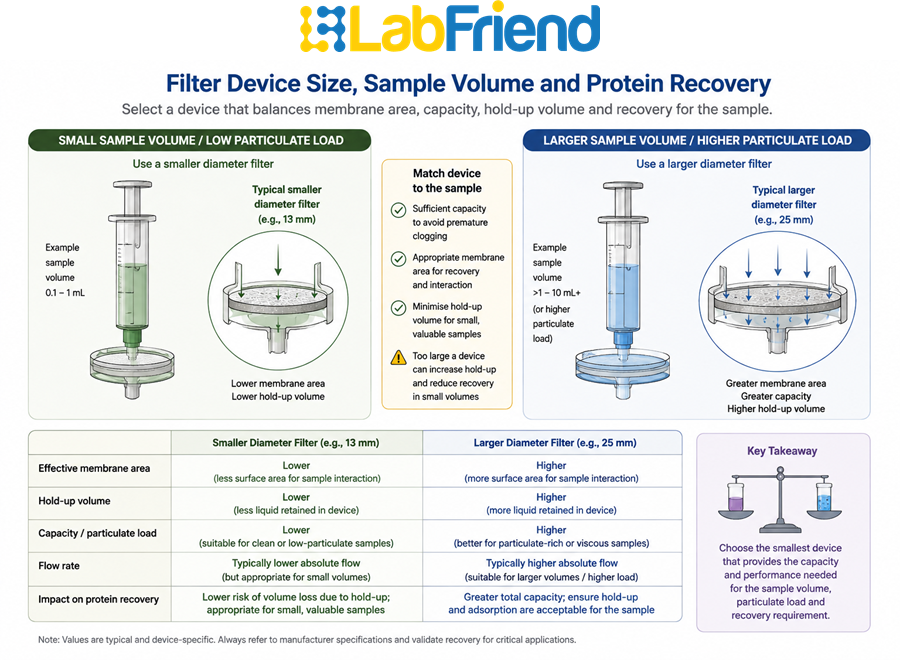
The correct objective is therefore not to use the largest filter available.
Nor is it always to use the smallest.
It is to select a device appropriately sized for the sample volume, particulate burden and recovery requirement.
For limited-volume protein samples, unnecessary membrane area and device hold-up deserve consideration. For larger or more particulate-rich preparations, too little membrane area can cause premature blockage and inefficient filtration.
Again, the optimal decision comes from the complete workflow rather than one membrane property.
Pore Size: 0.22µm or 0.45µm?
Pore size answers a different question from membrane chemistry.
Membrane chemistry helps determine how the filter interacts with the sample.
Pore size helps determine the size range of particles the filtration step is intended to retain.
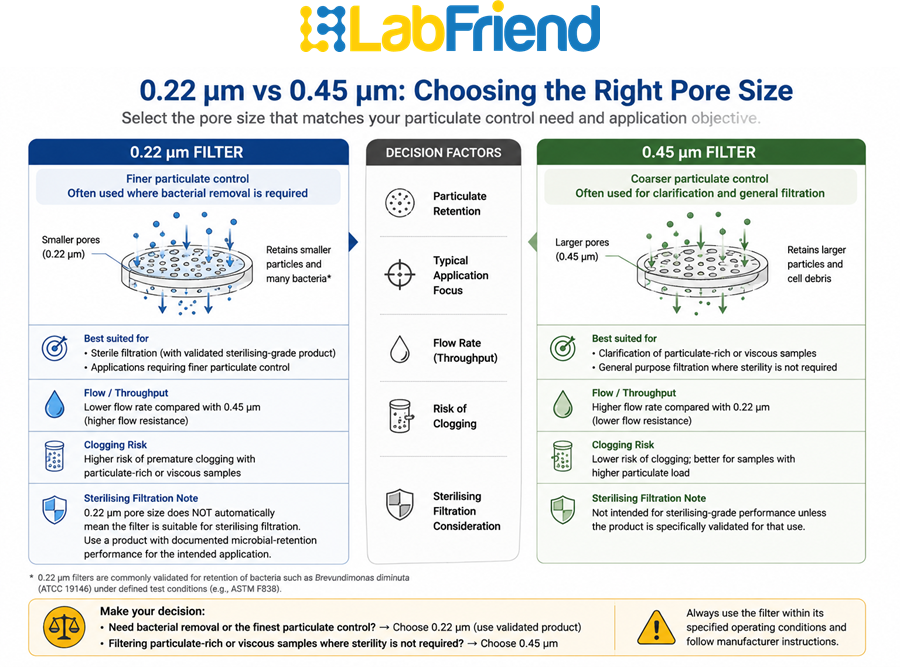
For clarification workflows, 0.45µm filtration may be appropriate in some methods. Where finer particulate control is required, 0.22µm may be selected.
0.22µm approximates the size range that also removes most bacteria, which is one reason it is often selected ahead of sensitive downstream steps—though, as noted above, this is a separate consideration from validated sterilising-grade performance.
For example, a laboratory clarifying cell-culture supernatant for a routine assay might use 0.45µm, while the same laboratory preparing a sample ahead of a more sensitive downstream step might use 0.22µm.
0.22µm filters can also exhibit lower flow and a higher risk of premature clogging than 0.45µm when handling particulate-rich biological samples, such as cell debris or protein precipitates, which is a practical factor alongside the particulate-control requirement.
However, neither pore size should be chosen solely because the sample contains protein.
And a nominal 0.22µm filter should not automatically be described as “sterilising-grade” simply because of its pore-size label. Where sterile filtration is required, the complete filter and its validated microbial-retention performance (evidence, from the manufacturer, that the specific product reliably removes the target microorganisms—not just a nominal pore-size figure) must be appropriate to that application. Sterilising-grade status is established through bacterial-challenge validation (for example, testing against Brevundimonas diminuta under recognised standards such as ASTM F838), not inferred from the nominal pore-size rating alone.
For protein recovery, pore size must therefore be considered alongside membrane chemistry, sample composition and device format rather than used as the starting and ending point of filter selection.
The Practical Lesson
RC and PES are both credible membrane technologies for protein and biological filtration, but their suitability comes from different combinations of characteristics and from the specifications of the actual product being considered.
RC deserves particular consideration where low adsorption, hydrophilicity and broad aqueous/mixed-solvent compatibility are important. PES deserves particular consideration for suitable aqueous and biological workflows where low binding and efficient flow are priorities. Current LabFriend guidance supports both as relevant low-binding membrane families rather than presenting one as universally superior.
The strongest selection principle is therefore:
Start with the sample and the required recovery—not the membrane abbreviation.
Turning the RC vs PES Comparison Into a Practical Selection Decision
The most useful way to compare regenerated cellulose (RC) and polyethersulfone (PES) is not to ask which membrane has the strongest list of advantages. It is to identify the characteristics the filtration step must deliver for the particular biological sample.
For protein-containing samples, this usually means considering several requirements together.
The filter must provide the required particulate retention. It must be chemically compatible with the sample. Unwanted interaction between the sample and filtration device should be sufficiently low for the analytical or biological objective. The device should also provide practical capacity and flow for the volume being processed.
Where recovery is important, these considerations become more significant because a filter can perform its physical filtration function perfectly while still being unsuitable for the method if it changes the sample.
A useful selection sequence is therefore:
define the sample → define the purpose of filtration → establish compatibility → consider protein-binding/recovery risk → select pore size and device format → evaluate the actual filter → standardise only after suitability has been demonstrated
This prevents membrane selection becoming an exercise in choosing RC or PES from a specification table without considering what the laboratory actually needs the filter to accomplish.
Scenario 1: A Low-Concentration Protein in an Aqueous Buffer
Consider a laboratory preparing a relatively small volume of a low-concentration protein solution for downstream quantitative analysis.
The solution is aqueous, so suitable RC and PES products may both initially appear credible.
In this situation, the decision should be driven strongly by sample recovery.
The laboratory should consider whether the target protein interacts with the membrane or complete filter device sufficiently to influence the downstream result. This is particularly important because an apparently small absolute loss can represent a more meaningful proportion of the available analyte when concentration is low.
Simply choosing whichever membrane is marketed as “low protein binding” may therefore be insufficient.
The more defensible approach is to identify technically suitable RC and PES products and assess whether filtration produces acceptable recovery under the actual method conditions.
If both perform acceptably, other practical factors—such as flow, availability, consistency of supply and opportunities for standardisation—can then help distinguish between them.
The order matters:
Technical suitability first. Procurement optimisation second.
Key outcome: identify technically suitable RC and PES candidates first, then let recovery testing—not marketing claims—decide between them.
Scenario 2: A Protein Sample Containing an Organic Component
The decision changes when the sample contains a meaningful organic-solvent component.
RC's broad aqueous and mixed aqueous-organic compatibility can make it particularly relevant in this type of workflow, though this compatibility is generally strongest with weaker or moderate organic solvents rather than aggressive ones. Current LabFriend guidance identifies RC as a useful membrane where laboratories need low adsorption combined with compatibility across aqueous and mixed-solvent applications.
That does not mean every RC filter is compatible with every solvent concentration.
The laboratory still needs to check the chemical compatibility of the specific product against the complete sample composition.
Likewise, PES should not be rejected simply because an organic component is present. Its suitability should be determined from the specification of the actual PES filter under consideration.
The decision sequence becomes:
Is the filter chemically compatible with the complete sample?
If no → eliminate it.
If yes → assess binding/recovery and filtration performance.
This illustrates an important hierarchy in membrane selection.
A favourable protein-binding characteristic cannot compensate for chemical incompatibility.
For a recovery-sensitive sample, both factors matter—but compatibility is a prerequisite.
Key outcome: check chemical compatibility with the complete sample first—a low-binding membrane that is chemically incompatible is not the correct filter.
Scenario 3: Routine Aqueous Biological Filtration
Now consider a biotechnology laboratory routinely filtering aqueous biological preparations or buffers.
An appropriate PES product can be a strong candidate because PES is widely associated with aqueous biological filtration, low protein binding and efficient flow characteristics.
RC may also remain technically suitable.
At this stage, the decision becomes less about whether either membrane can theoretically perform the filtration and more about which complete product best fits the routine workflow.
Questions may include:
- Is acceptable recovery demonstrated?
- What sample volumes are normally processed?
- Does the filter provide suitable flow and capacity?
- Is sterility required?
- Is the pore size appropriate to the filtration objective?
- Is the product consistently available?
- Can it be standardised across several appropriate workflows?
- Does the supplier provide adequate technical documentation?
This is where a technically qualified filter can move from being an individual consumable choice to becoming part of a controlled laboratory specification.
Key outcome: for routine aqueous workflows, the decision shifts from whether RC or PES can work to which complete product best fits the routine specification.
Scenario 4: A Small, Valuable Biological Sample
Small-volume biological samples deserve particular attention because the relationship between sample volume and filtration device becomes more important.
If only a limited amount of material is available, unnecessary loss within the filtration process can have a disproportionate effect.
Membrane binding is one potential source of loss, but so is liquid retained within the complete device.
A larger filter may provide greater membrane area and capacity, but those characteristics are not automatically advantageous when only a small sample volume needs to be processed.
For this application, the laboratory should consider:
membrane chemistry + membrane area + device hold-up + sample volume + required recovery
rather than deciding between RC and PES in isolation.
This is a useful example of why the question “Which membrane has lower protein binding?” cannot always identify the best filter.
The technically better device is the one that provides the required filtration while preserving acceptable recovery from the actual sample.
Key outcome: for small, valuable samples, weigh membrane chemistry against device hold-up and membrane area together, not membrane binding alone.
Scenario 5: A Higher-Volume Biological Preparation
The balance can change again when sample volume increases.
A very small filtration device may minimise membrane area but provide insufficient capacity or impractically slow processing. If particulate loading is significant, premature blockage can further reduce throughput.
Here, adequate membrane area and flow become more important.
A suitable PES product may be attractive in aqueous biological workflows where efficient flow is important, while RC may remain a strong option where its compatibility characteristics better match the preparation.
The laboratory therefore needs to avoid optimising one variable at the expense of the whole workflow.
For a larger-volume sample, the lowest possible membrane area is not necessarily desirable.
For a small recovery-critical sample, maximum membrane area is not necessarily desirable either.
Device sizing should reflect the sample being processed.
Key outcome: for higher-volume preparations, avoid under-sizing the filter as much as over-sizing it—match membrane area to the actual capacity and particulate load.
What If Sterile Filtration Is Required?
This is an area where terminology needs to remain precise.
A laboratory should not assume that selecting a 0.22µm RC or PES filter automatically establishes a validated sterile-filtration process.
Pore-size designation and validated microbial retention are related concepts, but they are not interchangeable claims.
Where sterile filtration is required, the laboratory should select a product specifically designed and validated for the intended sterile-filtration application and follow the relevant manufacturer instructions and validated laboratory procedure.
The decision therefore becomes more than:
RC or PES?
It includes:
Is this particular product suitable and validated for the required microbial-retention application?
This is especially relevant in cell-culture, media and biological-buffer workflows, where sterility requirements may be fundamentally different from simple analytical sample clarification.
RC vs PES: Application-Based Decision Matrix
The following matrix is intended as a decision aid rather than a substitute for product-specific technical documentation.
|
Application consideration |
RC may deserve particular consideration when… |
PES may deserve particular consideration when… |
|
Aqueous protein sample |
Low adsorption and recovery are important |
A suitable low-binding PES product matches the biological workflow |
|
Mixed aqueous-organic sample |
Broad mixed-solvent compatibility is required |
The specific PES product is confirmed compatible |
|
Routine biological buffer |
RC characteristics suit the established method |
Aqueous biological filtration and efficient flow are priorities |
|
Low-concentration protein |
Low unwanted adsorption is important |
Product-specific recovery is demonstrated to be acceptable |
|
Small sample volume |
Appropriate RC device minimises unnecessary sample loss |
Appropriate PES device minimises unnecessary sample loss |
|
Higher-volume aqueous workflow |
RC provides suitable capacity and compatibility |
PES flow/capacity characteristics suit the specific application |
|
Sterile filtration requirement |
The complete RC product is validated for the intended application |
The complete PES product is validated for the intended application |
|
Standardisation across aqueous and mixed-solvent methods |
RC's broader compatibility may be advantageous |
PES may suit predominantly aqueous/biological workflows |
|
Critical recovery requirement |
Verify experimentally |
Verify experimentally |
The final row is deliberately identical.
When biological sample recovery is critical, neither membrane family should be assumed to deliver acceptable recovery without appropriate supporting evidence.
How Should a Laboratory Evaluate Protein Recovery?
For routine applications, existing method validation, manufacturer information and previous laboratory experience may already establish the required filtration specification.
Where a new filter is being introduced into a recovery-sensitive method, a comparison may be appropriate.
Conceptually, the laboratory wants to determine whether the filtration step changes the amount of target material available for downstream analysis or processing.
A suitable evaluation may compare an appropriate control with samples processed through the candidate filtration device under representative conditions.
The precise study design depends on the method and laboratory quality system, but relevant variables can include:
- the actual protein or biomolecule;
- representative concentration;
- representative buffer or formulation;
- sample volume;
- filter diameter;
- pore size;
- filtration technique;
- initial filtrate handling where relevant;
- analytical method used to assess recovery; and
- replicate performance.
The objective is not necessarily to prove that recovery is exactly 100%.
It is to establish that the filtration process provides acceptable and reproducible performance for its intended use.
Laboratories designing this evaluation may find it useful to reference recognised general guidance, such as relevant USP general chapters or manufacturer-published validation protocols, as a starting framework alongside their own method requirements.
Why Testing the Actual Protein Matters
“Protein” describes an enormous range of molecules.
Different proteins can vary in size, charge, hydrophobicity, structure and behaviour under different solution conditions.
It would therefore be unsafe to assume that because a filter performs well with one model protein, it must provide identical recovery for every biological molecule.
Manufacturer protein-binding data can be extremely useful for screening products and understanding likely performance. But where recovery directly affects a critical analytical result, product selection should ultimately reflect the actual application.
The same reasoning applies when changing supplier.
Two filters labelled:
RC, 0.22µm
or
PES, 0.22µm
should not automatically be considered analytically interchangeable simply because membrane and nominal pore size match.
The complete devices may differ.
Why Filter Diameter Should Be Part of the Evaluation
Filter diameter influences the amount of membrane available for filtration.
Larger devices generally provide greater membrane area, which can improve capacity and help process larger or more particulate-rich samples. Smaller devices can be better suited to limited volumes.
For protein recovery, the practical objective is to avoid unnecessary exposure while still providing enough membrane capacity for reliable filtration.
Consider a laboratory routinely processing only a small volume of a valuable protein preparation.
Selecting a much larger filter solely because it is already held in stores may simplify inventory, but it could be a poor scientific standardisation decision if the device is unnecessarily large for the application.
Conversely, specifying the smallest possible device for a larger, particulate-rich biological preparation can create slow filtration, premature blockage and inconsistent handling.
Standardisation should therefore not be confused with forcing every workflow through the same filter size.
Common RC vs PES Selection Mistakes
Mistake 1: Choosing on membrane name alone
“RC” and “PES” are useful membrane classifications, but they do not fully specify a filtration device.
Better approach: Check the technical characteristics of the actual product.
Mistake 2: Treating “low protein binding” as “no protein loss”
Low binding is a relative performance characteristic, not a guarantee of zero interaction for every protein and formulation.
Better approach: Evaluate recovery where sample loss could affect the method.
Mistake 3: Ignoring the rest of the formulation
A protein sample can contain solvents, salts, surfactants and other components that affect compatibility and filtration behaviour.
Better approach: Assess the complete sample composition.
Mistake 4: Selecting pore size before defining the filtration objective
A 0.22µm membrane is not automatically preferable to 0.45µm merely because it is finer.
Better approach: Determine the particulate or microbial-control requirement first.
Mistake 5: Assuming all products using the same membrane polymer are interchangeable
Membrane formulation, construction, housing and device geometry can vary.
Better approach: Treat supplier or product changes as technical substitutions where the method requires it.
Mistake 6: Ignoring filter diameter
The same membrane in a different device size can create a different practical filtration process.
Better approach: Match membrane area to sample volume and particulate burden.
Mistake 7: Standardising before evaluating
Procurement simplification is useful only after technical suitability has been established.
Better approach: Qualify first; standardise second.
When Neither RC Nor PES Should Automatically Be Selected
A balanced comparison also needs to recognise that the correct outcome may occasionally be neither.
The wider membrane landscape includes other materials whose characteristics may better suit particular chemical or biological applications.
Commonly considered alternative membrane chemistries include PTFE, PVDF, nylon and mixed cellulose esters (MCE).
For example, a workflow may involve:
- unusual solvent conditions;
- specific analyte–membrane interactions;
- aggressive chemistry;
- specialised venting or gas filtration;
- a validated method specifying another membrane; or
- a product-specific performance requirement not adequately met by the RC or PES options being considered.
The purpose of an RC-versus-PES comparison is therefore not to force every biological filtration problem into a two-product decision.
It is to help laboratories determine when those two important membrane families are appropriate candidates—and when the technical requirements point elsewhere.
From Evaluation to an Approved Filtration Specification
Once a laboratory has identified a filter that performs appropriately, the next step is to capture enough information to reproduce that performance.
A specification that states only:
Use a PES syringe filter
is weak.
Even:
Use a 0.22µm PES syringe filter
may still leave important variables uncontrolled.
Depending on the method, an appropriate specification may need to identify:
- membrane material;
- pore size;
- filter diameter;
- product or validated equivalent;
- housing characteristics;
- sterility requirement;
- sample-volume range;
- relevant compatibility requirements; and
- any method-specific handling conditions.
The level of detail should reflect the risk and requirements of the application.
For a routine non-critical clarification, extensive controls may be unnecessary.
For a recovery-sensitive validated biological assay, the acceptable substitution boundaries may need to be considerably tighter.
For laboratories operating under a formal quality system, such as ISO/IEC 17025 or GxP, these substitution boundaries and the supporting documentation are typically defined by that system's change-control requirements.
Standardise the Requirement, Not Just the Product
There is an important distinction between product standardisation and performance standardisation.
A laboratory may approve one specific filter because it has demonstrated the required performance. That can be entirely appropriate.
But the underlying reason for approval should still be understood.
For example:
Approved because this device provides the required compatibility, particulate retention and recovery for Method X
is more useful than:
Approved because we always buy RC.
The first statement gives the laboratory a technical basis for assessing alternatives if supply changes.
The second creates dependence on a product choice without documenting what performance must be protected.
For an SME biotechnology business, this matters because supply continuity and procurement flexibility can become increasingly important as sample volumes grow.
The Procurement Opportunity After Technical Qualification
Once an RC or PES filter has been technically qualified, purchasing becomes much easier to manage.
The laboratory can forecast demand, consolidate routine requirements and reduce ad hoc substitutions.
For LabFriend, this is also where a one-off ecommerce purchase can develop into a valuable repeat customer relationship.
A customer who buys a packet of syringe filters for an individual experiment represents a transaction.
A customer who has established:
approved membrane + pore size + diameter + application + expected usage
represents a repeatable requirement.
The role of good technical content is not to force that transition. It is to give the customer enough confidence to make the specification correctly.
That is particularly important for biological filtration because the cost of the filter itself may be insignificant compared with the value of the sample passing through it.
A Practical RC vs PES Decision Framework
For protein and biological samples, use the following sequence.
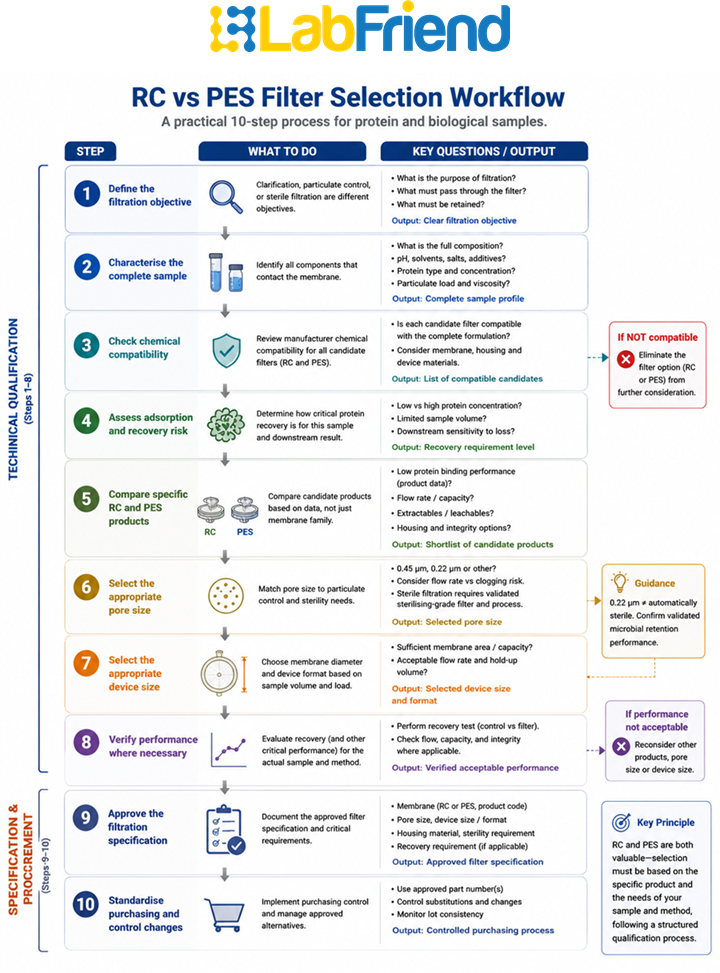
The sequence intentionally places commercial standardisation last.
That is how it should be.
For a biological filtration consumable, the strongest repeat-purchasing relationship is created when the customer knows why the product has been specified and trusts it to perform consistently.
The Practical Lesson II
RC and PES selection becomes much easier when the laboratory stops looking for a universal membrane winner.
RC can offer an attractive combination of low adsorption, hydrophilicity and broad aqueous/mixed-solvent compatibility. Appropriate PES products can offer low-binding performance and efficient filtration for aqueous biological workflows.
But those membrane-family characteristics are only the beginning of the decision.
For protein-containing samples, the complete filtration process needs to protect the thing the laboratory actually values: the sample and the integrity of the result.
That means matching membrane chemistry, pore size, filter diameter and product characteristics to the application—and verifying recovery where the consequences of sample loss justify it.
From Membrane Selection to a Repeatable Biological Filtration Process
Once a laboratory has established that an RC or PES filter performs appropriately with a protein-containing or biological sample, the commercial decision becomes much simpler.
The objective should not be to revisit membrane selection every time filters need replenishing. Nor should scientists be forced to select a substitute from whatever happens to be available when stock runs low.
A technically qualified filtration requirement can instead become part of the laboratory's controlled consumables specification.
For an SME biotechnology laboratory, this has practical value. Biological filtration may be performed repeatedly across development work, analytical testing, buffer preparation or routine sample processing. When the same technically appropriate filter is required again and again, consistent specification and purchasing can reduce variation between analysts and simplify procurement.
But the order remains important:
Technical qualification → approved specification → procurement standardisation → repeat purchasing.
Purchasing convenience should never be used to justify a membrane that is unsuitable for the sample.
What to Check Before Purchasing RC or PES Filters
A purchasing decision for a recovery-sensitive biological application should capture enough information to ensure that the product being ordered is technically appropriate.
The following criteria provide a practical starting point.
|
Selection criterion |
Why it matters |
|
Membrane material |
Establishes the fundamental membrane chemistry but does not define the complete product |
|
Product-specific membrane characteristics |
RC and PES products can differ between manufacturers and formats |
|
Pore size |
Must match the filtration objective rather than being selected solely from the sample type |
|
Filter diameter |
Influences membrane area, capacity and suitability for the sample volume |
|
Sample chemistry |
Determines whether the membrane and device materials are chemically compatible |
|
Protein/sample recovery |
Particularly important for low-concentration, limited-volume or valuable samples |
|
Sample volume |
Helps determine the appropriate device size and capacity |
|
Particulate loading |
Influences capacity requirements and risk of premature blockage |
|
Sterility requirement |
Requires a product suitable and validated for the intended application where sterile filtration is required |
|
Housing/device materials |
The complete device—not just the membrane—contacts the sample |
|
Technical documentation |
Supports compatibility and application assessment |
|
Approved alternatives |
Helps procurement maintain continuity without uncontrolled substitution |
|
Extractables/leachables risk |
Relevant where the filtrate feeds a sensitive downstream analytical method, since membrane or housing components can leach trace material into the sample |
|
Lot-to-lot consistency / batch documentation |
Relevant for validated methods, where reproducible performance between batches—and the manufacturer's supporting documentation—may need to be demonstrated |
This is a more robust specification than simply ordering an “RC filter” or “PES filter”.
For recurring applications, it also gives procurement teams a clearer basis for identifying acceptable products when supply conditions change.
Do Not Standardise RC or PES Solely to Reduce SKU Count
Consumables rationalisation can be commercially attractive.
If several laboratory methods genuinely use the same technically appropriate filter, consolidating those requirements can simplify inventory, improve demand forecasting and reduce the number of products purchasing teams need to manage.
But SKU reduction should be the consequence of compatibility between requirements—not the starting objective.
Suppose one laboratory uses:
- a small-volume recovery-sensitive protein assay;
- routine aqueous buffer filtration;
- mixed aqueous-organic analytical samples; and
- higher-volume biological preparations.
It would be convenient if one filter could support every application.
It might even be possible.
But that conclusion needs to emerge from the technical requirements of those workflows. It should not be assumed because a particular RC or PES product performs well in one of them.
A better standardisation question is:
Which of our filtration applications have sufficiently similar technical requirements to use the same validated specification?
That preserves the operational benefits of consolidation without sacrificing sample integrity.
Managing Approved Alternatives
Supply continuity matters in laboratories dependent on frequently used consumables.
If the approved filter becomes unavailable, procurement may need an alternative quickly. This is where a well-defined performance specification becomes more useful than a purchasing record containing only a manufacturer and catalogue number.
An alternative product can then be assessed against the characteristics that actually matter:
membrane chemistry → pore size → device dimensions → compatibility → biological recovery requirements → sterility where applicable → method-specific performance
A substitute should not automatically be accepted because it carries the same membrane abbreviation and nominal pore size.
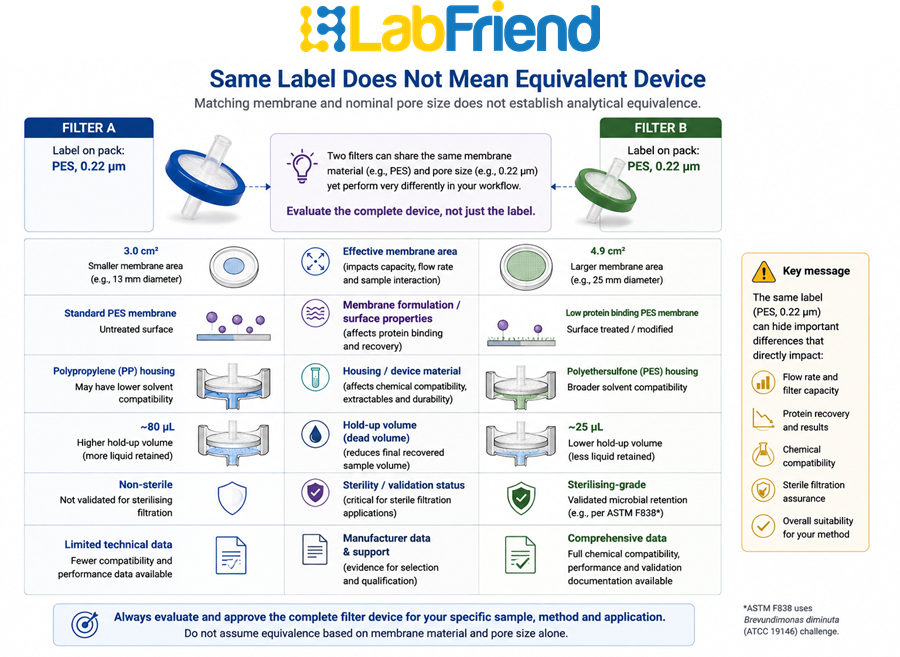
For example:
0.22µm PES
does not, by itself, establish equivalence between two complete syringe-filter products.
Nor does:
0.22µm RC.
Where filtration performance can affect a validated analytical method or critical biological process, substitution should follow the laboratory's appropriate change-control and evaluation procedures.
When Should RC Be the Stronger Candidate?
RC deserves particular consideration when the application benefits from the combination of hydrophilicity, low unwanted adsorption and broad aqueous/mixed aqueous-organic compatibility.
That can make RC attractive where laboratories:
- handle recovery-sensitive protein samples;
- work across aqueous and mixed-solvent methods;
- want a membrane technology capable of supporting several compatible analytical workflows; or
- need low adsorption without limiting filtration exclusively to aqueous biological applications.
The important word is candidate.
RC's general characteristics can justify putting it on the shortlist. They do not eliminate the need to check the specific filter's compatibility and performance.
For laboratories requiring broader information about regenerated cellulose beyond the RC-versus-PES comparison, Why Regenerated Cellulose (RC) Membranes are The Universal Standard for Lab Filtration provides the dedicated RC guidance.
When Should PES Be the Stronger Candidate?
PES deserves particular consideration for appropriate aqueous and biological filtration workflows, especially where a specific PES product provides suitable low-binding characteristics and efficient flow.
This can make PES attractive for applications involving:
- aqueous biological solutions;
- buffers;
- protein-containing preparations;
- cell-culture-related workflows; or
- higher-throughput aqueous filtration.
Again, product-specific information matters.
A buyer should not select an unfamiliar PES filter simply because PES as a membrane family is widely associated with biological filtration. The technical documentation for the actual product should establish that its characteristics match the intended application.
Where sample recovery is critical, suitable performance should be supported by appropriate evidence or evaluation.
What If Both RC and PES Are Suitable?
This is an entirely credible outcome.
For some aqueous protein workflows, technically appropriate RC and PES filters may both provide acceptable performance.
Once compatibility, filtration performance and recovery requirements have been satisfied, secondary factors can legitimately influence the final choice.
These might include:
- practical flow characteristics;
- device formats;
- availability;
- supply continuity;
- pack configuration;
- ease of standardisation;
- technical documentation;
- existing approved use elsewhere in the laboratory; and
- total purchasing requirement.
Price can also be considered at this point.
But price belongs after technical suitability.
A lower-cost filter that causes unacceptable sample loss or method variability is not the economically superior choice simply because its unit purchase price is lower.
The Cost of the Filter Is Not the Value of the Sample
This distinction is particularly important in biotechnology.
A disposable syringe filter may represent a very small proportion of the cost associated with producing, preparing or analysing the biological material passing through it.
The sample may contain:
- a valuable protein;
- a development candidate;
- limited experimental material;
- a critical QC sample; or
- material requiring substantial upstream preparation.
Consequently, filtration decisions should not be optimised solely around pence per device.
This does not mean laboratories should ignore consumables cost.
It means cost should be considered in the context of acceptable workflow performance.
For a routine, high-volume filtration process, unit economics may become commercially significant once suitable filters have been identified. For a scarce recovery-sensitive sample, preserving the integrity of the material may carry much greater weight.
The purchasing strategy should reflect that difference.
A Practical RC vs PES Purchasing Framework
Before approving a filter for repeat purchase, ask:
- What exactly are we filtering?
Define the biological material and complete formulation. - Why are we filtering it?
Clarification, particulate control and sterile filtration are not interchangeable objectives. - Are RC and PES both chemically compatible candidates?
Remove unsuitable options before comparing secondary characteristics. - How important is sample recovery?
Consider protein concentration, sample value and downstream analytical sensitivity. - What does the specific product claim?
Do not rely solely on generic assumptions about the membrane family. - What pore size is required?
Select 0.22µm, 0.45µm or another appropriate specification according to the method and filtration objective. - What device size is appropriate?
Match membrane area and capacity to sample volume and particulate loading. - Is sterility required?
Where it is, verify that the complete product is appropriate and validated for the intended sterile-filtration application. - Has acceptable performance been demonstrated?
Evaluate recovery or other method-critical characteristics where required. - What exactly needs to be controlled when we reorder?
Document the specification sufficiently to prevent inappropriate substitution.
Only then should procurement optimisation begin.
Frequently Asked Questions
Is RC or PES better for protein filtration?
Neither membrane is universally better for every protein filtration application.
RC can be particularly attractive where low adsorption and broad aqueous/mixed-solvent compatibility are important. Suitable PES products are widely used for aqueous biological filtration where low protein binding and efficient flow are valuable.
The better choice depends on the specific filter product, sample chemistry, recovery requirement, pore size, device format and intended filtration purpose.
Which membrane has lower protein binding: RC or PES?
Both RC and appropriate PES products can be described as low-protein-binding membranes, but a universal RC-versus-PES ranking should not be assumed from the polymer name alone.
Observed interaction can depend on the membrane product, protein, concentration, formulation and filtration conditions.
Where recovery is critical, product-specific evidence or application testing is more useful than relying on a generic membrane ranking.
Is regenerated cellulose suitable for biological samples?
RC can be suitable for many biological and protein-containing samples.
Its hydrophilic nature, low adsorption and compatibility with many aqueous and mixed aqueous-organic systems make it useful across a broad range of laboratory workflows.
Compatibility with the actual sample and the specification of the complete filtration product should still be confirmed.
Is PES suitable for protein samples?
Suitable PES products are widely used for protein-containing and other aqueous biological samples.
PES can offer low protein binding and efficient flow in appropriate filtration products. However, the laboratory should verify the characteristics and compatibility of the specific PES filter rather than assume that every PES product behaves identically.
Can a syringe filter reduce protein recovery?
Yes. Unwanted interaction with the membrane or other parts of the filtration device can potentially reduce the amount of protein recovered in the filtrate.
Overall recovery can also be influenced by sample volume, membrane area, device hold-up and the filtration procedure.
For recovery-sensitive methods, the complete device should therefore be considered rather than membrane chemistry alone.
Does filter diameter affect protein recovery?
Potentially.
Filter diameter influences membrane area and device characteristics. A larger membrane can provide greater capacity, but unnecessary membrane area may be undesirable for a very small recovery-sensitive sample.
The appropriate diameter should balance sample volume, particulate burden, capacity and recovery requirements.
Should I use a 0.22µm or 0.45µm filter for a protein sample?
The fact that a sample contains protein does not, by itself, determine pore size.
Use the pore size required by the filtration objective, analytical method and relevant product or process requirements. 0.22µm is not automatically better than 0.45µm simply because it is finer.
Where sterile filtration is required, do not infer validated microbial-retention performance from nominal pore size alone.
Can one membrane be standardised for all biological samples?
Sometimes one filter can be technically appropriate across several workflows, but this should be demonstrated rather than assumed.
Samples can differ in solvent composition, protein concentration, volume, particulate loading, recovery requirements and sterility requirements.
Standardise where technical requirements genuinely overlap.
Can I substitute one RC or PES filter for another with the same pore size?
Not automatically.
Two filters can have the same membrane abbreviation and nominal pore size but differ in membrane formulation, device construction, diameter, housing, sterility, hold-up characteristics and manufacturer-supported applications.
For controlled or validated methods, substitutions should follow the laboratory's appropriate assessment procedures.
Is RC or PES more expensive?
Relative cost varies by product and format, rather than following a fixed rule based on membrane chemistry alone.
Price should only be compared once technically suitable RC and PES candidates have been identified—consistent with the technical-suitability-first principle used throughout this article—rather than used to shortlist candidates in the first place.
How should a laboratory compare RC and PES before changing supplier?
Begin by defining the characteristics of the currently approved filtration process that must be preserved.
Compare candidate products for membrane and device specification, chemical compatibility, pore size, dimensions, application suitability and relevant documentation. Where protein recovery or analytical performance could be affected, evaluate the candidate under representative method conditions before standardising the replacement.
Compare RC and PES Filtration Options
Once the laboratory has established its technical requirements, product selection becomes much more focused.
Rather than browsing every syringe filter available, the buyer can compare candidate RC and PES products against a defined specification:
sample chemistry → membrane compatibility → binding/recovery requirement → pore size → device size → application requirement
This is the point at which LabFriend's product range can support the purchasing decision.
For laboratories buying filtration consumables repeatedly, the stronger commercial approach is to establish the correct specification first and then use that specification consistently for replenishment.
This helps turn product selection into a repeatable procurement process rather than a fresh technical decision on every order.
Conclusion
RC and PES are both important membrane technologies for protein and biological sample filtration, and both can be appropriate where low unwanted protein binding and sample recovery matter.
The decision should not be reduced to a claim that one polymer is universally better.
RC can be particularly attractive where a laboratory needs low adsorption together with hydrophilicity and broad compatibility across aqueous and mixed aqueous-organic samples.
PES can be particularly attractive in appropriate aqueous and biological workflows where low-binding characteristics and efficient filtration are important.
But those membrane-family characteristics are only the starting point.
The specific filter product, complete sample chemistry, protein concentration, recovery requirement, pore size, membrane area, sample volume and filtration objective can all influence the final choice.
For recovery-sensitive work, the governing principle should therefore be:
Select the filtration device that delivers acceptable performance with the actual biological sample—not the membrane with the strongest generic reputation.
Once that suitability has been demonstrated, laboratories can document the approved specification, control substitutions and standardise repeat purchasing.
That creates a better scientific and commercial outcome.
The scientist gains confidence that filtration is appropriate for the sample. QA gains a reproducible process. Procurement gains a clear specification. And the laboratory can replenish an established consumable requirement without repeatedly reopening the RC-versus-PES decision.
Read More
Continue exploring membrane selection and laboratory filtration:
- Why Regenerated Cellulose (RC) Membranes are The Universal Standard for Lab Filtration
- The Ultimate Guide to Laboratory Filtration for UK Laboratories
- Explore the range of filtration solutions from LabFriend
Written by: Donal O’Sullivan, BSc, Co-Founder and Sales Director, LabFriend UK. Donal brings deep chemistry-led technical expertise across analytical chemistry, biochemistry, environmental monitoring, laboratory instrumentation, consumables and scientific product selection.
Reviewed by: Michael Anderson, MBA, Founder and Managing Director, LabFriend UK. Michael reviews LabFriend UK content for customer relevance, commercial accuracy, operational practicality and alignment with LabFriend UK’s laboratory supply model.
Related Stories

Extractables and Leachables in Analytical Filtration Explained
Extractables and Leachables in Analytical Filtration Explained

How Lab Managers Can Standardise Centrifuge Tube Purchasing Without Increasing Technical Risk
How Lab Managers Can Standardise Centrifuge Tube Purchasing Without Increasing Technical Risk

Low Protein Binding Membranes Explained for Laboratory Filtration
Low Protein Binding Membranes Explained for Laboratory Filtration

Choosing Tube Racks for 15mL and 50mL Centrifuge Tubes
Choosing Tube Racks for 15mL and 50mL Centrifuge Tubes