

Share :
Low Extractable Syringe Filters for LC-MS and Trace Analytical Applications
Updated On 08/04/2026

By Donal O’Sullivan, BSc. Reviewed by Michael Anderson, MBA.
Modern LC-MS systems routinely detect compounds at concentrations measured in parts per billion—or even parts per trillion. This exceptional analytical sensitivity has transformed pharmaceutical development, environmental monitoring, food safety, forensic science and clinical research. However, it has also increased the importance of every consumable that comes into contact with a sample before analysis. Trace analytical applications, as referenced throughout this article, refer to methods designed to detect and quantify compounds at very low concentrations, often at or below parts-per-billion levels.
Among these consumables, syringe filters play a far more significant role than simply removing particulate matter. They can directly influence chromatographic cleanliness, ionisation efficiency (how efficiently analytes are converted into detectable ions), reproducibility and ultimately confidence in analytical results. For laboratories operating highly sensitive LC-MS methods, selecting a syringe filter with low extractable characteristics should therefore be considered part of method optimisation rather than a routine purchasing decision.
As explained in The Ultimate Guide to Laboratory Filtration, effective laboratory filtration is about far more than preventing instrument blockages. Every filtration step has the potential to influence analytical quality, making consumable selection an integral component of a robust analytical workflow.
Why Extractables Matter in LC-MS
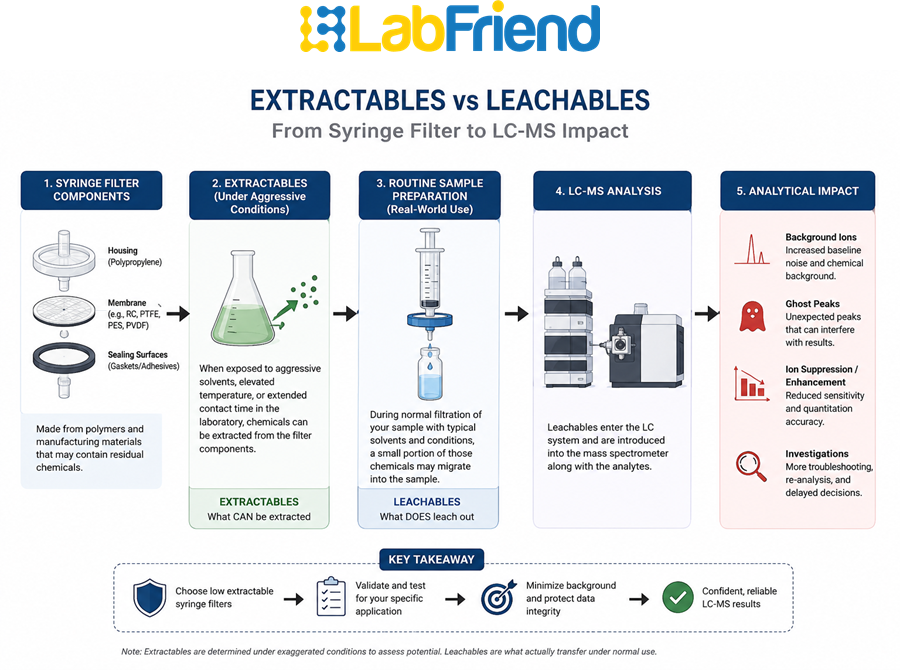
Liquid chromatography coupled with mass spectrometry differs from many traditional analytical techniques because the detector is capable of recognising extremely small quantities of chemical compounds. While this provides exceptional analytical capability, it also means that contaminants introduced during sample preparation may become visible as background ions, ghost peaks (unexpected peaks not related to the sample itself) or unexpected signals.
Unlike particulate contamination, which is generally removed by filtration, extractable compounds originate from the filtration device itself. Under certain solvent conditions, trace quantities of chemicals may migrate from the membrane, housing or manufacturing process into the sample, with extractable risk generally increasing as the aggressiveness or organic solvent strength of the sample matrix increases. Although these quantities are often extremely small, they may still be detectable by modern mass spectrometers.
The result can include:
- elevated background noise;
- ion suppression or ion enhancement;
- reduced quantitative accuracy;
- compromised method sensitivity;
- increased analytical variability; and
- unnecessary troubleshooting investigations.
For QA/QC laboratories operating under regulated quality systems, such effects can significantly increase investigation time, delay batch release and reduce confidence in validated analytical methods.
Understanding Extractables and Leachables
The terms extractables and leachables are frequently used together, but they describe different aspects of material behaviour.
Extractables are compounds that can be removed from a material under controlled extraction conditions using aggressive solvents or elevated temperatures. They represent the potential chemical profile of a material rather than what is necessarily introduced during routine use. Extractable and leachable risk assessment in the industry is often guided by recognised extractable-study frameworks and principles, which provide a structured basis for evaluating potential contamination risk.
Leachables, by contrast, are compounds that actually migrate into a sample during normal operating conditions, with the extent of migration influenced by contact time, temperature and solvent composition.
A syringe filter with a low extractable profile reduces the likelihood that detectable compounds will become leachables during routine LC-MS sample preparation. This distinction is particularly important when selecting consumables for trace analytical methods where analytical sensitivity is exceptionally high.
Why QA/QC Managers Should Care
For QA/QC professionals, analytical contamination is rarely viewed as an isolated technical issue. Instead, it represents a potential risk to method robustness, data integrity and regulatory compliance.
Unexpected chromatographic artefacts frequently initiate additional investigations that consume valuable laboratory resources. Analysts may initially suspect contaminated solvents, deteriorating chromatography columns or instrument faults before identifying the true source of contamination.
Selecting appropriate filtration consumables at the outset helps reduce this risk considerably.
Laboratories that standardise validated, low-extractable syringe filters often experience benefits extending beyond analytical performance alone, including improved method consistency, fewer repeat analyses and simplified procurement through the use of approved consumables.
Where Do Extractables Come From?
Although membrane chemistry receives most attention, extractable compounds may originate from several components within a syringe filter.
|
Potential Source |
Typical Contribution |
|
Membrane polymer |
Trace organic compounds characteristic of membrane chemistry |
|
Polypropylene housing |
Low levels of polymer-related compounds |
|
Manufacturing process |
Processing residues or cleaning agents |
|
Packaging materials |
External contamination during storage |
|
Assembly process |
Minor residues introduced during production |
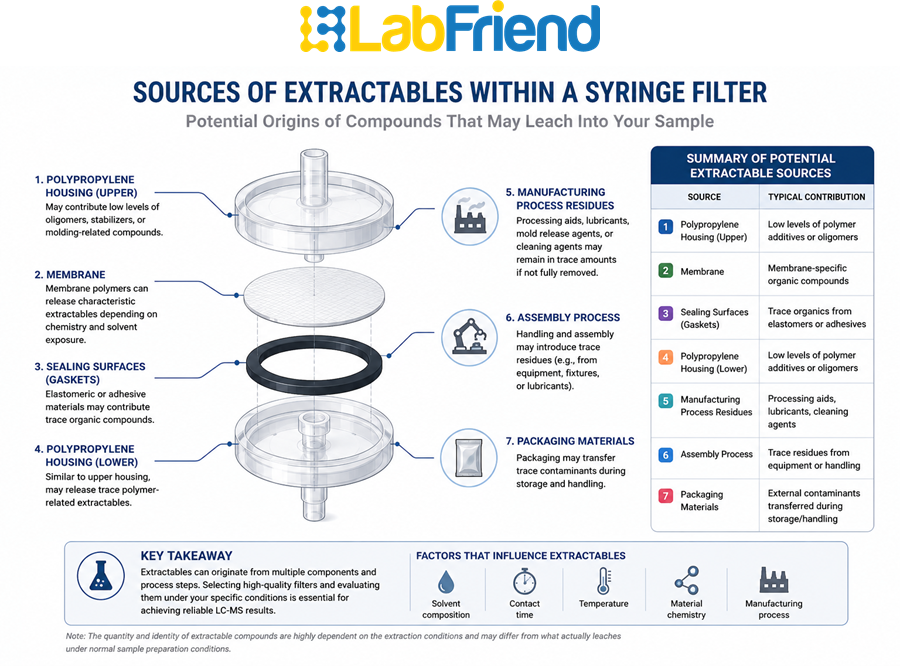
High-quality manufacturers employ carefully controlled production processes to minimise these potential sources, but no filtration material should ever be assumed to be completely inert under every analytical condition.
Consequently, laboratories should evaluate syringe filters within the context of the intended analytical method rather than selecting products solely on membrane type or purchase price.
Low Extractables Are Only One Selection Criterion
Choosing the correct syringe filter requires consideration of several interrelated factors.
Alongside extractable performance, laboratories should assess:
- membrane compatibility with the solvent system;
- analyte recovery;
- protein binding characteristics where applicable;
- pore size;
- filter diameter (selected according to sample volume and required throughput);
- sample volume;
- hold-up volume (the residual liquid volume retained within the filter after use);
- particulate loading; and
- overall method sensitivity.
For example, reducing extractables offers little benefit if the selected membrane exhibits excessive analyte adsorption or poor compatibility with the sample solvent. Similarly, a membrane optimised for aqueous solutions may perform poorly when exposed to aggressive organic solvents.
Successful LC-MS method development therefore considers filtration as part of the complete analytical workflow rather than an isolated sample preparation step.
Readers seeking broader guidance on selecting membranes for chromatography applications may also find Best Syringe Filters for HPLC and UHPLC Sample Preparation valuable.
Why Membrane Selection Influences LC-MS Performance
Different membrane materials exhibit different chemical characteristics, solvent compatibility profiles and potential extractable behaviour.
For many LC-MS applications, regenerated cellulose (RC) has become a popular choice because it combines broad solvent compatibility (particularly for aqueous and mixed aqueous-organic systems; compatibility with more aggressive organic solvents should be confirmed) with low non-specific binding and favourable analytical cleanliness across many aqueous and mixed-organic solvent systems. However, no membrane should be considered universally suitable. PTFE, PES, PVDF and nylon membranes each offer advantages for particular analytical applications, depending upon solvent chemistry, analyte characteristics and method requirements.
The objective is not to identify a single "best" membrane, but to select the membrane that provides the optimal balance between chemical compatibility, analyte recovery and low contamination risk for the specific analytical method being performed.
Comparing Membrane Materials for LC-MS Applications
Selecting a syringe filter for LC-MS is about achieving the right balance between analytical cleanliness, chemical compatibility and analyte recovery. While pore size is often the first specification considered, membrane chemistry frequently has a greater influence on the overall quality of trace analytical results.
Each membrane material possesses unique chemical and physical characteristics that determine its suitability for different solvent systems and analytical applications. Rather than searching for a universally superior membrane, laboratories should evaluate each option against the specific requirements of the analytical method.
The table below provides a practical comparison of the membrane materials most frequently encountered in LC-MS sample preparation.
|
Membrane |
Typical Strengths |
Typical Considerations |
Common LC-MS Applications |
|
Regenerated Cellulose (RC) |
Low extractables, broad solvent compatibility, low protein binding |
Not suitable for all aggressive solvent combinations |
Pharmaceutical analysis, environmental testing, routine LC-MS |
|
PTFE |
Excellent resistance to aggressive organic solvents |
Hydrophobic; aqueous samples often require pre-wetting unless hydrophilic PTFE is used (hydrophilic PTFE is typically achieved via surfactant treatment, which should be considered when assessing extractable risk) |
Organic solvent filtration |
|
PES |
High flow rates and low protein adsorption (often achieved via surfactant/wetting-agent treatment, which is relevant to extractable risk) |
Less suitable for certain aggressive organic solvents |
Biological and aqueous samples |
|
PVDF |
Broad chemical compatibility and low biomolecule binding (though compatibility with strongly polar aprotic solvents such as DMSO or DMF should be confirmed) |
Compatibility should be confirmed for individual solvent systems |
Biopharmaceutical and analytical workflows |
|
Nylon |
Robust mechanical strength and wide solvent compatibility (though nylon is generally incompatible with strong acids and strong oxidising agents) |
Can exhibit higher analyte binding for certain compounds |
General analytical laboratories |
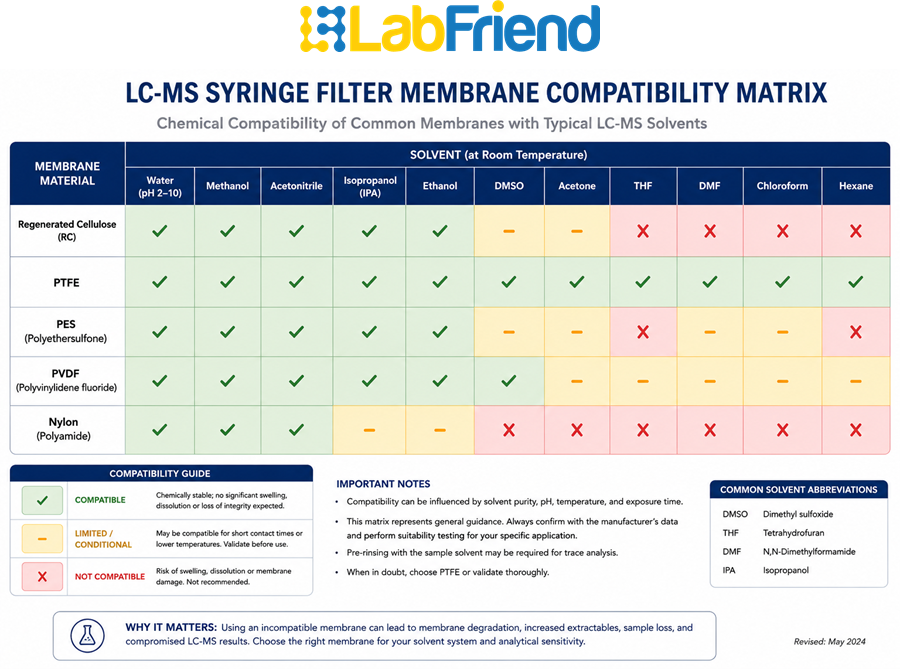
For many mixed aqueous/organic LC-MS methods, regenerated cellulose is frequently selected because it combines excellent analytical cleanliness with broad solvent compatibility and consistently low non-specific binding. However, every analytical method should validate membrane suitability before routine implementation.
Why Regenerated Cellulose Is Frequently Selected
Regenerated cellulose (RC) has become one of the most widely used membrane materials for analytical chromatography because it offers a combination of characteristics that align well with modern LC-MS workflows.
These include:
- low levels of extractable compounds;
- low non-specific adsorption (the membrane does not unintentionally trap or bind analyte molecules);
- excellent compatibility with aqueous and mixed-organic mobile phases (though strongly aggressive organic solvents should still be verified);
- broad applicability across pharmaceutical and analytical laboratories; and
- reliable analyte recovery for many routine applications.
These characteristics make RC membranes particularly attractive where analytical sensitivity is high and laboratories seek to minimise unnecessary background contamination without compromising filtration efficiency.
Readers interested in membrane technology may also benefit from Choosing the Best Filter Membrane for LC-MS Applications.
Membrane Selection Should Always Follow Solvent Compatibility
Although low extractables are important, membrane compatibility with the sample solvent remains the first consideration.
An unsuitable membrane may:
- degrade during filtration;
- release additional extractable compounds;
- reduce analyte recovery;
- block prematurely; or
- compromise method reproducibility.
For example, highly aggressive organic solvents often favour PTFE membranes, whereas mixed aqueous-organic solutions frequently perform well with regenerated cellulose.
The objective is therefore not simply to purchase the membrane with the lowest published extractables, but rather to identify the membrane that delivers the most appropriate combination of compatibility, cleanliness and analytical performance for the intended application.
Selecting the Correct Pore Size
Once membrane chemistry has been established, pore size becomes the next important consideration.
The majority of LC-MS sample preparation employs either:
|
Pore Size |
Typical Application |
|
Maximum particulate removal, UHPLC, highly sensitive analytical methods (UHPLC columns typically use sub-2µm particles, for which 0.22µm filtration is generally recommended) |
|
|
General HPLC, lower particulate loading, routine analytical applications |
A smaller pore size provides greater protection against fine particulates but may increase filtration resistance, particularly where samples contain suspended solids.
Conversely, larger pore sizes generally provide faster flow rates while remaining suitable for many conventional chromatographic applications.
Further guidance is available in 0.22 µm vs 0.45 µm Syringe Filters: When Should You Use Each?.
Practical Selection Framework for QA/QC Laboratories
Rather than relying upon a single specification, experienced laboratories typically evaluate syringe filters using a structured decision process.
|
Selection Question |
Why It Matters |
|
What solvent system is being filtered? |
Determines membrane compatibility. |
|
What analytical sensitivity is required? |
Influences acceptable extractable profile. |
|
What is the analyte chemistry? |
Helps minimise adsorption losses. |
|
Is protein recovery important? |
Influences membrane selection. |
|
What particulate loading is expected? |
Determines suitable filter diameter and throughput. |
|
What pore size is required? |
Protects analytical instrumentation while maintaining flow. |
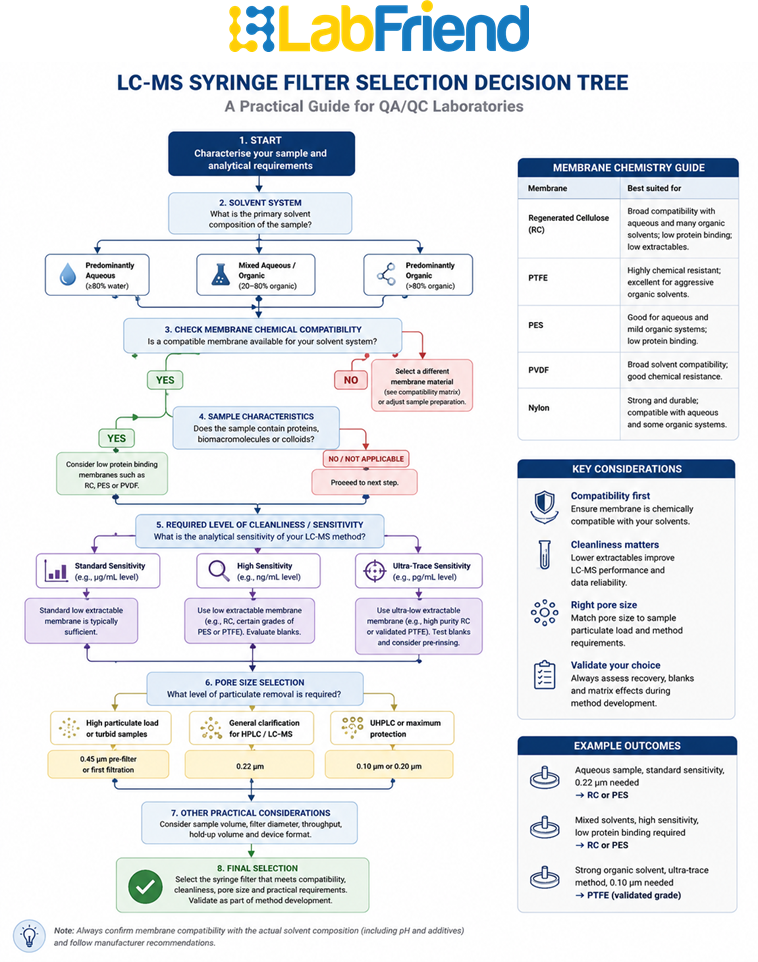
This structured approach helps ensure filtration consumables complement the analytical method rather than introducing unnecessary variables.
Common Mistakes When Selecting Syringe Filters for LC-MS
Many filtration problems arise not because the filter is defective, but because it is inappropriate for the analytical method.
Some of the most common selection errors include:
Choosing on Price Alone
The lowest-cost filter may not provide the analytical cleanliness required for trace analysis. Small differences in consumable cost can quickly be outweighed by the expense of repeat analyses and troubleshooting.
Assuming Every RC Filter Performs Identically
Although regenerated cellulose is recognised for its favourable analytical characteristics, manufacturing quality varies between suppliers. Laboratories should purchase from reputable manufacturers able to provide consistent quality and technical documentation.
Ignoring Sample Chemistry
Even an excellent membrane will perform poorly if it is chemically incompatible with the solvent system or analyte.
Using One Filter for Every Application
Standardising consumables offers procurement advantages, but laboratories should avoid forcing one membrane type into applications where another material is technically more appropriate.
Overlooking Syringe and Housing Material Compatibility
Aggressive solvents can also affect the syringe barrel or filter housing itself, particularly where polypropylene components are used, introducing an additional and often overlooked source of contamination or component failure.
Purchasing Considerations for Laboratory Managers
For procurement teams, syringe filters should be evaluated using both technical and commercial criteria.
A balanced purchasing assessment should consider:
|
Technical Consideration |
Commercial Benefit |
|
Low extractables |
Fewer investigations and repeat analyses (laboratories are encouraged to request supplier-provided extractable-testing data or batch documentation to substantiate low-extractable claims) |
|
Consistent manufacturing quality |
Improved analytical reproducibility |
|
Reliable supply |
Reduced operational risk |
|
Broad product availability |
Simplified procurement |
|
Technical support |
Faster method optimisation |
|
Batch consistency |
Greater confidence in validated methods |
Selecting filtration consumables that consistently support analytical quality can reduce total operating costs even where the unit purchase price is marginally higher.
Supporting Method Validation
Method validation frequently focuses on chromatography parameters, instrument performance and calibration. However, filtration consumables also deserve consideration during validation because they form part of the complete sample preparation workflow.
Laboratories developing new LC-MS methods should evaluate:
- membrane compatibility;
- analyte recovery;
- filtration reproducibility;
- background contamination;
- extractable profile; and
- consistency between manufacturing batches.
Incorporating syringe filter assessment during validation reduces the likelihood of unexpected contamination being discovered only after routine analytical use.
Best Practices for Contamination-Free LC-MS Sample Preparation
Even the highest quality syringe filter cannot compensate for poor laboratory practice. Contamination control should be viewed as a complete workflow that begins with sample collection and continues through preparation, filtration and instrumental analysis. Each stage has the potential to introduce variability, making consistency every bit as important as the choice of filtration consumable.
Laboratories that achieve consistently reliable LC-MS results typically standardise both their procedures and their consumables. Analysts use validated filtration methods, approved membrane types and controlled handling procedures to minimise variation between operators and analytical batches. This approach improves reproducibility while reducing the number of investigations arising from unexpected chromatographic artefacts.
Routine review of filtration practices should therefore form part of continuous improvement programmes within quality-controlled laboratories.
Practical Recommendations for Selecting Low Extractable Syringe Filters
When selecting syringe filters for LC-MS and trace analytical applications, laboratories should consider the entire analytical workflow rather than focusing on a single specification.
The following framework provides a practical approach.
|
Selection Requirement |
Recommended Consideration |
|
Trace analytical sensitivity |
Select membranes recognised for low extractable characteristics. |
|
Mixed aqueous/organic solvents |
Verify membrane compatibility before routine use. |
|
Protein or biomolecule analysis |
Consider membranes with low non-specific binding. |
|
Highly aggressive solvents |
Confirm chemical compatibility with the chosen membrane. |
|
High-throughput routine testing |
Standardise validated filters across laboratories where appropriate. |
|
Regulated environments |
Maintain documented consumable specifications and approved suppliers. |
Rather than assuming one membrane material is suitable for every application, laboratories should validate filter performance as part of method development and retain documented evidence to support routine use.
Developing a Standardised Filtration Strategy
Many laboratories initially purchase syringe filters on a project-by-project basis. While this approach may appear flexible, it often leads to unnecessary product variation, inconsistent analytical performance and increased procurement complexity.
A more effective strategy is to establish a standardised filtration programme that defines:
- approved membrane types for common analytical workflows;
- preferred pore sizes for specific applications;
- compatible solvent systems;
- approved manufacturers and suppliers;
- validation requirements for introducing alternative products; and
- periodic review of filtration performance.
This approach helps reduce purchasing complexity while ensuring analysts consistently use consumables that have already demonstrated acceptable analytical performance.
Why Supplier Consistency Matters
The performance of a syringe filter depends not only on membrane chemistry but also on manufacturing quality, batch consistency and quality control.
When evaluating suppliers, laboratories should consider factors such as:
|
Evaluation Criterion |
Importance |
|
Manufacturing consistency |
Supports reproducible analytical performance |
|
Product traceability |
Facilitates quality investigations |
|
Technical documentation |
Assists validation and method development |
|
Reliable product availability |
Reduces supply chain disruption |
|
Technical support |
Helps resolve application-specific challenges |
|
Range breadth |
Simplifies procurement across multiple workflows |
Working with a supplier capable of supporting both routine consumables and specialist analytical applications can reduce administrative effort while improving consistency across laboratory operations.
Supporting LC-MS Performance Through Better Filtration
Appropriate syringe filter selection contributes to several aspects of analytical performance, including:
- cleaner chromatograms;
- reduced background contamination;
- improved quantitative reproducibility;
- greater confidence in trace-level measurements;
- reduced instrument downtime caused by particulate contamination; and
- fewer repeat analyses resulting from unexplained analytical variability.
While filtration alone cannot eliminate every source of contamination, it represents one of the simplest and most cost-effective improvements laboratories can make to strengthen overall analytical quality.
Recommended Next Steps
Laboratories reviewing their LC-MS filtration procedures should consider the following actions:
- Review existing syringe filter specifications against current analytical methods.
- Confirm membrane compatibility with routinely used solvents.
- Assess whether current consumables provide suitably low extractable performance for trace analytical work.
- Standardise validated filtration consumables wherever practical.
- Review filtration procedures periodically as analytical methods evolve.
Implementing these measures can improve analytical consistency while reducing the likelihood of contamination-related investigations.
Explore LabFriend Solutions
Whether you are developing a new LC-MS method or reviewing an established analytical workflow, selecting the correct syringe filter is an important component of reliable sample preparation.
LabFriend supplies a comprehensive range of laboratory filtration products suitable for pharmaceutical, environmental, food, biotechnology and research laboratories throughout the UK.
To continue your filtration learning journey, we recommend exploring:
- The Ultimate Guide to Laboratory Filtration for a comprehensive overview of laboratory filtration technologies.
When you're ready to evaluate suitable products, browse the RC Filters and LC-MS Filters product ranges to identify filtration solutions appropriate for your analytical applications.
Written by: Donal O’Sullivan, BSc, Co-Founder and Sales Director, LabFriend UK. Donal brings deep chemistry-led technical expertise across analytical chemistry, biochemistry, environmental monitoring, laboratory instrumentation, consumables and scientific product selection.
Reviewed by: Michael Anderson, MBA, Founder and Managing Director, LabFriend UK. Michael reviews LabFriend UK content for customer relevance, commercial accuracy, operational practicality and alignment with LabFriend UK’s laboratory supply model.
Related Stories

Complete Guide to Centrifuge Tubes
Complete Guide to Centrifuge Tubes

The Ultimate Guide to Laboratory Filtration for UK Laboratories
The Ultimate Guide to Laboratory Filtration for UK Laboratories

Polypropylene vs Polystyrene Centrifuge Tubes
Polypropylene vs Polystyrene Centrifuge Tubes: Which Is Best for Laboratory Workflows?

PTFE vs PES Syringe Filters: Which Membrane Should You Choose?
PTFE vs PES Syringe Filters: Differences, Solvent Compatibility and Laboratory Applications