HPLC Sample Preparation Consumables for CROs and High-Throughput Testing Laboratories
29 mins read
HPLC Sample Preparation Consumables for CROs and High-Throughput Testing Laboratories

By Donal O’Sullivan, BSc. Reviewed by Michael Anderson, MBA.
For CROs and high-throughput testing laboratories, HPLC sample preparation is not simply a technical step before analysis. It is part of the operating system that keeps projects moving, instruments productive and client work on schedule.
In a lower-throughput research environment, a missing syringe filter, an unsuitable vial or a delayed consumable reorder may be inconvenient. In a busy CRO or contract testing laboratory, the same issue can delay batches, disrupt analyst time, create urgent purchasing work and put pressure on client turnaround commitments.
That is why HPLC sample preparation consumables should be managed as a repeat workflow category, not as occasional catalogue purchases.
This guide is part of LabFriend UK’s wider chromatography consumables content hub. For the full overview of HPLC, UHPLC, GC, SPE, TLC, vials, filters, columns and chromatography workflow consumables, read The Complete Guide to Chromatography Consumables for UK Laboratories.
LabFriend UK supplies chromatography sample preparation products, chromatography vials and septa, laboratory vials, HPLC accessories and HPLC columns for UK laboratories running routine and specialist analytical workflows.
Quick answer: how should CROs manage HPLC sample preparation consumables?
CROs and high-throughput testing laboratories should manage HPLC sample preparation consumables by standardising approved product specifications for each repeat workflow, recording method-critical requirements, setting reorder points and agreeing controlled alternatives where substitution is allowed.
The key consumables usually include syringe filters, syringes, chromatography vials, caps, septa, vial inserts, solvent bottles, solvent caps, tubing, fittings, inlet filters, guard columns and sample preparation devices.
The aim is not to force every method to use the same products. The aim is to create a controlled consumables system where analysts know what to use, procurement knows what to reorder, and operations teams can avoid preventable stockouts or last-minute substitutions.
For a CRO, the best HPLC sample preparation consumable is not simply the cheapest option. It is the product that fits the method, supports consistent results, can be sourced reliably and can be reordered without ambiguity.
Why HPLC sample preparation matters more in CRO environments
CROs and contract testing laboratories operate differently from single-project research labs. They often manage multiple client projects, multiple methods, multiple analysts and multiple instruments at the same time. That creates a higher operational penalty when routine consumables are not controlled.
A syringe filter that is out of stock, a vial format that does not match the autosampler, or a substituted septum that has not been technically reviewed can create disruption beyond the immediate product value. It may affect analyst scheduling, batch continuity, instrument availability, client reporting or repeat work.
In high-throughput analytical environments, the technical and operational risks are linked. A sample preparation consumable must work scientifically, but it must also be available, documented, repeatable and easy to purchase again.
This is where CRO operations managers can add real value. By standardising approved consumable records and repeat-order routes, they reduce avoidable interruptions while still allowing technical teams to retain control over method-sensitive choices.
The CRO challenge: standardise without over-standardising
Standardisation is essential in a high-throughput laboratory, but it has to be applied intelligently.
If every analyst, method or client project uses different filters, vials, caps, syringes and solvent handling products, procurement becomes fragmented and stock control becomes difficult. The laboratory may hold too many near-duplicate SKUs, yet still run out of the item needed for a critical workflow.
On the other hand, forcing a single consumable across every HPLC or UHPLC method can create technical risk. Different methods may involve different solvents, analytes, matrices, column chemistries, detector sensitivities and sample volumes. A filter membrane suitable for one workflow may not be suitable for another. A vial used for routine UV detection may not be appropriate for a trace-level or LC-MS-sensitive workflow.
The practical goal is not universal standardisation. It is controlled standardisation.
That means grouping workflows by technical need, identifying repeat-use consumables, documenting what is approved and defining where substitutions require scientific review.
Core HPLC sample preparation consumables for CRO workflows
Most HPLC sample preparation workflows involve several consumables before the sample reaches the column. In CROs, these products are often reordered regularly and should be managed as part of a repeat purchasing process.
|
Workflow area |
Typical consumables |
CRO operating concern |
|
Sample clarification |
Syringe filters, filter membranes, syringes |
Preventing particulate-related disruption without compromising recovery |
|
Sample containment |
Vials, caps, septa, inserts |
Autosampler compatibility and repeatable injection workflow |
|
Solvent handling |
Bottles, solvent caps, tubing, fittings, inlet filters |
Stable mobile phase handling and reduced contamination risk |
|
Column protection |
Guard columns, guard cartridges, inline filters |
Protecting method continuity and reducing avoidable downtime |
|
Procurement control |
Approved product records, reorder points, approved alternatives |
Avoiding stockouts, wrong orders and uncontrolled substitutions |
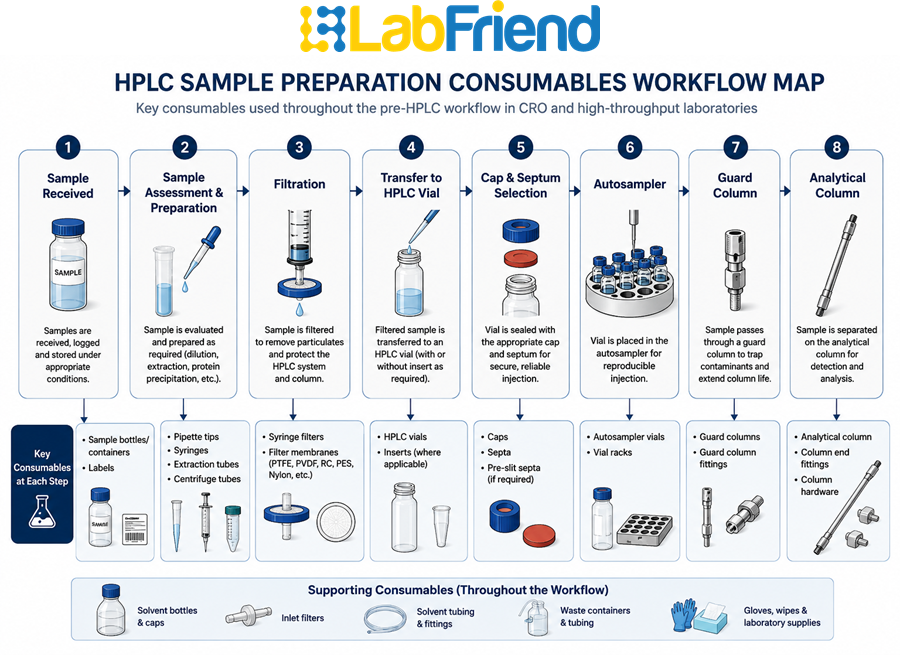
This table should not be used as a final product specification. It is a workflow map. Each laboratory still needs to confirm the specific membrane, pore size, vial format, cap type, tubing material and column protection products that fit its methods.
Syringe filters: small consumables with large workflow impact
Syringe filters are one of the most important HPLC sample preparation consumables in high-throughput environments. They are relatively low-cost, frequently used and easy to reorder, but the wrong filter can affect analyte recovery through adsorption, introduce extractables where unsuitable materials are used, reduce filtration efficiency, or allow particulate matter to reach the analytical column.
For CROs, the issue is not only choosing the correct membrane or pore size once. The bigger challenge is making sure the same correct filter can be used consistently across repeated work.
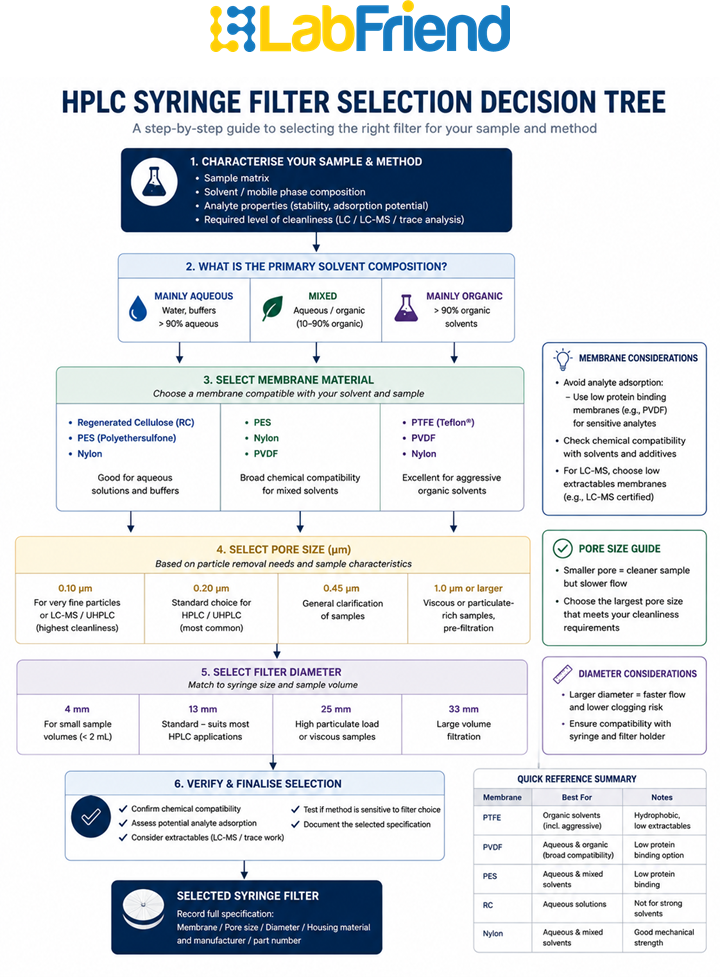
A laboratory may have one method that uses 0.45 µm filtration for routine HPLC clarification and another that requires 0.22 µm filtration for a finer-particle-sensitive workflow. Membrane selection should be based on solvent compatibility, analyte chemistry, sample matrix and potential analyte adsorption. For example, PTFE membranes are commonly used with aggressive organic solvents, whereas hydrophilic membranes such as regenerated cellulose or PES may be more appropriate for aqueous samples. Some analytes may be more sensitive to binding, extractables or recovery losses than others.
This is why filter selection should be recorded by method or workflow, not by a generic description such as “HPLC syringe filter.”
For more detailed filter guidance, LabFriend UK’s Ultimate Syringe Filter Guide explains how pore size, membrane material and filter diameter affect HPLC and UHPLC workflows.
Verifying compatibility before routine use
Before introducing a new syringe filter into routine analytical use, laboratories should verify that the selected membrane does not adversely affect analyte recovery, chromatographic performance or method precision. Evaluation may include recovery studies, comparison against the existing approved consumable and assessment of any additional chromatographic peaks attributable to extractables.
How CROs should record syringe filter specifications
A CRO or contract testing lab should record enough detail for procurement to reorder the correct filter without needing to interpret the method every time.
|
Filter specification |
Why it matters |
|
Membrane material |
Determines solvent and analyte compatibility |
|
Pore size |
Supports particulate removal and column protection requirements |
|
Filter diameter |
Should match sample volume and throughput |
|
Housing material |
May affect chemical compatibility, extractables and mechanical integrity under the intended operating conditions. |
|
Sterile / non-sterile status |
Relevant only where the workflow requires it |
|
Low-binding or low-extractables requirement |
Important for sensitive analytes or trace workflows |
|
Pack size |
Supports cost control and reorder planning |
|
Approved alternatives |
Helps avoid stockouts without uncontrolled switching |
For CROs, the approved alternative field is especially important. It gives procurement a backup route when supply is tight, but it also protects the laboratory from accidental product changes where the method is sensitive.
Vials, caps and septa: the sample containment system
Once the sample has been prepared or filtered, the vial system becomes the next control point. In a high-throughput laboratory, this can become a hidden source of operational friction.
A vial that does not fit the autosampler tray correctly, a cap that does not match the neck finish, or a septum that behaves differently under repeated needle penetration can disrupt a run. In a CRO environment, this does not only affect one sample. It can affect a full sequence, a batch schedule or a client method.
The most important procurement principle is that the vial, cap and septum should be treated as one system. A laboratory may successfully standardise a vial format, but if the cap or septum changes without review, the workflow may still be affected.
For routine HPLC workflows, many laboratories standardise around a small number of approved vial formats to reduce purchasing complexity. For LC-MS-sensitive, headspace, volatile, low-volume or client-specified workflows, the specification may need to be more tightly controlled.
LabFriend UK’s Vials & Septa category is the primary route for chromatography vial and septa purchasing, while Laboratory Vials supports broader vial requirements.
Syringes and sample transfer steps
Syringes are sometimes treated as secondary to the filter, but in HPLC sample preparation they are part of the same workflow. The syringe controls how the sample is transferred, filtered and introduced into the next container.
In high-throughput environments, poor syringe selection can slow down filtration, make handling inconsistent or create additional analyst friction. A syringe that is too small may require repeated loading. A syringe that is poorly matched to a filter may be difficult to use with viscous or particulate-loaded samples. Reusable syringes may create cleaning and carryover control questions, while disposable syringes create predictable replenishment demand.
For CROs, the right question is not simply “which syringe works?” It is “which syringe can be used consistently, safely and efficiently across this workflow without creating avoidable variation?”
That answer may differ between workflows. A routine method, viscous matrix, limited-volume sample and trace-sensitive workflow may each justify different handling choices.
Solvent handling and mobile phase consumables
In CROs and high-throughput labs, solvent handling can become a repeat source of operational risk if it is not standardised. Mobile phase bottles, solvent caps, tubing, fittings, inlet filters and waste handling products are not glamorous purchases, but they help support system stability and workflow continuity.
Poor solvent handling can contribute to contamination, dissolved gas ingress, solvent evaporation, flow instability, pressure fluctuations, leaks or baseline instability. These issues may not always be caused by the consumable itself, but solvent-contact products should be included in the investigation when problems recur.
For high-throughput laboratories, the operational issue is repeatability. The laboratory needs the correct solvent bottles, caps, lines and fittings available when methods are running. If these products are bought reactively, analysts may improvise or reuse items longer than intended.
The HPLC Accessories category is the relevant commercial route for solvent handling accessories, tubing, fittings and related HPLC workflow products.
Preventive replacement of consumables
Consumables that are exposed to mobile phases, including inlet filters, solvent tubing and solvent reservoir caps, should be inspected and replaced according to documented preventive maintenance schedules or when evidence of wear, contamination or reduced performance is observed.
Column protection and sample preparation discipline
HPLC columns are higher-value items than many sample preparation consumables, and column performance can be affected by what happens before injection. CROs running repeated methods need to protect columns not only through instrument care, but also through sample preparation discipline.
Filtering samples where particulate removal is appropriate, selecting suitable membranes, avoiding particulate-loaded injections, applying suitable sample clean-up procedures for complex matrices, including filtration, centrifugation, protein precipitation or solid phase extraction where appropriate and using guard columns where appropriate can all support workflow continuity. A guard column does not replace good sample preparation, but it can form part of a broader column protection strategy where the method and matrix justify it.
The risk for CROs is that column problems can ripple through the schedule. If a column blocks, pressure rises or performance changes, the laboratory may lose time investigating the method, replacing parts or repeating analysis.
The HPLC Columns category supports column-related purchasing, including workflows where column protection and approved replacements need to be managed carefully.
Method validation and consumable changes
Changing a consumable used in a validated analytical method should be evaluated through the laboratory's change control process before implementation. Depending on the method and regulatory environment, demonstrating equivalence may require documented technical assessment, verification testing or partial method revalidation. Laboratories operating under ISO 17025, GMP or regulated client requirements should ensure any consumable change complies with their quality management system.
Building approved consumable lists for CROs
A CRO-approved consumable list should be practical enough to use and detailed enough to prevent ambiguity. It should not become a static spreadsheet that nobody updates. It should be a working control document shared between analysts, lab managers, operations and procurement.
A good approved list answers four questions:
- What product is approved for this workflow?
- When can procurement reorder without further technical review?
- When does a substitution need scientific approval?
- What is the reorder point before the laboratory is at risk?
The table below shows the level of detail that is usually useful.
|
Consumable group |
What to record |
|
Syringe filters |
Membrane, pore size, diameter, housing, pack size, approved alternatives |
|
Vials and inserts |
Volume, dimensions, neck type, material, colour, insert requirement |
|
Caps and septa |
Closure type, septum material, pre-slit status, pack size |
|
Syringes |
Volume, material, connection type, disposable/reusable status |
|
Solvent handling |
Bottle type, cap thread, tubing, fittings, inlet filters |
|
Column protection |
Guard column, cartridge, holder, inline filter or method restriction |
|
Procurement control |
Supplier route, LabFriend URL/SKU, quote reference, reorder point |
|
Technical control |
Approved, restricted, no substitution, or approval required |
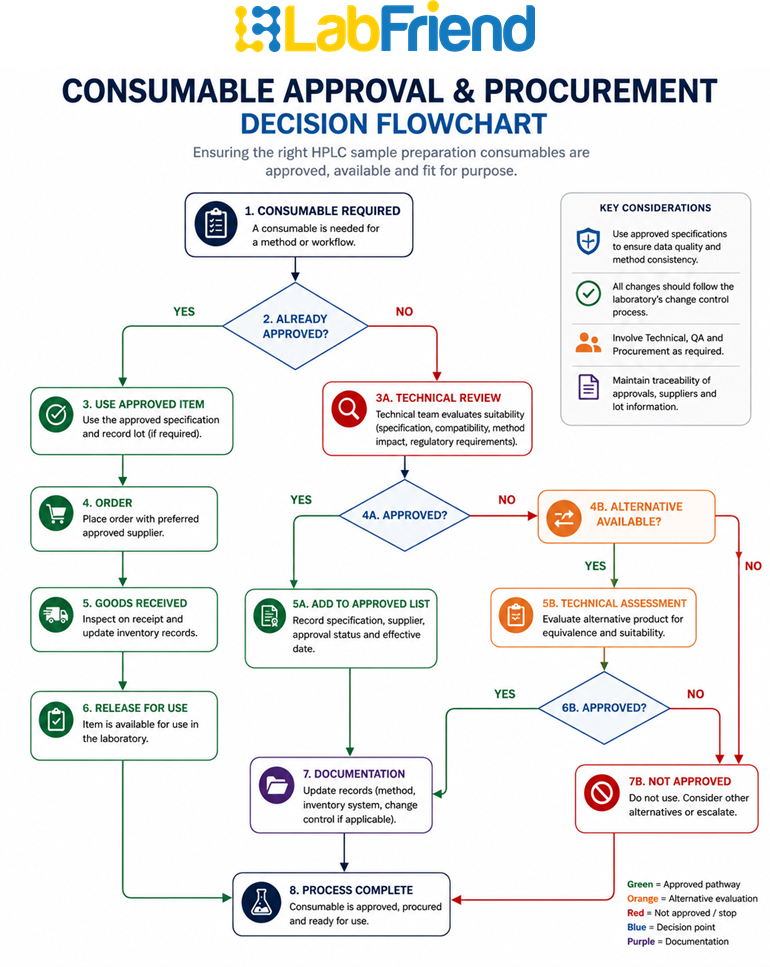
For CROs, the value of this list is not administrative. It protects throughput. It helps avoid situations where the laboratory has plenty of general consumables in stock but not the exact product needed for the next client workflow.
Recommended control fields
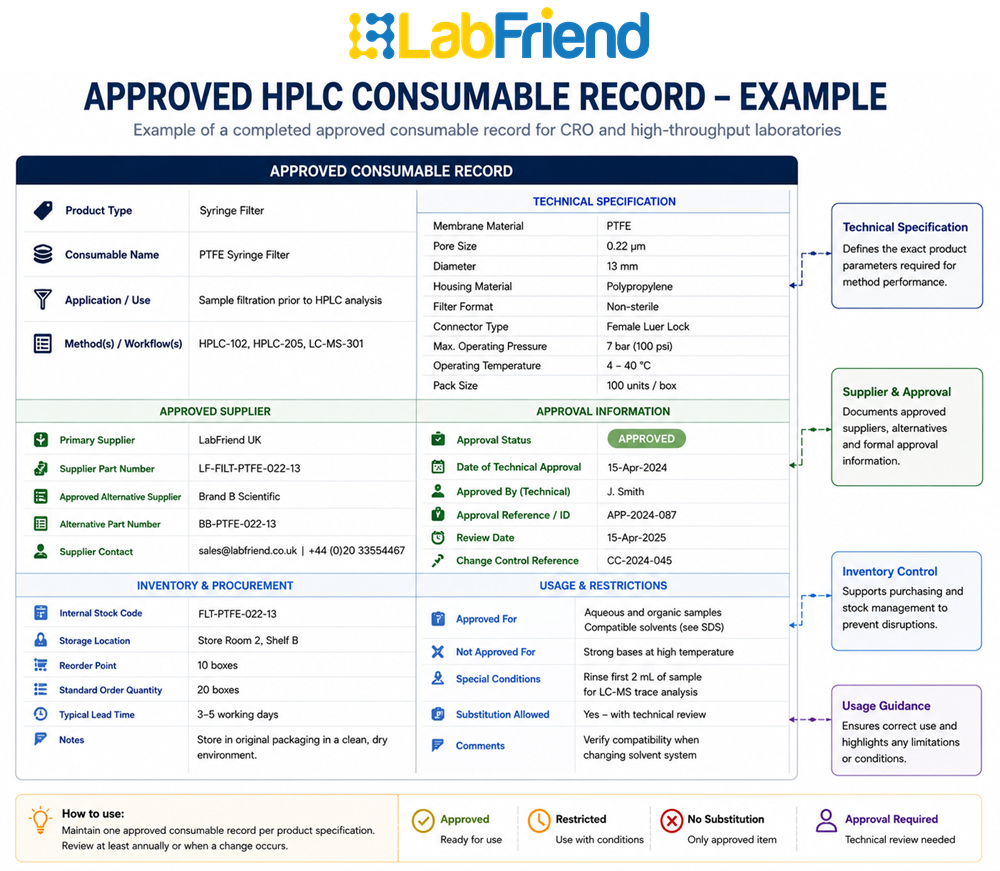
In addition to the technical specification, each approved consumable record should include:
- Manufacturer and catalogue number
- Internal stock code (where applicable)
- Approved supplier(s)
- Date of technical approval
- Review date
- Change control reference (where applicable)
- Method(s) or workflow(s) covered
- Approval status
Repeat-order planning and stockout prevention
Repeat-order planning is where CRO operations managers, lab managers and procurement teams can create real commercial efficiency.
Many laboratories only notice sample preparation consumables when stock is low. That reactive pattern creates urgent orders, emergency substitutions and avoidable analyst time spent searching for alternatives. For high-throughput laboratories, this is inefficient and risky.
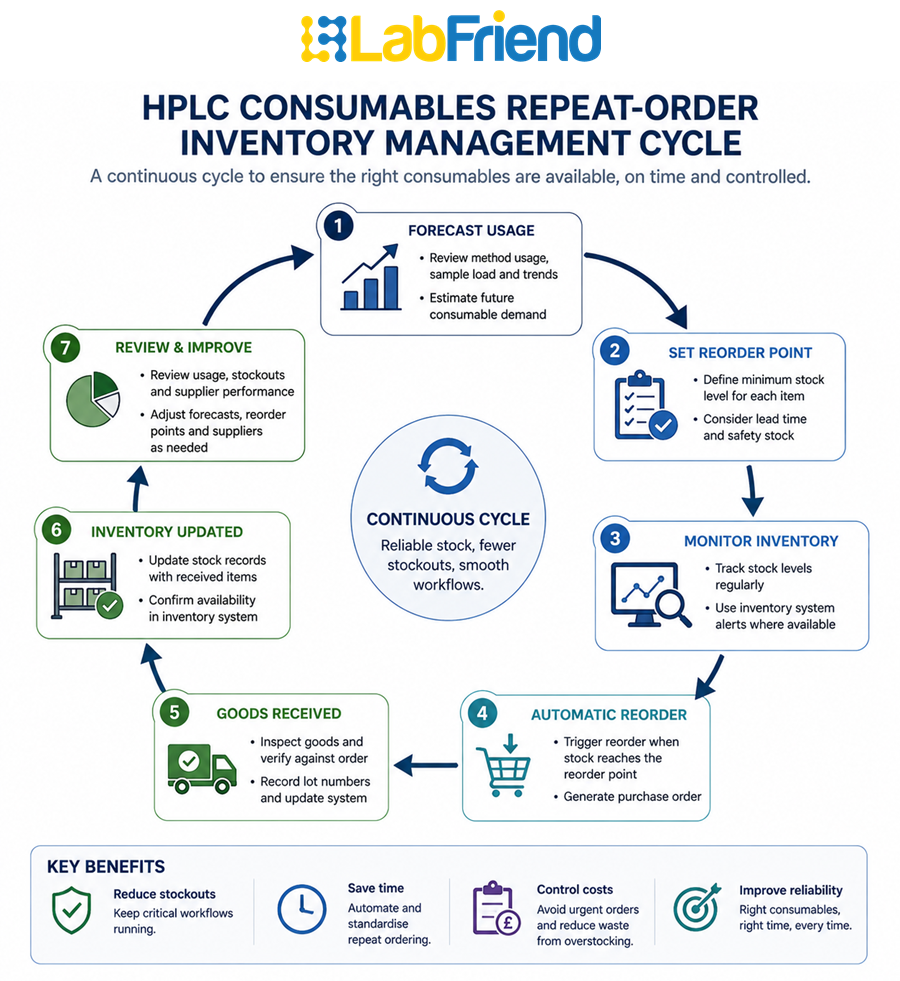
A better approach is to identify the high-use consumables behind repeat HPLC workflows and manage them with reorder points.
This does not need to be complicated. Start with products that are used daily or weekly: syringe filters, vials, caps, septa, syringes, solvent caps, tubing and guard cartridges. Then record typical monthly usage, pack size, supplier route and minimum stock level.
The objective is to avoid both extremes: understocking that causes workflow interruption and overstocking that ties up cash in products that may expire, become obsolete or change specification.
Where laboratory inventory software is available, approved consumables should be linked to automated stock monitoring, minimum stock thresholds and preferred suppliers to reduce manual purchasing activity.
Managing lot-to-lot consistency
Where analytical methods are particularly sensitive, laboratories should consider recording consumable lot numbers and assessing new lots before routine use. This approach can help identify unexpected variability arising from manufacturing changes or differences between production batches.
Controlled alternatives and supplier switching
CROs often need flexibility. A single-source approach may be convenient until a product becomes delayed, discontinued or commercially unattractive. Approved alternatives can reduce this risk, but only if they are controlled properly.
A controlled alternative is not simply a cheaper product. It is a product that has been reviewed against the workflow and accepted for use under defined conditions.
For routine workflows, alternatives may be approved where the specification can be matched and the technical user is satisfied. For validated, client-specified, LC-MS-sensitive, trace-level or regulated workflows, substitution may require more formal review.
This is especially important for syringe filters, vial systems, septa, tubing and sample preparation products, where materials and dimensions may affect performance. Products with apparently similar specifications may differ in membrane chemistry, manufacturing tolerances, extractables profile or dimensional tolerances, which may affect analytical performance.
Supplier switching should therefore be framed as a controlled improvement process, not a purchasing shortcut.
Supplier qualification
Where alternative suppliers are introduced, laboratories should confirm that supplied consumables consistently meet the approved specification. Supplier evaluation may include review of technical documentation, certificates where applicable, dimensional verification, performance testing and ongoing supplier performance monitoring.
How operations and procurement should work together
The strongest CRO consumables systems usually involve both technical and procurement ownership. Analysts understand what the method needs. Procurement understands supplier routes, pricing, pack sizes and availability. Operations understands the cost of delays and the importance of throughput.
If those functions work separately, problems appear. Analysts may specify products informally. Procurement may substitute without enough technical context. Operations may discover the issue only when a batch is delayed.
A better model is to agree a shared repeat-order process:
|
Step |
Owner |
Purpose |
|
Confirm workflow-critical consumables |
Technical user / lab manager |
Identify products that affect method performance |
|
Record specifications |
Lab manager / procurement |
Reduce ambiguity in ordering |
|
Set reorder points |
Operations / procurement |
Avoid stockouts |
|
Approve alternatives |
Technical user / QA where needed |
Control supplier switching |
|
Review usage regularly |
Operations / procurement |
Adjust stock levels and quote routes |
This is particularly important where CROs run client work under time pressure. The consumable may be small, but the disruption caused by its absence can be significant.
Procurement performance should be reviewed periodically using metrics such as stockout frequency, emergency purchases, approved substitution requests and supplier delivery performance.
Where LabFriend UK fits
LabFriend UK supports UK laboratories with an ecommerce-led procurement model, broad product access, quotation support and repeat purchasing convenience. The About LabFriend page states that the business model is designed to help laboratories simplify procurement through competitive online pricing, broad product availability, fast quotation support, repeat purchasing convenience and responsive customer support. It also confirms that Donal O’Sullivan brings more than 30 years of laboratory distribution experience.
For CROs and high-throughput laboratories, this matters because chromatography consumables are rarely isolated purchases. A first order for syringe filters may lead to repeat vials, caps, septa, solvent handling products, tubing, fittings, guard columns or wider sample preparation products.
Relevant LabFriend UK routes include:
- Chromatography Sample Preparation
- Vials & Septa
- Laboratory Vials
- HPLC Accessories
- HPLC Columns
- Contact LabFriend UK
For repeat-use workflows, the most useful starting point is to build a clear consumables list and use that list for future quotes, repeat orders and approved alternatives.
Common mistakes in high-throughput HPLC sample preparation purchasing
Mistake 1: Treating sample preparation as a one-off purchase
In CROs, filters, vials, syringes and solvent handling products are often recurring workflow items. They should be managed as repeat consumables.
Mistake 2: Standardising too broadly
One filter, vial or septum system may not suit every method. Standardise by workflow group, not by forcing one product across all methods.
Mistake 3: Recording product descriptions instead of specifications
“HPLC filter” or “2 mL vial” is not enough for reliable repeat purchasing. Record membrane, pore size, vial dimensions, closure type, septum material and pack size.
Mistake 4: Allowing uncontrolled substitutions
Supplier switching can be useful, but method-sensitive products should not be changed without technical approval.
Mistake 5: Forgetting solvent handling consumables
Solvent caps, bottles, tubing, fittings and inlet filters are part of the HPLC workflow and should be included in repeat-order planning.
Mistake 6: Waiting until stock is low
Reactive ordering creates avoidable pressure. High-use consumables should have reorder points and a clear quote route.
Final recommendation
For CROs and high-throughput testing laboratories, HPLC sample preparation consumables should be managed as operational workflow infrastructure.
Start by identifying the consumables used repeatedly across active HPLC and UHPLC methods. Record the approved syringe filters, syringes, vials, caps, septa, solvent handling products, tubing, fittings and column protection items for each workflow. Then set reorder points, define approved alternatives and agree when technical approval is required before substitution.
This approach protects throughput, reduces stockouts, makes procurement easier and helps laboratories avoid unnecessary disruption to client work.
For broader chromatography consumables planning, use The Complete Guide to Chromatography Consumables for UK Laboratories as the parent reference for this cluster.
Browse chromatography sample preparation products, review chromatography vials and septa, explore HPLC accessories, browse HPLC columns, or contact LabFriend UK to build a repeat-order list for high-use HPLC sample preparation consumables.
Frequently Asked Questions
What HPLC sample preparation consumables do CROs commonly reorder?
CROs commonly reorder syringe filters, syringes, chromatography vials, caps, septa, vial inserts, mobile phase bottles, solvent caps, tubing, fittings, inlet filters, guard columns, guard cartridges and other sample preparation consumables.
Why should CROs standardise HPLC sample preparation consumables?
Standardisation helps CROs reduce stockouts, avoid ordering errors, improve analyst consistency, control spend and maintain repeatable workflows across client projects. It should be applied by workflow group rather than forced across every method.
Should CROs use the same syringe filter for every HPLC method?
Not necessarily. Syringe filter choice depends on membrane material, pore size, filter diameter, sample matrix, solvent system, analyte chemistry, compatibility with the filter membrane, potential analyte adsorption and method requirements. CROs should record approved filters by workflow or method type.
What should be included in a CRO-approved consumables list?
A CRO-approved consumables list should include product type, manufacturer reference, LabFriend SKU or URL where available, membrane, pore size, vial format, cap and septum type, pack size, reorder point, approved alternatives and substitution restrictions.
How can CROs reduce HPLC sample preparation stockouts?
CROs can reduce stockouts by identifying high-use consumables, recording monthly usage, setting reorder points, maintaining approved alternatives and using a clear repeat-order route for filters, vials, syringes, caps, septa and HPLC accessories.
When should sample preparation consumable substitutions require approval?
Substitutions should require technical approval where the workflow is validated, client-specified, LC-MS-sensitive, trace-level, contamination-sensitive, regulated or historically trended. Routine workflows may allow approved alternatives where specifications are matched.
Why do solvent handling products matter in HPLC sample preparation?
Solvent bottles, caps, tubing, fittings and inlet filters can affect mobile phase handling, contamination risk, pressure stability and workflow continuity. High-throughput laboratories should include them in repeat-order planning.
Where can CROs buy HPLC sample preparation consumables from LabFriend UK?
CROs can browse chromatography sample preparation products, vials and septa, laboratory vials, HPLC accessories and HPLC columns through LabFriend UK’s online platform, or contact LabFriend UK for repeat-order and quotation support.
Written by: Donal O’Sullivan, BSc, Co-Founder and Sales Director, LabFriend UK. Donal brings deep chemistry-led technical expertise across analytical chemistry, biochemistry, environmental monitoring, laboratory instrumentation, consumables and scientific product selection.
Reviewed by: Michael Anderson, MBA, Founder and Managing Director, LabFriend UK. Michael reviews LabFriend UK content for customer relevance, commercial accuracy, operational practicality and alignment with LabFriend UK’s laboratory supply model.
Read more from LabFriend UK
- The Complete Guide to Chromatography Consumables for UK Laboratories
- The Ultimate Syringe Filter Guide: Pore Size, Membranes, and Applications
- Browse Chromatography Sample Preparation
- Browse Chromatography Vials and Septa
- Browse HPLC Accessories
- Browse HPLC Columns
Frequently asked questions
Delivery times vary by product and supplier. Each product page shows current stock levels and the expected lead time, and we confirm this when you place your order. Most items arrive within 2 to 3 weeks. Specialised items can take longer if they are not in stock. If you need something by a certain date, contact us and we’ll check for you.
Yes. Register for a commercial account and, once it’s approved, you will be able to process orders via PO Once you have a commercial account, you can directly email your purchase orders
Add products to your cart and click Get a Quote. You’ll get a formal quote instantly, ready to send to your email address. For bulk orders or custom requirements, send us your product list and we’ll reply with itemized pricing.
If your item is faulty, not as described or sent in error, let us know within 14 days of delivery and we’ll arrange a return. Change of mind returns are only accepted if the item is unused and in its original packaging. A restocking fee will apply and you pay the return freight. Read our full Returns Policy for details.
Yes, prices are shown including VAT by default. Use the Prices Inc. VAT toggle at the top of the page to view prices without VAT.