

Share :
GC Consumables Guide - Liners Ferrules Syringes Gas Filters and Columns
Updated On 07/29/2026

By Donal O’Sullivan, BSc. Reviewed by Michael Anderson, MBA.
Gas chromatography depends on more than the instrument and method. In routine QA/QC (Quality Assurance/Quality Control) laboratories, the reliability of a GC workflow is often protected by small, repeat-use consumables: inlet liners, ferrules, syringes, gas filters, septa, seals and columns. These products are easy to underestimate because many are inexpensive compared with the instrument itself. But when the wrong consumable is fitted, overused, substituted without review or poorly matched to the method, the impact can appear as leaks, poor peak shape, carryover, contamination, unstable baselines, poor reproducibility or avoidable downtime.
For QA/QC teams, GC consumables should not be treated as incidental parts. They should be treated as method-supporting components that need clear specifications and repeatable purchasing control. A liner that suits one injection mode may not suit another. A ferrule that performs well in one installation may not be right for a different temperature range or fitting. A syringe with the wrong needle style can affect injection repeatability. A gas filter that is not replaced appropriately may compromise carrier gas quality. A column with the wrong phase, dimensions or film thickness can change the separation itself.
This guide explains the main GC consumables that laboratories should understand and control: liners, ferrules, syringes, gas filters and columns. It is written for QA/QC managers, analytical scientists and laboratory teams that need practical, repeatable GC workflows rather than one-off product selection. Readers new to GC hardware may find it easiest to start with the quick-answer table below before reading the consumable-by-consumable sections in detail.
This article is part of LabFriend UK’s chromatography consumables content hub. For the wider context across HPLC, UHPLC, GC, SPE, TLC, vials, filters, columns and sample preparation products, read The Complete Guide to Chromatography Consumables for UK Laboratories.
LabFriend UK supplies GC consumables, GC columns, wider gas chromatography products and broader chromatography supplies for UK laboratories.
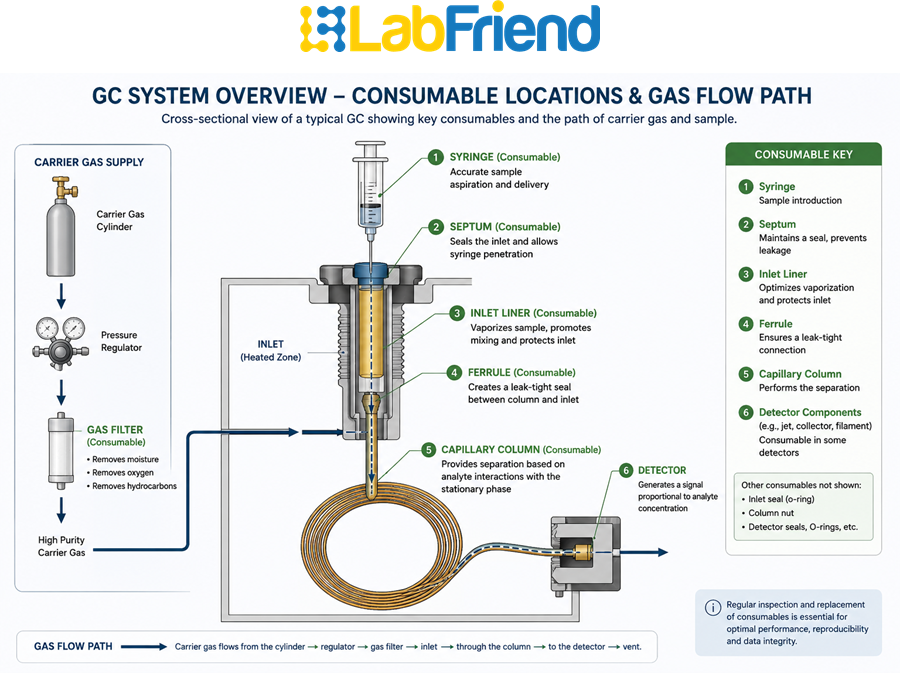
Quick answer: which GC consumables matter most?
The most important GC consumables to standardise are usually inlet liners, ferrules, syringes, gas filters and GC columns. Septa, O-rings, seals, column nuts and headspace consumables may also be important depending on the instrument configuration and method.
Each consumable supports a different part of the GC workflow. Liners influence how the sample vaporises and enters the column. Ferrules help create leak-free connections. Syringes affect injection precision and sample introduction. Gas filters help protect carrier gas quality. Columns determine the separation itself. Because these consumables interact with the method, they should be selected according to instrument configuration, injection type, sample matrix, carrier gas requirements and internal QA/QC procedures.
|
GC consumable |
Main role in the workflow |
Why specification matters |
|
Inlet liners |
Support sample vaporisation and transfer into the column |
Geometry, volume, packing and deactivation can affect injection performance |
|
Ferrules |
Seal column and gas-path connections |
Poor fit or unsuitable material can cause leaks or installation issues |
|
Syringes |
Introduce sample into the inlet or autosampler system |
Volume, needle style and plunger design can affect injection repeatability |
|
Gas filters |
Help protect carrier and detector gas quality |
Moisture, oxygen or hydrocarbon control may matter for system stability |
|
GC columns |
Perform the chromatographic separation |
Phase, dimensions, film thickness and temperature limits are method-critical |
The safest approach is to document the approved specification for each repeat-use GC consumable. Do not rely on partial descriptions such as “standard liner”, “graphite ferrule” or “10 µL syringe” unless the method is genuinely tolerant of variation.
Why GC consumables matter in QA/QC laboratories
QA/QC laboratories need consistency. The same method may be run repeatedly across batches, products, clients, matrices or reporting cycles. In that environment, small consumable differences can become practical quality risks.
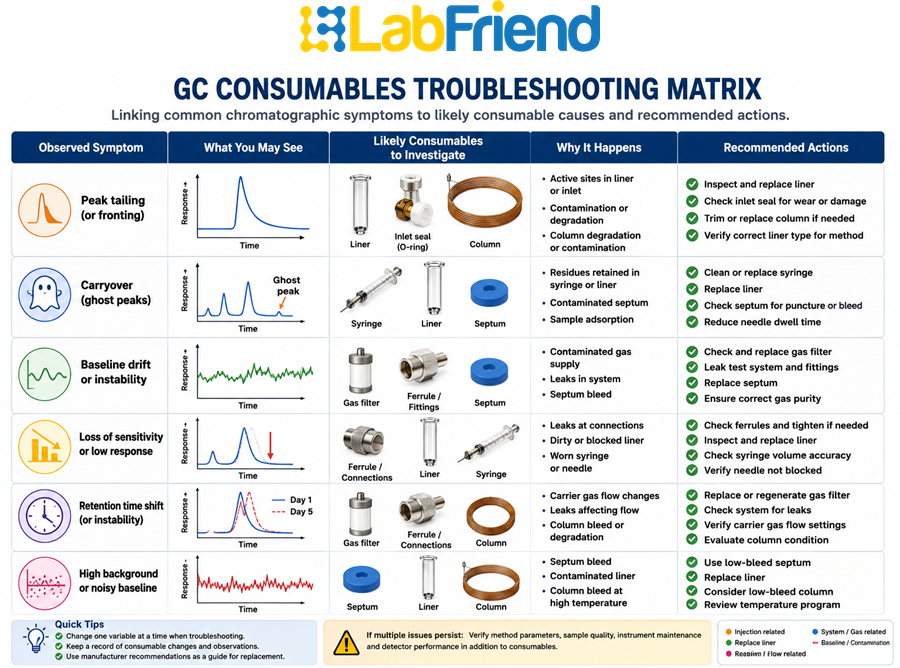
GC consumables sit directly in the sample introduction, gas flow and separation pathway. A worn syringe can affect injection volume. A contaminated liner can contribute carryover or ghost peaks. A leaking ferrule can reduce system integrity. A saturated or overdue gas filter can compromise gas quality. A changed column specification can alter retention, resolution or method performance.
These issues are not always obvious immediately. A consumable problem may first look like an instrument fault, a method issue, a sample problem or an analyst technique problem. That can lead to unnecessary investigations, repeated injections and lost time.
For QA/QC teams, the commercial and operational impact matters as much as the technical issue. A failed run can delay batch release, client reporting, investigation closure or routine throughput. That is why GC consumables should be managed as controlled workflow components, not just low-value accessories.
GC inlet liners
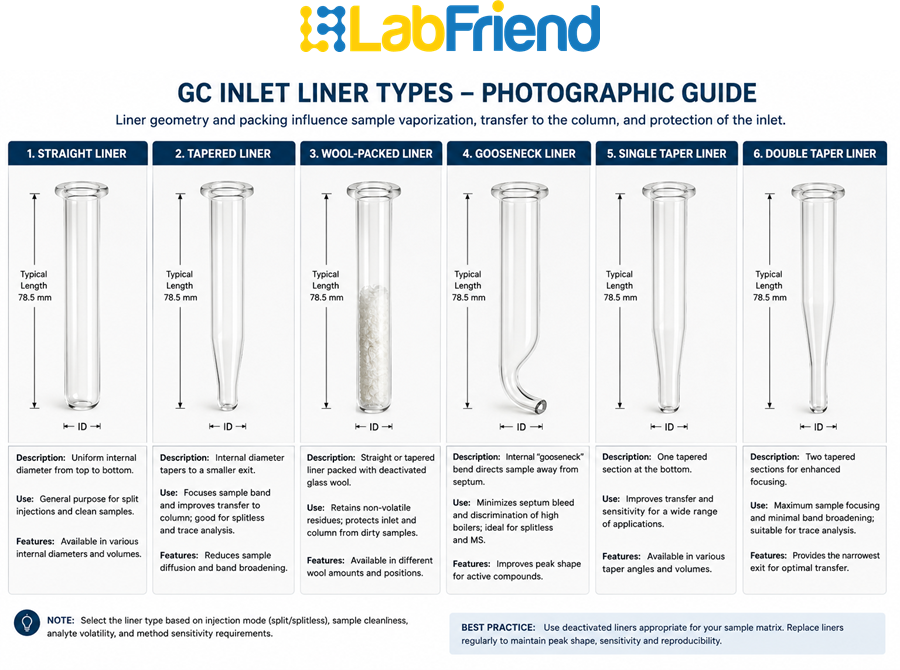
The inlet liner is one of the most important consumables in a GC system because it is where the injected sample first encounters the heated inlet environment. The liner supports sample vaporisation and helps direct the sample into the column. Its geometry, internal diameter, volume, packing and surface treatment can all influence how the injected sample behaves.
A liner that works well for one method may be unsuitable for another. Split and splitless injections, dirty samples, high-boiling compounds, trace-level work and active analytes can all place different demands on the inlet environment. Packed liners, straight liners, tapered liners, deactivated liners and application-specific designs exist because sample introduction is not a single universal process.
For QA/QC laboratories, the key is to match the liner to the method and injection mode. Changing liner type without review can affect peak shape, recovery, reproducibility, contamination behaviour or carryover. Even when two liners appear physically similar, differences in deactivation, geometry or packing can matter.
Liner deactivation (for example, silanization) reduces active sites that can adsorb or degrade reactive analytes, so the deactivation grade should be confirmed rather than assumed equivalent across suppliers. A practical liner specification should include the instrument compatibility, inlet type, liner geometry, internal diameter, packing status, deactivation status, pack size and any method restrictions. If a method is validated, client-specified or contamination-sensitive, liner substitutions should be reviewed before use.
GC Ferrules
Ferrules are small compression seals fitted around the column, typically at the inlet and detector connections — small components, but central to leak control. They are used to seal connections between the GC column and inlet, detector or other fittings. A poorly selected, poorly installed or damaged ferrule can create leaks, dead volume, poor column positioning or unstable system performance.
Ferrule selection depends on the fitting, column dimensions, operating temperature and instrument setup. Common ferrule material families — including graphite, Vespel/polyimide, graphite–Vespel blends and stainless steel — differ in maximum temperature rating, reusability after venting, and chemical inertness, so material should be confirmed against the instrument's operating temperature range rather than assumed equivalent. Different ferrule materials and formats may behave differently during installation and thermal cycling. A ferrule that is suitable for one connection or temperature profile may not be the right choice elsewhere.
In practice, ferrule problems often appear indirectly. The laboratory may see poor sensitivity, unstable baseline, retention instability, oxygen ingress, carrier gas consumption issues or repeated leak checks. The ferrule itself may not be the first suspected cause, but it should be part of any GC consumables review where leaks or connection issues are possible. A documented leak check after ferrule or column installation is good practice to confirm seal integrity before samples are run.
QA/QC teams should avoid treating ferrules as generic parts. Record the approved material, size, fitting compatibility and column dimensions. Keep ferrules linked to the instrument and method where required, and avoid substitutions unless the alternative is technically suitable for the same connection.
GC Syringes
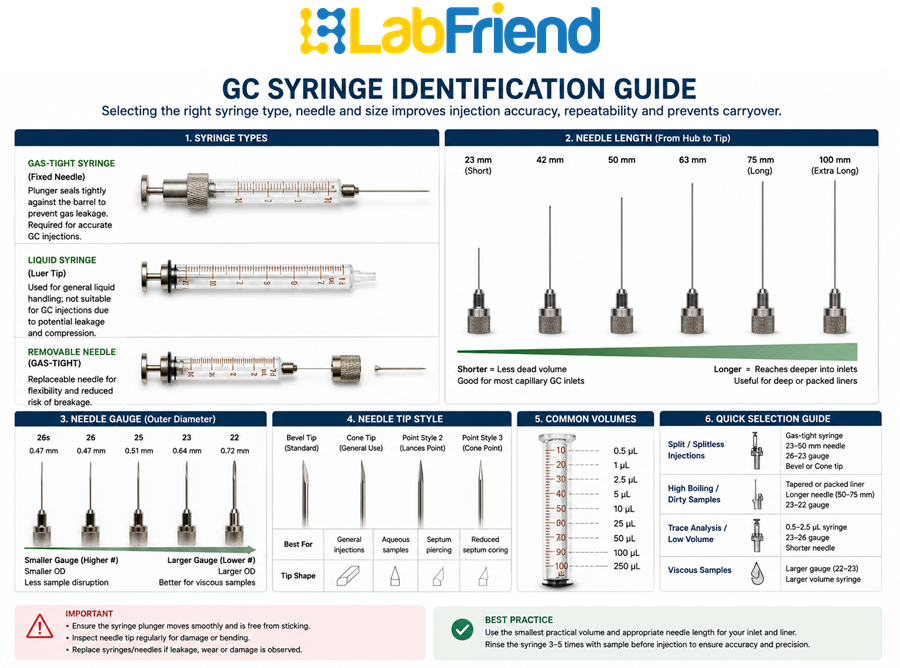
GC syringes influence how consistently the sample is introduced into the inlet. In manual injection, analyst technique is a major variable. In autosampler workflows, syringe condition, size, needle style and compatibility still matter.
The correct syringe depends on the injection volume, sample type, autosampler compatibility, inlet configuration and method requirements. Needle length, needle tip style, gauge, syringe volume and plunger design can all affect suitability. Needle tip style — for example cone tip versus side-hole/bevel tip — can influence coring risk and where the sample is deposited within the liner, and should be matched to septum type and injection technique. Gas-tight syringes may be required for some workflows, while liquid injections may use different syringe formats.
A syringe can also become a source of variability as it wears. Plunger movement, needle condition, sample carryover, blocked needles and poor washing can all affect repeatability. In routine QA/QC use, syringes should be specified clearly and inspected as part of the laboratory’s normal GC consumables control.
For purchasing, “10 µL GC syringe” is rarely enough information. A repeat-order specification should capture the manufacturer reference/ injector model, volume, needle type, tip style, compatibility, pack configuration and approved use. This reduces the chance of ordering a physically similar but method-unsuitable syringe.
LabFriend UK’s GC consumables category includes GC syringes alongside liners, septa and related consumables.
Gas Filters and Gas Quality
Gas quality matters in GC because the carrier gas and detector gases are part of the analytical system. Moisture, oxygen or hydrocarbons can affect system performance, column life, detector stability and baseline behaviour, depending on the method and instrument configuration.
Gas filters, traps and purifiers are used to help protect gas quality. The right configuration depends on the gas type, detector, instrument, method sensitivity and laboratory gas supply arrangement. For example, moisture and oxygen control may be particularly important for protecting columns and maintaining stable performance in some systems. Moisture traps, oxygen traps and hydrocarbon traps are typically separate, gas-specific filter types rather than a single universal filter, so the filter configuration should be matched to the specific carrier or detector gas in use.
The main risk with gas filters is neglect. Because filters often sit outside the direct sample-handling workflow, they can be forgotten until performance issues appear. In busy QA/QC laboratories, gas filters should be part of the standard GC consumables record, with replacement responsibility and reorder planning assigned clearly. Laboratories switching to hydrogen carrier gas should also review filter and leak-check requirements specific to hydrogen, given its different filtration needs and flammability.
GC Columns
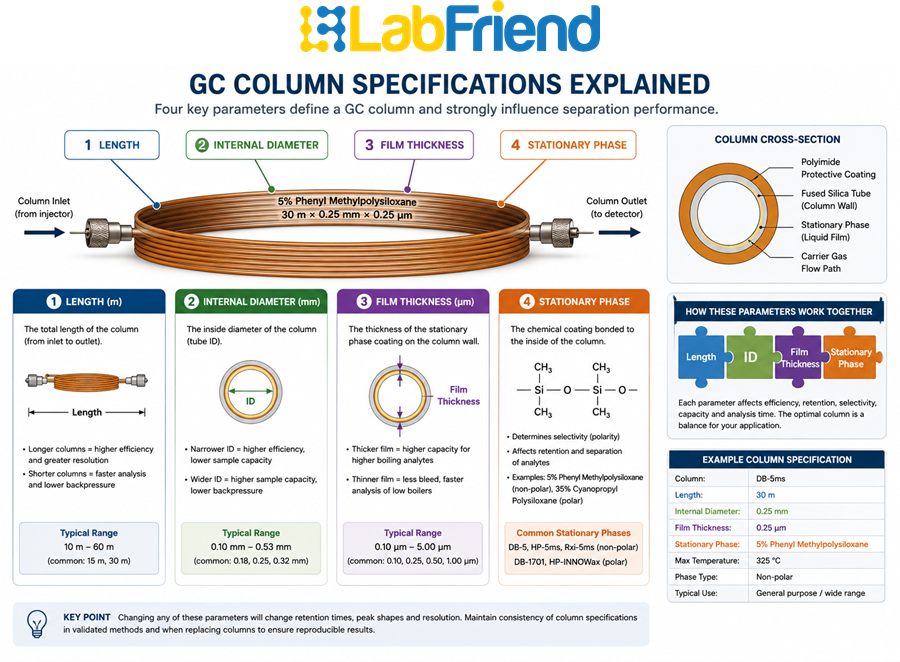
The GC column is not merely another consumable. It is the separation device. Its stationary phase, length, internal diameter, film thickness and temperature limits are method-critical. Column bleed, particularly at higher oven temperatures, can affect baseline stability and is a specific concern for MS detection, so bleed characteristics should be considered alongside phase and dimensions. Changing the column can change retention, resolution, selectivity, run time and robustness.
For QA/QC laboratories, GC columns should be controlled carefully because they often sit inside validated or semi-standardised methods. Even where a column is described as equivalent, the laboratory should consider whether the stationary phase, dimensions, film thickness and performance characteristics match the method requirements closely enough. This guide focuses on capillary columns, which are standard in modern QA/QC gas chromatography; packed columns, though less common today, have different ferrule, fitting and flow requirements.
Column selection should start with the method. What analytes are being separated? What matrix is being analysed? What temperature programme is used? What detector is fitted? What resolution or retention behaviour is required? What column dimensions are specified? What phase is required?
A good GC column purchasing record should include:
|
Column specification |
Why it matters |
|
Stationary phase |
Drives selectivity and separation behaviour |
|
Length |
Affects resolution, analysis time and pressure requirements — efficiency gains per unit length diminish as column length increases, while analysis time and pressure requirements continue to rise |
|
Internal diameter |
Influences capacity, efficiency and flow behaviour |
|
Film thickness |
Affects retention, volatility range and loading behaviour |
|
Temperature limits |
Must suit the method conditions |
|
Manufacturer reference |
Reduces ambiguity when reordering |
|
Approved alternatives |
Supports continuity where substitution is technically acceptable |
LabFriend UK provides a dedicated GC Columns category, with live listings for capillary columns and related GC column products.
Septa, Seals, O-rings and Supporting Parts
Although this guide focuses on liners, ferrules, syringes, gas filters and columns, supporting parts such as septa, seals, O-rings, column nuts and headspace consumables should not be ignored.
Septa are repeatedly pierced during injection and can contribute to leaks, coring, contamination or poor sealing if unsuitable or worn. Seals and O-rings help maintain instrument integrity in specific locations. Column nuts and fittings help support correct installation. Headspace workflows introduce additional requirements because vials, caps and septa may be heated and pressurised. Headspace vial crimp caps and septa should be specified for compatibility with the vial’s heating and pressurisation conditions, not assumed interchangeable with standard GC inlet septa. Headspace vial crimp caps removed crimp as can be crimp or screw, and possibly magnetic
For QA/QC laboratories, the right level of control depends on method sensitivity and instrument configuration. A routine method may tolerate some flexibility, while a trace-level, validated or client-specified method may require tighter control.
The practical rule is simple: any consumable that touches the sample pathway, gas pathway or method-critical connection should have an approved specification if it is used repeatedly.
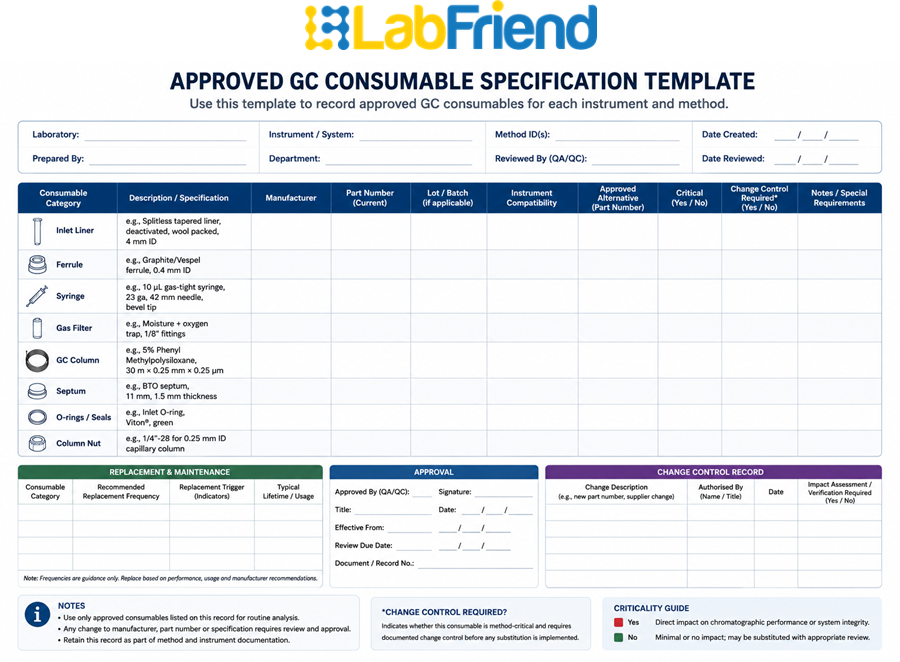
How to record approved GC consumable specifications
Specification control is where technical selection becomes operationally useful. A consumable is only easy to reorder if the laboratory has recorded enough detail for scientists, lab managers and procurement teams to buy the same item again. In regulated or audited environments, recording the supplier’s lot or batch number alongside the specification supports traceability during investigations.
For GC workflows, the reorder record should be more specific than the product family. It should capture the exact attributes that affect method suitability.
|
Consumable |
Minimum useful specification to record |
|
Liners |
Instrument compatibility, inlet type, geometry, internal diameter, packing, deactivation, manufacturer reference |
|
Ferrules |
Material, size, column compatibility, fitting type, temperature suitability where relevant |
|
Syringes |
Volume, needle length, needle gauge, tip style, gas-tight / liquid handling type, autosampler compatibility |
|
Gas filters |
Gas type, filter function, connection type, instrument/system association, replacement responsibility |
|
GC columns |
Phase, length, internal diameter, film thickness, temperature limits, manufacturer reference |
|
Septa / seals |
Material, size, inlet compatibility, temperature suitability, pack size |
The purpose of this record is not bureaucracy. It prevents purchasing errors. It also helps avoid uncontrolled substitutions when an item is out of stock, visually similar or described differently by another supplier.
For recurring GC workflows, a standard consumables list can be one of the simplest ways to protect analytical consistency and reduce avoidable ordering mistakes. New liners and columns typically require conditioning or bake-out before analytical use to remove manufacturing residues that could otherwise contribute to baseline noise or ghost peaks.
Substitution risks in GC consumables
Substitution is not always wrong. In many routine workflows, approved alternatives can help control cost, improve availability and reduce stockout risk. The problem is uncontrolled substitution.
A substitute liner may differ in geometry, packing or deactivation. A substitute ferrule may behave differently during installation or heating. A substitute syringe may have a different needle style. A substitute gas filter may not protect against the same contaminants. A substitute GC column may differ in stationary phase or dimensions even if it appears similar at first glance.
For QA/QC teams, the question is not whether alternatives are allowed. The question is who approves them, under what conditions, and how the approved alternative is documented.
Substitutions should be reviewed carefully where the method is validated, regulated, client-specified, contamination-sensitive, trace-level, or dependent on documented consistency. In these cases, the cost of a poor substitution may be higher than the saving.
Where LabFriend UK fits
LabFriend UK supports laboratories through an ecommerce-led purchasing model, access to a broad range of laboratory products, quotation support and repeat purchasing convenience. The About page describes LabFriend UK as a specialist online supplier of laboratory consumables, equipment and instruments serving organisations across the United Kingdom, with ecommerce-first procurement, quotation support and repeat purchasing convenience.
For GC workflows, this means laboratories can use LabFriend UK to source routine and repeat-use consumables such as liners, ferrules, syringes, septa, gas filters and columns, while keeping the purchasing route simple and documented.
Browse GC consumables, compare GC columns, explore wider gas chromatography products, or contact LabFriend UK for help matching repeat-use GC consumables to your workflow.
Common mistakes when buying GC consumables
The first mistake is buying GC consumables by partial description. “Liner”, “ferrule”, “syringe” or “column” is not enough. The details matter.
The second mistake is treating columns and consumables separately. A column installation depends on ferrules, fittings, nuts and correct connection technique. A method may fail not because the column is wrong, but because the supporting consumables were poorly matched or poorly installed.
The third mistake is allowing emergency substitutions without technical review. This often happens when a laboratory is under pressure to keep a method running. It may solve a short-term stock problem but create a longer-term analytical problem.
The fourth mistake is not linking GC consumables to the method or instrument. A laboratory may use several GC systems and several methods, each with different inlet, column, syringe and gas requirements. A centralised record prevents avoidable confusion.
The fifth mistake is leaving replacement planning until performance degrades. This guide is focused on selection, but replacement discipline matters. If a liner, syringe, septum, ferrule or filter is replaced only after failure, the laboratory may already have lost time and confidence in the data.
The sixth mistake is overlooking storage conditions and shelf life. Septa can degrade over time, and liners can pick up ambient contamination if stored improperly, so storage practice should be part of the consumables control programme, not an afterthought.
Conclusion: manage GC consumables as method-supporting components
GC consumables are small parts with a large effect on reliable gas chromatography. Liners, ferrules, syringes, gas filters and columns all influence how consistently a method performs. They can affect sample introduction, leak control, carrier gas quality, separation behaviour, contamination risk and repeatability.
For QA/QC laboratories, the best approach is method-led specification control. Start with the instrument, method, injection mode, sample matrix, carrier gas requirements and internal procedures. Then record the approved consumable specifications clearly enough that the same products can be reordered without ambiguity.
The most reliable GC consumables programme is not necessarily the one with the most expensive parts. It is the one where the correct parts are selected, documented, reordered consistently and reviewed before substitution.
For wider chromatography guidance, read The Complete Guide to Chromatography Consumables for UK Laboratories. To source GC workflow products, browse GC consumables, compare GC columns, explore gas chromatography products, or contact LabFriend UK for repeat-use specification support.
Frequently Asked Questions
What are the main GC consumables laboratories should control?
The main GC consumables laboratories should control are usually inlet liners, ferrules, syringes, gas filters, GC columns, septa, seals, O-rings and column fittings. The exact list depends on the instrument configuration, injection type, detector and method.
Why are GC liners important?
GC liners support sample vaporisation and transfer through the inlet. Their geometry, volume, packing and deactivation can affect injection performance, carryover, contamination and reproducibility.
Are GC ferrules interchangeable?
Not always. Ferrules must match the column dimensions, fitting type, temperature requirements and installation method. Substitution should be reviewed where leaks, dead volume or method performance could be affected.
How do I choose a GC syringe?
Choose a GC syringe by checking injection volume, needle length, needle gauge, tip style, plunger type, autosampler compatibility and sample type. A syringe should be matched to the method and injection system, not selected by volume alone.
Why do gas filters matter in GC?
Gas filters help protect carrier and detector gas quality by controlling contaminants such as moisture, oxygen or hydrocarbons, depending on the filter type. Poor gas quality can affect system stability, column life and analytical performance.
What information should be recorded for GC columns?
A GC column specification should record stationary phase, length, internal diameter, film thickness, temperature limits, manufacturer reference and approved alternatives. These details are method-critical.
Can GC consumables be substituted for alternatives?
Sometimes, but not blindly. Substitution may be acceptable where the specification is matched and the method allows it. Validated, client-specified, contamination-sensitive or trace-level methods may require technical review before substitution.
Where can UK laboratories buy GC consumables?
LabFriend UK supplies GC consumables, GC columns and wider gas chromatography products through its online catalogue. Laboratories can browse the relevant categories or contact LabFriend UK for help matching repeat-use GC consumables.
How often should GC consumables be replaced or inspected?
There is no single universal interval. Replacement and inspection frequency should follow manufacturer guidance, method requirements and observed performance indicators such as leaks, baseline drift or carryover. Liners, septa and ferrules typically need more frequent inspection than columns.
Read More Block
Read more from LabFriend UK
- The Complete Guide to Chromatography Consumables for UK Laboratories
- Browse GC Consumables
- Browse GC Columns
- Browse Gas Chromatography Products
- Browse Chromatography Products
Written by: Donal O’Sullivan, BSc, Co-Founder and Sales Director, LabFriend UK. Donal brings deep chemistry-led technical expertise across analytical chemistry, biochemistry, environmental monitoring, laboratory instrumentation, consumables and scientific product selection.
Reviewed by: Michael Anderson, MBA, Founder and Managing Director, LabFriend UK. Michael reviews LabFriend UK content for customer relevance, commercial accuracy, operational practicality and alignment with LabFriend UK’s laboratory supply model.
Related Stories

The Complete Guide to Chromatography Consumables for UK Laboratories
The Complete Guide to Chromatography Consumables for UK Laboratories

HPLC Sample Preparation Consumables - Filters Vials Syringes and Solvent Handling
HPLC Sample Preparation Consumables - Filters Vials Syringes and Solvent Handling

HPLC Sample Preparation Consumables for CROs and High-Throughput Testing Laboratories
HPLC Sample Preparation Consumables for CROs and High-Throughput Testing Laboratories

0.22µm vs 0.45µm Filters for HPLC and UHPLC Sample Preparation
0.22µm vs 0.45µm Filters for HPLC and UHPLC Sample Preparation