Pipetting Technique Errors That Affect Laboratory Reproducibility
24 mins read
Pipetting Technique Errors That Affect Laboratory Reproducibility

By Donal O’Sullivan, BSc. Reviewed by Michael Anderson, MBA.
A calibrated pipette does not, by itself, make a liquid-handling method reproducible.
Two researchers can use the same pipette, set the same
volume and follow the same written protocol yet perform the transfer
differently. Differences in aspiration, pipette position, tip immersion, timing
and dispensing technique can become part of the experimental variation when
those elements matter to the transfer but are not sufficiently controlled.
This is particularly relevant in university and research
laboratories, where methods routinely move between PhD students, postdoctoral
researchers, research assistants, technicians and collaborating groups.
A protocol may be highly specific about reagent
concentrations, incubation times and instrument settings while describing an
important liquid-handling step with little more than:
“Pipette 10 µL.”
The volume is defined. The technique may not be.
Reproducible pipetting therefore does not mean prescribing
every movement an operator makes. It means identifying the aspects of technique
that materially influence a particular transfer and ensuring that those
elements are performed consistently between researchers.
If the source of inconsistent pipetting performance has not
yet been established, begin with Common Causes of Pipetting Error in Laboratory Liquid Handling. That broader
troubleshooting framework considers the complete liquid-handling system,
including the pipette, tip, liquid, operator, environment and method.
This article addresses a more specific question:
What should a research group standardise when operator
technique itself is contributing to variability?
Why Can Two Competent Researchers Obtain Different
Pipetting Results?
Manual pipetting is an interaction between an instrument and
an operator.
The pipette controls important mechanical elements of the
transfer, but the researcher controls how the instrument is positioned and
operated. Two nominally identical transfers are therefore not necessarily
performed under identical conditions.
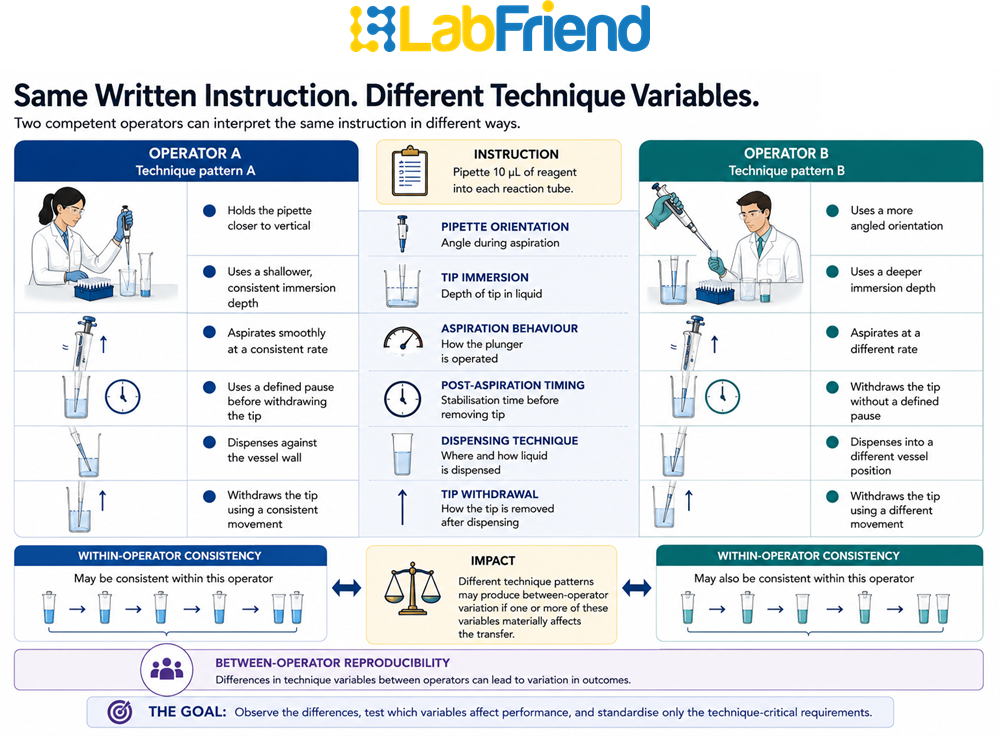
One researcher may aspirate with the pipette close to
vertical, maintain a consistent relationship between the tip and liquid surface
and operate the plunger smoothly.
Another equally competent researcher may use a different
orientation, immerse the tip more deeply, aspirate at a different rate or
withdraw the tip immediately after aspiration.
Both may believe they are following exactly the same
protocol.
The important question is not whether their techniques look
different. It is:
Do those differences influence the transfer sufficiently
to affect the experiment?
A researcher can develop a technique that is highly
repeatable for them personally. Another researcher may also work very
consistently, but use a slightly different technique.
The result can be good within-operator consistency
but poorer between-operator reproducibility.
This becomes particularly important when an established
method is transferred to another researcher or laboratory.
If experimental performance changes consistently with the
operator, it is reasonable to investigate technique alongside other potential
causes.
The problem does not necessarily mean that either researcher
is pipetting incorrectly. It may indicate that the method contains an unwritten
technique dependency.
For example, an experienced researcher may know from
experience to aspirate a particular solution in a certain way, pause before
withdrawing the tip or dispense into a particular position in the receiving
vessel. Those behaviours may have become habitual without ever being
documented.
When important knowledge exists only as operator experience,
the method becomes more difficult to transfer.
Good technique standardisation therefore converts relevant tacit
knowledge into reproducible method instructions.
“Pipette 10 µL” May Not Be a Complete Method Instruction
Consider a seemingly precise instruction:
Pipette 10 µL of reagent into each reaction vessel.
The numerical volume is clearly defined.
For a straightforward transfer performed by trained
researchers, that may be sufficient when normal laboratory pipetting practices
define everything else.
For a technique-sensitive transfer, however, several
important questions may remain unanswered:
- Which
pipette or operating range should be used?
- Is a
particular tip type or characteristic required?
- Does
the liquid require a defined aspiration approach?
- Is
pre-wetting part of the established procedure?
- Is
forward or reverse pipetting intended?
- Does
tip position during dispensing matter?
- Is
timing between aspiration and withdrawal important?
- Is a
defined mixing step required after dispensing?
Not every method needs to answer every question.
Adding unnecessary instructions can make an SOP more
difficult to follow without improving experimental performance.
The more useful question during method development is:
Which liquid-handling variables influence this procedure
enough that another trained researcher needs them defined?
Those are the variables that should become part of the
method.
Which Pipetting Technique Variables May Need to Be Controlled?
Operator technique contains several variables that can
differ between researchers.
Their importance depends on the pipette, volume, liquid,
vessel and experimental method. There is therefore no single detailed pipetting
technique that should automatically be imposed on every laboratory transfer.
Instead, laboratories should identify the variables that
matter to the particular method.
|
Technique variable |
Why it may matter |
Standardisation question |
|
Pipette orientation |
Can alter aspiration conditions |
Are researchers using an appropriate and sufficiently
consistent orientation? |
|
Tip immersion |
Changes the relationship between the tip and liquid |
Is tip positioning controlled sufficiently for the
transfer? |
|
Aspiration behaviour |
Different plunger operation can influence liquid uptake
and bubble formation |
Are researchers aspirating in a comparable manner
appropriate to the liquid? |
|
Liquid-level tracking |
Liquid level changes as material is removed |
Do researchers maintain suitable tip positioning as the
level changes? |
|
Timing |
Some transfers may be sensitive to the interval between
aspiration and withdrawal |
Is any required stabilisation period defined? |
|
Dispensing |
Speed, position and completion of the dispensing sequence
can influence delivery |
Does the method require a defined dispensing behaviour? |
|
Pre-wetting |
Conditioning the tip can affect some transfers |
If required, is pre-wetting performed consistently? |
|
Pipetting mode |
Forward and reverse pipetting use different
liquid-handling sequences |
Does the method specify the appropriate technique where it
matters? |
The objective is not to standardise technique simply for the
sake of uniformity.
A small difference between researchers is irrelevant if it
has no meaningful effect on the transfer.
Conversely, an apparently minor difference deserves
attention if it consistently influences experimental performance.
For detailed troubleshooting of individual pipetting
variables and other potential causes of error, see Common Causes of Pipetting Error in Laboratory Liquid Handling.
For sensitive low-volume PCR and qPCR workflows, see Troubleshooting Low-Volume Pipetting in PCR & qPCR Workflows.
How Can You Recognise Operator-Dependent Pipetting Variation?
A useful first clue is whether experimental performance
appears to follow the person performing the transfer.
Technique may warrant closer investigation when:
- one
researcher consistently obtains a different result from colleagues using
the same method;
- variability
appears after an experiment is transferred to a new researcher;
- performance
improves after an experienced researcher demonstrates the procedure;
- researchers
interpret the same written pipetting instruction differently; or
- a
method performs consistently within one research group but becomes less
consistent when transferred elsewhere.
None of these observations proves that pipetting technique
is responsible.
Similar patterns can result from differences in reagents,
equipment, consumables, sample preparation, environmental conditions or other
parts of the experimental process.
Operator dependence should therefore be treated as a clue
rather than a diagnosis.
Where practical, compare the relevant liquid-handling step
while keeping other important variables as consistent as possible.
Observe how researchers perform the transfer.
Are there systematic differences in pipette orientation, tip
immersion, aspiration, timing, dispensing position or pipetting mode?
The objective is not to decide whose technique looks more
correct.
It is to establish whether a technique difference
corresponds with a measurable difference in performance.
Reproducibility Does Not Require Every Movement to Be Identical
It is possible to take standardisation too far.
Researchers do not need to move their hands in precisely the
same way to achieve reproducible liquid handling.
A method only needs to control those aspects of technique
that materially influence the required result.
For one transfer, aspiration behaviour may be important
while small differences in dispensing position have no measurable consequence.
For another, liquid properties may make aspiration timing,
pre-wetting or the chosen pipetting mode considerably more important.
This distinction prevents SOPs from becoming unnecessarily
prescriptive.
A useful test is:
If two trained researchers follow this instruction
independently, does it define the important parts of the liquid transfer
clearly enough for both to reproduce it?
If not, the method may be relying on undocumented operator
knowledge.
What Should a Pipetting SOP Specify?
Strong laboratory procedures distinguish between general
pipetting competence and method-specific technique requirements.
Researchers do not need every experimental method to explain
how to operate a micropipette from first principles.
General technique can be addressed through laboratory
training, pipette manufacturer instructions and overarching laboratory
procedures.
The experimental method should then define additional
requirements where the particular transfer depends on them.
|
Area |
Possible method-specific question |
Include when |
|
Pipette selection |
Is a particular pipette or volume range required? |
Performance depends on instrument or operating range |
|
Tip selection |
Is a defined tip characteristic required? |
Compatibility, contamination control or retention matters |
|
Aspiration |
Is a particular technique important? |
Liquid or volume is sensitive to handling |
|
Pre-wetting |
Is a defined procedure required? |
It has been demonstrated or specified to matter |
|
Pipetting mode |
Forward or reverse? |
Technique selection affects the transfer |
|
Dispensing |
Is position or sequence important? |
Recovery or mixing depends on it |
|
Timing |
Is a pause or defined sequence required? |
Timing affects transfer behaviour |
|
Mixing |
Is post-transfer mixing defined? |
Homogeneity affects downstream performance |
This framework should not be copied wholesale into every
method.
Instead, use it to identify where operator discretion
needs to become method definition.
Training Researchers: Demonstrate the Method, Not Just the Pipette
Teaching someone how a pipette operates is not necessarily
the same as training them to reproduce an established experimental method.
A new PhD student, research assistant or technician may
already know how to select a volume, attach a tip and operate a pipette.
What they may not know are the technique-critical details
specific to a particular workflow.
Method transfer can therefore benefit from practical
demonstration.
An experienced researcher can perform the relevant transfer
while explaining why particular steps are controlled. The trainee can then
repeat the procedure under observation, allowing differences to be identified
before they become established habits.
This is particularly useful where written instructions rely
on words such as:
slowly, carefully, briefly or gently.
Those terms can mean different things to different people.
If the behaviour matters to experimental performance, the
instruction may need to be more clearly defined or demonstrated.
Training should also explain why the technique
matters.
A researcher who understands why a particular aspiration
behaviour is important for a particular transfer is better equipped to
recognise when the same principle may apply elsewhere than someone who has
simply memorised a sequence of hand movements.
How Should You Compare Pipetting Technique Between Researchers?
When operator-dependent variation is suspected, comparison
should be structured rather than anecdotal.
Start with a defined transfer or workflow and minimise
unrelated differences as far as practical.
Then observe the technique-critical stages.
A comparison may include:
- pipette
and volume selection;
- tip
selection and loading;
- pipette
orientation;
- immersion
behaviour;
- aspiration
and plunger operation;
- timing
before tip withdrawal;
- visible
bubble formation;
- dispensing
position and sequence; and
- any
pre-wetting or alternative pipetting technique being used.
Look for systematic differences, not occasional
imperfections.
If Researcher A consistently performs a particular step
differently from Researcher B, and experimental performance also differs
consistently, that variable may warrant controlled investigation.
The purpose is not to score researchers against one another.
It is to determine whether different interpretations of the
method produce different outcomes.
Test Technique Differences Before Adding Them to the SOP
Observation can identify a possible technique difference,
but it does not establish that the difference matters.
Suppose one researcher routinely pauses after aspiration and
another withdraws the tip immediately.
The laboratory should not automatically conclude:
“Everyone must now pause after aspiration.”
Where practical, test whether that difference actually
affects the relevant transfer.
This principle prevents SOPs from accumulating rules based
primarily on individual preference.
A useful sequence is:
Observation → controlled comparison → performance
evidence → method definition
Depending on the application and laboratory requirements,
verification might involve repeatability checks, an appropriate gravimetric
assessment, comparison of downstream experimental variability or another
suitable performance measure.
The exact verification approach will depend on the workflow.
The principle remains the same:
A technique should become a method requirement because it
contributes to the required performance, not simply because one experienced
researcher prefers it.
A Practical Framework for Standardising Pipetting Technique
When pipetting technique is suspected of contributing to reproducibility problems, research groups can use six steps.
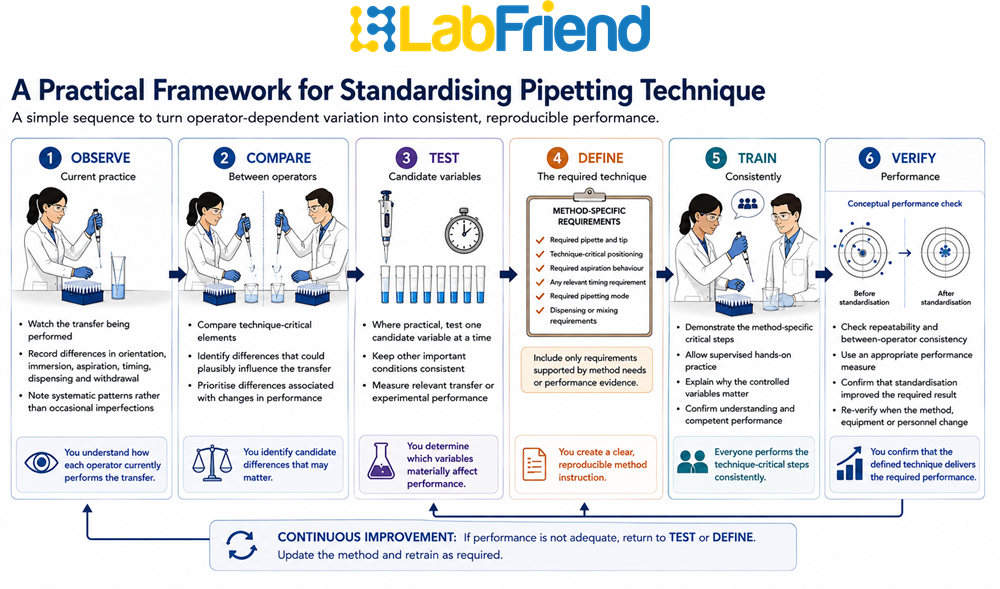
1. Observe
Watch how researchers actually perform the transfer rather
than assuming everyone interprets the method identically.
2. Compare
Identify systematic differences between operators that could
plausibly influence liquid handling.
3. Test
Investigate important candidate variables individually where
practical rather than changing several elements simultaneously.
4. Define
Identify the technique-critical elements that demonstrably
or justifiably matter to the method and document them clearly.
5. Train
Demonstrate the established technique and ensure researchers
understand both what is required and why.
6. Verify
Confirm that the standardised method provides the required
repeatability or experimental performance.
This approach shifts the discussion away from:
“Who is pipetting incorrectly?”
and towards the more useful question:
“What does this method require us to control?”
Frequently Asked Questions
Can pipetting technique affect experimental
reproducibility?
Yes. If researchers differ in technique variables that
materially affect a transfer, those differences can contribute to
operator-dependent experimental variation. Relevant variables can include
aspiration behaviour, pipette positioning, tip immersion, timing and
dispensing. Reproducibility can improve when technique-critical variables are
identified and standardised.
Why do different researchers get different pipetting
results?
Technique is one possible cause, but differences can also
arise from equipment, consumables, liquids, environmental conditions and other
parts of the experimental method. If results consistently follow the operator,
compare how researchers perform the technique-critical liquid-handling steps
while investigating other plausible causes.
Does pipette angle affect reproducibility?
Pipette orientation can influence aspiration conditions,
particularly with air-displacement pipettes. Researchers should follow
applicable manufacturer and method guidance. From a reproducibility
perspective, the important question is whether operators are using materially
different orientations for a transfer where orientation affects performance.
Should pipette tips always be pre-wetted?
No. Pre-wetting can be useful in appropriate workflows, but
it should not become a universal ritual. If pre-wetting is important to a
particular method, the procedure should define it sufficiently so that
researchers perform it consistently.
What pipetting information should an SOP include?
An SOP should define the liquid-handling variables necessary
for another trained researcher to reproduce the method. Depending on the
workflow, this may include pipette or tip selection, aspiration behaviour,
pre-wetting, pipetting mode, dispensing position, timing or mixing. Detail that
has no justified relevance to method performance does not need to be added.
How can a laboratory standardise pipetting technique?
Observe how researchers currently perform the transfer,
compare operators, identify potentially important differences, test whether
those differences affect performance, define the technique-critical variables,
train researchers and verify that the resulting method provides the required
performance.
Conclusion
Reproducible manual pipetting depends on more than setting
the correct volume on a calibrated instrument.
Researchers also control how the pipette is positioned, how
the tip interacts with the liquid and how aspiration and dispensing are
performed. When those behaviours materially influence a transfer but remain
undefined, individual operator habits can become part of the experiment.
That helps explain why two competent researchers can follow
the same written protocol and still obtain different results.
The solution is not to prescribe every hand movement or
assume that one researcher's preferred technique is universally correct.
Instead:
Observe → Compare → Test → Define → Train → Verify.
Identify the technique variables that matter, demonstrate
their effect where appropriate and convert important operator knowledge into
reproducible method instructions.
For research groups, this makes methods easier to transfer
between PhD students, postdoctoral researchers, technicians, collaborators and
future members of the laboratory.
A useful principle is:
If a pipetting behaviour is necessary for the experiment
to be reproduced, it should not exist only in the experienced researcher's
hands. It should exist in the method.
Choosing Pipette Tips for Reproducible Liquid Handling
Technique should be controlled before consumables are used
as an explanation for poor reproducibility.
Once technique has been appropriately standardised,
pipette-tip selection can still matter. Tips need to be compatible with the
pipette, volume and application, while particular workflows may require
characteristics such as filtration, sterility or reduced liquid retention.
Where liquid retention is demonstrably relevant,
low-retention tips may warrant evaluation. They should not, however, be treated
as a way to compensate for inconsistent aspiration or dispensing.
Researchers can browse LabFriend pipette tips to compare
options for routine and more demanding liquid-handling workflows.
Read More
For broader troubleshooting, see Common Causes of
Pipetting Error in Laboratory Liquid Handling.
For sensitive low-volume workflows, see Troubleshooting
Low-Volume Pipetting in PCR & qPCR Workflows.
For wider guidance on pipettes, pipette tips, liquids and
technique, see The Complete Guide to Pipette Tips, Pipetting Accuracy &
Laboratory Liquid Handling.
Written by: Donal O’Sullivan, BSc, Co-Founder and Sales Director, LabFriend UK. Donal brings deep chemistry-led technical expertise across analytical chemistry, biochemistry, environmental monitoring, laboratory instrumentation, consumables and scientific product selection.
Reviewed by: Michael Anderson, MBA, Founder and Managing Director, LabFriend UK. Michael reviews LabFriend UK content for customer relevance, commercial accuracy, operational practicality and alignment with LabFriend UK’s laboratory supply model.
Frequently asked questions
Delivery times vary by product and supplier. Each product page shows current stock levels and the expected lead time, and we confirm this when you place your order. Most items arrive within 2 to 3 weeks. Specialised items can take longer if they are not in stock. If you need something by a certain date, contact us and we’ll check for you.
Yes. Register for a commercial account and, once it’s approved, you will be able to process orders via PO Once you have a commercial account, you can directly email your purchase orders
Add products to your cart and click Get a Quote. You’ll get a formal quote instantly, ready to send to your email address. For bulk orders or custom requirements, send us your product list and we’ll reply with itemized pricing.
If your item is faulty, not as described or sent in error, let us know within 14 days of delivery and we’ll arrange a return. Change of mind returns are only accepted if the item is unused and in its original packaging. A restocking fee will apply and you pay the return freight. Read our full Returns Policy for details.
Yes, prices are shown including VAT by default. Use the Prices Inc. VAT toggle at the top of the page to view prices without VAT.