Low-Retention Pipette Tips for Protein and Enzyme Workflows
18 mins read
Low-Retention Pipette Tips for Protein and Enzyme Workflows
By Donal O’Sullivan, BSc. Reviewed by Michael Anderson, MBA.
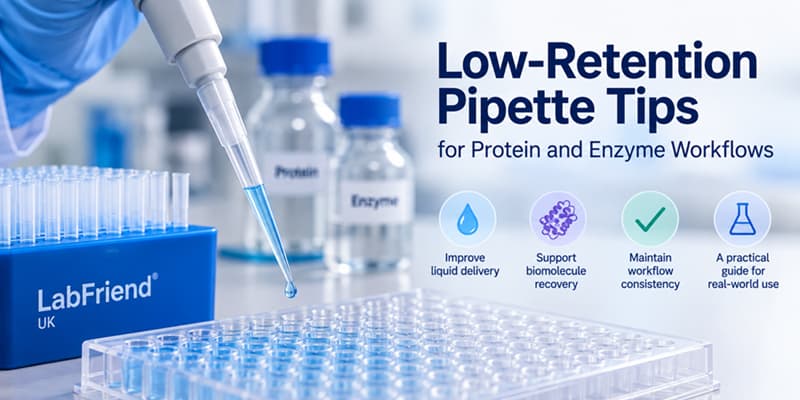
Handling proteins and enzymes can make small liquid losses more important, particularly when samples are limited, reagents are expensive or transfer volumes are low. Low-retention pipette tips can help reduce liquid left behind on the internal tip surface, but low retention is not the same as low protein binding.
For protein and enzyme workflows, the right question is
therefore not simply whether a tip is labelled “low retention”. Laboratories
should consider what is causing sample loss, what performance the manufacturer
actually supports, and whether the candidate tip performs acceptably with the
real workflow.
Key Takeaways
- Low-retention
pipette tips are designed to reduce liquid remaining on the internal tip
surface after dispensing. They can be worth evaluating when residual
liquid is significant relative to the transfer volume or sample value.
- Low
retention and low protein binding describe different performance
characteristics. A low-retention claim does not by itself demonstrate
reduced adsorption of proteins, peptides or enzymes.
- Protein
and enzyme behaviour can vary with the biomolecule, concentration,
formulation, additives and handling conditions. A tip that performs well
in one workflow should not automatically be assumed suitable for another.
- Check
the complete tip specification, including pipette fit, working volume,
contamination-control requirements and any relevant manufacturer evidence.
Do not select on a low-retention label alone.
- Where
recovery is important, a practical comparison using the laboratory's
actual or representative workflow can provide stronger evidence than
relying only on a general product claim.
Why Can Pipette Tip Choice Matter for Proteins and
Enzymes?
Every liquid transfer leaves some potential for material to
remain behind. Part of this may be liquid retained on the internal surface of
the pipette tip. With proteins and enzymes, there can also be interactions
between the biomolecule and surfaces it contacts.
Liquid retention is influenced not only by the presence of a
protein or enzyme but also by the physical properties of the complete
formulation. Components such as detergents can reduce surface tension and
promote wetting of conventional polypropylene tip surfaces, while viscosity can
also affect liquid-handling performance. The benefit of a low-retention tip
should therefore be assessed against the complete formulation rather than
inferred simply from the presence of a biomolecule.

These are related practical concerns, but they are not the
same phenomenon.
For routine transfers where the amount left behind is
insignificant relative to the working volume and the requirements of the
method, conventional tips may perform perfectly well. The case for evaluating a
specialist tip becomes stronger when small losses could matter — for example,
when handling limited samples, valuable reagents or low transfer volumes.
The consequences also depend on the workflow. Losing a small
amount of an inexpensive bulk reagent is different from losing the same
proportion of a scarce protein preparation or enzyme solution.
That is why tip selection should begin with the application
rather than the product label.
Low Retention and Low Protein Binding Are Not the Same
Thing
This is the most important distinction when selecting
pipette tips for protein and enzyme work.
Low-retention performance concerns the tendency of a
liquid to wet and remain on the internal tip surface during liquid handling.
Low-retention tips are designed to reduce this wetting and the resulting
residual liquid, which can improve liquid delivery where retention on the tip
surface is a significant source of transfer loss.
Protein binding or adsorption concerns interactions
between biomolecules and the material or surface they contact.
A product described as low retention should therefore not
automatically be interpreted as a low-protein-binding tip.

The distinction matters because an apparently cleaner
dispense does not establish how much of a particular protein or enzyme may have
interacted with the surface. Protein adsorption can depend on factors including
the particular biomolecule, its concentration, formulation and the conditions
under which it is handled.
If protein adsorption is a material concern in your
workflow, look for evidence relevant to that characteristic rather than assuming
that a general low-retention claim covers it.
For a broader explanation of when low-retention tips are
useful across laboratory applications, see when laboratories should use low-retention pipette tips.
When Are Low-Retention Tips Worth Evaluating?
There is no useful rule that says every protein or enzyme
workflow requires low-retention tips.
Instead, consider whether residual liquid is likely to be
material to the work being performed.
Low-retention tips may warrant evaluation where:
- residual
liquid represents a meaningful proportion of the volume being handled;
- the
formulation contains components, such as detergents, that promote wetting
of conventional tip surfaces;
- proteins,
enzymes or other reagents are expensive, limited or difficult to replace;
- visible
or measured liquid retention is occurring with the current tips;
- repeated
transfers make small individual losses operationally significant;
- consistency
of transferred material is important to a controlled laboratory workflow.
The decision should still be proportional. If the existing
tip performs acceptably and residual liquid is not materially affecting the
workflow, changing consumables simply because a low-retention version exists
may add cost or complexity without a demonstrated benefit.
Start by Identifying the Problem You Are Trying to Solve
Before changing tips, define the concern.
Is liquid visibly remaining in the tip after dispensing?
Is recovery lower than expected?
Is the concern specifically adsorption of a protein or
enzyme?
Are results varying between transfers?
Or is the laboratory trying to reduce the amount of an
expensive reagent left behind during routine handling?
These questions lead to different investigations.
For example, visible liquid remaining on the tip wall may
justify evaluating low-retention performance. Suspected protein adsorption
requires evidence relevant to protein binding or a suitable recovery
assessment. Inconsistent transfer results could also have causes unrelated to
surface retention, including pipetting technique, pipette condition, tip fit or
the physical properties of the liquid.
Avoid using a specialist consumable as a substitute for
identifying the underlying problem.
What Should You Check When Choosing a Tip?
A low-retention claim is only one part of the specification.
1. Evidence for the Performance You Need
Check what the manufacturer actually claims and, where
available, how that performance has been assessed.
If your concern is residual liquid, evidence relating to
low-retention performance is relevant.
If your concern is protein or enzyme adsorption, look
specifically for evidence relevant to biomolecule binding or recovery. Do not
infer this from terminology such as “low retention” alone.
Be cautious when comparing claims from different
manufacturers. Similar terminology does not necessarily mean that products have
been evaluated using identical test methods or conditions.
2. Pipette Fit and Functional Compatibility
A specialist surface does not compensate for poor
pipette-tip fit.
The tip must form an appropriate seal with the pipette and
function correctly across the intended working range. Poor fit can introduce
its own liquid-handling problems and undermine the reason for selecting a
specialist tip in the first place.
Where compatibility is important, use manufacturer
information or appropriate laboratory evaluation rather than assuming that
physical attachment alone establishes acceptable performance.
3. Working Volume
Select a tip and pipette appropriate to the volume being
transferred.
At low transfer volumes, even small absolute losses can
represent a meaningful proportion of the intended delivery. However, the extent
of liquid retained in a tip also depends on the properties of the liquid and
its interaction with the tip surface, so volume alone does not predict the
benefit of a low-retention tip.
The pipette, tip, liquid and working volume should therefore
be considered as a system rather than selecting the tip characteristic in
isolation.
4. Contamination-Control Requirements
Low-retention performance does not automatically tell you
whether a tip is sterile, filtered or suitable for a particular
contamination-control requirement.
Determine those requirements separately.
A workflow may need a low-retention tip and an aerosol
barrier, for example, but the need for one does not establish the need for the
other. Similarly, sterility or specified purity characteristics should be
confirmed from the relevant product documentation rather than inferred from the
low-retention designation.
5. Workflow-Specific Requirements
Consider the actual protein or enzyme preparation being
handled.
Relevant factors may include:
- transfer
volume;
- biomolecule
and concentration;
- formulation
and additives;
- number
and frequency of transfers;
- value
or availability of the sample or reagent;
- consequences
of unacceptable recovery;
- downstream
sensitivity to the transfer process.
This prevents the purchasing decision becoming a generic
specification exercise detached from the laboratory method.
A Practical Selection Framework
A useful way to approach the decision is to match the
observed concern to the characteristic that needs investigation.

The important point is that the problem determines the
specification. “Low retention” should not become a catch-all description
for every performance requirement associated with protein and enzyme handling.
Should You Test Low-Retention Tips Before Standardising
Them?
Where the consequences of changing consumables are material,
a controlled comparison is sensible.
The aim does not have to be an elaborate validation
exercise. The level of evaluation should reflect the importance and risk of the
workflow.
A practical assessment could compare the existing tip with a
candidate low-retention tip using the actual workflow or a suitably
representative system.
Define What You Are Comparing
Keep the comparison focused on the performance that matters.
Depending on the application, that might include:
- consistency
of delivered volume;
- observable
residual liquid;
- gravimetric
or other appropriate assessment of liquid delivery, where volume-transfer
performance is the concern;
- an
appropriate protein-, enzyme- or activity-based recovery measurement,
where biomolecule recovery is the concern;
- repeatability
across representative transfers;
- practical
pipette fit and handling.
For enzymes, define recovery according to the purpose of the
workflow. Measuring recovered protein concentration does not necessarily
establish preservation of enzyme activity, because loss of activity can occur
without an equivalent loss of measurable protein. Where functional enzyme
recovery is important, an appropriate activity measurement may therefore be
more informative than protein concentration alone.
Do not interpret one observation as proof of an unrelated
characteristic. For example, reduced visible liquid does not by itself
demonstrate reduced protein adsorption.

Use Representative Conditions
Where practical, test under conditions that resemble routine
use.
A result obtained with a different liquid, concentration or
volume may not represent the actual protein or enzyme workflow. This is
particularly important where biomolecule behaviour rather than simply liquid
wetting is the concern.
Compare Like with Like
Avoid changing several variables simultaneously.
If the laboratory changes pipette, tip, technique and sample
preparation at the same time, it becomes difficult to determine what caused any
difference observed.
A controlled comparison should isolate the consumable change
as far as reasonably practical.
Use the same pipetting procedure for each tip being
compared, including aspiration and dispense settings or technique, pre-wetting
where applicable, immersion depth, aspiration and dispense speed, and any
blow-out or touch-off step. These factors can affect delivered volume and
residual liquid independently of the tip surface.
Record the Decision
For repeat workflows, document why the selected tip was
accepted.
The record need not be complicated. Depending on the
laboratory's requirements, useful information could include:
- pipette
and tip identification;
- relevant
tip specification;
- working
volume;
- representative
sample or reagent conditions;
- what
was compared;
- observed
result;
- final
purchasing specification.
This turns the decision into a repeatable purchasing
requirement rather than relying on individual preference.
Common Selection Mistakes
Assuming “Low Retention” Means “Low Protein Binding”
It does not. Treat the two characteristics separately and
look for evidence relevant to the actual concern.
Choosing on Surface Technology Alone
Different products may use different approaches to achieving
their claimed performance. The practical question is whether the finished tip
meets the requirements of your workflow, not whether a particular technology
sounds more advanced.
Ignoring Tip Fit
Surface performance cannot compensate for an unsuitable
pipette-tip interface. Fit and functional compatibility remain fundamental.
Assuming Every Protein Workflow Needs a Specialist Tip
Some workflows may gain little practical benefit from
changing. Evaluate the significance of the problem before adding a specialist
consumable to the purchasing specification.
Treating Sterility, Filtration and Low Retention as a
Package
These are separate characteristics. Specify each only when
required by the application and verify it for the product being considered.
Standardising Before Checking the Workflow
Standardisation can simplify purchasing and repeat ordering,
but only after technical suitability has been established. A single
specification should not be imposed across workflows with materially different
requirements simply for procurement convenience.
From Technical Evaluation to Repeat Purchasing
For a growing biotech laboratory, the commercial benefit of
a consumable specification comes from being able to repeat a technically sound
decision.
Once a low-retention tip has been shown to meet the
requirements of a protein or enzyme workflow, recording the specification can
make subsequent purchasing more straightforward. Scientists do not need to
reconsider the entire selection each time, and purchasing teams have a clearer
basis for reordering.
That does not mean the laboratory must standardise every
workflow on the same tip. Different pipettes, transfer volumes, contamination
controls or biomolecule-handling requirements may justify different
specifications.
The objective is controlled standardisation where the
evidence supports it.
When you are ready to compare suitable options, browse low-retention pipette tips and check the complete specification against
your application requirements.
Frequently Asked Questions
Are low-retention pipette tips the same as
low-protein-binding tips?
No. Low-retention performance concerns reducing liquid
remaining on the tip surface after dispensing, while low-protein-binding
performance concerns interactions between proteins and the surface. A
low-retention claim alone does not demonstrate reduced protein adsorption, so
check evidence relevant to the characteristic your workflow requires.
Do all protein and enzyme workflows need low-retention
pipette tips?
No. Low-retention tips are worth evaluating when residual
liquid could materially affect the transfer or when the formulation promotes
wetting of conventional tip surfaces. Factors such as sample or reagent value,
transfer conditions and the properties of the complete formulation should
inform the decision. If conventional tips already provide acceptable
performance, changing to a specialist tip may offer no meaningful workflow
benefit.
Can low-retention tips improve protein recovery?
Low-retention tips can reduce liquid retained on the tip
surface, but this does not establish improved protein recovery in every
workflow. Protein recovery can also be affected by adsorption and other
workflow factors. Where recovery matters, use relevant product evidence or
compare candidate tips under representative conditions rather than assuming
that low-retention performance also demonstrates low protein binding.
Should low-retention tips be tested before routine use?
Low-retention tips should be evaluated under representative
conditions where changing the consumable could materially affect the workflow.
A proportionate comparison can determine whether a candidate tip provides a
useful benefit while meeting requirements for fit, liquid delivery and any
relevant protein-, enzyme- or activity-based recovery measure. Keep the
pipetting procedure consistent between tips so that technique does not confound
the comparison.
Are low-retention tips automatically sterile or filtered?
No. Low retention, sterility and filtration are separate
product characteristics. If a workflow requires sterile tips, aerosol barriers
or particular purity specifications, verify those requirements independently
for the exact product being considered.
Read More
- When Should Laboratories Use Low-Retention Pipette Tips?
- The Complete Guide to Pipette Tips, Pipetting Accuracy & Laboratory Liquid Handling
Explore More
Written by: Donal O’Sullivan, BSc, Co-Founder and Sales Director, LabFriend UK. Donal brings deep chemistry-led technical expertise across analytical chemistry, biochemistry, environmental monitoring, laboratory instrumentation, consumables and scientific product selection.
Reviewed by: Michael Anderson, MBA, Founder and Managing Director, LabFriend UK. Michael reviews LabFriend UK content for customer relevance, commercial accuracy, operational practicality and alignment with LabFriend UK’s laboratory supply model.
Frequently asked questions
Delivery times vary by product and supplier. Each product page shows current stock levels and the expected lead time, and we confirm this when you place your order. Most items arrive within 2 to 3 weeks. Specialised items can take longer if they are not in stock. If you need something by a certain date, contact us and we’ll check for you.
Yes. Register for a commercial account and, once it’s approved, you will be able to process orders via PO Once you have a commercial account, you can directly email your purchase orders
Add products to your cart and click Get a Quote. You’ll get a formal quote instantly, ready to send to your email address. For bulk orders or custom requirements, send us your product list and we’ll reply with itemized pricing.
If your item is faulty, not as described or sent in error, let us know within 14 days of delivery and we’ll arrange a return. Change of mind returns are only accepted if the item is unused and in its original packaging. A restocking fee will apply and you pay the return freight. Read our full Returns Policy for details.
Yes, prices are shown including VAT by default. Use the Prices Inc. VAT toggle at the top of the page to view prices without VAT.