

Share :
GC Troubleshooting Guide: How Consumables Affect Leaks, Carryover, Ghost Peaks and Poor Reproducibility
Updated On 08/17/2026

By Donal O’Sullivan, BSc. Reviewed by Michael Anderson, MBA.
Gas chromatography troubleshooting often starts with the instrument, method or sample. That is understandable. When a GC run shows ghost peaks, carryover, leaks, poor reproducibility, poor peak shape or baseline instability, the first instinct is usually to check the method conditions, instrument status or sample preparation process.
But GC consumables should not be overlooked. Liners, septa, ferrules, syringes, gas filters and columns all sit close to the sample pathway, gas pathway or separation process. If they are contaminated, worn, mismatched, poorly installed, overused or substituted without review, they can contribute to practical GC problems that are easy to misdiagnose.
The important word is contribute. A consumable should not automatically be blamed for every GC issue. Carryover may involve the sample, syringe, inlet, liner, septum, column, wash solvent or method. A leak may involve ferrules, fittings, septa, column installation or gas-path components. Poor reproducibility may involve the syringe, autosampler, sample preparation, injection conditions, liner condition or analyst handling.
This guide explains how GC consumables can affect common troubleshooting symptoms and how laboratories can assess them in a structured way. For broader context across HPLC, UHPLC, GC, headspace, SPE, TLC and chromatography sample preparation products, read The Complete Guide to Chromatography Consumables for UK Laboratories.
LabFriend UK supplies GC consumables, GC columns, wider gas chromatography products and broader chromatography supplies for UK laboratories.
Quick answer: can GC consumables cause troubleshooting problems?
Yes. GC consumables can contribute to troubleshooting problems such as leaks, carryover, ghost peaks, poor reproducibility, poor peak shape, baseline instability and loss of sensitivity.
The most common consumable areas to check are:
|
Symptom |
Consumables that may be involved |
|
Ghost peaks |
Liner, septum, syringe, wash solvent contact surfaces, column contamination |
|
Carryover |
Syringe, liner, septum, inlet, column, vial or sample-contact consumables |
|
Leaks |
Ferrules, septa, fittings, column connections, seals |
|
Poor reproducibility |
Syringe, liner, septum, autosampler injection consumables, vial closure |
|
Poor peak shape |
Liner, inlet consumables, septum, column, ferrules, installation |
|
Baseline instability |
Gas filters, gas quality, column bleed, leaks, contamination |
|
Loss of sensitivity |
Leaks, syringe condition, inlet contamination, column condition, gas quality |
The safest troubleshooting approach is to work from the symptom, check recent changes, inspect the most likely consumables, and document any replacement or substitution. Do not replace consumables randomly without understanding what the symptom is telling you. Readers new to GC troubleshooting may find it easiest to identify their symptom in the table above, then go directly to the matching section below rather than reading the guide start to finish.
Why GC troubleshooting should be symptom-led, not guess-led
Consumable-related GC problems can look similar to instrument or method problems. A contaminated liner may look like a sample issue. A leaking ferrule may look like poor sensitivity. A worn syringe may look like analyst variability. A saturated or overdue gas filter may appear as baseline instability. A column problem may show as peak tailing, loss of resolution or increased bleed (background signal from gradual breakdown of the column’s internal coating).
This is why troubleshooting should be structured. The laboratory should first ask what changed, when the problem started, which methods are affected, whether the issue appears in blanks or standards, and whether a consumable was recently replaced or substituted.
Running a solvent blank or system-suitability check is a standard first step in most symptom-led investigations. Comparing a blank against a standard and a sample helps confirm whether a symptom originates in the consumable pathway, the sample itself, or the method, before any consumable is replaced.
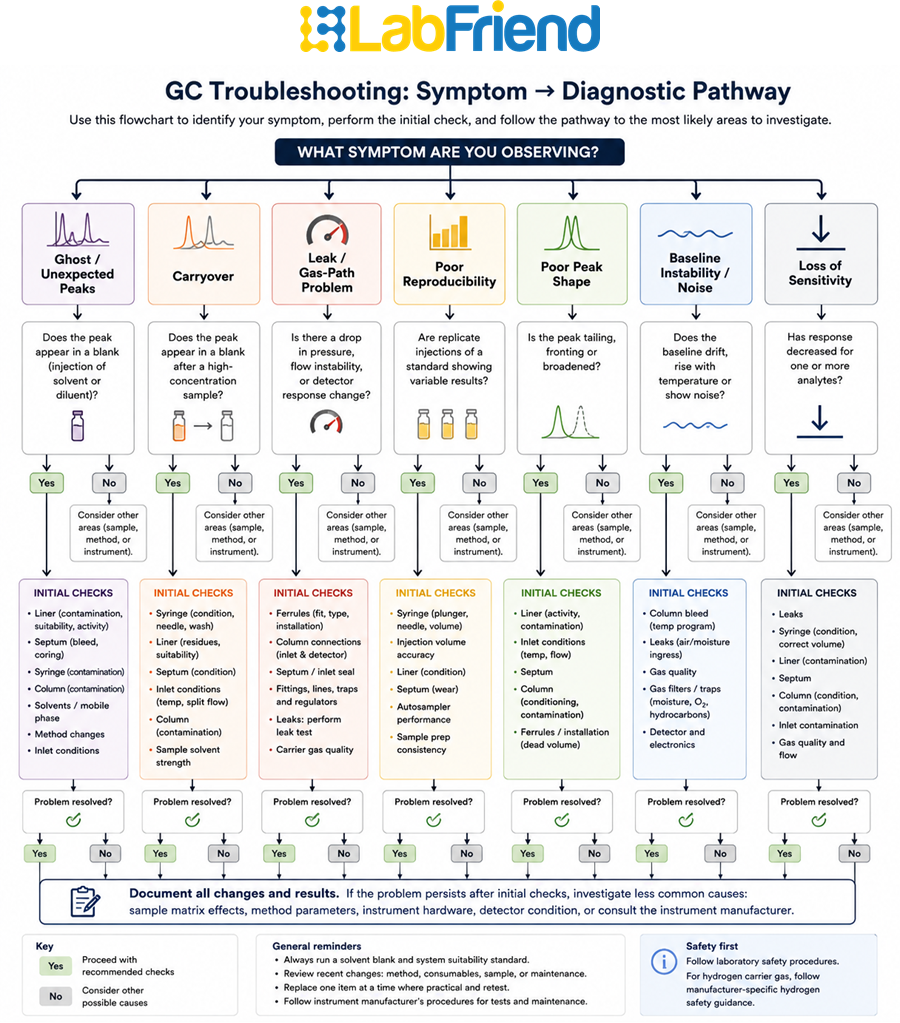
A symptom-led approach avoids two common mistakes. The first is ignoring consumables completely. The second is replacing everything at once. Replacing multiple items at the same time may get the system running, but it can hide the true cause and make future prevention harder.
For QA/QC (Quality Assurance/Quality Control) laboratories, this matters because unexplained GC problems can affect batch release, client reporting, retesting workload, analyst time and confidence in routine methods. A controlled troubleshooting process protects both data quality and laboratory efficiency.
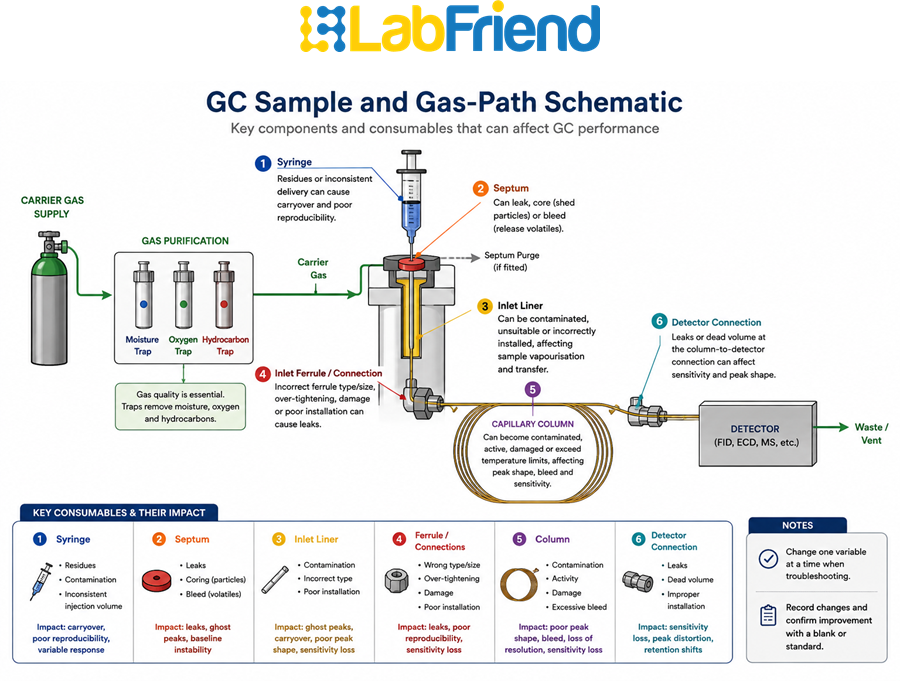
Ghost peaks and unexpected peaks
Ghost peaks are unexpected peaks that appear when they should not. They may appear in blanks, after high-concentration samples, after method changes, or during sequences where contamination is building up. Consumables are not the only possible source, but they are a practical place to investigate.
Liners — the replaceable glass tube inside the inlet through which vaporised sample passes before reaching the column — are a common area to review because they sit directly in the inlet and are exposed to sample residues, heat and repeated injections. A contaminated or unsuitable liner may contribute to unwanted peaks, especially where dirty samples, high-boiling residues or active compounds are involved.
Septa can also contribute to background or contamination where they are unsuitable, degraded, overheated or shedding material. These are two distinct mechanisms: septum coring sheds physical fragments into the inlet, while septum bleed releases volatile siloxane-type compounds that show up as chemical background — the two point to different corrective actions. Syringes may carry residues between injections if washing is inadequate or if the needle or barrel is contaminated. Columns can retain contaminants and release them later, depending on method conditions and sample history.
A useful troubleshooting question is: does the ghost peak appear in blanks after sample injections, or is it present even before sample exposure? If it appears after samples, carryover or contamination may be more likely. If it appears consistently, consumable background, solvent, gas, column or system contamination may need review.
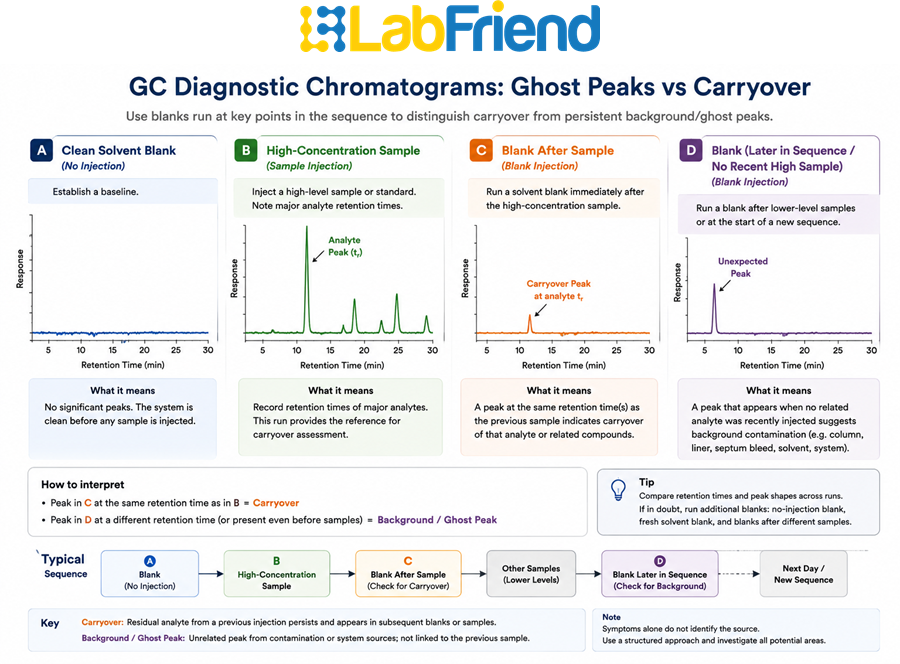
Carryover
Carryover occurs when material from a previous injection affects a later run. It is often associated with sample properties or method conditions, but consumables can contribute.
The syringe should be reviewed first in many carryover investigations. Needle contamination, poor washing, sample adsorption or a worn syringe can all affect carryover behaviour. Autosampler wash settings, wash solvent suitability and syringe condition should be checked before assuming the column is the problem. The wash solvent should be miscible with both the sample matrix and any high-boiling residues; a single wash solvent is not always sufficient, and a two-solvent wash sequence is often used to address polar and non-polar carryover sources separately.
The inlet is another key area. A dirty liner can retain residues and release them later. Septa and inlet seals may also contribute where they degrade, shed material or interact with residues. In some cases, the column may retain sample components and release them under later conditions.
Carryover troubleshooting should not become a blind replacement exercise. A better approach is to compare blanks, standards and samples, review wash conditions, inspect the liner and syringe, and check whether the issue follows a particular sample type, concentration range or method.
For repeat workflows, laboratories should record which liner, syringe and septum specifications are approved. Where carryover appears after a substitution, the consumable change should be treated as a serious clue.
Leaks and gas-path problems
Leaks are one of the most common GC troubleshooting issues, and consumables can be involved. Ferrules, septa, fittings, column nuts, seals and column installation points all deserve attention.
Ferrules are small compression seals fitted around the column, typically at the inlet and detector connections — small, but they play a major role in sealing column connections. A poorly selected, over-compressed, reused, damaged or poorly installed ferrule may contribute to leaks. The risk can increase after column changes, maintenance work or repeated connection disturbance.
Septa are another practical leak point. They are repeatedly pierced and exposed to heat. Over time, they can wear, core or fail to seal as expected. In methods with frequent injections, septum condition should be part of routine leak-related checks.
However, not every leak is a ferrule or septum issue. Gas lines, fittings, instrument connections, column installation depth and detector or inlet hardware can also be involved. That is why laboratories should use appropriate leak-check procedures and follow instrument guidance rather than relying only on visual inspection. An electronic leak detector is generally preferable to a liquid leak-check solution, particularly with hydrogen carrier gas, where flammability and the risk of liquid entering the gas path are additional concerns.
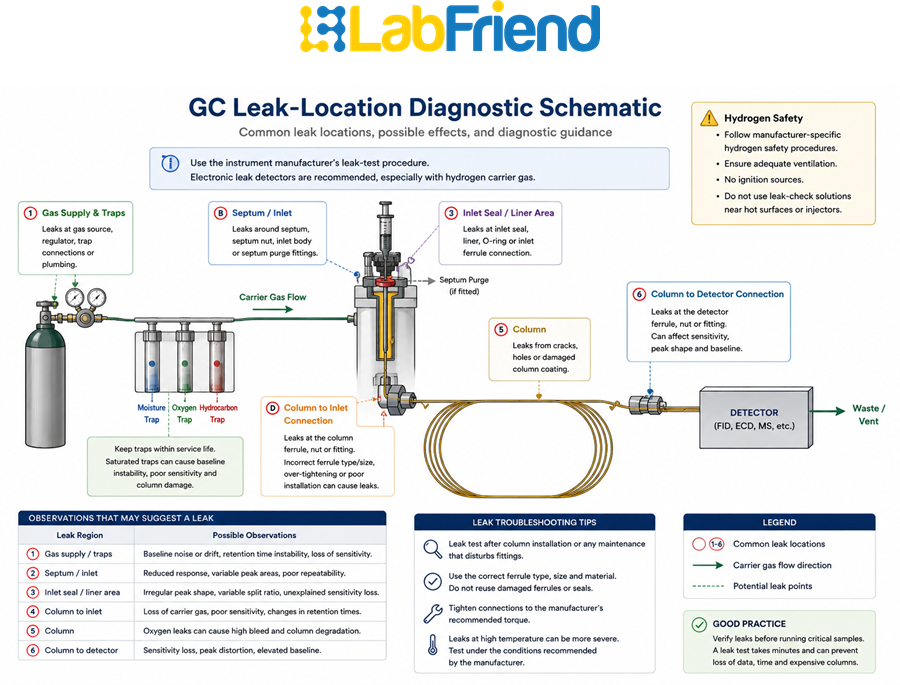
Where hydrogen is used as carrier gas, leak-related troubleshooting carries additional safety considerations. Hydrogen is flammable and diffuses faster than helium or nitrogen, so leak checks should follow the instrument manufacturer’s hydrogen-specific guidance, and any suspected leak should be treated as a priority rather than left until a convenient maintenance window.
Where leaks are recurring, the laboratory should check whether the correct ferrule size, material, fitting and column dimensions are being used. Similar-looking ferrules are not always interchangeable: graphite ferrules typically need periodic retightening as they relax under heat cycling, while graphite/polyimide blends hold torque better at high temperature but have different compression characteristics — the correct choice depends on the method’s temperature programme, not just the column outer diameter.
Poor reproducibility
Poor reproducibility is one of the most frustrating GC symptoms because it can have many causes. Consumables are often part of the investigation because they influence injection, sample transfer, sealing and inlet behaviour.
A syringe can affect reproducibility through plunger wear, needle damage, blockage, poor washing, sample residue or incorrect specification. Plunger wear typically shows up as reduced precision, with greater random variation between injections, while a partially blocked needle more often produces a consistent under-delivery of volume — a pattern that points to reduced accuracy rather than precision. In autosampler workflows, syringe compatibility and condition are especially important. A syringe that appears functional may still contribute to inconsistent injection volumes or poor sample transfer.
Liners can affect reproducibility if they are contaminated, incorrectly selected, poorly installed or unsuitable for the injection mode. Splitless injections are generally more sensitive to liner geometry and deactivation than split injections, because the sample vapour spends longer in contact with the liner surface. Septa may contribute if coring, leakage or contamination affects repeated injections. Vials and closures can also matter where sample evaporation or inconsistent sealing is possible.
The key is to separate injection reproducibility from sample and method variability. Running appropriate standards, blanks and repeat injections can help determine whether the issue is linked to the injection path, sample preparation or broader method behaviour.
When a consumable is replaced during a reproducibility investigation, the change should be recorded. If reproducibility improves, the laboratory should capture the approved specification so the same issue is less likely to recur.
Poor peak shape and tailing
Poor peak shape, fronting or tailing can be linked to many parts of the GC workflow. Consumables can contribute, but they should not be treated as the only possible cause.
The inlet liner is a frequent area to inspect. Liner geometry, contamination, deactivation, packing and suitability for the injection type may affect sample transfer and peak shape. An inadequately deactivated liner disproportionately affects active or polar analytes, such as free acids and amines, producing tailing or peak loss for those compounds while less-active analytes in the same run remain largely unaffected — a useful diagnostic clue when only some peaks are affected. A liner that is acceptable for one method may not be ideal for another.

Septa and inlet components may contribute contamination or active sites where unsuitable or degraded. Ferrules and installation issues can affect flow paths or contribute to leaks. Column condition, contamination or method mismatch may also appear as poor peak shape.
Column-related peak shape issues should be approached carefully. A column may be contaminated, damaged or unsuitable for the method, but peak shape problems can also come from injection conditions, inlet maintenance, flow settings, sample solvent effects or analyte chemistry.
For practical troubleshooting, start with recent changes. If peak shape changed after a liner, septum, ferrule or column replacement, review the specification and installation before making wider method changes.
Baseline instability and noise
Baseline instability can be especially difficult because it may involve gases, detector behaviour, contamination, leaks, column bleed, temperature conditions or method settings. Consumables can still be involved.
Gas filters and traps are worth reviewing because gas quality can affect GC performance. Moisture, oxygen and hydrocarbon traps each target a different contaminant, so an assumption that “the filter is fine” should specify which trap type was checked rather than treating gas filtration as a single generic item. Filters should be checked according to manufacturer guidance, indicator status where applicable, installation date, gas usage and method sensitivity. An overdue or unsuitable filter should not automatically be blamed, but it should not be ignored.
Column bleed can also appear as baseline behaviour, especially under higher temperature conditions or where the column has degraded. Oxygen ingress from an undetected leak accelerates oxidative degradation of the stationary phase, so recurring bleed-related baseline problems should prompt a gas-path leak check rather than a column replacement in isolation. Septa, inlet components or contaminated liners can contribute background. Leaks can introduce instability or sensitivity changes depending on the system and detector.
The troubleshooting sequence should consider whether instability is constant, temperature-programmed, detector-specific, method-specific or linked to recent maintenance. This helps narrow the possible cause.
A useful rule is to avoid changing gas filters, columns, liners and method conditions all at once unless downtime pressure demands it. Where possible, make controlled changes and record the result.
Loss of sensitivity
Loss of sensitivity can be caused by leaks, injection problems, inlet contamination, detector issues, gas quality, column condition or method factors. Consumables may contribute at several points.
A leaking ferrule or poor connection can reduce effective sample transfer or alter system performance. Leak location is a useful diagnostic clue: an inlet-side leak typically reduces effective sample transfer and shows up as loss of sensitivity, while a leak nearer the detector or column-to-detector connection more often introduces baseline noise or an altered response. A worn or contaminated syringe may deliver less sample or introduce variability. A dirty liner may affect transfer, recovery or peak response. A degraded column may reduce performance for some analytes. Gas quality or filter issues may affect detector stability or background, and the effect is detector-dependent: ECD is particularly sensitive to oxygen and moisture contamination, FID responds to hydrocarbon contamination in the gas supply, and MS detectors are especially sensitive to septum and column bleed because these appear as chemical background rather than a simple loss of signal.
Sensitivity troubleshooting should begin by asking whether all compounds are affected or only some. If all compounds are affected, leaks, injection volume, detector response or gas flow may be more likely. If only specific compounds are affected, inlet activity, analyte behaviour, liner suitability, column condition or method chemistry may need closer review.
Consumable replacement may be appropriate, but it should be method-led. Where sensitivity is critical, especially in trace analysis, substitutions should be reviewed carefully and documented.
Column performance changes
GC columns are method-critical consumables. They can contribute to retention changes, resolution loss, peak broadening, peak tailing, bleed or sensitivity changes. But columns are not always the first or only cause.
Before replacing a column, laboratories should review whether the problem followed a specific sample batch, temperature programme, maintenance event, inlet change, ferrule replacement, gas issue or method adjustment. Column contamination may sometimes be managed through method-appropriate conditioning or maintenance, while physical damage or serious degradation may require replacement. Briefly exceeding the column’s maximum temperature limit is a separate risk: it can irreversibly degrade the stationary phase and increase bleed even where the column otherwise appears undamaged, and conditioning will not reverse this.
Column replacement should be planned carefully where methods are validated, client-specified or performance-sensitive. The replacement column should match the required stationary phase, length, internal diameter, film thickness and temperature limits unless an alternative has been technically approved.
New columns and liners typically require conditioning or bake-out under carrier gas flow before analytical use, to remove manufacturing residues that could otherwise contribute to baseline noise or ghost peaks. This step should be built into the replacement process rather than treated as optional.
For product discovery and replacement planning, LabFriend UK’s GC Columns category provides the appropriate commercial route.
How to document consumable changes during troubleshooting
Troubleshooting without documentation creates repeat problems. If a laboratory solves a GC issue by replacing a liner, septum, ferrule, syringe, gas filter or column, but does not record the change, the same issue may return later.
A simple troubleshooting record should capture what changed, why it changed and what happened afterwards.
|
Field |
What to record |
|
Symptom |
Ghost peaks, carryover, leak, poor reproducibility, peak shape issue, baseline instability |
|
Method / instrument |
Which GC system and method were affected |
|
Recent changes |
Consumable replacement, method change, new sample matrix, maintenance event |
|
Consumables checked |
Liner, septum, ferrule, syringe, gas filter, column or fittings |
|
Corrective action |
Inspection, cleaning, replacement, leak check, specification confirmation |
|
Result |
Improved, unchanged, worsened or inconclusive |
|
Approved specification |
Exact product or technical specification to use again |
|
Follow-up |
Stock level, approved alternative, repeat-order note or supplier support |
In regulated or accredited environments, the troubleshooting record should also capture the lot or batch number of any consumable used, alongside the approved specification. This supports traceability if a problem is later linked to a specific batch rather than the specification generally.
This record helps QA/QC managers, analysts and procurement teams work from evidence rather than memory. It also supports repeat purchasing because the laboratory can identify which consumables are genuinely method-critical.
When to replace and when to investigate further
Consumable replacement is often necessary, but it should not be automatic. Replacing a visibly damaged septum, contaminated liner, worn syringe or leaking ferrule is sensible. Replacing a column before checking the inlet, syringe, gas path or recent method changes may waste time and money.
A practical rule is to replace consumables when there is a clear link between the symptom and the component, when the item is visibly damaged or overdue, when a recent substitution is suspect, or when the method procedure requires replacement. Investigate further when symptoms are inconsistent, affect multiple systems, appear unrelated to the sample pathway, or persist after the likely consumable has been replaced.
If symptoms persist after the relevant consumables have been correctly replaced and inspected, or if the problem affects multiple methods or multiple systems at once, this is a reasonable point to escalate to an instrument engineer rather than continuing to substitute consumables. Escalating at this stage helps avoid unnecessary consumable spend on a problem that is not consumable-related.
For busy laboratories, the goal is not to minimise consumable use at all costs. The goal is to avoid uncontrolled, repeated troubleshooting. Keeping the correct GC consumables available, documented and matched to the method reduces unnecessary downtime.
Where LabFriend UK fits
LabFriend UK supports laboratories through online product discovery, quotation support and repeat purchasing convenience. For GC troubleshooting, this matters because a single problem often reveals a wider need: approved liners, septa, ferrules, syringes, gas filters and columns should be easy to reorder consistently.
Browse GC consumables for routine GC consumable requirements, or compare GC columns where column replacement or method continuity is relevant. For broader GC workflow requirements, use the gas chromatography products category.
For support with repeat-use specifications, troubleshooting-related consumables or approved reorder lists, contact LabFriend UK. For wider chromatography context, browse the full chromatography supplies category.
Common GC troubleshooting mistakes involving consumables
The first mistake is assuming the instrument is always at fault. GC instruments are complex, but simple consumable issues can create symptoms that look like deeper problems.
The second mistake is replacing too many parts at once. This may solve the immediate problem but makes it harder to identify the cause.
The third mistake is ignoring recent substitutions. If a liner, septum, syringe, ferrule, gas filter or column was changed just before the problem started, that change should be reviewed.
The fourth mistake is using vague reorder descriptions. “Standard liner”, “GC ferrule” or “10 µL syringe” may not be enough to ensure repeatable purchasing.
The fifth mistake is failing to connect troubleshooting with procurement. If a consumable repeatedly causes downtime or uncertainty, it should be added to an approved repeat-order list with clear specification control.
The sixth mistake is overlooking consumable storage and shelf life. Septa, ferrules and liners can degrade or pick up contamination if stored incorrectly or held in stock beyond their recommended shelf life, so a consumable that tests as faulty may simply have been stored too long or under unsuitable conditions.
Conclusion: troubleshoot GC consumables systematically, not randomly
GC consumables can have a significant effect on troubleshooting outcomes. Liners, septa, ferrules, syringes, gas filters and columns may all contribute to leaks, carryover, ghost peaks, poor reproducibility, poor peak shape, baseline instability or loss of sensitivity.
But the best response is not random replacement. The best response is structured troubleshooting. Start with the symptom, review recent changes, check the most likely consumables, document what was changed, and confirm whether the problem improved.
For QA/QC laboratories, this approach protects method consistency and reduces avoidable downtime. It also turns troubleshooting knowledge into a repeat purchasing advantage: once the correct consumables are identified, they can be standardised, reordered and controlled more effectively.
For wider chromatography guidance, read The Complete Guide to Chromatography Consumables for UK Laboratories. To source routine GC troubleshooting consumables, browse GC consumables, compare GC columns, explore gas chromatography products, or contact LabFriend UK for support with repeat-use specifications.
Frequently Asked Questions
Can GC consumables cause ghost peaks?
Yes. GC consumables such as liners, septa, syringes and columns may contribute to ghost peaks if they are contaminated, unsuitable, degraded or carrying residues. Ghost peaks can also come from solvents, samples, methods or instrument contamination, so troubleshooting should be structured.
Can a GC liner cause carryover?
A GC liner can contribute to carryover if residues build up, if the liner is unsuitable for the sample or method, or if dirty samples are being run. Syringe washing, inlet conditions, septa, sample properties and column behaviour should also be reviewed.
Can ferrules cause GC leaks?
Ferrules can contribute to GC leaks if they are the wrong size or material, poorly installed, damaged, reused inappropriately or mismatched to the column and fitting. Leaks may also involve septa, fittings, gas lines or installation points.
Why is my GC reproducibility poor?
Poor GC reproducibility may involve syringe condition, injection volume, autosampler behaviour, liner condition, septum wear, sample preparation, vial closure, method conditions or analyst handling. Consumables should be checked as part of the troubleshooting process.
Can gas filters affect GC baseline stability?
Gas filters may affect baseline stability where gas quality, moisture, oxygen or hydrocarbon control is relevant to the method and detector. Filter condition should be checked according to product guidance, installation date, gas usage and laboratory procedures.
When should a GC column be replaced?
A GC column may need replacement when performance degradation, contamination, excessive bleed, physical damage, resolution loss or method requirements justify it. Not every peak-shape or sensitivity issue means the column is the cause.
Should I replace all GC consumables during troubleshooting?
Not usually. Replacing everything at once can hide the true cause. A better approach is to work from the symptom, check recent changes, inspect likely consumables and document each corrective action.
How can laboratories prevent repeat GC troubleshooting problems?
Laboratories can reduce repeat problems by documenting approved consumable specifications, recording troubleshooting outcomes, holding minimum stock for critical consumables and controlling substitutions.
How can I tell if a leak is caused by a consumable or by the instrument itself?
Start at the most recently disturbed connection, such as a column just installed or a septum just replaced, since consumable-related leaks often follow recent handling. If the leak persists after ferrules, septa and fittings have been checked and correctly reinstalled, the cause is more likely to be an instrument-side issue such as a gas line, internal fitting or detector seal, and should be escalated according to instrument guidance.
Can a single leak cause carryover, ghost peaks and loss of sensitivity at the same time?
Yes. A single gas-path leak can present as more than one symptom simultaneously, for example reduced sensitivity alongside baseline instability, because the underlying cause affects flow, pressure and background at the same time. Where multiple symptoms appear together, checking the gas path and connections is a reasonable early step rather than investigating each symptom in isolation.
Read more from LabFriend UK
- The Complete Guide to Chromatography Consumables for UK Laboratories
- Browse GC Consumables
- Browse GC Columns
- Browse Gas Chromatography Products
- Browse Chromatography Supplies
Written by: Donal O’Sullivan, BSc, Co-Founder and Sales Director, LabFriend UK. Donal brings deep chemistry-led technical expertise across analytical chemistry, biochemistry, environmental monitoring, laboratory instrumentation, consumables and scientific product selection.
Reviewed by: Michael Anderson, MBA, Founder and Managing Director, LabFriend UK. Michael reviews LabFriend UK content for customer relevance, commercial accuracy, operational practicality and alignment with LabFriend UK’s laboratory supply model.
Related Stories

HPLC Column Purchasing Checklist for QA-QC and Procurement Teams
HPLC Column Purchasing Checklist for QA/QC and Procurement Teams

How to Choose an HPLC Column - Particle Size, Column Dimensions and Guard Columns
How to Choose an HPLC Column - Particle Size, Column Dimensions and Guard Columns

Autosampler Vial Compatibility Checklist for Procurement Teams
Autosampler Vial Compatibility Checklist for Procurement Teams

Autosampler Vial Compatibility: How to Avoid Incorrect Vial, Cap and Insert Selection
Autosampler Vial Compatibility: How to Avoid Incorrect Vial, Cap and Insert Selection