

Share :
0.22µm vs 0.45µm Filters for HPLC and UHPLC Sample Preparation
Updated On 07/17/2026

By Donal O’Sullivan, BSc. Reviewed by Michael Anderson, MBA.
0.22µm vs 0.45µm Filters for HPLC and UHPLC Sample Preparation
Choosing between a 0.22µm syringe filter and 0.45µm syringe filter is one of the most common decisions in HPLC and UHPLC sample preparation. It looks simple because the difference is expressed as a single number. In practice, that number affects how much particulate material is removed, how easily the sample passes through the filter, how much pressure the analyst may need to apply, and how well the filtration step protects the column and flow path.
The right pore size is not chosen in isolation. There is no single factor that decides this on its own. It depends on how several variables interact: the chromatography method, column particle size, sample matrix, particulate load, solvent system, analyte behaviour, filter membrane and the sensitivity of the workflow.
For many routine HPLC workflows, 0.45µm filtration may be suitable where the aim is to remove visible or method-relevant particulates before injection. For UHPLC, finer-particle columns, LC-MS-sensitive methods or workflows where very fine particulates may affect performance, 0.22µm filtration may be preferred. The correct choice should always be checked against the method, column manufacturer guidance and internal laboratory requirements.
This article is part of LabFriend UK’s wider chromatography consumables content hub. For the full overview of HPLC, UHPLC, GC, SPE, TLC, vials, filters, columns and chromatography workflow consumables, read The Complete Guide to Chromatography Consumables for UK Laboratories.
LabFriend UK supplies chromatography sample preparation products, HPLC accessories and wider chromatography products for UK analytical laboratories.
Quick answer: should I use a 0.22µm or 0.45µm filter for HPLC?
Use a 0.45µm syringe filter when the method, column and sample matrix allow it and the aim is routine particulate removal before HPLC injection. Use a 0.22µm syringe filter when finer filtration is required, especially for UHPLC, finer-particle columns, more sensitive methods or workflows where small particulates could increase pressure, shorten column life or affect analytical consistency.
That said, pore size alone is not enough. A 0.22µm filter with the wrong membrane chemistry may be less suitable than a 0.45µm filter with the correct solvent and analyte compatibility. The filtration decision should include pore size, membrane material, sample volume, particulate load, recovery requirements and method sensitivity.
|
Filter pore size |
Typical use case |
Main advantage |
Main trade-off |
|
0.45µm |
Routine HPLC sample preparation where method requirements allow |
Faster flow and lower resistance than finer filtration |
May allow finer particulates through compared with 0.22µm |
|
0.22µm |
UHPLC, finer-particle columns, more sensitive workflows or stricter particulate control |
Finer particulate removal |
Can filter more slowly and may be more prone to clogging with dirty samples |
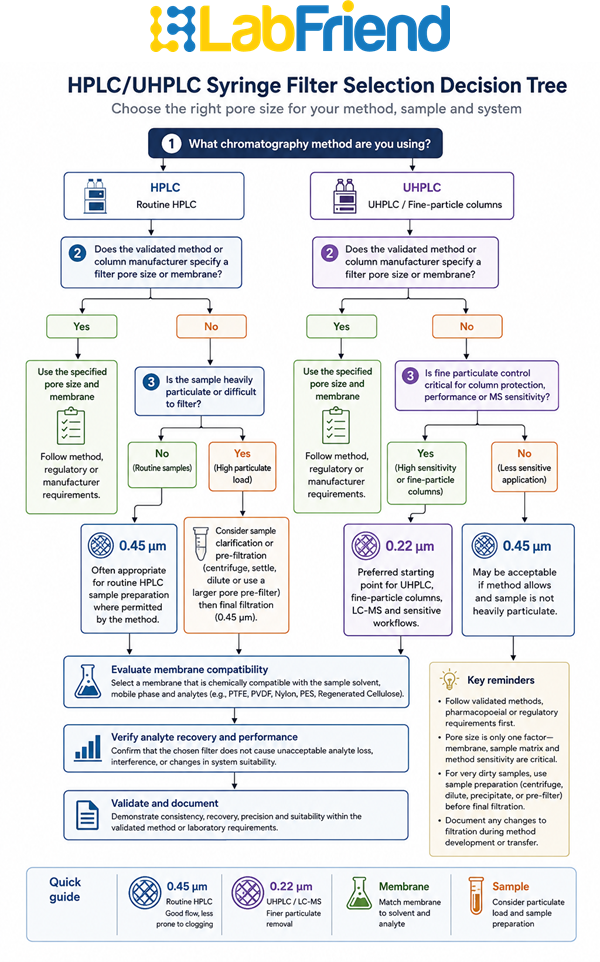
The practical decision is not “which pore size is better?” It is “which pore size is appropriate for this method, this sample and this instrument?”
Why syringe filter pore size matters in chromatography
Syringe filtration is used before HPLC or UHPLC injection to reduce the amount of particulate material entering the vial, injector, column and flow path. Particulates can contribute to blocked frits (the small inlet filters that protect the column packing), increased backpressure, poor peak shape, unstable results and shorter column lifetime.
Pore size ratings are typically nominal rather than absolute: a membrane rated at 0.22µm is validated to a defined retention efficiency at that size (commonly assessed by bubble point or challenge testing), not a guaranteed hard cut-off, so particles close to the rated pore size may still pass through in some cases.
The filter does not improve every sample automatically. It is a preparation step that must be matched to the method. If the filter is too coarse for the workflow, fine particles may still enter the system. If the filter is too fine for a heavily particulate sample, filtration can become slow, difficult or inconsistent. If the membrane chemistry is unsuitable, the sample may lose analyte, generate extractables or interact with the filter material.
This is why pore size should be treated as one part of a wider sample preparation decision.
For a broader explanation of pore size, membrane material, filter diameter and application selection, read LabFriend UK’s Ultimate Syringe Filter Guide.
What does 0.45µm filtration mean in HPLC sample preparation?
A 0.45µm syringe filter is commonly used in routine HPLC sample preparation where the purpose is to remove particulates that may affect the injector, column inlet or chromatographic performance. It often provides a practical balance between particle removal and ease of filtration.
For samples that are not heavily loaded with very fine particulates, 0.45µm filtration may offer good handling characteristics. The sample may pass through the filter more easily than through a finer pore size, which can help when analysts are preparing multiple samples or working with limited time.
The limitation is that 0.45µm filtration is less fine than 0.22µm filtration. If the method uses very fine-particle columns, if the instrument is sensitive to smaller particulates, or if the sample contains fine suspended material, 0.45µm may not provide enough particulate control.
In practical terms, 0.45µm is often a good starting point for routine HPLC workflows, but it should not be treated as a universal default. The method and column requirements should decide.
What does 0.22µm filtration mean in UHPLC and sensitive workflows?
A 0.22µm syringe filter provides finer filtration than a 0.45µm syringe filter. It is often considered where the method needs stricter particulate control, particularly in UHPLC or other workflows using finer-particle columns and narrower flow paths.
The benefit is better removal of small particulates before injection. That can help protect the column inlet, frit and flow path in workflows where small particles may contribute to pressure problems or reduced method robustness.
The trade-off is filtration resistance. A 0.22µm filter may be slower to use, particularly with dirty, viscous or particulate-rich samples. It may clog more easily than a 0.45µm filter. Analysts may need to consider pre-clarification, centrifugation, dilution, a larger filter diameter or a different sample preparation approach where samples are difficult to filter.
A 0.22µm filter is not automatically “better” because it is finer. It is better only when finer filtration is appropriate for the method and sample.
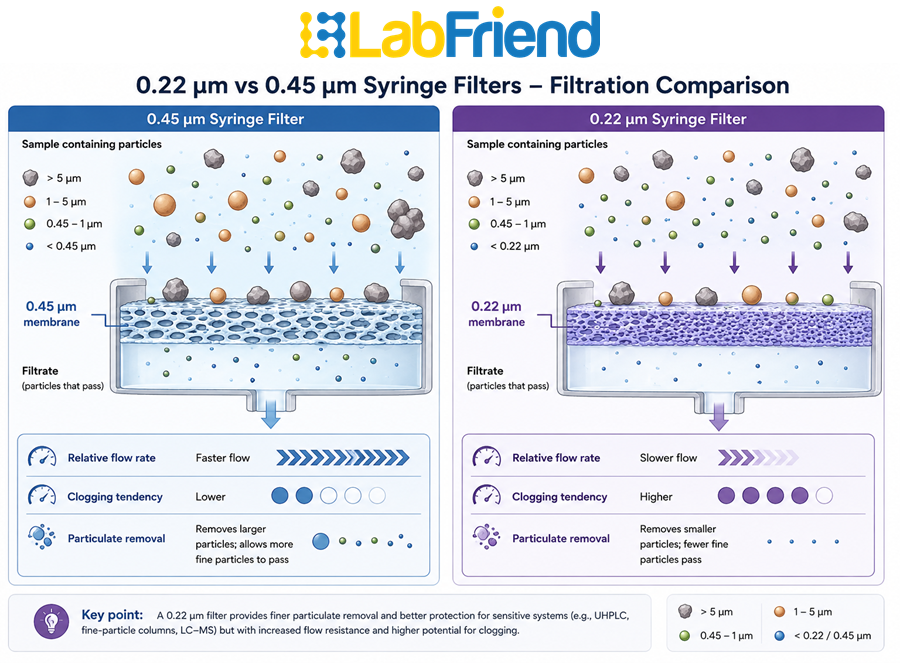
0.22µm vs 0.45µm: practical comparison
The table below summarises the main differences. Use it as a decision support tool, not as a replacement for method requirements or manufacturer guidance.
|
Decision factor |
0.45µm filter |
0.22µm filter |
|
Particulate removal |
Removes larger particulates |
Removes finer particulates |
|
Flow resistance |
Usually lower |
Usually higher |
|
Filtration speed |
Often faster |
Often slower |
|
Clogging risk |
Lower with particulate samples |
Higher with particulate samples |
|
Routine HPLC use |
Common where method permits |
May be used where stricter filtration is needed |
|
UHPLC use |
May be unsuitable for finer-particle-sensitive methods |
Often preferred where finer particulate control is required |
|
Dirty samples |
Easier to pass than finer filters |
May clog unless sample is pre-treated |
|
Column protection |
Useful for many routine workflows |
Stronger fine-particle protection where needed |
|
Main risk |
May not remove fine enough particles |
May slow filtration or increase sample handling difficulty |
The decision becomes easier when you start from the method rather than the filter. If the method has been developed, validated or transferred using one pore size, changing that pore size may need review. If the method is still being developed, pore size can be evaluated alongside recovery, pressure, baseline, reproducibility and sample handling.
How column type and particle size influence the decision
The column is one of the main reasons pore size matters. HPLC and UHPLC columns are designed with different particle sizes, frits, dimensions and pressure characteristics. A method using a more robust routine HPLC column may tolerate sample preparation conditions that would be less suitable for a finer-particle UHPLC method.
UHPLC workflows often use smaller particle sizes and narrower tolerances. In those cases, fine particulate control becomes more important because small particles may have a greater effect on pressure stability or column performance.
This is because UHPLC systems already operate close to their maximum rated pressure, so even a small amount of additional particulate loading at the column inlet can push system backpressure over the instrument’s or column’s operating limit, triggering pressure-related shutdowns or reducing column lifetime.
This does not mean every UHPLC method must use 0.22µm filtration in every situation. It means the laboratory should check the method and column requirements carefully. If the column supplier or validated method specifies a pore size, that should take priority over general preference.
For laboratories reviewing column protection and method continuity, LabFriend UK also supplies HPLC accessories and wider chromatography workflow products.
Sample matrix matters as much as pore size
The sample matrix often determines how practical filtration will be. A clean standard solution is very different from an extracted food sample, environmental sample, biological matrix, formulation sample or dirty process sample.
A 0.22µm filter may be technically desirable for fine particulate control, but if the sample clogs the filter immediately, the workflow may become inconsistent. Analysts may apply excessive pressure, change handling technique, lose sample volume or introduce variability between samples.
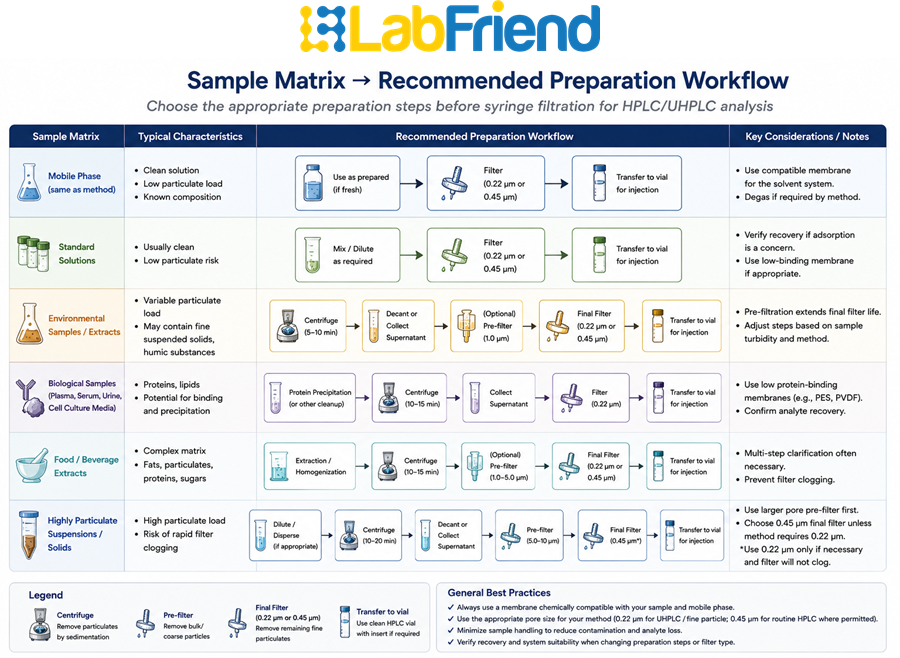
In those cases, the right solution may not be simply switching back to 0.45µm. The laboratory may need to consider centrifugation, pre-filtration, dilution, sample cleanup, a larger filter diameter, a different membrane, or a staged preparation workflow.
This is why the question should not be asked as “0.22 or 0.45?” in isolation. It should be asked as:
What level of particulate removal does the method need, and what sample preparation route gives that result consistently?
Membrane chemistry can be more important than pore size
Pore size controls the approximate particle size retained by the filter, but membrane chemistry controls how the sample interacts with the filter. In chromatography, that interaction can be just as important.
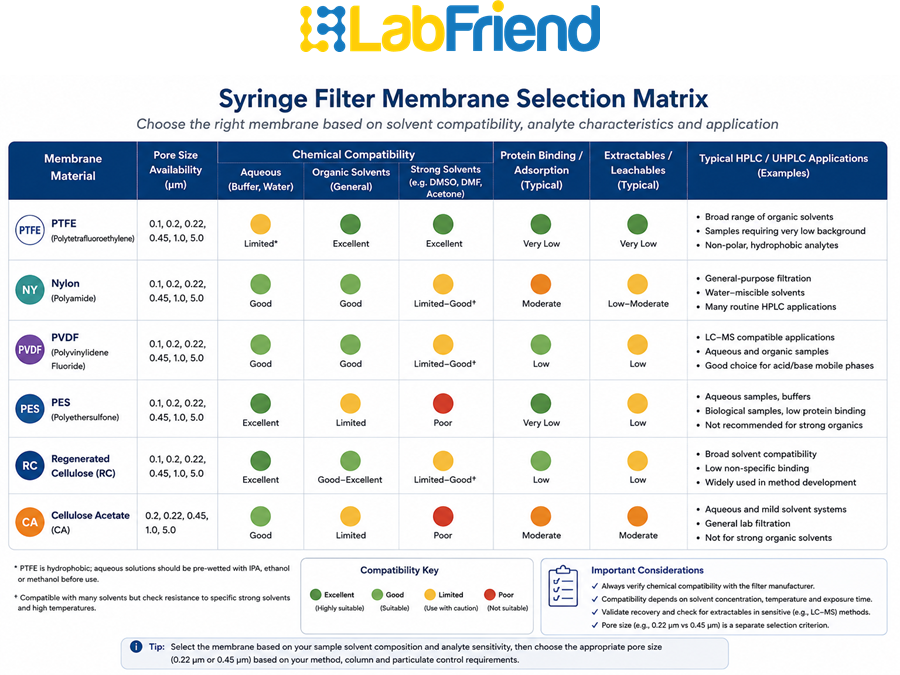
The filter membrane must be compatible with the solvent system. It should also be suitable for the analyte and sample matrix. A membrane that is poorly matched to the solvent may swell, degrade or contribute extractables. A membrane that binds the analyte may reduce recovery. A membrane that is suitable for aqueous samples may not be suitable for strong organic solvents, and vice versa.
Housing material matters alongside membrane chemistry: a chemically resistant membrane can still be compromised by a housing (commonly polypropylene or polycarbonate) that is not compatible with the solvent in use, so both the membrane and the housing should be checked against the solvent system.
Common membrane choices include PTFE, nylon, PES, PVDF, regenerated cellulose and others, but no membrane is universally suitable for every HPLC or UHPLC workflow.
Standard PTFE membranes are inherently hydrophobic and can resist wetting by aqueous samples, so they may need to be pre-wetted with a compatible solvent, or replaced with a hydrophilic-PTFE grade, when filtering aqueous or mixed-aqueous samples.
For scientists, the practical rule is this: select pore size and membrane chemistry together. A correct pore size with an unsuitable membrane is still the wrong filter.
Recovery, adsorption and extractables
This section is most relevant to LC-MS, trace-level and other high-sensitivity methods; routine UV-based HPLC users with straightforward matrices may find pore size and membrane compatibility sufficient without further evaluation.
In routine sample preparation, it is easy to think of filtration only as particle removal. In sensitive chromatography workflows, the filter can also affect analyte recovery and background cleanliness.
Some analytes may adsorb to particular filter membranes or housings; nylon membranes, for example, can bind certain polar or ionic compounds, including some proteins and basic pharmaceutical analytes, which may reduce measured recovery if the membrane has not been evaluated for the specific analyte. Some workflows may be sensitive to extractables or leachables (trace chemical compounds that can migrate out of the filter material into the sample) from the filter material. Some LC-MS or trace-level methods may require lower-background consumables or method-specific suitability checks.
This is not a reason to avoid filtration. It is a reason to evaluate the filter properly. A laboratory developing or transferring a method should consider whether changing pore size, membrane or supplier affects recovery, baseline, blank response or reproducibility.
Where analytical sensitivity is critical, avoid unvalidated substitutions.
When 0.45µm is usually the better starting point
A 0.45µm filter may be the better starting point where the method is routine, the column and method allow it, and the sample is not expected to contain very fine particulates that would affect performance.
It may also be more practical where the sample is moderately particulate and filtration speed matters. For high-throughput laboratories, faster filtration and lower clogging risk can make a real difference to analyst time, provided the filtration level is suitable for the method.
Typical situations where 0.45µm may be considered include routine HPLC sample clarification, workflows where the method already specifies 0.45µm filtration, and samples where 0.22µm filtration creates avoidable clogging or handling difficulty.
The important caveat is that “routine” does not mean “uncontrolled.” If the method, column or detector requires finer filtration, or if the laboratory has experienced pressure issues, then 0.45µm may not be enough.
When 0.22µm is usually the better starting point
A 0.22µm filter may be the better starting point where finer particulate control is needed. This is often relevant for UHPLC, fine-particle columns, sensitive workflows, LC-MS methods or applications where small particulates could affect pressure stability or analytical consistency.
It may also be appropriate where the method has already been developed, validated or transferred using 0.22µm filtration. In that case, the value lies not only in particle removal, but in consistency with the established method.
The trade-off is handling. A 0.22µm filter can be more demanding with difficult samples. If analysts experience slow filtration or frequent clogging, the laboratory should review sample preparation rather than simply applying more force.
In many cases, the best solution is to improve the sample preparation route, not to force a finer filter through an unsuitable matrix.
Cost and performance trade-off
The cost difference between 0.22µm and 0.45µm filters is usually less important than the workflow impact of using the wrong specification. A cheaper or easier-to-use filter is not good value if it allows particulates into the system, shortens column life or causes reruns. A finer filter is not good value if it slows sample preparation unnecessarily or creates avoidable clogging in a method that does not require it.
For repeat-use laboratories, the best commercial decision is to standardise the correct filter for each workflow and reorder it consistently.
That means recording:
|
Specification |
Why it matters |
|
Pore size |
Prevents accidental switching between 0.22µm and 0.45µm |
|
Membrane material |
Controls solvent and analyte compatibility |
|
Filter diameter |
Affects sample volume, hold-up and handling |
|
Housing material |
May affect chemical compatibility and extractables risk |
|
Pack size |
Supports cost comparison and repeat purchasing |
|
Approved alternatives |
Reduces stockout risk without uncontrolled substitution |
|
Method restriction |
Identifies workflows where substitution needs review |
This is especially useful for CROs, QA/QC laboratories, independent testing laboratories and SME biotech teams where the same filters are reordered repeatedly.
Filter diameter and sample volume
Pore size and membrane chemistry are not the only specifications that affect performance. Filter diameter, commonly available in sizes such as 4mm, 13mm, 25mm and 30mm for syringe filters, affects how much sample volume is needed to prime the filter, how much dead volume is lost to the filter membrane and housing, and how quickly a given sample volume filters through.
For small-volume UHPLC injections, a smaller diameter filter can reduce sample loss and hold-up volume, which matters when sample is limited or expensive to generate. For larger or heavily particulate-loaded samples, a larger diameter filter provides more surface area, which can reduce clogging and speed up filtration. As with pore size and membrane chemistry, filter diameter should be matched to the sample volume and matrix rather than selected as a default.
Storage, shelf life and certificates of analysis
Syringe filters are consumable items with their own storage and traceability requirements. Filters should be stored as specified by the manufacturer, typically in their original packaging, away from contamination sources, and used within any stated shelf life.
For regulated or accredited laboratories, it is good practice to retain the certificate of analysis or certificate of conformity for each filter lot, along with lot numbers, so that filter performance can be traced if a method shows unexpected recovery, background or pressure issues. This is particularly relevant for CROs, QA/QC laboratories and other environments where method performance must be defensible on audit.
Common mistakes when choosing between 0.22µm and 0.45µm filters
The most common mistake is assuming that the finer filter is always the better filter. A 0.22µm filter can be the right choice, but only where the method and sample support that decision.
Another common mistake is choosing by pore size while ignoring membrane compatibility. This can lead to poor recovery, solvent incompatibility, extractables or inconsistent results.
A third mistake is changing pore size during routine purchasing without technical review. If a method has historically used 0.45µm filters and procurement substitutes 0.22µm filters, the workflow may become slower or harder to reproduce. If a method requires 0.22µm and a 0.45µm alternative is ordered, column protection or method performance may be affected.
The safest approach is to record approved filter specifications and treat pore size changes as technical changes, not simple purchasing substitutions.
In a regulated or quality-managed laboratory, any change to filter pore size, membrane or supplier for a validated method should be routed through the laboratory’s change-control process rather than actioned directly by procurement or bench staff.
Final recommendation
For HPLC and UHPLC sample preparation, do not choose between 0.22µm and 0.45µm filters based on pore size alone.
Start with the method. Check the column requirements, sample matrix, particulate load, detector sensitivity, solvent system and analyte recovery needs. Then choose the pore size and membrane chemistry together.
For many routine HPLC workflows, 0.45µm filtration may provide a practical balance between particulate removal and ease of use. For UHPLC, finer-particle columns, LC-MS-sensitive methods or workflows requiring stricter particulate control, 0.22µm filtration may be more appropriate.
Once the correct specification is confirmed, record it clearly for repeat purchasing. That should include pore size, membrane material, filter diameter, housing material, pack size, approved alternatives and any method restrictions.
For broader chromatography consumables guidance, read The Complete Guide to Chromatography Consumables for UK Laboratories. For filter selection across pore size, membrane and applications, read the Ultimate Syringe Filter Guide.
Browse chromatography sample preparation products, explore HPLC accessories, or contact LabFriend UK for help matching repeat-use syringe filter specifications.
Frequently Asked Questions
Is 0.22µm better than 0.45µm for HPLC?
Not always. A 0.22µm filter removes finer particulates, but it may filter more slowly and clog more easily with particulate-rich samples. A 0.45µm filter may be suitable for many routine HPLC workflows where the method and column allow it.
When should I use a 0.22µm filter for HPLC or UHPLC?
Use a 0.22µm filter where the method requires finer particulate control, such as UHPLC, finer-particle columns, LC-MS-sensitive workflows or methods where small particulates could affect pressure stability or analytical consistency.
When should I use a 0.45µm filter for HPLC?
Use a 0.45µm filter where the method, sample and column requirements allow routine particulate removal and where finer filtration is not necessary. It may be easier and faster to use with some sample types.
Can I switch from 0.45µm to 0.22µm filters?
Possibly, but the change should be reviewed. A 0.22µm filter may affect filtration speed, clogging, recovery or sample handling. If the method is validated, client-specified or sensitive, technical approval may be needed.
Can I switch from 0.22µm to 0.45µm filters?
Only if the method allows it. Switching from 0.22µm to 0.45µm may reduce fine particulate removal and could affect column protection or method robustness in sensitive workflows.
Does membrane material matter as much as pore size?
Yes. Membrane material affects solvent compatibility, analyte recovery, adsorption and extractables risk. Pore size and membrane chemistry should be selected together.
Do syringe filters need pre-wetting before use?
Some membrane types, particularly standard PTFE, are hydrophobic and may resist wetting by aqueous samples. Where this is the case, the filter may need to be pre-wetted with a small volume of a compatible solvent before the sample is filtered, or a hydrophilic-PTFE or alternative membrane may be more practical for aqueous work. Manufacturer guidance for the specific filter should confirm whether pre-wetting is required.
Does it matter if a syringe filter is sterile or non-sterile for HPLC use?
For most routine HPLC and UHPLC sample preparation, sterility is not usually the deciding factor, since the goal is particulate removal rather than microbial control. However, sterile filters may be relevant where the sample itself must remain sterile or free from microbial contamination, such as in some biological, pharmaceutical or environmental testing workflows. Where sterility is a requirement, this should be specified separately from pore size and membrane chemistry.
What pore size should I use before UHPLC?
UHPLC workflows often require finer particulate control, so 0.22µm filtration may be appropriate, but the final decision should follow the method, column guidance, sample matrix and laboratory requirements.
Why do syringe filters clog during HPLC sample preparation?
Filters can clog when the sample contains high particulate load, precipitated material, viscous matrix components or particles larger than the filter can handle efficiently. Pre-clarification, centrifugation, dilution, larger filter diameter or a different preparation route may help.
Where can I buy syringe filters for HPLC sample preparation?
LabFriend UK supplies chromatography sample preparation products and related HPLC accessories through its online platform. Laboratories can browse the relevant categories or contact LabFriend UK for help matching repeat-use filter specifications.
Read more from LabFriend UK
- The Complete Guide to Chromatography Consumables for UK Laboratories
- The Ultimate Syringe Filter Guide: Pore Size, Membranes, and Applications
- Browse Chromatography Sample Preparation
- Browse HPLC Accessories
- Browse Chromatography Products
Written by: Donal O’Sullivan, BSc, Co-Founder and Sales Director, LabFriend UK. Donal brings deep chemistry-led technical expertise across analytical chemistry, biochemistry, environmental monitoring, laboratory instrumentation, consumables and scientific product selection.
Reviewed by: Michael Anderson, MBA, Founder and Managing Director, LabFriend UK. Michael reviews LabFriend UK content for customer relevance, commercial accuracy, operational practicality and alignment with LabFriend UK’s laboratory supply model.
Related Stories

The Complete Guide to Chromatography Consumables for UK Laboratories
The Complete Guide to Chromatography Consumables for UK Laboratories

HPLC Sample Preparation Consumables - Filters Vials Syringes and Solvent Handling
HPLC Sample Preparation Consumables - Filters Vials Syringes and Solvent Handling

HPLC Sample Preparation Consumables for CROs and High-Throughput Testing Laboratories
HPLC Sample Preparation Consumables for CROs and High-Throughput Testing Laboratories

Syringe Filter Membrane Compatibility for HPLC UHPLC and Chromatography Solvents
Syringe Filter Membrane Compatibility for HPLC UHPLC and Chromatography Solvents