

Share :
0.22 µm vs 0.45 µm Syringe Filters: When Should You Use Each?
Updated On 07/17/2026

By Donal O’Sullivan, BSc. Reviewed by Michael Anderson, MBA.
If your objective is routine sample clarification, a 0.45 µm syringe filter is often sufficient and may provide faster flow rates and lower risk of premature blockage.
If your workflow requires finer particulate removal, highly sensitive analytical methods, or a validated sterilising-grade filtration step, a sterile-rated 0.2/0.22 µm filter that has been validated for bacterial retention may be appropriate.
The correct choice depends on:
- analytical method requirements
- sample characteristics
- instrument sensitivity
- particulate loading
- sample volume
- filter diameter and hold-up volume
- membrane compatibility
- validation requirements
Selecting the correct pore size helps improve reproducibility, protect laboratory instrumentation and reduce unnecessary filtration costs.
Why Pore Size Selection Matters
For many laboratories, syringe filtration is a routine task. However, selecting the wrong pore size can create avoidable problems:
- slow filtration
- excessive filter blockage
- inconsistent analytical results
- increased instrument maintenance
- reduced throughput
- unnecessary consumables expenditure
For QA/QC laboratories, CROs, analytical chemistry teams and research organisations, filtration decisions should be driven by workflow requirements rather than assumptions.
Browse Syringe Filters by Pore Size
Explore laboratory syringe filters available in:
- 0.22 µm syringe filters
- 0.45 µm syringe filters
- multiple membrane types
- PTFE Syringe Filters
- PES Syringe Filters
- RC Syringe Filters
- PDVF Syringe Filters
- Nylon Syringe Filters
- analytical and biological workflows
Reliable. Precise. Delivered.
What Does Filter Pore Size Mean?
A syringe filter membrane contains microscopic pores that allow liquids to pass while retaining particles according to the membrane’s rated pore size, structure and test method.
Retention is not always a simple absolute cut-off, especially for deformable particles, biological material or nominally rated membranes.
In practical laboratory use:
|
Pore Size |
Typical Role |
|
0.45 µm |
Routine sample clarification and particulate removal |
|
0.22 µm |
Finer filtration and many sterilising-grade workflows |
In manufacturer literature, 0.2 µm syringe filter and 0.22 µm syringe filter ratings are often used for similar fine-filtration or sterilising-grade applications. Users should follow the exact pore size and sterility status specified by their method, SOP or validation package.
A smaller pore size generally provides finer filtration but may also:
- reduce flow rate
- increase pressure requirements
- block more quickly when filtering particulate-rich samples
This is why smaller is not always better.
Understanding 0.45 µm Syringe Filters
0.45 µm syringe filters are among the most widely used filtration products in analytical laboratories.
Their primary role is routine sample clarification.
They are commonly used to:
- remove visible and sub-visible particulates from samples
- help protect HPLC injectors, column inlet frits and flow paths from particulate build-up
- reduce contamination entering analytical systems
- improve sample consistency
- support routine testing workflows
Typical Applications
- HPLC sample preparation
- environmental testing
- water analysis
- pharmaceutical QC
- food and beverage testing
- industrial chemistry laboratories
Browse 0.45 µm syringe filters
Understanding 0.22 µm Syringe Filters
0.22 µm syringe filters provide finer particulate retention.
They are frequently selected when:
- highly sensitive analytical methods are used
- finer particulate removal is required
- sterilising-grade filtration procedures are specified
- method validation requires a 0.22 µm filtration step
In manufacturer literature, 0.2 µm and 0.22 µm filters are often discussed together for fine filtration and sterilising-grade applications. Laboratories should follow the exact method requirement rather than assuming these ratings are automatically interchangeable in every validated workflow.
Typical Applications
- UHPLC sample preparation
- LC-MS workflows
- cell culture media preparation
- sterile buffer preparation
- microbiology applications
- biotechnology laboratories
For LC-MS and trace analysis, low extractables, low leachables and low analyte-binding characteristics may be as important as pore size.
Explore 0.22 µm Syringe Filters
Visual Comparison of 0.22 µm vs 0.45 µm Syringe Filters
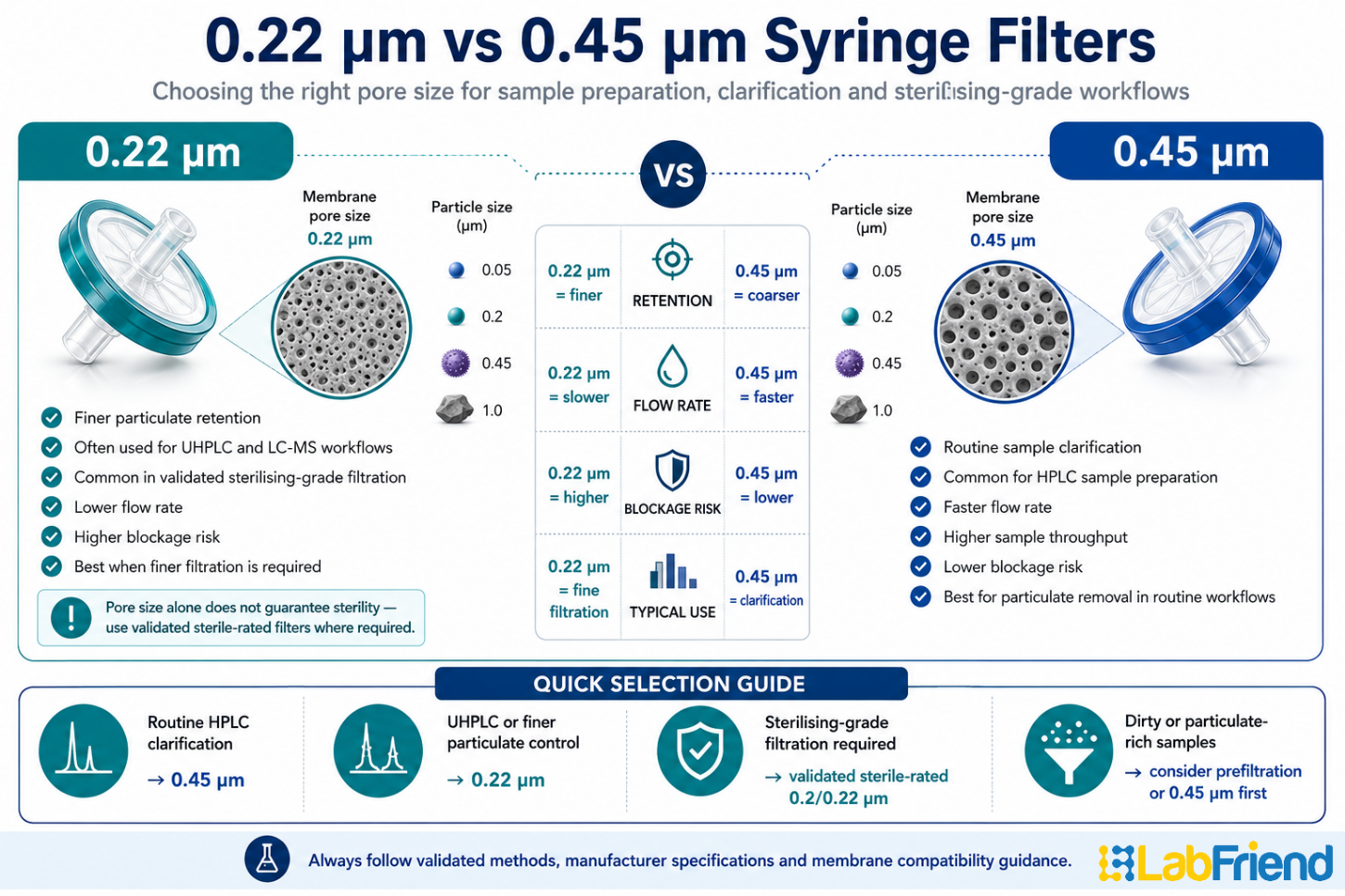
0.22 µm vs 0.45 µm Comparison Table
|
Feature |
0.22 µm |
0.45 µm |
|
Particle Retention |
Finer |
Coarser |
|
Flow Rate |
Typically Lower |
Typically Higher |
|
Risk of Blockage |
Higher |
Lower |
|
Sample Throughput |
Lower |
Higher |
|
Sterilising-Grade Filtration Workflows |
Commonly Used when validated |
Less Common |
|
HPLC Preparation |
Method Dependent |
Commonly Used |
|
UHPLC Preparation |
Frequently Used |
Method Dependent |
|
Sample Clarification |
Finer clarification, lower throughput |
Routine clarification, higher throughput |
Does 0.22 µm Always Mean Sterile?
No.
This is one of the most common misconceptions in laboratory filtration.
A 0.22 µm pore size alone does not automatically make a filtration process sterile.
For sterility-critical work, the filter should be supplied sterile where required, described by the manufacturer as sterilising-grade, and supported by appropriate bacterial-retention validation, typically using Brevundimonas diminuta challenge testing. The process also depends on aseptic handling and validated use conditions.
Whether a process can be considered sterilising depends on factors including:
- membrane design
- filter construction
- manufacturing controls
- application validation
- challenge testing
- workflow requirements
- aseptic handling
Users should also note that 0.2/0.22 µm filtration is intended primarily for bacterial retention and particulate removal. It should not be assumed to remove viruses, mycoplasma, endotoxins or dissolved contaminants unless the filter and process are specifically validated for that purpose.
Laboratories should always follow validated procedures and manufacturer specifications when sterility is required.
HPLC and UHPLC Sample Preparation
One of the most common questions concerns chromatography workflows.
HPLC
Many HPLC methods use:
- 0.45 µm filtration
- 0.22 µm filtration
depending on:
- method requirements
- sample cleanliness
- column specifications
- membrane compatibility
- analyte binding and extractables risk
For conventional HPLC, 0.45 µm filtration is commonly used for routine sample clarification. However, validated methods and column manufacturer guidance should always take precedence.
UHPLC
UHPLC systems often contain:
- smaller particle columns
- narrower flow paths
- more sensitive components
As a result, finer filtration may be specified more frequently.
As a practical starting point, many suppliers recommend 0.45 µm filtration for conventional HPLC and 0.2/0.22 µm filtration for UHPLC, but the validated method, column manufacturer guidance and sample matrix should take precedence.
Explore HPLC and UHPLC Filtration Products
Filter Selection Decision Tree
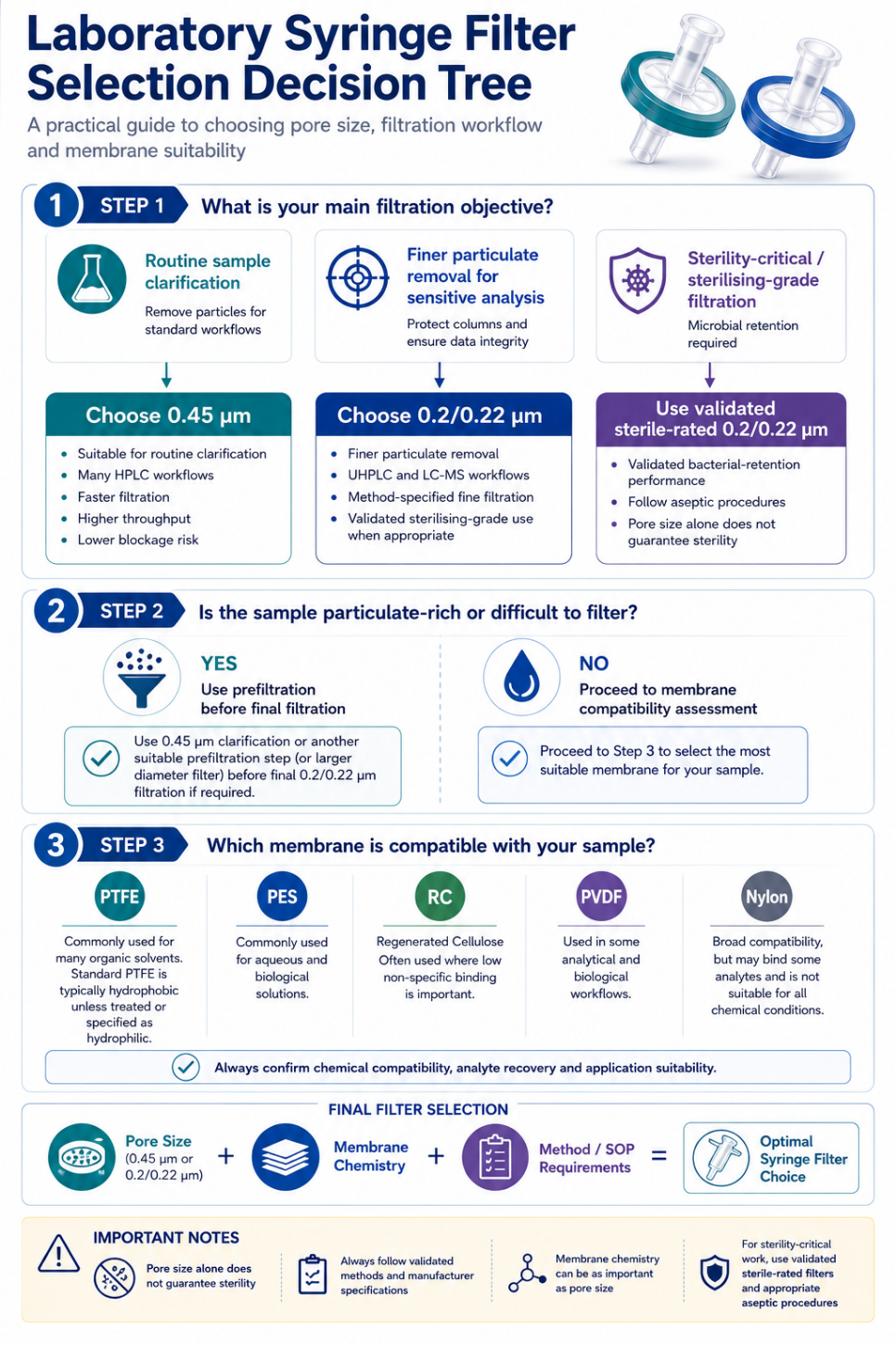
Decision Framework
|
Question |
Recommended Starting Point |
|
Is the goal routine sample clarification? |
Often 0.45 µm |
|
Is sterilising-grade filtration required? |
Use a validated sterile-rated 0.2/0.22 µm filter where specified |
|
Is UHPLC being used? |
Review method and column requirements |
|
Is particulate loading high? |
Consider prefiltration, a larger filter diameter or 0.45 µm clarification before any required 0.2/0.22 µm final filtration |
|
Is maximum throughput important? |
Often 0.45 µm |
|
Does the method specify 0.22 µm? |
Use 0.22 µm |
|
Is sample volume limited? |
Consider filter diameter and hold-up volume |
|
Is LC-MS or trace analysis involved? |
Consider low extractables, low leachables and low analyte binding |
Common Selection Mistakes
Assuming Smaller Is Always Better
Smaller pore sizes may:
- block more quickly
- reduce throughput
- increase filtration time
- increase consumable costs
A 0.22 µm filter may provide finer filtration, but it is not automatically the best choice for every sample or workflow.
Ignoring Method Requirements
Validated methods should always take precedence over generic guidance.
If a method specifies pore size, membrane type, filter diameter, sterility status or prefiltration steps, those requirements should be followed.
Focusing Only on Pore Size
Membrane chemistry can be equally important.
Performance may vary depending on:
- PTFE
- PES
- RC
- PVDF
- nylon
For example, PTFE is commonly chosen for strong organic solvent compatibility, but standard PTFE is hydrophobic unless treated or specified as hydrophilic. PES is widely used for aqueous biological solutions and low protein binding. Regenerated cellulose is often used where low non-specific binding is important. Nylon offers broad solvent compatibility but may bind some analytes and is not suitable for all strongly acidic samples.
Other important selection factors include:
- chemical compatibility
- extractables and leachables
- analyte adsorption
- protein binding
- sample volume
- filter diameter
- hold-up volume
- sterile or non-sterile format
Need Help Choosing the Correct Filter?
LabFriend UK can help laboratories select the appropriate:
- pore size
- membrane type
- filter diameter
- filtration format
for specific workflows.
Procurement and Workflow Standardisation
Laboratories with recurring filtration demand often benefit from standardising:
- pore sizes
- membrane types
- approved filtration products
- validated filtration procedures where required
Benefits include:
- simplified procurement
- reduced stock complexity
- improved workflow consistency
- easier staff training
- more efficient repeat ordering
Standardise Your Filtration Workflow
Reduce purchasing complexity by standardising approved filtration products across:
- analytical laboratories
- QC laboratories
- CROs
- biotechnology facilities
Reliable. Precise. Delivered.
Relevant Product Categories
Depending on your workflow, explore:
- 0.22 µm syringe filters
- 0.45 µm syringe filters
- PTFE Syringe Filters
- PES Syringe Filters
- RC Syringe Filters
- PDVF Syringe Filters
- Nylon Syringe Filters
- HPLC filtration products
- UHPLC filtration products
- sterilising-grade filtration products
- analytical and biological workflows
Read More
Explore related articles covering laboratory filtration selection, applications, membranes, workflows and analytical best practices.
The Ultimate Guide to Laboratory Filtration for UK Laboratories
Frequently Asked Questions
What is the difference between 0.22 µm and 0.45 µm syringe filters?
A 0.22 µm syringe filter has a smaller rated pore size than a 0.45 µm syringe filter, so it is generally used for finer particulate retention.
A 0.45 µm syringe filter is commonly used for routine sample clarification, especially in HPLC sample preparation and general analytical workflows where faster flow and higher throughput are useful.
When should I use a 0.22 µm syringe filter?
Use a 0.22 µm syringe filter when finer particulate removal is required, when the analytical method specifies 0.22 µm filtration, or when a validated sterilising-grade filtration step is required.
Typical applications include UHPLC sample preparation, LC-MS workflows, sterile buffer preparation, cell culture media preparation and microbiology workflows.
When should I use a 0.45 µm syringe filter?
Use a 0.45 µm syringe filter for routine sample clarification, particulate removal and many HPLC sample-preparation workflows.
A 0.45 µm filter is often suitable when the main objective is to remove particulates that could affect analytical instruments, while maintaining faster flow and lower blockage risk than a finer 0.22 µm filter.
Is a 0.22 µm syringe filter always sterile?
No. A 0.22 µm pore size alone does not mean the filter is sterile or that the filtered liquid can be considered sterile.
For sterility-critical work, use a sterile-rated, sterilising-grade filter that is supported by appropriate bacterial-retention validation, and follow validated aseptic handling procedures.
Can I filter cell culture media with a non-sterile 0.22 µm filter?
A non-sterile 0.22 µm filter should not be used when the purpose is to prepare sterile cell culture media.
For cell culture media preparation, use a sterile, sterilising-grade 0.2/0.22 µm filter that is suitable for biological solutions and follow the relevant aseptic procedure. Membrane type is also important, as low protein binding and low extractables are often preferred for biological applications.
Should I prefilter before using a 0.22 µm syringe filter?
Prefiltration may be useful when samples contain visible particulates, suspended solids or high particulate loading.
Using a 0.45 µm filter, a larger filter diameter or another appropriate prefiltration step before final 0.2/0.22 µm filtration can help reduce blockage, improve flow and extend filter life.
Is 0.22 µm or 0.45 µm better for HPLC sample preparation?
Many HPLC workflows use 0.45 µm syringe filters for routine sample clarification.
However, some HPLC methods may specify 0.22 µm filtration depending on the column, sample matrix or method validation requirements. Always follow the validated method and column manufacturer guidance.
Is a 0.22 µm filter required for UHPLC?
Not always, but 0.2/0.22 µm filtration is commonly used for UHPLC because UHPLC systems often use smaller particle columns and narrower flow paths.
The correct choice should be based on the validated method, column specifications and sample characteristics.
Which syringe filter pore size is best for LC-MS?
For LC-MS, pore size is only one part of the selection.
A 0.2/0.22 µm filter is often selected for finer particulate control, but membrane compatibility, low extractables, low leachables and low analyte binding are also critical. The wrong membrane can introduce contaminants or reduce analyte recovery.
Which syringe filter blocks more easily: 0.22 µm or 0.45 µm?
A 0.22 µm syringe filter usually blocks more easily than a 0.45 µm syringe filter because the pores are smaller.
Samples with high particulate loading may require prefiltration, centrifugation, dilution where appropriate, or a larger filter diameter to improve throughput.
Does a 0.22 µm filter remove bacteria?
A validated sterilising-grade 0.2/0.22 µm filter is commonly used for bacterial retention under specified conditions.
However, bacterial retention depends on the filter design, membrane, validation, process conditions and correct handling. A pore-size label alone should not be treated as proof of sterility.
Does a 0.22 µm filter remove viruses, mycoplasma or endotoxins?
No, not reliably unless the filter and process are specifically validated for that purpose.
Standard 0.2/0.22 µm syringe filtration should not be assumed to remove viruses, mycoplasma, endotoxins or dissolved contaminants.
Can I use a 0.45 µm syringe filter for sterile filtration?
A 0.45 µm syringe filter is generally not the standard choice for sterilising-grade filtration.
If sterility is required, use a validated sterile-rated 0.2/0.22 µm filter and follow the relevant validated procedure. Always check the manufacturer’s specifications and your internal method requirements.
What membrane type should I choose for 0.22 µm or 0.45 µm syringe filters?
The best membrane depends on the sample and application.
Common examples include:
- PTFE for many organic solvents, noting that standard PTFE is hydrophobic unless treated or specified as hydrophilic
- PES for many aqueous and biological solutions
- regenerated cellulose for low non-specific binding applications
- PVDF for some biological and analytical workflows
- nylon for broad compatibility, although it may bind some analytes and is not suitable for every chemical condition
Always check chemical compatibility, analyte recovery, extractables, leachables and binding characteristics before selecting a membrane.
Does syringe filter diameter matter?
Yes. Filter diameter affects filtration area, sample throughput, pressure requirements and hold-up volume.
Smaller filter diameters are often useful for limited sample volumes because they can reduce sample loss. Larger diameters are often better for larger sample volumes or particulate-rich samples because they provide more filtration area.
Can a syringe filter affect analytical results?
Yes. A syringe filter can affect analytical results if the membrane is incompatible with the sample, releases extractables or leachables, adsorbs analytes, or contributes contamination.
This is especially important for LC-MS, trace analysis, protein analysis and validated pharmaceutical methods.
Should laboratories standardise syringe filter pore sizes?
Standardising syringe filter pore sizes can improve consistency, simplify procurement and reduce variation between users.
However, standardisation should include more than pore size. Laboratories should also consider membrane type, filter diameter, sterility status, extractables, leachables, analyte binding and validated method requirements.
Can I use the same syringe filter for every sample?
No. A single syringe filter type is unlikely to be suitable for every sample.
Different samples may require different pore sizes, membrane chemistries, diameters or sterility formats depending on solvent compatibility, particulate loading, sample volume and method requirements.
How do I choose between 0.22 µm and 0.45 µm syringe filters?
As a general guide:
- Choose 0.45 µm for routine clarification, many HPLC workflows and faster filtration.
- Choose 0.22 µm when finer particulate removal is required, when the method specifies it, or when a validated sterilising-grade filtration step is needed.
- Consider prefiltration for dirty or particulate-rich samples.
- Always check membrane compatibility, sample volume, filter diameter and validation requirements.
Written by: Donal O’Sullivan, BSc, Co-Founder and Sales Director, LabFriend UK. Donal brings deep chemistry-led technical expertise across analytical chemistry, biochemistry, environmental monitoring, laboratory instrumentation, consumables and scientific product selection.
Reviewed by: Michael Anderson, MBA, Founder and Managing Director, LabFriend UK. Michael reviews LabFriend UK content for customer relevance, commercial accuracy, operational practicality and alignment with LabFriend UK’s laboratory supply model.
Related Stories

Complete Guide to Centrifuge Tubes
Complete Guide to Centrifuge Tubes

The Ultimate Guide to Laboratory Filtration for UK Laboratories
The Ultimate Guide to Laboratory Filtration for UK Laboratories

Polypropylene vs Polystyrene Centrifuge Tubes
Polypropylene vs Polystyrene Centrifuge Tubes: Which Is Best for Laboratory Workflows?

PTFE vs PES Syringe Filters: Which Membrane Should You Choose?
PTFE vs PES Syringe Filters: Differences, Solvent Compatibility and Laboratory Applications