

Share :
The Ultimate Syringe Filter Guide: Pore Size, Membranes, and Applications
Updated On 03/05/2026

In analytical chemistry and life sciences, the margin between a successful run and a costly instrument repair often comes down to a few micrometres. Whether you are performing HPLC/UHPLC analysis, sterilising cell culture media, or clarifying aggressive solvents, selecting the correct syringe filter is a critical step in your workflow.
This guide provides a technical breakdown of how to choose the right pore size, membrane material, and filter diameter to ensure reproducible results and protect your laboratory hardware.
Understanding Pore Size: 0.22 µm vs 0.45 µm
_0.webp)
The most common decision a scientist faces is choosing between a 0.22 µm and 0.45 µm membrane. While they may look identical, their impact on your sample and equipment is vastly different.
0.45 µm Syringe Filters: General Clarification
The 0.45 µm filter is the "workhorse" of the lab. It is designed to remove the majority of particulates that could interfere with standard analytical results.
- Best for: Standard HPLC Columns (columns with >3 µm packing), general solvent filtration, and removing visible debris.
- Advantage: Offers faster flow rates and lower back pressure, making it ideal for viscous samples.
0.22 µm Syringe Filters: Sterilisation and High-Sensitivity
When your application requires the removal of bacteria or the protection of high-end sensitive equipment, 0.22 µm is the industry standard.
- Best for: Sterile filtration of buffers and media, UHPLC (columns with <2 µm packing), and protecting sensitive detectors from sub-micron particles.
- Advantage: Effectively "cold-sterilises" heat-sensitive reagents like antibiotics or proteins.
|
Application |
Recommended Pore Size |
Technical Justification |
|
Standard HPLC |
0.45 µm |
Protects 3µm or 5µm column frit. |
|
UHPLC / Nano-LC |
0.22 µm |
Prevents blockage in sub-2µm columns. |
|
0.22 µm |
Validated for the removal of common bacteria. |
|
|
Viscous Buffer Prep |
0.45 µm |
Balances filtration efficiency with flow rate. |
Selecting the Correct Filter Diameter
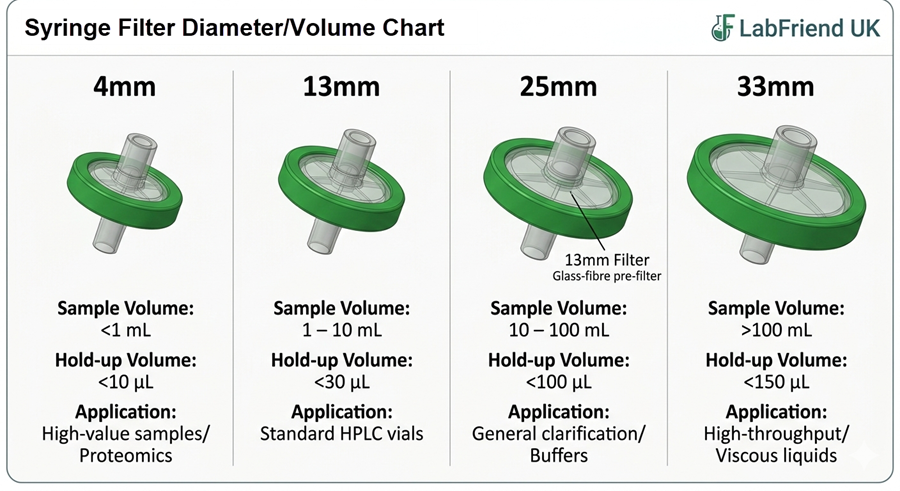
Choosing a diameter is a balance between Sample Volume and Hold-up Volume (the liquid trapped inside the filter housing after use). Minimising hold-up is essential when working with expensive or limited analytes.
|
Filter Diameter |
Typical Sample Volume |
Typical Hold-up Volume |
Primary Application |
|
4 mm |
< 1 mL |
< 10 µL |
High-value samples/Proteomics |
|
13 mm |
1 – 10 mL |
< 30 µL |
Standard HPLC vials |
|
25 mm |
10 – 100 mL |
< 100 µL |
General clarification/Buffers |
|
33 mm |
> 100 mL |
< 150 µL |
High-throughput/Viscous liquids |
Expert Tip: If your sample is "dirty" or laden with particulates, look for filters with a glass fibre (GF) pre-filter. This prevents the membrane from clogging prematurely and protects your chromatography column from "pressure spikes."
Membrane Selection & Chemical Compatibility
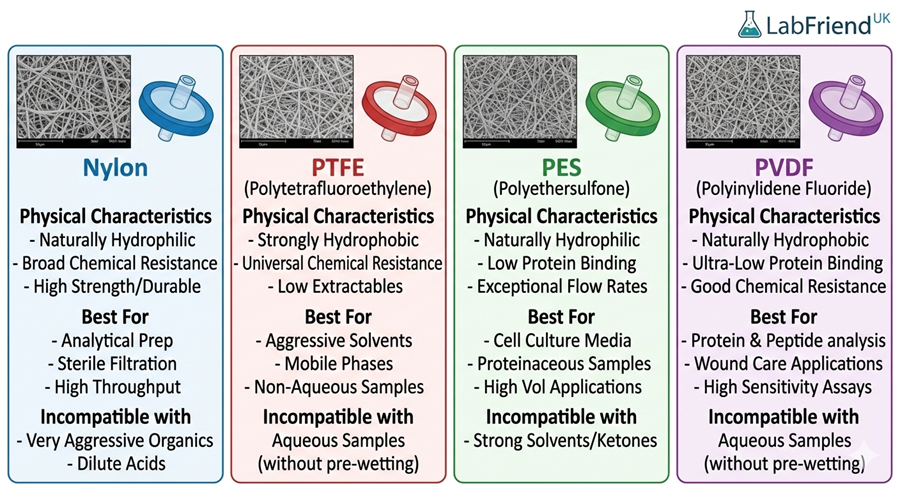
The membrane material must be compatible with your solvent to prevent membrane dissolution or the leaching of "extractables" into your sample.
- PTFE (Polytetrafluoroethylene): The "Universal" choice for aggressive chemicals and organic solvents. Naturally hydrophobic; use Hydrophilic PTFE for aqueous samples.
- PES (Polyethersulfone): The gold standard for Life Sciences. Offers extremely high flow rates and very low protein binding. Perfect for cell culture media.
- Nylon: A durable, high-strength membrane. Excellent for HPLC prep, but avoid with very acidic samples or proteins (high binding).
- PVDF (Polyvinylidene Fluoride): Ideal for protein-containing samples where you cannot afford to lose your analyte to membrane "sticking."
- Regenerated Cellulose (RC): Preferred for sensitive chromatography due to its wide solvent resistance and ultra-low extractables. Often considered the Universal Standard for Lab Filtration, to understand why see our article Universal Standard for Lab Filtration
Best Practices for Professional Filtration
To maintain the integrity of your chromatography columns and instrumentation and ensure reproducible data:
- Discard the first 1ml: This "pre-rinses" the filter and ensures any residual air or trace extractables do not interfere with your baseline.
- Use steady, gentle pressure: Forcing a syringe too hard can cause "breakthrough," where particles are pushed through the pores by sheer force.
- One Filter, One Sample: Never reuse a filter. Cross-contamination is the leading cause of "ghost peaks" in HPLC analysis.
Why Source Syringe Filters from LabFriend UK?
At LabFriend UK, we supply high-performance filtration solutions from leading brands like Sartorius, Cytiva Whatman, Macherey-Nagel, Hahnemühle and GVS. Whether you need sterile PES for a cleanroom or PTFE for a petrochemical lab, our range is designed to meet the most stringent ISO and analytical standards.
- Broad Chemical Compatibility: Comprehensive stock of all major membrane types.
- Technical Expertise: Our team can help you match the right filter to your specific solvent or analyte.
- Value & Reliability: Precision-manufactured filters that offer consistent results, run after run.
Related Stories

The Ultimate Guide to Choosing the Right Laboratory Mixer
Explanation of the different types of mixers used in laboratories

The Scientist’s Guide to Laboratory Glassware: Material, Precision, and Selection
Guide to choosing glassware

Laboratory Centrifuge Maintenance: A Guide to Safety and Longevity
Centrifuge Maintenance Guide
%20Membranes%20Is%20The%20Universal%20Standard%20for%20Lab%20Filtration%20SML_0.png&w=3840&q=75)
Why Regenerated Cellulose (RC) Membranes are The Universal Standard for Lab Filtration
Cellulose as a filtration medium