


20 mins read
Troubleshooting Conductivity Measurements: Unstable, Incorrect and Failed Readings
Troubleshooting Conductivity Measurements: Unstable, Incorrect and Failed Readings
Stirring head Ø
Stirring rotor Ø
Type
Specifications
Compare modelsAlternative in-stock items
£349.54
Inc. VAT
The IKA Dissolver Stirrer R 1300 is a high-performance stirring tool designed for effective mixing and dissolving tasks in laboratory applications. With a robust build, it features a stirrer diameter, shaft diameter, and a shaft length of 80 mm, 8 mm, and 350 mm respectively. Ideal for use with overhead stirrers, it ensures stable and efficient mixing of low to medium viscosity liquids.
The IKA Dissolver Stirrer R 1300 is a reliable laboratory accessory for precise and consistent mixing performance.

£349.54
Inc. VAT
Manufacturer P/N
0000513500
Part Number
9.197 001
Manufacturer
IKA
Stirring head Ø
80 mm

Manufacturer P/N
0002387900
Part Number
9.197 003
Manufacturer
IKA
Stirring head Ø
100 mm

£543.84
Inc. VAT
Manufacturer P/N
0002746700
Part Number
9.197 007
Manufacturer
IKA
Stirring head Ø
40 mm
It is a high-performance stirring tool designed for effective mixing and dissolving tasks in laboratory applications. With a robust build, it features a stirrer diameter, shaft diameter, and a shaft length of 80 mm, 8 mm, and 350 mm respectively. Ideal for use with overhead stirrers, it ensures stable and efficient mixing of low to medium viscosity liquids.
Yes. It is designed for dissolving and mixing low to medium viscosity substances, and offers a shaft length of 350 mm to support this kind of work.
It has a shaft length of 350 mm.
It offers Ø 80 mm and Ø 8 mm.
20 mins read
Troubleshooting Conductivity Measurements: Unstable, Incorrect and Failed Readings

24 mins read
TLC Consumables and Accessories: Plates, Chambers, Applicators and Detection

23 mins read
How Lab Managers Can Standardise Laboratory Bottle Purchasing

33 mins read
The Complete Guide to Laboratory Gloves for UK Laboratories
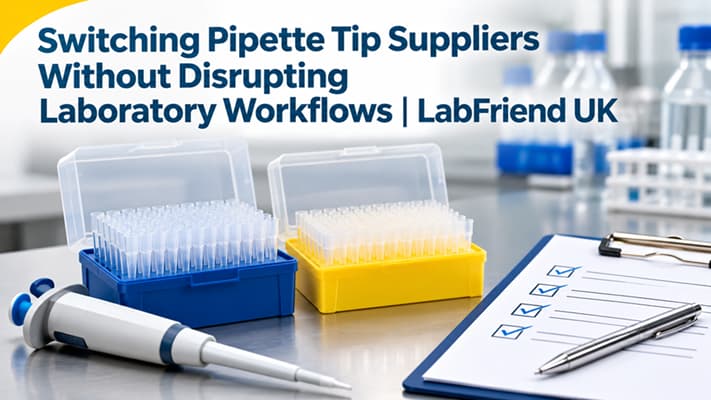
21 mins read
Switching Pipette Tip Suppliers Without Disrupting Laboratory Workflows