How QA-QC Labs Should Check Centrifuge Tube RCF Rotor and Documentation Requirements
27 mins read
How QA-QC Labs Should Check Centrifuge Tube RCF Rotor and Documentation Requirements
By Donal O’Sullivan, BSc. Reviewed by Michael Anderson, MBA.
Opening answer
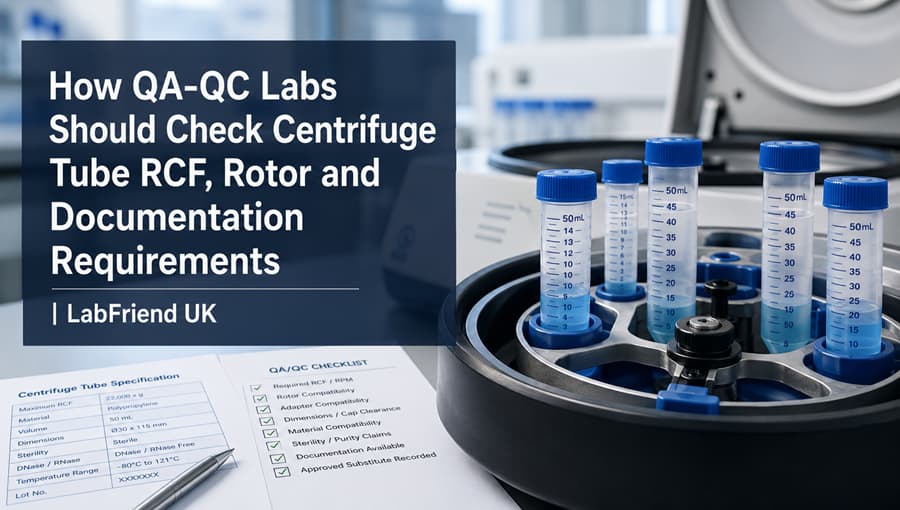
QA/QC laboratories should check centrifuge tube suitability by reviewing the tube’s product-specific RCF (relative centrifugal force) rating, rotor and adapter compatibility, material, cap design, dimensions, fill conditions and supporting documentation before purchase or substitution. The question is not simply whether the tube is 15 mL, 50 mL, sterile or made from polypropylene. The question is whether the tube is documented as suitable for the laboratory’s centrifugation conditions and workflow requirements.
For QA/QC teams, this matters because centrifuge tubes are often used in repeat methods, controlled workflows, sample preparation routines and documented procedures. A tube that appears equivalent can still differ in maximum RCF, cap design, dimensions, sterility status, DNase/RNase claims, material grade or available documentation.
Laboratories reviewing options can start with LabFriend UK’s centrifuge tubes, but the purchasing decision should always be supported by product-specific evidence. For the technical background on RCF, RPM and rotor compatibility, read Understanding RCF, RPM and Rotor Compatibility for Centrifuge Tubes.
Why QA/QC labs need a documentation-led approach
In many research environments, a centrifuge tube may be selected because it is the right volume, available from stock and familiar to the team. In QA/QC environments, that is usually not enough.
QA/QC laboratories often work with repeat sample preparation steps, controlled methods, internal SOPs, batch records, client requirements or accredited workflows. Even where a consumable is relatively routine, the laboratory may still need to show why a product was selected, whether it is suitable for the intended conditions and what evidence supports a substitution.
This does not mean every centrifuge tube purchase requires a formal validation exercise. The level of control should match the workflow risk and the laboratory’s own quality system. However, it does mean that QA/QC teams should avoid undocumented assumptions.
A tube should not be accepted for a controlled workflow simply because it is the same nominal size as the previous product. It should be reviewed against the conditions in which it will actually be used.
The QA/QC selection principle
The practical QA/QC principle is:
Approve centrifuge tubes by documented suitability, not by appearance, habit or nominal volume alone.
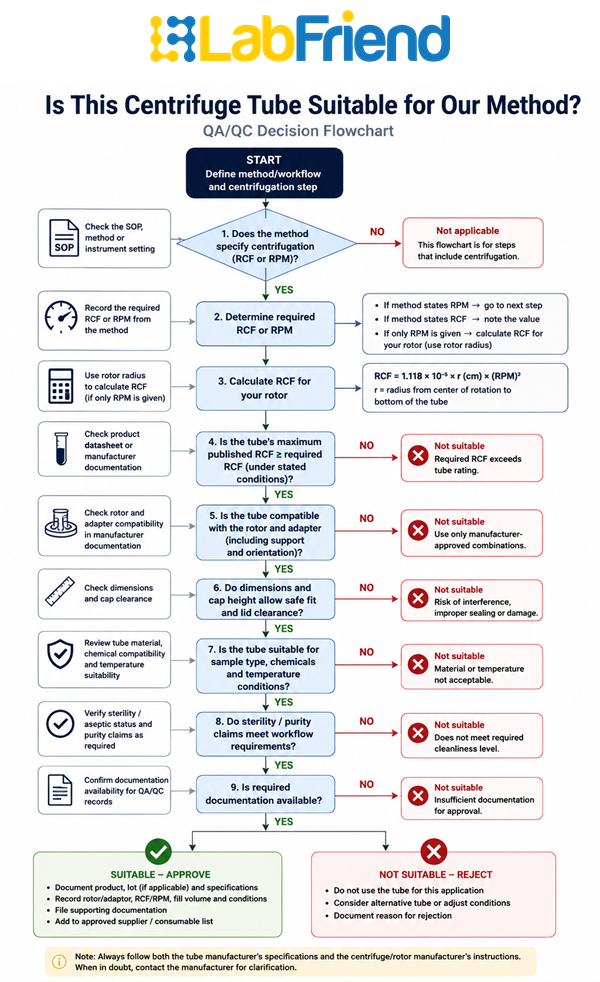
This distinction is important because several different requirements can sit behind a simple purchasing request. A buyer may ask for “50 mL sterile centrifuge tubes,” but the laboratory may also need to know whether the tubes are aseptic or sterile, whether DNase/RNase-free status matters, whether the tubes will be centrifuged at a defined RCF, whether they fit the rotor adapter, and whether product documentation is available.
In a controlled laboratory, the best purchasing decision is the one that protects the method while keeping repeat ordering practical. Procurement efficiency is useful, but it should follow technical suitability rather than replace it.
RCF is product-specific and condition-dependent
RCF, or relative centrifugal force, describes the force experienced by the sample during centrifugation. RPM (revolutions per minute) describes rotor speed. The two are related, but they are not the same thing. RCF depends on rotor radius as well as RPM, which means the same RPM can generate different forces in different rotors. The relevant rotor radius is measured from the centre of the centrifuge spindle to the point in the tube where the sample sits furthest from the axis, so the same rotor can produce different RCF values at different fill levels or tube positions. As a reference, RCF can be estimated using the formula RCF (× g) = 1.118 × 10⁻⁵ × r × N², where r is the rotor radius in centimetres and N is the speed in RPM; many centrifuge and rotor manufacturers also provide RCF/RPM conversion charts or built-in calculators for this purpose.
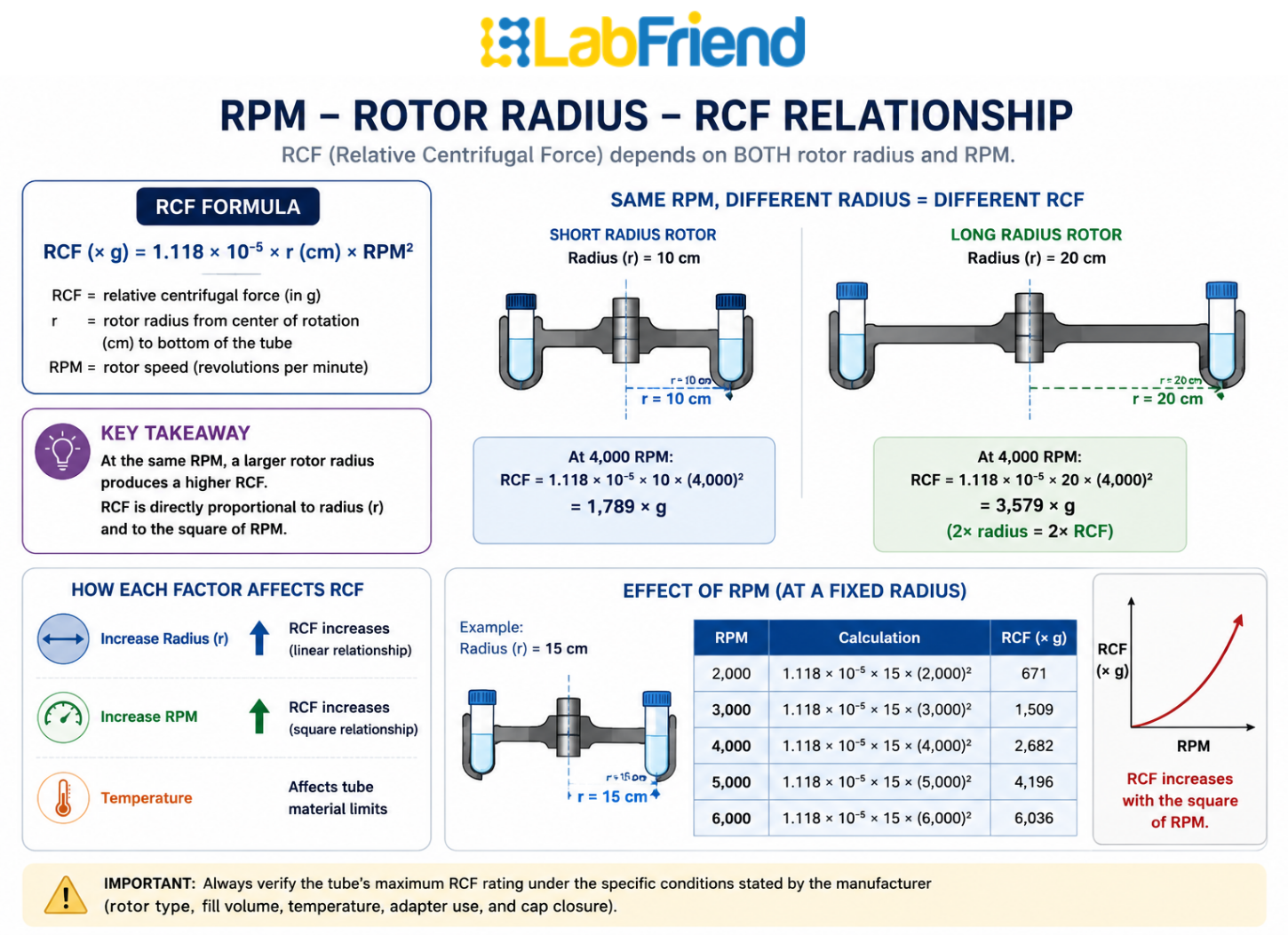
For QA/QC laboratories, this is not just a technical detail. If a method specifies a centrifugation condition, the laboratory needs to check whether the tube, rotor, adapter and centrifuge setup can support that condition.
A maximum RCF value should be treated as product-specific. It should not be generalised across every tube of the same volume, brand or material. Two 15 mL tubes may not have the same rating. Two 50 mL tubes may not behave the same way under force. The rating may also depend on manufacturer-stated conditions such as fill volume, temperature, rotor support or cap closure. In many polymer tubes, the maximum rated RCF is derated at higher temperatures because the mechanical strength of the plastic decreases as temperature rises, so a rating confirmed at room temperature may not apply at elevated or physiological temperatures.
That is why the QA/QC review should include both the tube specification and the centrifuge setup.
What QA/QC teams should check for RCF suitability
The RCF review does not need to be complicated, but it should be deliberate.
The laboratory should identify the required centrifugation condition first. If the SOP or method states RCF, check the tube’s maximum rated RCF directly. If the method states RPM, confirm the equivalent RCF for the specific rotor radius before comparing it with the tube specification.
The review should then confirm whether the tube is suitable for the intended force, sample volume, temperature, rotor type and adapter support. Tube wall thickness and moulding design also influence the maximum force a tube can safely withstand, so two tubes of the same material and nominal volume can still carry different RCF ratings. Physical fit is not enough. A tube may fit into a rotor or bucket and still be unsuitable if it is unsupported, too tall, incompatible with the cap clearance, or used above its documented rating.
|
QA/QC check |
Why it matters |
Evidence source |
|
Required RCF or RPM |
Confirms the centrifugation condition used in the method |
SOP, method or instrument setting |
|
Rotor radius and rotor type |
Needed to understand RCF and tube behaviour |
Centrifuge or rotor documentation |
|
Tube maximum RCF |
Confirms product-specific force limit |
Product page, datasheet or manufacturer documentation |
|
Tube dimensions |
Confirms physical fit and cap clearance |
Product specification |
|
Adapter or bucket support |
Confirms the tube is properly supported |
Rotor/accessory documentation |
|
Fill volume and sample type |
Affects stress, balance and leakage risk |
SOP and manufacturer guidance |
|
Tube balancing |
Confirms opposing tubes are matched in weight to prevent rotor imbalance during the run |
SOP and centrifuge operating instructions |
|
Temperature condition |
Important for refrigerated or low-temperature workflows |
Method and product documentation |
|
Freeze/thaw or cryogenic use |
Confirms the tube material remains suitable (non-brittle, non-leaking) at the required storage or processing temperature |
Product specification or manufacturer documentation |
This table should be adapted to the laboratory’s own quality system. The important point is that the basis for suitability should be visible and repeatable.
Rotor compatibility is more than physical fit
In QA/QC purchasing, “it fits” should not be treated as full compatibility.
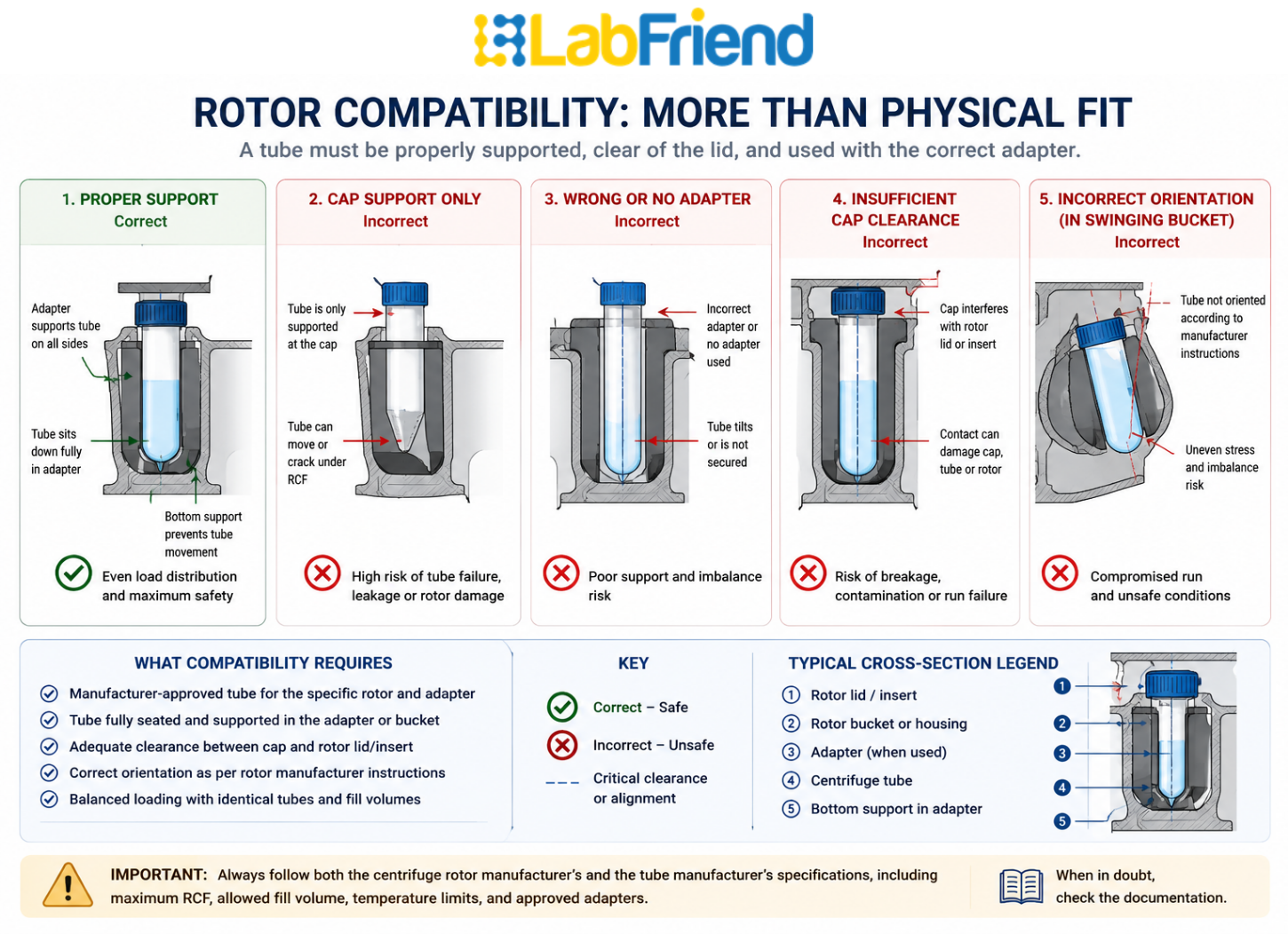
A centrifuge tube should be checked against the rotor, bucket or adapter in which it will be used. This includes diameter, height, bottom shape, cap clearance, support along the tube body, maximum rotor RCF, balancing requirements and any manufacturer restrictions.
The same tube may be acceptable in one rotor and unsuitable in another. A fixed-angle rotor and a swinging-bucket rotor can place different demands on the tube. In a fixed-angle rotor the centrifugal force acts at an angle to the tube's long axis, driving the pellet toward the side and bottom of the tube, whereas a swinging-bucket rotor aligns the force close to the tube axis and drives the pellet toward the tube base; this difference affects both pellet location and the stress pattern the tube wall experiences. An adapter may support one tube shape well but leave another poorly supported. A tube’s maximum rated RCF is generally validated using the manufacturer’s specified adapter, so using the tube in a different or unapproved adapter can reduce the effective maximum RCF below the value stated on the product documentation. A cap may clear one bucket lid but interfere with another.
This is why QA/QC teams should avoid approving a tube only from a catalogue description. Product data and instrument compatibility need to be considered together. Where the laboratory is also reviewing centrifuge equipment, LabFriend UK’s benchtop centrifuges category can provide relevant equipment context, but final compatibility should always be checked against the centrifuge and rotor documentation.
Documentation requirements for QA/QC purchasing
The documentation required for a centrifuge tube depends on the workflow. A routine non-controlled preparation step may only need a product page or specification sheet. A controlled QA/QC method may require more formal evidence, such as manufacturer datasheets, lot information, certificates or internal change-control records. Where the laboratory operates under a formal quality framework such as ISO/IEC 17025 or GLP, documentation requirements for consumable selection and substitution should also be checked against that framework's own record-keeping and traceability requirements.
The purpose of documentation is not to create unnecessary administration. It is to make the purchasing decision defensible. If a tube is used in a repeat method, the laboratory should be able to explain what was purchased, why it was considered suitable and what changed if a substitute was introduced.
|
Documentation item |
When it may be needed |
What it helps confirm |
|
Product specification |
Most purchasing decisions |
Volume, material, dimensions, cap type and pack format |
|
Manufacturer datasheet |
Controlled or repeat workflows |
Detailed product limits and usage conditions |
|
Maximum RCF statement |
Any centrifugation workflow |
Product-specific force suitability |
|
Sterility or aseptic claim |
Contamination-sensitive workflows |
Whether the product carries the stated claim |
|
DNase/RNase claim |
Molecular biology or nucleic acid workflows |
Whether nuclease-related claims are documented |
|
Lot or batch information |
QA/QC or traceability-sensitive workflows |
Product traceability where required |
|
Certificate or declaration |
Higher-control workflows |
Stated product claims or manufacturing information |
|
Internal substitution record |
Supplier or product change |
Why a replacement was accepted |
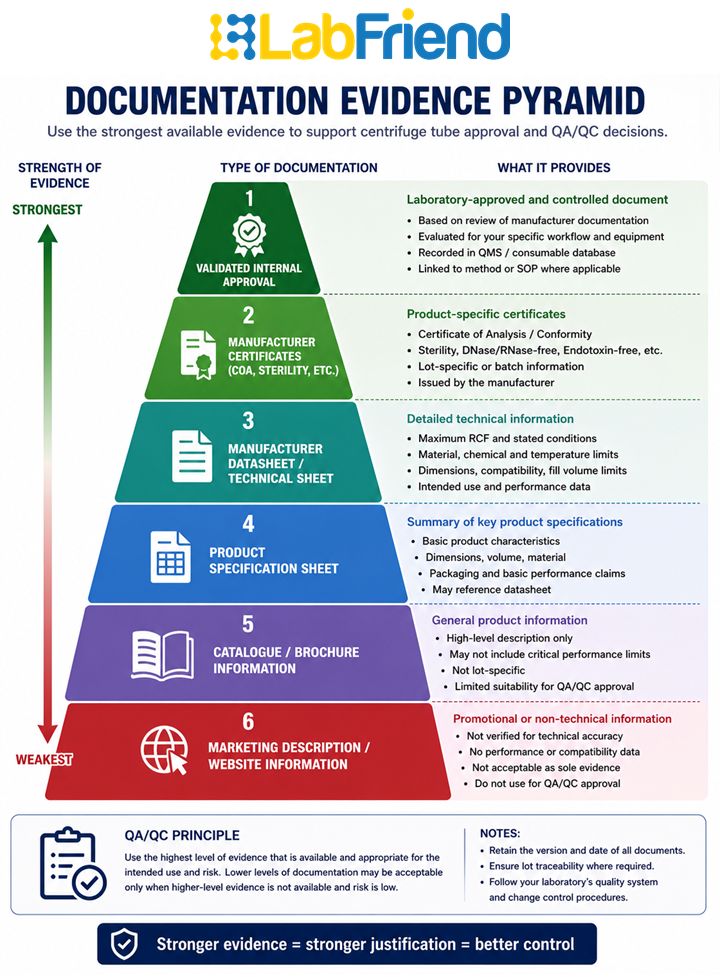
Not every product will provide every document, and not every workflow needs every document. The QA/QC team should define the minimum evidence required for each type of use.
Product-page specifications: how to read them carefully
Product pages can be useful starting points because they often contain structured specifications such as nominal capacity, material, dimensions, cap type, bottom shape, sterility status and maximum RCF. QA/QC teams should read those fields carefully and avoid inferring claims that are not stated.
For example, a product page may show a maximum RCF value. That value should be read as a product-specific specification, not as a general statement about all tubes of the same volume. Similarly, a page may state that a product is aseptic, sterile, non-sterile, DNase-free or RNase-free. Those words should not be treated as interchangeable.
A useful QA/QC habit is to ask:
What does the page explicitly state, and what does it not state?
If a tube is described as aseptic, that does not automatically mean it is DNase-free or RNase-free. If a tube is polypropylene, that does not automatically mean it is chemically compatible with every reagent. If a tube has a maximum RCF listed, that does not automatically confirm suitability for every rotor, adapter or fill condition.
That careful reading protects the laboratory from accidental over-interpretation.
Sterility, aseptic status and purity claims
QA/QC laboratories should be particularly careful with contamination-control language.
Sterile, aseptic, DNase-free, RNase-free, endotoxin-free, non-pyrogenic and PCR-clean are not the same claim. They may relate to different risks and different workflows. In particular, “sterile” typically indicates the product has been processed to a validated sterility assurance level, while “aseptic” typically describes manufacture under controlled conditions without a terminal sterilisation step, and the two should not be treated as interchangeable evidence of the same level of contamination control. Claims such as DNase-free, RNase-free and PCR-clean are most relevant to laboratories working with nucleic acids or performing molecular biology techniques; QA/QC teams outside these workflows may not need to request them, and should confirm which claims are actually required for their own method before adding them to a specification. A product may carry one claim but not another.
This matters because purchasing language can become imprecise. A user may request “sterile tubes” when they actually need DNase/RNase-free tubes for a nucleic acid workflow. Another user may request “clean tubes” without specifying whether sterility, endotoxin control or nuclease control is the real requirement.
For contamination-control decisions, read sterile vs non-sterile centrifuge tubes. In QA/QC purchasing, the rule should be simple: use only the claim that is explicitly supported by product documentation.
Material and chemical compatibility
Material selection also needs careful handling. Polypropylene is commonly used for centrifuge tubes and is suitable for many routine laboratory workflows, but material alone does not confirm compatibility with every sample, solvent, reagent, temperature condition or centrifugation setup.
Polystyrene, polypropylene, PPCO and other materials can differ in clarity, mechanical behaviour, chemical resistance and temperature suitability. A QA/QC team should therefore avoid approving substitutes based only on volume and general material name.
For material-selection background, read polypropylene vs polystyrene centrifuge tubes. For controlled workflows, final suitability should be checked against manufacturer information and the laboratory’s own method requirements.
Supplier switching in QA/QC environments
Supplier switching can be commercially sensible. A new product may offer better value, improved availability, easier ordering or better alignment with the laboratory’s purchasing process. However, QA/QC laboratories should treat centrifuge tube substitution as a controlled decision when the tube is used in a defined workflow.
The review does not always need to be complex. For a low-risk routine task, a documented comparison may be enough. For a controlled method, the laboratory’s own quality system may require technical approval, change control, method review or user acceptance.
The key point is that a substitute should not be accepted because it is “similar enough” on appearance. It should be compared against the required specification.
|
Substitution factor |
QA/QC question |
|
Volume |
Is the nominal and practical working volume suitable? |
|
Dimensions |
Will the tube fit the rotor, adapter, rack and storage format? |
|
Material |
Is the material suitable for the workflow? |
|
Cap design |
Does the closure meet handling and leakage-risk requirements? |
|
RCF rating |
Is the maximum RCF suitable for the method? |
|
Sterility or aseptic status |
Does the product carry the required claim? |
|
DNase/RNase status |
Are nuclease claims required and explicitly documented? |
|
Documentation |
Is the required evidence available? |
|
User acceptance |
Has the tube been checked in representative handling conditions where needed? |
|
Internal approval |
Does the laboratory’s quality system require sign-off? |
Where supplier standardisation is part of a wider purchasing strategy, the article on standardising centrifuge tube purchasing can support the procurement discussion.
Common QA/QC mistakes
Assuming all tubes with the same volume are equivalent
A 15 mL or 50 mL label does not confirm material, RCF rating, dimensions, cap performance, sterility status or documentation availability. Volume is only one selection criterion.
Treating RPM as a complete compatibility check
RPM alone does not describe the force applied to the sample. If the method or instrument uses RPM, QA/QC teams should confirm the equivalent RCF for the rotor being used.
Checking fit but not support
A tube that fits inside a rotor cavity may still be poorly supported. Adapter fit, tube shape, cap clearance and manufacturer guidance all matter.
Treating sterile as a broad purity claim
Sterility does not automatically confirm DNase-free, RNase-free, endotoxin-free, non-pyrogenic or PCR-clean status. These claims should be checked separately. Where an endotoxin-free or non-pyrogenic claim is stated, it should be understood as testing to a defined endotoxin threshold (typically expressed in EU/mL or EU/tube) rather than an absolute absence of endotoxin.
Changing supplier without recording the basis for acceptance
If the tube is used in a repeat or controlled workflow, the laboratory should be able to explain why the substitute was accepted. That does not always require a lengthy document, but it should be clear enough for the workflow risk.
What this article does not solve
This article supports QA/QC decision-making, but it does not replace the laboratory’s own quality system, method requirements, instrument manuals or manufacturer documentation.
It does not confirm that any specific centrifuge tube is suitable for a regulated method, clinical workflow, diagnostic workflow, GMP environment, accredited method, cryogenic condition, chemical exposure, rotor system or internal SOP.
It also does not confirm that a product is validated for a laboratory’s method. Suitability, substitution and change-control decisions must be made by the laboratory using the appropriate evidence and internal approval process.
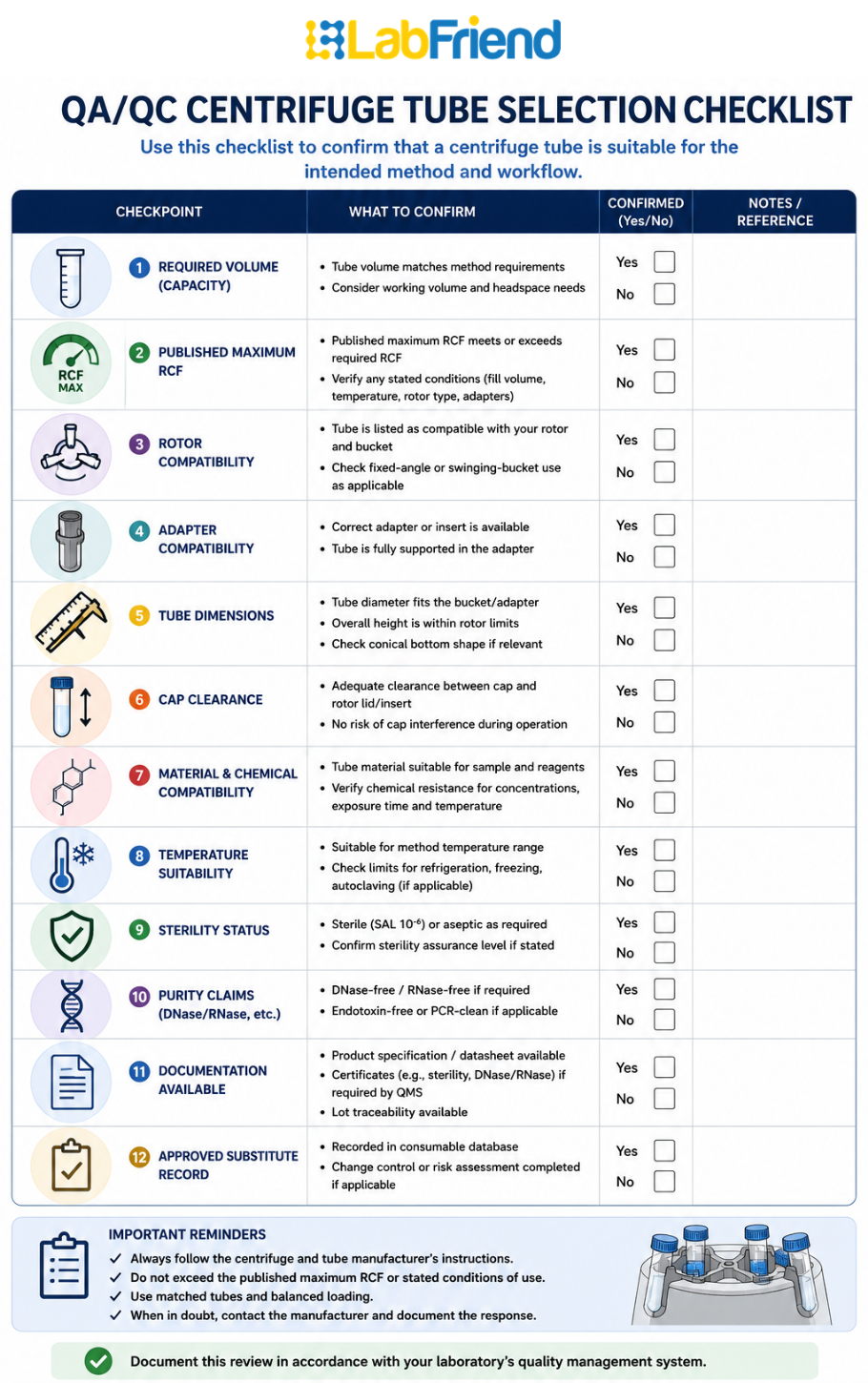
Practical QA/QC purchasing framework
A practical QA/QC purchasing process can be kept simple while still being evidence-led.
Start by defining the workflow. Identify whether the tube is used for routine sample handling, centrifugation, biological work, molecular biology, QA/QC sample preparation or a controlled method. Then identify the technical requirement: volume, material, RCF, rotor fit, cap design, sterility, purity claims and documentation.
Once the required specification is clear, compare candidate products against that specification. If the product is a repeat purchase, record the accepted product and any approved substitutes. If the product is being changed, record the reason for the change and the basis for acceptance.
This framework helps QA/QC teams avoid two opposite problems: excessive administrative burden for routine consumables, and uncontrolled substitution where documentation matters.
When to involve procurement, QA and technical users
Centrifuge tube purchasing often sits between procurement and the laboratory team. Procurement may control supplier choice, price and ordering. Technical users understand workflow needs. QA/QC managers understand documentation and change-control expectations.
The best decisions usually involve all three perspectives when risk is meaningful. Procurement can identify value and availability options. Technical users can confirm practical suitability. QA/QC can decide what evidence is required before the product is accepted for a controlled workflow.
This collaborative approach is particularly useful when switching supplier, introducing LLG Labware alternatives, changing pack format, moving between sterile and non-sterile products, or approving a tube for use across multiple departments.
Frequently asked questions
How should QA/QC labs check centrifuge tube RCF before purchase?
QA/QC labs should compare the product-specific maximum RCF with the centrifugation conditions used in the method. If the method uses RPM, the equivalent RCF should be confirmed using the rotor radius. The tube, rotor, adapter, fill volume and sample conditions should be considered together.
Is RPM enough to confirm centrifuge tube compatibility?
No. RPM is rotor speed, not the force experienced by the sample. RCF depends on RPM and rotor radius, so the same RPM can produce different forces in different rotors.
Does physical fit mean a centrifuge tube is compatible?
No. Physical fit is only one part of compatibility. The laboratory should also check tube dimensions, adapter support, cap clearance, maximum RCF, fill conditions, material and manufacturer guidance.
What documentation should QA/QC teams request for centrifuge tubes?
The required documentation depends on the workflow. It may include product specifications, manufacturer datasheets, maximum RCF information, sterility or aseptic claims, DNase/RNase claims, lot information, certificates or internal substitution records.
Can QA/QC labs substitute one centrifuge tube for another?
Yes, but substitution should be based on documented comparison. Volume, material, dimensions, cap design, RCF rating, sterility or aseptic status, purity claims and documentation should be reviewed before approval.
Does sterile mean DNase-free or RNase-free?
No. Sterile, DNase-free and RNase-free are separate claims. DNase-free or RNase-free status must be explicitly stated where required. DNase-free and RNase-free claims are typically based on manufacturer testing to the detection limit of a defined assay rather than an absolute guarantee of zero enzyme presence, so the specific test method should be checked where nucleic acid work is highly sensitive.
Are product page specifications enough for QA/QC approval?
Sometimes they may be enough for low-risk workflows, but controlled methods may require datasheets, certificates, lot information or internal approval. The laboratory’s own quality system should define the evidence required.
Should QA/QC labs record centrifuge tube substitutions?
For repeat or controlled workflows, yes. The record should explain what changed, why the substitute was considered acceptable and what evidence supported the decision.
Are RCF-rated tubes suitable for all centrifuges?
No. A product-specific RCF rating does not automatically confirm suitability for every rotor, adapter, fill condition or temperature. The centrifuge setup must still be checked.
What is the biggest QA/QC risk when buying centrifuge tubes?
The biggest risk is assuming equivalence without evidence. Tubes that look similar may differ in RCF rating, dimensions, material, cap design, sterility, purity claims or documentation.
Conclusion
QA/QC laboratories should select centrifuge tubes through a documentation-led process that protects workflow suitability and repeat purchasing control.
The essential checks are product-specific RCF rating, rotor and adapter compatibility, tube dimensions, material, cap design, fill conditions, sterility or aseptic status, purity claims and supporting documentation. These checks should be proportionate to the workflow risk and the laboratory’s own quality system.
A centrifuge tube does not become suitable because it is the right nominal volume or because it physically fits the rotor. It becomes suitable when the laboratory can show that its specification supports the intended workflow.
To review suitable options, browse LabFriend UK’s centrifuge tubes. For broader technical context, read the Complete Guide to Centrifuge Tubes and Understanding RCF, RPM and Rotor Compatibility for Centrifuge Tubes.
Article End Before CTA
Written by: Donal O’Sullivan, BSc, Co-Founder and Sales Director, LabFriend UK. Donal brings deep chemistry-led technical expertise across analytical chemistry, biochemistry, environmental monitoring, laboratory instrumentation, consumables and scientific product selection.
Reviewed by: Michael Anderson, MBA, Founder and Managing Director, LabFriend UK. Michael reviews LabFriend UK content for customer relevance, commercial accuracy, operational practicality and alignment with LabFriend UK’s laboratory supply model.
Frequently asked questions
Delivery times vary by product and supplier. Each product page shows current stock levels and the expected lead time, and we confirm this when you place your order. Most items arrive within 2 to 3 weeks. Specialised items can take longer if they are not in stock. If you need something by a certain date, contact us and we’ll check for you.
Yes. Register for a commercial account and, once it’s approved, you will be able to process orders via PO Once you have a commercial account, you can directly email your purchase orders
Add products to your cart and click Get a Quote. You’ll get a formal quote instantly, ready to send to your email address. For bulk orders or custom requirements, send us your product list and we’ll reply with itemized pricing.
If your item is faulty, not as described or sent in error, let us know within 14 days of delivery and we’ll arrange a return. Change of mind returns are only accepted if the item is unused and in its original packaging. A restocking fee will apply and you pay the return freight. Read our full Returns Policy for details.
Yes, prices are shown including VAT by default. Use the Prices Inc. VAT toggle at the top of the page to view prices without VAT.