

Share :
Narrow-Mouth vs Wide-Mouth Laboratory Bottles: Which Should You Choose?
Updated On 09/01/2026

By Donal O’Sullivan, BSc. Reviewed by Michael Anderson, MBA.
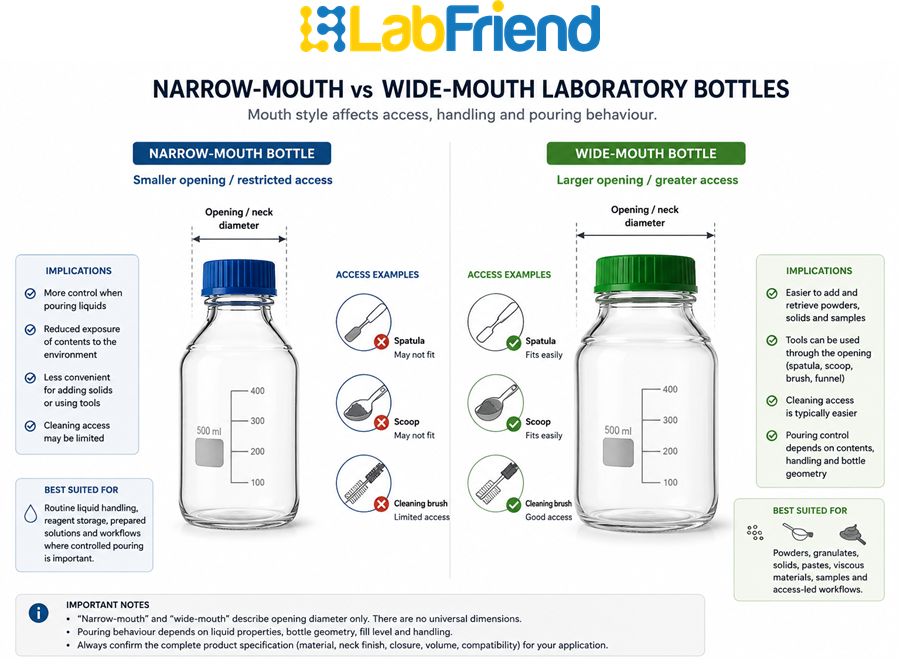
Narrow-mouth laboratory bottles are often useful where controlled pouring, routine liquid handling and reduced opening exposure matter. Wide-mouth laboratory bottles are often useful where filling access, powders, solids, samples, viscous materials, emptying or cleaning access matter.
The right choice depends on how the bottle will be filled, handled, poured, accessed, emptied, cleaned, stored and reused. Mouth style is one part of the bottle specification, not a complete suitability decision. It should be checked alongside the contents, material, volume, cap/thread, closure, storage conditions and documentation requirements.
For broader bottle-selection context, read LabFriend UK’s Laboratory Bottles: Selection Guide for UK Laboratories. Once the mouth style is clear, you can compare narrow-mouth laboratory bottles and wide-mouth laboratory bottles by format, material, volume and closure requirement.
Why mouth style matters in practical lab work
The opening of a laboratory bottle affects how the bottle behaves in everyday use. It influences how easily material can be added, how controlled pouring feels, how much access the user has, whether contents can be retrieved easily, how practical cleaning may be, and whether the bottle suits the workflow on the bench.
This is why mouth style should not be treated as an afterthought. A 500 ml narrow-mouth bottle and a 500 ml wide-mouth bottle may share the same nominal capacity, but they can feel very different in use. One may support controlled liquid transfer. The other may make powders, solids, pastes or sample retrieval more practical.
The best mouth style is not the one that looks most convenient in isolation. It is the one that supports the way the bottle will actually be used. Scientists and researchers should start with the application: what is going into the bottle, how it will be transferred, whether the contents need to be poured, scooped, mixed, inspected, emptied or cleaned, and whether the closure system remains suitable.
A simple rule of thumb is useful but incomplete: narrow-mouth formats often suit routine liquid handling; wide-mouth formats often suit filling access and solid materials. This is a generalisation about opening diameter only, and it does not mean wide-mouth formats exclude liquid use — wide-mouth bottles, such as media bottles, are also routinely used for liquids. Real laboratory selection needs more judgement than that.
When narrow-mouth bottles are useful
Narrow-mouth bottles are often selected for liquids where controlled pouring is important. The smaller opening can make transfer more manageable in routine handling, especially where users are pouring from the bottle into another vessel, dispensing into a workflow or storing prepared solutions.
They may also be useful where the user wants to reduce the open area during handling. This does not make the bottle automatically safer or more suitable, but it may be practical in workflows where liquid handling is routine and access into the bottle is not a priority.
Narrow-mouth formats are commonly considered for liquid storage, reagent handling, prepared solutions, sample storage and general laboratory workflows where pouring control matters more than internal access.
However, narrow-mouth bottles can become inconvenient where the user needs to add powders, granulates, solids or viscous materials. They may also be less practical where a spatula, scoop, funnel, brush or cleaning tool needs access to the inside of the bottle. How much of an issue this is often depends on neck diameter and particle size: very fine, free-flowing granulates can still be manageable through some narrow necks, while coarser or bulkier materials generally cannot.
For liquid-handling workflows, you can compare narrow-mouth laboratory bottles once the required volume, material and closure are known.
When wide-mouth bottles are useful
Wide-mouth bottles are often selected where access matters. The larger opening can make filling, emptying, retrieving contents and cleaning more practical. This can be important for powders, granulates, solids, samples, pastes, viscous materials or workflows where the user needs to work directly through the bottle opening.
A wide-mouth format may also be useful where material is added using a scoop, spatula, funnel or other transfer tool. It can reduce the difficulty of getting material into the bottle, especially where the contents do not pour easily. This mainly reduces the risk of spillage or bridging when adding solids by hand or with a scoop; for liquids, fill accuracy depends more on pouring control and spout design than on mouth width alone.
Wide-mouth bottles can also support workflows where cleaning access matters. That does not mean they are automatically easy or safe to clean in every case. Residue, contamination risk, bottle material, shape, contents and laboratory procedure still matter. But where access is a practical requirement, the mouth style can make a real difference.
For powders, solids, samples or access-led workflows, you can compare wide-mouth laboratory bottles after confirming the full specification.
Narrow-mouth vs wide-mouth comparison
|
Selection factor |
Narrow-mouth bottles |
Wide-mouth bottles |
Practical decision point |
|
Liquid pouring |
Often useful for controlled liquid transfer |
May be less controlled depending on contents and handling |
Is pouring control important? |
|
Powders and solids |
May be awkward for scooping or filling |
Often more practical for adding and retrieving solids |
Does the user need access through the opening? |
|
Viscous materials |
Can be difficult to fill or empty |
May be easier to fill, empty or access |
How easily will the material move? |
|
Sample retrieval |
Limited access may be a drawback |
Larger opening may help retrieval |
Does the sample need to be removed manually? |
|
Cleaning access |
May be harder to clean manually |
May allow better access for cleaning |
Is cleaning part of the workflow? |
|
Exposure during opening |
Smaller opening may reduce open area |
Larger opening increases access and exposure |
Does exposure matter for the contents? |
|
Cap and closure |
Commonly uses a different neck finish/thread than wide-mouth (e.g. GL25/GL32) |
Commonly uses a different neck finish/thread than narrow-mouth (e.g. GL45); caps are typically not interchangeable between formats |
Are bottle and closure specified together? |
|
Storage and labelling |
Depends on bottle shape and size |
Depends on bottle shape and size |
Does it fit the storage location and label requirement? |
This table should be used as a selection guide, not as a universal rule. The correct mouth style depends on the actual workflow.
Liquids, powders, solids, pastes and viscous materials
Contents are one of the strongest drivers of mouth-style selection. Free-flowing liquids may be well suited to narrow-mouth bottles where pouring control matters. Powders, granulates and solids often benefit from a wider opening because the user may need to add or remove material with a scoop, spatula or funnel.
Viscous materials need particular care. They may pour slowly, cling to surfaces or leave residue. A narrow-mouth bottle may be difficult to fill or empty if the material does not flow easily. A wide-mouth bottle may improve access, but it does not automatically solve residue or contamination concerns. Viscosity is also temperature-dependent, so how a material flows — and therefore which mouth style suits it best — can change with storage or handling temperature; a liquid that pours easily at room temperature may become significantly more viscous when refrigerated.
The same applies to samples. Some samples are liquid and pour easily. Others are particulate, semi-solid, heterogeneous or difficult to retrieve. The mouth style should support both storage and removal, not just initial filling.
For reagent storage, mouth style should be considered alongside material, volume, cap/thread and chemical-storage requirements. Where reagent suitability is a key part of the decision, use the technical guide to selecting reagent bottles for chemical storage alongside this mouth-style guide.
Filling, pouring, dispensing and sample retrieval
A bottle that is easy to fill may not be easy to pour. A bottle that pours well may not be easy to clean. This is why mouth style should be selected around the full workflow rather than one task.
For filling, wide-mouth bottles can be more forgiving, especially where material is added manually or where powders, solids or viscous liquids are involved. For pouring, narrow-mouth bottles can be more practical where the user needs a controlled stream of liquid. For dispensing, the closure system, thread, cap and accessory compatibility may matter as much as the opening.
Sample retrieval is another important factor. If the user needs to remove the contents with a tool, inspect the inside of the bottle or recover material after storage, a wider opening may be more practical. If the contents are only poured out, a narrow opening may be sufficient.
Use this as the deciding question:
Does the workflow need controlled transfer out of the bottle, easy access into the bottle, or both?
If both are important, the user may need to compare formats carefully rather than defaulting to one mouth style.
Cleaning, residue and contamination considerations
Cleaning is often overlooked during bottle selection. In some workflows, the bottle is single-use or disposed of according to procedure. In others, it may be rinsed, washed, reused or prepared for another process. Where cleaning is part of the workflow, mouth style matters.
Wide-mouth bottles may provide better access for cleaning tools, rinsing and visual inspection. Narrow-mouth bottles may be harder to access internally. However, mouth style does not confirm whether a bottle is suitable for reuse, sterilisation, autoclaving or contamination-sensitive work. Reuse and sterilisation are also distinct considerations: reusability depends on material degradation and cleanability over repeated cycles, while sterilisation depends on a specific validated process, so neither should be treated as a single combined check.
Residue can also influence the choice. Powders, viscous materials, oils, biological materials and precipitating solutions can leave deposits. A wider opening may make residue easier to see or access, but cleaning suitability still depends on material, shape, procedure and product documentation.
If contamination control, sterility, certification (which can mean different things, such as material compliance, sterility certification or batch/lot documentation), pre-cleaning or regulated workflow requirements apply, the bottle should be selected using the relevant method, Standard Operating Procedure (SOP) and product documentation. Mouth style alone does not confirm suitability.
Volume, headspace and mouth style
Mouth style interacts with volume. A small narrow-mouth bottle may be easy to handle for routine liquid storage. A larger narrow-mouth bottle may still pour in a controlled way, but the filled weight and handling posture may become more important. A wide-mouth bottle may make filling easier, but the larger opening can change how the user handles the contents.
The same nominal volume can behave differently depending on opening style. A 1 litre narrow-neck reagent bottle and a 1 litre wide-neck sample jar may hold an identical volume on the label, but one will typically suit controlled pouring while the other will typically suit adding or retrieving solid or particulate material.
Headspace should also be considered. Some workflows require space for mixing or safe handling, and freezing has its own headspace driver: aqueous liquids expand as they freeze, which is a distinct consideration from headspace needed for mixing or venting. Mouth style does not replace that working-volume decision. It should sit alongside volume, fill level and headspace checks.
Deeper volume-selection guidance — covering working volume, fill level and headspace requirements in more detail — should be checked alongside the mouth-style decision covered in this article, particularly for workflows involving mixing, expansion or freezing.
Cap/thread and closure compatibility
Mouth style is closely linked to the closure system. A bottle body should not be selected without checking the cap, thread, liner, seal and closure requirement. A narrow-mouth and wide-mouth bottle may use different cap formats, and replacement caps may not be interchangeable. Cap and closure interchangeability is governed by the bottle’s neck finish and thread specification, not simply by the narrow-mouth or wide-mouth category — for example, narrow-mouth bottles are commonly specified with GL25 or GL32 threads, while wide-mouth bottles are more commonly specified with GL45, though this should always be confirmed against the specific product range before ordering.
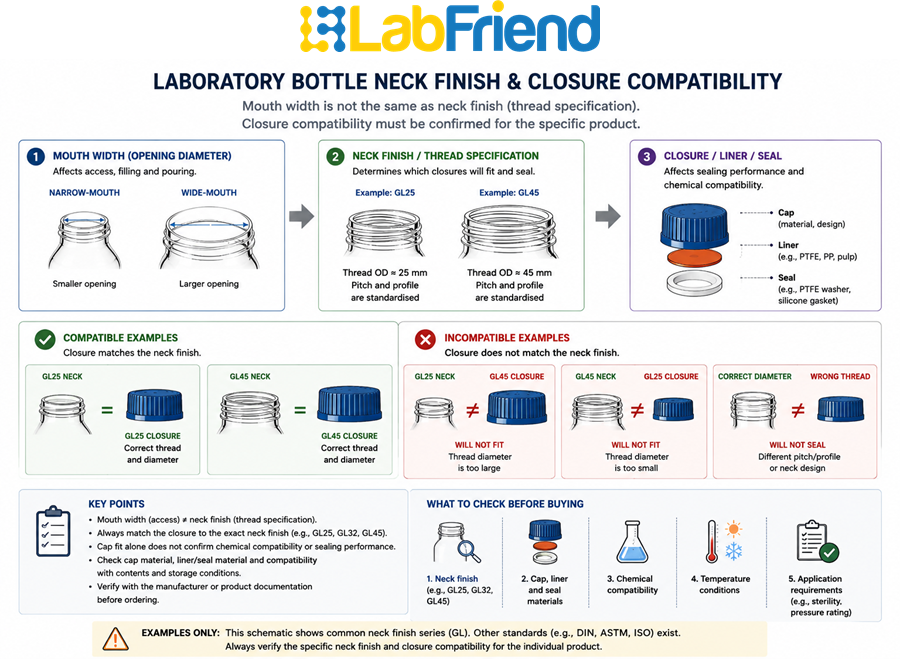
This matters in routine laboratory use because mismatched caps can create leakage, evaporation, contamination, labelling or storage problems. It also matters for repeat ordering. If the bottle and cap are ordered separately, the product codes should be captured together.
A good selection record should identify the bottle product code, cap/thread, closure or liner requirement, pack size and any acceptable alternatives. This prevents the laboratory from selecting the right bottle shape but the wrong closure later.
Mouth style should therefore be treated as part of the complete bottle system, not a standalone feature.
Material, storage and documentation checks
A mouth-style decision should always be checked alongside bottle material. Glass, amber glass, HDPE, LDPE, PP and other materials can differ in chemical compatibility, temperature behaviour, flexibility, impact or breakage risk (more relevant to glass) versus stress-cracking or softening risk (more relevant to plastics), transparency, light protection and handling. The opening does not determine any of those properties. Closure liners, such as PTFE-lined caps, are a related material-compatibility consideration and should be checked alongside the bottle material itself.
If the workflow involves chemical storage, temperature exposure, freezing, autoclaving, light-sensitive contents, sterile handling, certified bottles or contamination-sensitive materials, the product documentation should be checked before purchase. Autoclave suitability also depends on the cap or closure — for example, whether it needs to be loosened, is vented, or is itself autoclave-rated — and on the stated temperature rating of both bottle and cap, not the bottle body alone. Light sensitivity is a property of the bottle material and colour (for example, amber versus clear glass, or UV-stabilised plastics) rather than something mouth style itself affects.
Where material choice is part of the decision, LabFriend UK’s laboratory bottle materials explained guide can support the comparison. Where the decision includes glass or plastic bottle format, the glass vs plastic laboratory bottle comparison may also be useful.
The important point is simple: mouth style affects usability, but material and documentation determine whether the bottle is suitable for the contents and conditions.
Common mistakes when choosing mouth style
Mistake 1: assuming narrow-mouth bottles are always best for liquids. They are often useful for controlled pouring, but not every liquid workflow is the same. Viscosity, filling method, cleaning, storage and closure still matter.
Mistake 2: assuming wide-mouth bottles are always best for powders or solids. They may provide better access, but volatile, dusty, hazardous, contamination-sensitive or method-controlled materials may require additional controls.
Mistake 3: focusing on the opening and forgetting the cap. The selected bottle and closure should work together. A bottle that suits the contents may still be a poor choice if the cap, liner or thread does not match the workflow.
Mistake 4: choosing the mouth style without considering cleaning. If residue, reuse or inspection matters, access into the bottle should be part of the selection decision.
Mistake 5: treating mouth style as proof of suitability. It is not. Chemical compatibility, sterility, certification, cleanliness, autoclave suitability and temperature suitability must be confirmed separately.
What this article does not solve
This article helps scientists and researchers compare narrow-mouth and wide-mouth laboratory bottles. It does not confirm that a specific bottle is chemically compatible, sterile, certified, pre-cleaned, autoclavable, freezer-suitable, pressure-rated, vacuum-rated or method-approved.
Those checks must come from product documentation, manufacturer information, Safety Data Sheets (SDS), a Control of Substances Hazardous to Health (COSHH) assessment, method requirements, SOPs and local laboratory procedures. This documentation is typically available on the relevant product page or from LabFriend UK support, and it should always be checked against the specific product before ordering.
Standard laboratory bottles should not be used for pressure, vacuum, sealed heating or gas-generating reactions unless the product documentation specifically confirms suitability for that use.
What to check before buying
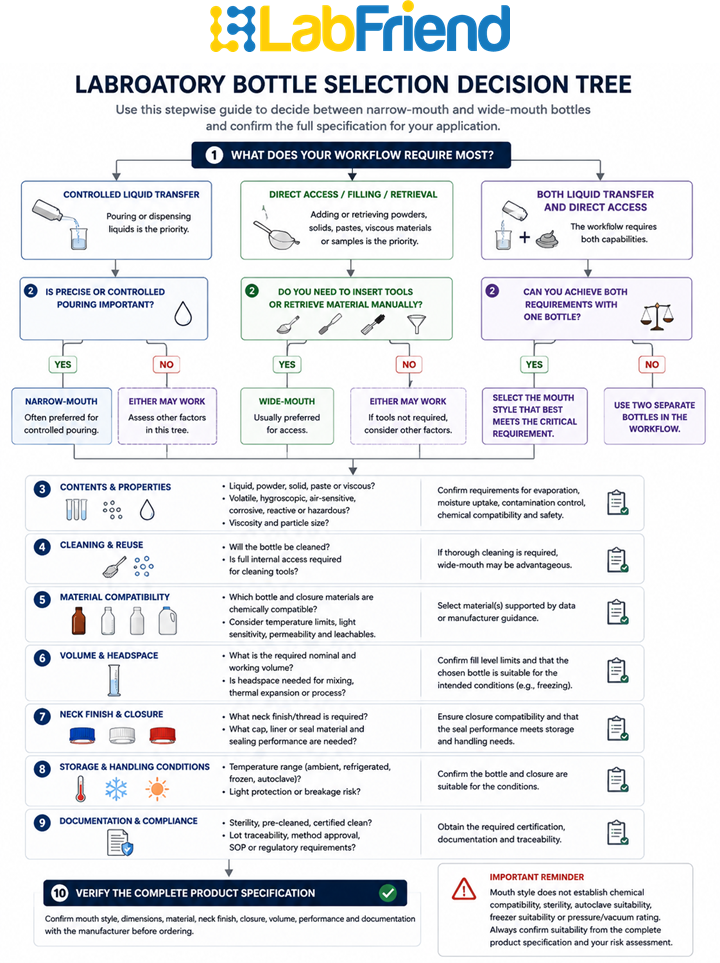
Before selecting a narrow-mouth or wide-mouth laboratory bottle, check how the bottle will be used in practice.
|
Check |
Question to ask |
|
Contents |
Is the bottle for liquids, powders, solids, samples, pastes or viscous materials? |
|
Filling method |
Will the contents be poured, scooped, funnelled or transferred manually? |
|
Pouring control |
Does the user need controlled liquid transfer? |
|
Access |
Does the user need to reach into the bottle or retrieve material? |
|
Cleaning |
Will the bottle need rinsing, washing, inspection or reuse? |
|
Volume and headspace |
Does the bottle need working volume or headspace beyond nominal capacity? |
|
Material |
Is glass, amber glass, HDPE, LDPE, PP or another material required? |
|
Cap/thread |
Does the closure match the bottle format and workflow? |
|
Storage condition |
Will the bottle be stored on the bench, shelf, fridge, freezer, cabinet or controlled area? |
|
Documentation |
Is sterility, certification, pre-cleaning or method approval required? |
|
Repeat ordering |
Are bottle and cap product codes captured together? |
|
Labelling |
Will the label adhere and stay legible in the storage condition used (e.g. bench, fridge, freezer or chemical exposure)? |
This checklist should support selection, but it should not replace product-specific documentation.
Where to compare bottle options once the mouth style is clear
Once the mouth style is clear, follow this sequence to compare bottle options that match the workflow.
If controlled pouring and routine liquid handling are the priority, start with narrow-mouth laboratory bottles. If filling access, powders, solids, samples, viscous materials or cleaning access matter, compare wide-mouth laboratory bottles.
Next, for reagent storage, compare laboratory reagent bottles by volume, material, cap/thread and bottle format. If the decision is specifically about glass formats, you can review narrow-mouth glass bottle search results or wide-mouth glass bottle search results. If the decision is about plastic formats, review narrow-mouth plastic bottle search results or wide-mouth plastic bottle search results.
For broader context, review laboratory glassware or browse laboratory consumables and glassware. If the mouth style, material, closure or documentation requirement is uncertain, contact LabFriend UK for support before ordering.
The correct sequence is: confirm the contents and workflow, choose the appropriate mouth style, check material and closure suitability, then compare suitable bottle options.
FAQs
What is the difference between narrow-mouth and wide-mouth laboratory bottles?
Narrow-mouth bottles have a smaller opening and are often useful where controlled liquid pouring matters. Wide-mouth bottles have a larger opening and are often useful where filling access, powders, solids, samples, viscous materials or cleaning access matter. These formats are sometimes also referred to as narrow-neck and wide-neck bottles.
When should I use a narrow-mouth laboratory bottle?
Use a narrow-mouth bottle where the workflow involves routine liquid handling, controlled pouring or storage where internal access is not a priority. Confirm material, volume, cap/thread and closure suitability before buying.
When should I use a wide-mouth laboratory bottle?
Use a wide-mouth bottle where the user needs easier filling, emptying, sample retrieval, cleaning access or transfer of powders, solids, granulates, pastes or viscous materials.
Are narrow-mouth bottles better for liquids?
They are often useful for liquids where controlled pouring matters, but they are not automatically best for every liquid. Viscosity, filling method, cleaning, closure and storage conditions should still be checked.
Are wide-mouth bottles better for powders?
They are often more practical for powders and solids because the larger opening improves access. However, dusty, hazardous, volatile or contamination-sensitive materials may need additional workflow controls.
Which bottle mouth style is easier to clean?
Wide-mouth bottles may provide better access for cleaning, rinsing or inspection, but cleaning suitability also depends on the contents, residue, bottle material, shape, procedure and product documentation.
Does bottle mouth style affect pouring?
Yes. Narrow-mouth bottles may support more controlled liquid pouring. Wide-mouth bottles may be better for access and filling, but pouring behaviour depends on contents, volume, bottle shape and handling.
Does bottle mouth style affect cap compatibility?
Yes. Mouth style can affect thread, cap, liner and closure compatibility. Bottle and closure should be selected as a complete system, especially where replacement caps are ordered separately.
Can I use the same volume in narrow-mouth and wide-mouth bottles?
Often the same nominal volume may be available in both formats, but the working experience can differ. Filling, pouring, emptying, cleaning and handling may not be the same.
What should I check before buying narrow-mouth or wide-mouth bottles?
Check contents, filling method, pouring control, access, cleaning, volume, headspace, material, cap/thread, storage condition, labelling, documentation requirements and repeat-order product codes.
Does mouth style affect the price of a laboratory bottle?
Not directly. Price is typically driven more by material, volume and brand than by whether the bottle is narrow-mouth or wide-mouth, so cost is rarely the deciding factor in mouth-style selection.
Conclusion
Narrow-mouth and wide-mouth laboratory bottles should be selected around the workflow, not around a simple rule. Narrow-mouth bottles are often useful where controlled pouring and routine liquid handling matter. Wide-mouth bottles are often useful where filling access, powders, solids, samples, viscous materials or cleaning access matter.
The best choice depends on how the bottle will be filled, handled, poured, accessed, emptied, cleaned, stored and reordered. Mouth style should be checked alongside volume, material, cap/thread, closure, storage conditions and documentation requirements.
Once the requirement is clear, compare narrow-mouth laboratory bottles, wide-mouth laboratory bottles, laboratory reagent bottles, or broader laboratory glassware depending on the workflow.
Compare narrow-mouth and wide-mouth laboratory bottle options
Confirm the contents, filling method, pouring needs, access requirements, cleaning workflow, volume, material and closure first. Then compare LabFriend UK’s narrow-mouth laboratory bottles, wide-mouth laboratory bottles, or contact LabFriend UK for support matching bottle mouth style, material and closure requirements.
Read more from LabFriend UK
- Laboratory Bottles: Selection Guide for UK Laboratories
- How to Select Laboratory Reagent Bottles for Chemical Storage
- Laboratory Bottle Materials Explained
- Glass vs Plastic Laboratory Bottles: Which Should UK Labs Choose?
Explore more from LabFriend UK
Written by: Donal O’Sullivan, BSc, Co-Founder and Sales Director, LabFriend UK. Donal brings deep chemistry-led technical expertise across analytical chemistry, biochemistry, environmental monitoring, laboratory instrumentation, consumables and scientific product selection.
Reviewed by: Michael Anderson, MBA, Founder and Managing Director, LabFriend UK. Michael reviews LabFriend UK content for customer relevance, commercial accuracy, operational practicality and alignment with LabFriend UK’s laboratory supply model.
Related Stories

Choosing Bottles for Sterile Sampling and Contamination-Sensitive Workflows
Choosing Bottles for Sterile Sampling and Contamination-Sensitive Workflows
Autoclavable Laboratory Bottles for QA/QC Labs - Specification and Documentation Checks
Autoclavable Laboratory Bottles for QA/QC Labs - Specification and Documentation Checks
Autoclavable Laboratory Bottles - What to Check Before Buying
Autoclavable Laboratory Bottles - What to Check Before Buying
Narrow-Mouth vs Wide-Mouth Bottles for Lab Managers - Reducing Handling Errors and Stock Complexity
Narrow-Mouth vs Wide-Mouth Bottles for Lab Managers - Reducing Handling Errors and Stock Complexity