

Share :
Low Protein Binding Membranes Explained for Laboratory Filtration
Updated On 09/08/2026

By Donal O’Sullivan, BSc. Reviewed by Michael Anderson, MBA.
When laboratories filter protein-containing or biological samples, removing unwanted particles is only part of the job.
The filtration step should also avoid unnecessarily removing
the material the laboratory actually wants to retain.
That is where low-protein-binding membranes become
important.
A low-protein-binding membrane is selected to minimise
unwanted nonspecific adsorption of proteins and other biological macromolecules
to the filtration surface. This can help protect analyte recovery when
preparing protein samples, biological solutions, buffers and other
recovery-sensitive materials.
However, the term needs to be interpreted carefully.
Low protein binding does not mean zero protein binding.
Nor does choosing a membrane commonly described as low
binding guarantee complete protein recovery.
Regenerated cellulose (RC), polyethersulfone (PES) and
appropriate PVDF products can all be relevant to protein-sensitive filtration.
The correct choice depends on the specific filter product, the protein or
biomolecule, sample chemistry, concentration, sample volume, membrane area and
the level of recovery the method requires.
The most useful selection principle is therefore:
Use “low protein binding” to identify suitable membrane
candidates. Use the actual sample and required recovery to determine whether
the filtration device is suitable.
What Does “Low Protein Binding” Actually Mean?
“Low protein binding” is a comparative description rather
than a guarantee that no protein will interact with a membrane.
Where manufacturers quantify protein adsorption, the result
is generally linked to a defined test method, protein and set of test
conditions rather than a single universal value that applies to every sample.
That distinction matters because proteins are not a single
uniform class of analytes.
They vary in characteristics including:
- molecular
size;
- structure;
- charge
distribution;
- hydrophobic
and hydrophilic regions;
- concentration;
and
- behaviour
under different solution conditions.
The surrounding sample environment also matters. Changes in
pH, ionic strength, buffer composition, solvents, surfactants and other
formulation components can influence how a protein interacts with a filtration
surface.
A membrane that provides good recovery for one protein
formulation should therefore not automatically be assumed to provide identical
performance with another.
For most researchers, the useful question is not simply:
“Is this membrane described as low protein binding?”
It is:
“Does this filtration device provide acceptable recovery
under the conditions in which I intend to use it?”
Why
Protein Adsorption Matters During Filtration
Every filtration membrane creates a surface that comes into
contact with the sample.
For straightforward particulate-removal applications,
attention naturally focuses on what the membrane retains physically.
Protein-containing samples introduce an additional concern.
Proteins can interact with the membrane and other
sample-contacting surfaces. If some of the target material becomes associated
with those surfaces, less may appear in the collected filtrate.
That can matter in applications such as:
- quantitative
protein analysis;
- biochemical
assays;
- sample
preparation;
- downstream
chromatography;
- biological
experiments; and
- limited-volume
or low-concentration samples.
The practical significance depends on the application.
A modest absolute loss from a plentiful, concentrated
preparation may have little effect on the outcome.
The same loss from a scarce, low-concentration sample could
be much more important.
This is why low-protein-binding filtration is ultimately
about protecting the downstream workflow, not simply choosing a filter
with a particular description on its specification sheet.

Protein Adsorption and Overall Recovery Are Not the Same Thing
Protein adsorption is one possible cause of sample loss.
Overall recovery is the broader outcome.
A useful way to think about the process is:
Starting protein sample
→ contact with membrane and filtration device
→ possible adsorption, device interaction and retained liquid
→ protein recovered in the filtrate
→ downstream measurement or use
Recovery can be expressed conceptually as:
% recovery = (protein measured in filtrate ÷ protein
present in starting sample) × 100
If a sample contains 100 µg of protein before filtration and
92 µg is measured afterwards, recovery is 92%.
The missing 8% should not automatically be attributed to
membrane adsorption alone. Other sample-contacting surfaces, device hold-up and
the filtration procedure may also contribute.
This becomes particularly important when comparing complete
filtration devices.
Two filters described as, for example, 0.22 µm RC syringe
filters may share a membrane family and nominal pore size while differing
in membrane area, housing construction or other characteristics relevant to
recovery.
The complete filter matters, not just the polymer
abbreviation.
What Influences Protein–Membrane Interaction?
Researchers do not need a complete surface-chemistry model
to make sensible filtration decisions.
The main principle is that protein behaviour depends on the
interaction between:
the protein + the solution environment + the
membrane/device surface
Material chemistry, wettability and product-specific surface
characteristics can influence how aqueous biological samples behave during
filtration.
Hydrophilic membranes are therefore commonly considered for
aqueous protein and biological applications.
The submitted guidance identifies RC and PES as hydrophilic
membrane families used in aqueous workflows and recognises hydrophilic PVDF
variants as relevant to protein-sensitive filtration.
But hydrophilic and low protein binding should
not be treated as interchangeable specifications.
A membrane may wet readily with an aqueous sample without
necessarily providing adequate protein recovery for every application.
Protein concentration also changes the practical importance
of filtration loss.
Recovery deserves greater scrutiny when the workflow
combines:
low concentration + low sample volume + valuable material
+ sensitive downstream measurement.
RC vs PES vs PVDF for Protein-Sensitive Filtration
There is no scientifically defensible universal ranking in
which every RC, PES and PVDF filter can be placed in a fixed best-to-worst
order.
All three can be legitimate candidates when the specific
product and sample are appropriate.
Regenerated Cellulose — RC
RC is an important membrane technology where unwanted
adsorption and sample compatibility both matter.
The submitted guidance describes RC as hydrophilic and low
in unwanted protein adsorption, with useful compatibility across many aqueous
and mixed aqueous-organic applications.
That combination can make RC attractive where a laboratory
needs:
aqueous wettability + relatively low unwanted adsorption
+ broad sample compatibility
RC can be particularly relevant when biological and
analytical sample-preparation workflows overlap.
However, “broad compatibility” should not be interpreted as
universal compatibility. Strong acids, strong bases and aggressive solvent
environments can still require product-specific verification.
RC should therefore be treated as a strong candidate
where its adsorption and compatibility characteristics fit the sample, not
as a universal solution.
Polyethersulfone — PES
PES is another important membrane family for aqueous
biological filtration.
Suitable PES products are commonly considered where
researchers need low protein binding, aqueous compatibility and efficient flow.
Typical applications can include:
- aqueous
protein samples;
- biological
buffers;
- cell-culture-related
preparations;
- routine
biological solutions; and
- higher-throughput
aqueous workflows.
But the specific filter still matters.
Flow depends not only on the polymer but also on
characteristics such as membrane structure and the complete product design.
The letters PES should therefore identify a candidate
membrane family, not replace review of the actual filter specification.
PVDF
PVDF requires particular attention to the specific variant.
Unmodified PVDF is inherently hydrophobic. For aqueous,
protein-sensitive filtration, appropriately specified hydrophilic or
surface-modified low-binding PVDF products are the relevant candidates.
This is why specifying “PVDF” alone may be insufficient.
The useful question is:
What are the surface characteristics and intended
applications of this particular PVDF filter?
A suitable hydrophilic, low-binding PVDF product may perform
very well in a biological workflow.
Another PVDF product designed for a different application
should not automatically be considered equivalent.
Practical comparison
|
Selection consideration |
RC |
PES |
PVDF |
|
Protein-sensitive filtration |
Strong low-adsorption candidate where product is suitable |
Suitable low-binding products widely used |
Appropriate low-binding variants can be strong candidates |
|
Aqueous samples |
Strong candidate where compatible |
Common application area |
Hydrophilic variants can be appropriate |
|
Mixed aqueous-organic samples |
Broad compatibility can be a useful strength |
Check specific product |
Check specific product |
|
Biological workflows |
Relevant where recovery matters |
Particularly prominent in aqueous biological filtration |
Relevant where the appropriate low-binding variant is
specified |
|
Flow / throughput |
Product dependent |
Efficient flow is a common reason for selection |
Product dependent |
|
Critical recovery |
Verify with actual application |
Verify with actual application |
Verify with actual application |
The key point is simple:
Membrane family creates the shortlist. The actual product
and application determine approval.
Does Pore Size Affect Protein Binding?
Pore size and protein binding are separate selection
variables.
A 0.22 µm membrane is not automatically lower protein
binding than a 0.45 µm membrane simply because the nominal pore size is smaller.
Pore size should primarily be selected according to what the
filtration step needs to retain or remove.
Protein binding relates to unwanted interaction between the
sample and the membrane/device.
These are two different questions:
What pore size does the method require?
and
What membrane/device provides acceptable compatibility and
recovery?
Can a 0.22 µm filter remove protein?
For many dissolved proteins, a 0.22 µm microfiltration
membrane should not be thought of as a conventional molecular-size separation
device.
Microfiltration membranes use µm-scale pore ratings for
particulate or microbial removal.
Size-based separation of proteins by molecular size is
instead associated with ultrafiltration membranes rated by molecular-weight
cut-off, or MWCO.
That does not mean protein recovery through a 0.22 µm filter
must be complete.
Proteins can still interact with the membrane or other
device surfaces, and aggregates or other structures in biological samples may
behave differently from individual dissolved molecules.

.
Why Sample Volume and Filter Diameter Matter
Membrane chemistry is not the only factor affecting
recovery.
Filter diameter influences membrane area and generally
affects device capacity.
A larger filter can provide more filtration area, which can
be useful for larger sample volumes or greater particulate loading.
But more membrane area also creates more surface contact
with the sample.
For a very small, valuable protein sample, a substantially
oversized device may therefore provide unnecessary capacity.
The opposite mistake is also possible.
A device that is too small for the volume or particulate
burden may block prematurely or become impractical to use.
The correct objective is not:
smallest filter = best recovery
or:
largest filter = best performance
It is:
Use a filtration device appropriately sized for the sample
volume, particulate load and required recovery.
Device hold-up can also become particularly important where
only a small volume of sample is available.
A Practical Low-Protein-Binding Filter Selection Framework
A good selection process should start with the sample, not
with a preferred membrane polymer.
1. Define the filtration objective
What does the filtration step need to accomplish?
Clarification, particulate removal, sample preparation and
microbial-retention applications are not interchangeable requirements.
2. Characterise the complete sample
Understand:
- protein
or biomolecule;
- concentration;
- sample
volume;
- formulation
or buffer;
- pH
where relevant;
- salts,
surfactants and additives;
- organic
components;
- particulate
burden; and
- downstream
use.
The term “protein sample” alone is not a complete
filtration specification.
3. Establish compatibility
Remove chemically unsuitable membrane/device candidates
before optimising protein-binding characteristics.
A filter with excellent low-binding characteristics is still
unsuitable if the sample damages or is incompatible with the device.
4. Determine how important recovery is
Ask:
Would filtration-related loss materially affect the
experimental or analytical result?
A plentiful routine buffer and a scarce low-concentration
protein immediately before quantitative analysis do not require the same level
of scrutiny.
5. Shortlist suitable membrane and device options
Use RC, PES, PVDF or another appropriate membrane as
candidate technologies.
Then review the specifications of the actual products.
Select the required pore size and an appropriate device
diameter for the volume and particulate burden.
6. Evaluate recovery where the risk justifies it
For critical recovery-sensitive workflows, representative
testing can determine whether the chosen device performs acceptably.
The level of evidence should be proportionate to the
consequence of sample loss.

When Should Protein Recovery Be Tested?
Not every routine filtration requires an extensive
validation study.
Testing becomes more valuable when the target material is:
- present
at low concentration;
- difficult
or expensive to produce;
- available
only in limited volume;
- important
to quantitative analysis; or
- sensitive
to the sample-preparation process.
A practical comparison can involve an appropriate reference
or unfiltered control and material passed through the candidate filter.
Conditions should reflect the actual intended workflow.
Relevant variables may include:
- protein
or biomolecule;
- concentration;
- buffer
or formulation;
- sample
volume;
- membrane/filter
product;
- pore
size;
- filter
diameter;
- filtration
procedure; and
- method
used to assess recovery.
The purpose is not necessarily to demonstrate perfect
recovery.
It is to determine whether the process provides acceptable
and reproducible recovery for the intended use.
And conclusions should remain application-specific.
A result from one filter, protein and formulation should not
be generalised into a statement that an entire membrane family universally
provides the same recovery.

Common Low-Protein-Binding Filter Selection Mistakes
Looking for a universal “lowest-binding” membrane
There is no single polymer that can be assumed to be best
for every protein and formulation.
Better approach: shortlist technically suitable
products and evaluate them against the actual sample.
Treating low binding as zero binding
Low binding reduces unwanted adsorption but does not
guarantee complete recovery.
Better approach: consider recovery explicitly where
loss could affect the result.
Choosing by polymer abbreviation alone
RC, PES and PVDF describe membrane families, not complete
filtration devices.
Better approach: review the specification of the
actual filter product.
Ignoring sample chemistry
A low-binding membrane still needs to be compatible with the
complete formulation.
Better approach: establish compatibility before
optimising secondary characteristics.
Assuming smaller pore size means lower protein binding
A 0.22 µm membrane is not inherently lower binding than a
0.45 µm membrane.
Better approach: choose pore size for the filtration
objective and membrane/device characteristics for compatibility and recovery.
Ignoring filter diameter and device hold-up
Membrane area, capacity and retained liquid can matter,
particularly for small-volume samples.
Better approach: match the device format to sample
volume and filtration requirements.
These mistakes and corrective principles are drawn directly
from the submitted selection guidance.
Frequently Asked Questions
What is a low-protein-binding membrane?
A low-protein-binding membrane is selected to minimise
unwanted nonspecific adsorption of proteins and other biological macromolecules
to the filtration surface.
Lower adsorption can help protect recovery, but it does not
mean zero binding or guarantee complete recovery.
Which membrane has the lowest protein binding?
There is no universal RC-versus-PES-versus-PVDF ranking that
applies to every product, protein and formulation.
All three membrane families can contain products relevant to
protein-sensitive filtration.
The correct choice depends on the actual product and sample.
Is regenerated cellulose low protein binding?
RC is commonly considered where relatively low nonspecific
adsorption and good sample recovery are important.
Its hydrophilic behaviour and broad compatibility across
many aqueous and mixed aqueous-organic systems can make it particularly useful,
provided the specific product is compatible with the sample.
Is PES low protein binding?
Appropriate PES products are widely used in aqueous
biological filtration because low protein binding and good aqueous flow can be
valuable characteristics.
The actual filter specification should still be checked
rather than assuming that all PES products are interchangeable.
Is PVDF low protein binding?
Appropriate PVDF products can provide low-protein-binding
performance, particularly hydrophilic variants intended for aqueous biological
applications.
Because PVDF products can differ in surface characteristics,
the specific filter should be reviewed carefully.
Can a syringe filter reduce protein recovery?
Potentially.
Unwanted interaction with the membrane or other
sample-contacting surfaces can contribute to loss. Device hold-up and other
aspects of the filtration process can also influence the amount recovered.
Does protein concentration affect the importance of
filtration loss?
Yes.
For a low-concentration sample, a given amount of loss can
represent a greater proportion of the available target material than it would
in a more concentrated sample.
Where concentration is low and downstream measurement is
recovery-sensitive, the filtration process deserves greater scrutiny.
Does filter diameter affect protein recovery?
Filter diameter changes membrane area and generally affects
filtration capacity.
Device hold-up and sample-contact area can also become
important for small-volume recovery-sensitive samples.
The correct diameter should therefore reflect sample volume,
particulate burden, required capacity and sensitivity to sample loss.
Does pore size affect protein binding?
Pore size and protein binding are different selection
considerations.
Select pore size according to the filtration objective.
Select the membrane and device according to compatibility, recovery and other
application requirements.
Conclusion
Low-protein-binding membranes are important because
filtration should remove what the laboratory intends to remove without
unnecessarily sacrificing the protein, biomolecule or analyte it wants to
recover.
But low protein binding is not a guarantee of zero
protein loss.
RC, PES and appropriate PVDF products can all have
legitimate roles in protein-sensitive laboratory filtration.
Their membrane-family characteristics help create a
shortlist.
The final decision should be based on:
the actual filter + the complete sample + the required
filtration performance.
Consider the protein and its concentration. Check the
complete formulation for compatibility. Select the pore size required by the
filtration objective. Match the device size to the sample volume and
particulate load.
Where recovery is critical, determine whether the filtration
process performs acceptably under representative conditions.
The central principle is:
Choose the membrane family to create the shortlist.
Choose the actual filter by the performance the sample requires.
Once an appropriate filtration specification has been
established, researchers can compare suitable LabFriend filtration products for
routine and recovery-sensitive laboratory workflows.
Read More
For broader guidance on membrane selection, pore size and
filtration formats, see The Ultimate Guide to Laboratory Filtration for UK Laboratories.
For more detail on regenerated cellulose, see Why Regenerated Cellulose (RC) Membranes are the Universal Standard for Lab Filtration.
For membrane wettability, see Hydrophilic vs Hydrophobic Membranes: How to Choose the Right Filter for Your Laboratory Application.
Written by: Donal O’Sullivan, BSc, Co-Founder and Sales Director, LabFriend UK. Donal brings deep chemistry-led technical expertise across analytical chemistry, biochemistry, environmental monitoring, laboratory instrumentation, consumables and scientific product selection.
Reviewed by: Michael Anderson, MBA, Founder and Managing Director, LabFriend UK. Michael reviews LabFriend UK content for customer relevance, commercial accuracy, operational practicality and alignment with LabFriend UK’s laboratory supply model.
Related Stories

Vacuum Filtration in Analytical and Microbiology Laboratories
Vacuum Filtration in Analytical and Microbiology Laboratories

Cost-Effective Alternatives for Routine Centrifuge Tube Workflows
Cost-Effective Alternatives for Routine Centrifuge Tube Workflows
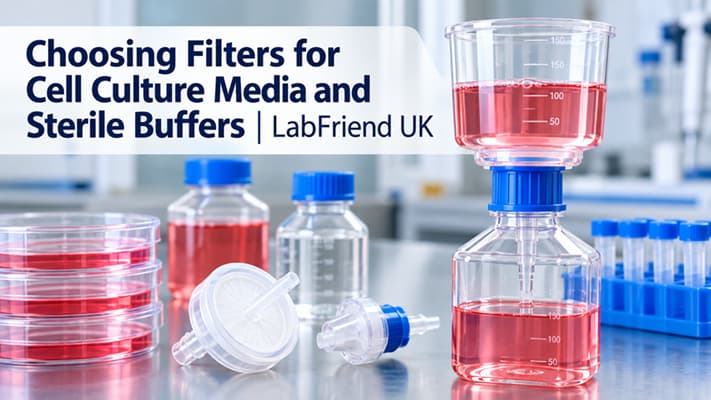
Choosing Filters for Cell Culture Media and Sterile Buffers
Choosing Filters for Cell Culture Media and Sterile Buffers

Centrifuge Tube Supply Planning for CROs and Project-Based Laboratories
Centrifuge Tube Supply Planning for CROs and Project-Based Laboratories