

Share :
How to Choose the Right Pipette: The Ultimate Guide to Accuracy and Lab Efficiency
Updated On 03/16/2026

Whether you are performing PCR preparation, ELISA assays, or handling volatile solvents, your choice of pipette is the single most important factor in protecting your data integrity and reducing user fatigue. Selecting the right laboratory pipette—whether you require a manual single-channel model or an electronic multi-channel system—is essential for achieving consistent experimental results and faster workflow completion.
Choosing the correct manual or electronic pipette ensures:
- Consistent experimental results
- Faster workflow completion
- Reduced risk of repetitive strain injuries (RSI)
- Long-term calibration stability
By understanding the core mechanics of your equipment, you can maintain the high standards required for modern research and ensure long-term calibration stability. At LabFriend UK, we provide high-performance solutions from industry-leading brands to help you achieve precision with every drop.
Key Considerations for Pipette Selection
To optimize your lab's productivity, consider these four critical pillars:
- Technology Type: Decide between air-displacement for routine aqueous tasks and positive-displacement for viscous or volatile samples.
- Workflow Requirements: Choose between single-channel pipettes for individual transfers or multi-channel options for high-throughput plate preparation.
- Actuation Method: Evaluate manual vs. electronic pipetting to improve precision and minimize the risk of repetitive strain injuries (RSI).
- Tip Compatibility: Ensure your tips provide a secure, airtight seal, which is critical for reproducibility
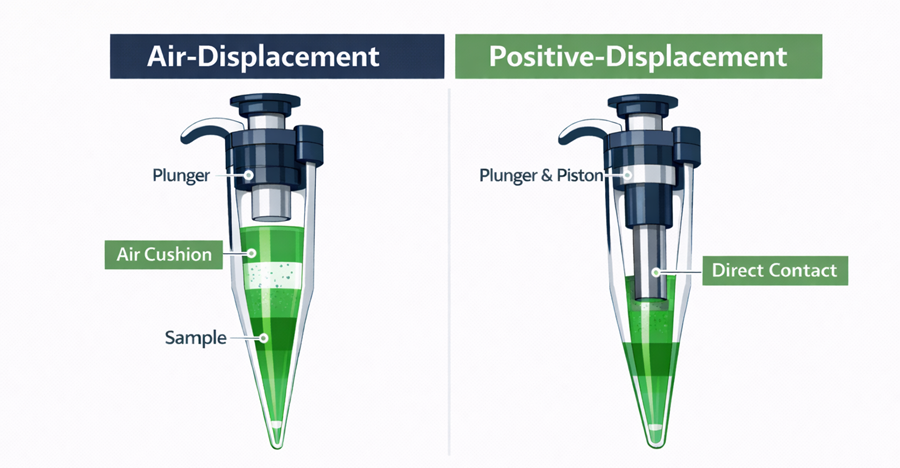
Air-Displacement vs. Positive-Displacement Pipettes: Which Do You Need?
The nature of your sample dictates the technology required.
|
Feature |
Air-Displacement Pipette |
Positive-Displacement Pipette |
|
Mechanism |
Air cushion between piston & liquid |
Piston in direct contact with liquid |
|
Best For |
Aqueous solutions (buffers, water) |
Viscous, volatile, or dense liquids |
|
Accuracy |
High for routine tasks |
Superior for "difficult" samples |
|
Contamination |
Excellent (liquid does not touch piston) |
Highest (disposable piston system) |
|
Consumables |
Standard, low-cost pipette tips |
Specialized capillary/piston tips |
|
Blow-out Step |
Required for full dispensing |
Not required |
Air-Displacement Pipettes (Best for Aqueous Samples)
Ideal for routine tasks and standard molecular biology (DNA/RNA workflows).
- Top Performance: BRAND Transferpette® S (durable/adjustable) and Sartorius Tacta® (ergonomic comfort).
- Cost-Effective Choice: LLG proMLP offers high accuracy with extremely low pipetting force.
Positive-Displacement Pipettes (Best for Difficult Liquids)
When working with viscous (glycerol), volatile (solvents), or dense liquids, air-displacement models may fail.
- Recommended: Gilson Microman® E provides exceptional control for challenging volumes.
- Serial Dispensing: BRAND HandyStep® Touch is the go-to for repetitive dispensing.
Single-Channel vs. Multi-Channel: Maximising Throughput
- Single-Channel: Perfect for individual sample transfers where precision on a single point is key.
- Multi-Channel: Designed to dramatically speed up ELISA and PCR plate preparation.
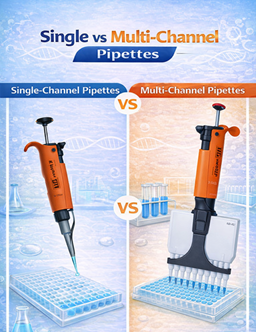
Top Choice: Sartorius Picus® NxT (8- & 12-channel) or the LLG proMLP Multi-Channel
|
Single Channel Pipette |
Multi-Channel Pipettes |
|
Pipettes one sample at a time using a single tip Ideal for precise manual work and low-throughput experiments Perfect for individual sample transfers where precision is key |
Designed to dramatically speed up:
High-throughput labs benefit from:
|
The Shift to Electronic Pipetting
Electronic pipettes eliminate human error by removing inconsistent plunger pressure. They are essential for high-throughput labs to reduce strain during long sessions.
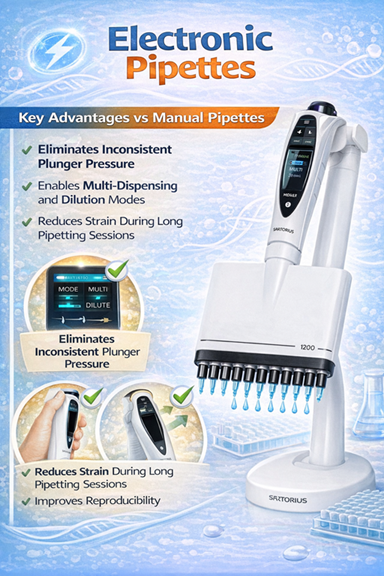
Leading Models:
- Sartorius Picus® NxT Electronic Compact, intuitive digital control
- Brand Trasferpette Renowned for its user-friendly, one-handed operation
- Thermo Finnpipette Secure tip sealing for consistent volumes
Pipette Best Practices for Maximum Accuracy
To maintain precision, follow these industry-standard protocols:
- Work in the Mid-Range: For optimal accuracy, use the mid-range of your pipette's volume (e.g., 50 µL on a 10–100 µL pipette).
- Prioritise Ergonomic Design: Maintains natural wrist posture, reduces thumb force minimising repetitive strain injuries.
- Ensure Tip Compatibility: Poor tip fit is a leading cause of error. Always use compatible tips to ensure a secure, airtight seal.
- Regular Calibration: Calibrate your instruments at least twice annually to prevent calibration drift.
- Proper Storage: Always store pipettes vertically on a stand to prevent internal contamination.
Expert Insight: "The right instrument doesn't just transfer liquid—it safeguards your research."
Browse our Full Range of Pipettes
- Manual micropipettes
- Electronic pipettes
- Single- and multi-channel models
- Pipette tips & accessories
We supply trusted brands including:
- Sartorius
- BRAND
- Thermo Scientific
- LLG
- And many more!
If you are looking to maximize your laboratory budget without compromising on experimental precision, we highly recommend exploring the LLG Labware range. Developed to meet the rigorous demands of daily laboratory use, our private label manual pipettes offer exceptional quality and industry-leading reliability at a highly competitive price point. Whether you are stocking a new facility or upgrading your existing bench equipment, LLG Labware provides a sustainable, high-value solution for all your routine liquid handling requirements. Please note that our current LLG selection is focused on high-performance manual pipetting systems.
Remember:
- Aqueous Solutions: Use Air-Displacement (e.g., BRAND Transferpette S).
- Viscous/Volatile Liquids: Use Positive-Displacement (e.g., Gilson Microman E).
- High-Throughput ELISA: Use Multi-Channel Electronic (e.g., Sartorius Picus NxT).
- Great quality better price: Try the LLG Labware options.
Optimize Your Accuracy with Compatible Pipette Tips
The precision of even the most advanced pipette is only as reliable as its tip. Using incompatible or low-quality tips is a primary cause of measurement error and can compromise the essential airtight seal required for reproducibility. To safeguard your research and ensure a perfect fit every time, explore the LabFriend UK Pipette Tip Range. Our selection includes standard, filtered, and low-retention options designed to deliver a secure, leak-proof seal for all major brands, including Sartorius, BRAND, Thermo Scientific, the value range from LLG Labware and many more.
Frequently Asked Questions about Pipettes
Q: How do I choose between an air-displacement and a positive-displacement pipette?
A: The choice depends on your sample's physical properties. Air-displacement pipettes are the standard for aqueous liquids. However, if you are working with viscous, volatile, or dense liquids (like glycerol or oils), a positive-displacement pipette is required to maintain accuracy and prevent leakage.
Q: When is a multi-channel pipette more efficient than a single-channel model
A: Multi-channel pipettes are designed to speed up high-throughput workflows such as ELISA, PCR plate preparation, and microplate assays. While single-channel pipettes offer maximum precision for individual transfers, multi-channel models ensure consistency across multiple wells simultaneously.
Q: What are the main benefits of switching to an electronic pipette?
A: Electronic pipettes transform repetitive workflows by providing controlled, programmable precision. They significantly reduce human error by eliminating inconsistent plunger pressure and help prevent repetitive strain injuries (RSI) during long pipetting sessions.
Q: How often should laboratory pipettes be calibrated to ensure accuracy?
A: For maximum data integrity, it is recommended to calibrate your pipettes at least twice annually. Regular maintenance, including cleaning seals and pistons and storing instruments vertically on a stand, is essential to prevent calibration drift.
Related Stories

The Ultimate Guide to Choosing the Right Laboratory Mixer
Explanation of the different types of mixers used in laboratories

The Scientist’s Guide to Laboratory Glassware: Material, Precision, and Selection
Guide to choosing glassware

Laboratory Centrifuge Maintenance: A Guide to Safety and Longevity
Centrifuge Maintenance Guide
%20Membranes%20Is%20The%20Universal%20Standard%20for%20Lab%20Filtration%20SML_0.png&w=3840&q=75)
Why Regenerated Cellulose (RC) Membranes are The Universal Standard for Lab Filtration
Cellulose as a filtration medium