

Share :
How to Choose an HPLC Column - Particle Size, Column Dimensions and Guard Columns
Updated On 09/08/2026

By Donal O’Sullivan, BSc. Reviewed by Michael Anderson, MBA.
Choosing an HPLC column is not just a matter of selecting a brand name, a C18 phase or the lowest available price. The column is central to the separation. It influences retention, selectivity, resolution, pressure, run time, sensitivity, reproducibility and method continuity.
For routine chromatography users, the challenge is that many
HPLC columns can look similar in a product listing. Two columns may both be
described as C18, but still differ in base silica, bonding chemistry,
endcapping, carbon load, particle size, pore size, column dimensions, pressure
capability, hardware design and intended method use. Those differences can
matter. This guide is written for analytical, QA/QC and research laboratory
staff involved in HPLC method setup, troubleshooting or column purchasing.
A good HPLC column selection process starts with the method
and analyte, then works back to the column specification. The aim is not simply
to find a column that can produce a separation once. The aim is to select a
column that suits the workflow, can be reordered consistently and can be
controlled if substitutions or method transfers are considered later.
This guide explains how to choose an HPLC column using the
key decision points: C18 and other phase chemistries, particle size, column
dimensions, pore size, system capability, guard columns and repeat-use
specification control. For wider chromatography consumables guidance, read The Complete Guide to Chromatography Consumables for UK Laboratories.
LabFriend UK supplies HPLC columns, HPLC accessories, wider
liquid chromatography equipment, chromatography sample preparation equipment and broader chromatography supplies for UK laboratories.
Quick answer: how do you choose an HPLC column?
Choose an HPLC column by matching the method requirement,
analyte properties, separation mode, stationary phase chemistry, column
dimensions, particle size, pore size, system pressure capability and protection
strategy.
For most routine reversed-phase HPLC methods, C18 is a
common starting point, but it should not be treated as universal or
interchangeable. A complete column specification should include the phase
chemistry, column length, internal diameter, particle size, pore size, hardware
format, pressure suitability, mobile phase conditions, temperature range where
relevant, guard column requirement and approved alternatives.
|
Selection factor |
Why it matters |
|
Separation mode |
Determines whether reversed-phase, normal-phase,
ion-exchange, HILIC (hydrophilic interaction liquid chromatography) or
another approach is suitable |
|
Stationary phase |
Affects retention, selectivity and method behaviour |
|
C18 / C8 / phenyl / cyano |
Different chemistries can change analyte interaction and
separation profile |
|
Column length |
Influences resolution, run time and backpressure |
|
Internal diameter |
Influences sensitivity, flow rate, solvent use and method
transfer |
|
Particle size |
Affects efficiency and pressure |
|
Pore size |
Important for analyte size and mass transfer |
|
Guard column |
Helps protect the analytical column from particulates and
strongly retained material |
|
System capability |
Column pressure and particle size must suit the HPLC or
UHPLC system |
|
Repeat-use specification |
Protects method continuity and prevents uncontrolled
substitutions |
The safest approach is to document the approved column
specification and avoid substitutions unless the method allows the change and
the key specifications have been reviewed.
Why HPLC column selection matters
The HPLC column is where the separation happens. Sample
preparation, mobile phase quality, instrument condition and detector settings
all matter, but the column is the controlled environment in which analytes
interact with the stationary phase and are separated over time.
When the column is poorly selected, the consequences may
appear as weak resolution, poor peak shape, excessive run time, high pressure,
unstable retention, reduced sensitivity or method transfer difficulty. In some
cases, the method may still run, but with less robustness than expected.
This is particularly important in QA/QC and routine
analytical laboratories. Once a method is established, the column becomes part
of the method identity. Changing it without proper review can affect
comparability, retention time, selectivity and reporting confidence.
For research laboratories, column selection often has a
discovery element. Scientists may screen phases, dimensions and particle sizes
to improve separation. For routine laboratories, the priority is more likely to
be reproducibility, stock availability, repeat ordering and controlled change.
In both cases, the decision should be specification-led.
Start with the method, not the product listing
A common mistake is to start with a product category and
then choose a column that looks familiar. A better approach is to start with
the method question.
What are you trying to separate? Are the analytes polar,
non-polar, ionisable, structurally similar, large, small, hydrophobic or prone
to adsorption? Is the method reversed-phase, normal-phase, HILIC, ion-exchange
or another separation mode? Is the priority resolution, speed, sensitivity,
robustness, solvent reduction or method transfer?
The answers determine what the column must do.

For example, a routine reversed-phase method for small
organic molecules may start with a C18 column. But if selectivity is poor,
another phase may be needed. If analysis time is too long, dimensions or
particle size may need review. If the system pressure is too high, particle
size, column length, internal diameter or flow rate may need adjustment.
This is why column selection should not be reduced to “buy a
C18 column”. C18 may be the right answer, but it is still only one part of the
full specification.
Stationary phase chemistry and separation mode
The stationary phase determines how analytes interact with
the column. In reversed-phase HPLC, hydrophobic interactions are commonly used,
with C18 being one of the most widely used choices. Other chemistries may
provide different selectivity or better performance for particular analytes.
The key point is that stationary phase chemistry affects
selectivity. Selectivity is often more powerful than simply changing run time
or flow rate because it changes how analytes separate from one another.
|
Phase / mode |
Typical role |
Selection caution |
|
C18 |
Common reversed-phase starting point for many small
molecules |
Not all C18 columns behave the same |
|
C8 |
Less hydrophobic than C18; may reduce retention for
hydrophobic analytes |
May not retain less hydrophobic analytes sufficiently |
|
Phenyl |
Can offer different selectivity for aromatic compounds |
Behaviour depends on analyte and mobile phase |
|
Cyano |
Can be useful in certain reversed-phase or normal-phase
contexts |
Method-dependent; not a universal substitute |
|
HILIC |
Often used for polar compounds where reversed-phase
retention is weak, retaining analytes through partitioning into a
water-enriched layer on the polar stationary phase under high-organic mobile
phase conditions |
Requires suitable mobile phase and equilibration control |
|
Ion-exchange |
Used where charge interactions drive separation |
Strongly dependent on pH, ionic strength and analyte
charge |
This table is a starting framework, not a substitute for
method knowledge. The same phase description across different manufacturers or
product ranges does not always mean identical performance.
C18 and when it is not enough to say “C18”
C18 columns are widely used because they suit many
reversed-phase applications. They are often the first phase considered for
routine HPLC methods, especially where analytes have moderate hydrophobicity
and reversed-phase separation is appropriate.
However, “C18” is not a complete specification. Two C18
columns may differ in base particle, bonding density, endcapping, pore size,
carbon load, surface chemistry, silanol activity, pressure capability and
batch-to-batch behaviour. These differences can influence retention, peak
shape, selectivity and method robustness. Most silica-based C18 columns are
also limited to an approximate pH 2–8 operating range, though hybrid
organic–inorganic particle technologies can extend this range where the method
requires it.
This matters most when a method is already established. If
the approved method names a specific C18 column, substituting another C18
column should not be assumed to be acceptable. It may work, but it should be
treated as a potential alternative requiring review.
For new method development, C18 may be a sensible starting
point, but it should not restrict thinking. If selectivity is not adequate,
changing the stationary phase may be more effective than repeatedly adjusting
mobile phase conditions.
C8, phenyl, cyano and other common phase choices
When C18 does not provide the required separation, other
phases may be considered.
C8 phases are generally less hydrophobic than C18 and may
reduce retention for strongly retained compounds. This can shorten run times in
some methods, although the effect depends on the analytes and method
conditions.
Phenyl phases can provide different interactions for
aromatic compounds and may change selectivity where C18 does not separate
closely related peaks. They should not be chosen simply because an analyte
contains an aromatic ring, but they can be valuable during selectivity
screening.
Cyano phases can behave differently again and may be used in
specific reversed-phase or normal-phase methods. Their suitability is
method-dependent and should be assessed against the analyte, solvent system and
required separation.
The practical recommendation is to treat phase choice as a
selectivity decision. Where separation is poor, the question should not only be
“should we change the column length?” It may also be “should we change the
chemistry?”
Column dimensions: length and internal diameter
Column dimensions affect separation performance, analysis
time, solvent consumption, sensitivity and method transfer.
Column length influences the available separation path.
Longer columns may improve resolution, though resolution scales with the square
root of plate number so the benefit diminishes as length increases, but they
can also increase run time and backpressure. Shorter columns may reduce run
time, but they may not provide enough resolving power for complex mixtures.

Internal diameter affects flow rate, solvent use and
sensitivity. Narrower columns can reduce solvent consumption and may improve
sensitivity in some workflows, but they also require careful system setup and
extra-column volume control. Wider columns may be more forgiving in routine
workflows but use more solvent.

Column temperature also affects retention and
reproducibility. Operating a column outside its intended temperature range, or
without a stable column oven, can shift retention times and reduce
comparability between runs, so temperature control should be treated as part of
the dimensional and hardware specification rather than a minor detail.
|
Dimension choice |
Potential benefit |
Practical caution |
|
Longer column |
May improve resolution |
Longer run time and higher pressure |
|
Shorter column |
Faster analysis |
May reduce separation capacity |
|
Narrower internal diameter |
Lower solvent use; potential sensitivity benefit |
Requires suitable system configuration |
|
Wider internal diameter |
Robust routine use in some workflows |
Higher solvent consumption |
|
Same dimensions as approved method |
Supports continuity |
Still requires phase and hardware match |
For method continuity, column dimensions should be recorded
exactly. “C18 column” is not enough. “150 mm × 4.6 mm, 5 µm C18” is more
useful, but still incomplete without phase range, pore size, hardware and
approved product reference.
Particle size and system pressure considerations
Particle size affects column efficiency and backpressure.
Smaller particles can improve efficiency and support sharper peaks, but they
usually increase backpressure sharply, since pressure rises approximately with
the inverse square of particle diameter. The system must be capable of
operating within the pressure conditions created by the selected column and
method. Core-shell (superficially porous) particles are a widely used option
that can offer efficiency approaching that of fully porous sub-2-micron particles
while generating lower backpressure, making them a practical route to improved
performance on conventional HPLC systems.

This is one reason HPLC and UHPLC column selection must be
handled carefully. A column suitable for a UHPLC system may not be appropriate
for a conventional HPLC system if pressure requirements exceed system
capability. Equally, transferring a method from HPLC to UHPLC is not simply a
matter of choosing a smaller particle size.
Particle size should be selected in the context of
resolution, run time, system pressure, instrument capability and method
requirements.
For routine laboratories, the safest choice is often the
column particle size already defined in the method. For method development,
particle size can be part of optimisation, but it should be balanced against
system limits and practical robustness.
Pore size and analyte size
Pore size matters because analytes need access to the
stationary phase surface. For many small-molecule methods, common pore sizes
(typically around 100 Å) may be suitable, but larger analytes such as peptides,
proteins or other biomolecules may require wider-pore columns, often around 300
Å, to allow adequate access to the stationary phase surface.

If the pore size is poorly matched to the analyte,
separation performance can suffer. Large analytes may not access the stationary
phase effectively. Smaller analytes may not require larger pore structures.
Pore size is therefore part of the method specification, not
an optional detail. It should be recorded with the column description,
particularly where methods involve larger molecules or where the approved
method specifies it.
HPLC, UHPLC and method transfer considerations
HPLC and UHPLC systems are related, but they should not be
treated as interchangeable when selecting columns. System pressure limits,
extra-column volume, detector flow cell volume, tubing, fittings, injection
volume and method conditions can all affect transfer.
A method developed on a conventional HPLC column may need
careful review before being moved to a shorter, narrower or smaller-particle
column, particularly because dwell volume and extra-column volume typically
differ between HPLC and UHPLC platforms. The potential benefits may include
faster analysis, sharper peaks or lower solvent use, but the transfer must
preserve the required separation and reproducibility.

The same caution applies in reverse. A UHPLC method may not
transfer cleanly to a standard HPLC platform without changes to particle size,
dimensions, flow rate or gradient conditions.
This is where repeat-use specification control matters. The
laboratory should record not only the column but the system and method context
in which the column is used.
Guard columns and column protection
Guard columns are used to help protect the analytical column
from particulates, strongly retained material and sample matrix burden. They
are particularly useful where samples are complex, matrices are dirty or the
analytical column is expensive or method-critical.
A guard column should be compatible with the analytical
column chemistry and method conditions. It should not be selected randomly or
treated as a universal protector. If the guard column chemistry, dimensions or
hardware are mismatched, it may affect retention, peak shape or system pressure
— for example, a mismatched particle size or frit porosity between guard and
analytical column can cause void formation, channelling or added dead volume.
Guard columns also do not replace good sample preparation.
If samples contain particulates or interfering material, filtration,
centrifugation, extraction or other preparation steps may still be required.
For related fittings, tubing and column-protection products,
browse HPLC accessories.
For upstream sample preparation, browse chromatography sample preparation equipment.
A dedicated guard column article could go deeper into guard
cartridge format, replacement frequency and method-specific selection. In this
article, the key point is that guard columns should be part of the column
protection strategy, not an afterthought. In the meantime, replacement
frequency should be defined as part of the method's protection strategy and
reviewed if backpressure rises or peak shape degrades, rather than left until
failure.
Sample preparation and column lifetime
Column performance is strongly affected by what enters the
column. Poorly prepared samples can shorten column lifetime, increase pressure,
block frits, contaminate the stationary phase or create inconsistent results.
This is why column selection should be linked to sample
preparation. A well-chosen column can still perform poorly if samples contain
particulates, incompatible solvents, precipitated material or strongly retained
matrix components.
Column storage and start-up conditioning also affect
lifetime. Columns should be stored and flushed according to the manufacturer's
recommended solvent and conditions between uses, and re-equilibrated after
storage or after a mobile phase change before being used for analysis.
For HPLC and UHPLC workflows, sample filtration and clean
sample handling can be important parts of column protection. LabFriend UK’s
article on HPLC sample preparation consumables explains how filters, vials, syringes and
solvent handling consumables support consistent workflows. The guide to 0.22µm vs 0.45 µm filters for HPLC and UHPLC sample preparation provides more
specific filtration context.
For LC-MS (liquid chromatography–mass spectrometry) or
trace-sensitive methods, consumable cleanliness and background contribution may
require additional attention. LabFriend’s guide to reducing LC-MS contamination risk from consumables may help when column selection
sits within a low-background workflow.
Repeat purchasing and approved HPLC column specifications
Once the correct HPLC column has been selected, the next
challenge is repeat purchasing. This is especially important for QA/QC
laboratories, CROs (contract research organisations) and routine testing
environments where consistency matters.
A repeat-use column specification should capture enough
detail to prevent uncontrolled substitutions. The table below can be used as a
working checklist to complete for each method.
|
Specification field |
What to record |
|
Method / application |
Method name, analyte group or workflow |
|
Separation mode |
Reversed-phase, HILIC, ion-exchange or other mode |
|
Stationary phase |
C18, C8, phenyl, cyano or specific phase name |
|
Column dimensions |
Length and internal diameter |
|
Particle size |
Approved particle size |
|
Pore size |
Required pore size where specified |
|
Hardware / pressure suitability |
HPLC or UHPLC suitability where relevant |
|
Guard column |
Approved guard column or cartridge format |
|
Mobile phase limits |
pH, solvent or method restrictions where specified |
|
Approved product |
Manufacturer code, supplier code or LabFriend reorder
route |
|
Approved alternatives |
Specific alternatives only, not generic equivalents |
|
Change-control rule |
Who must approve substitutions |
The phrase “equivalent column” should be used cautiously.
Unless a specific comparison has been documented, it is safer to refer to a potential
alternative that requires technical review.
For help matching repeat-use column specifications, contact LabFriend UK with the
current column code, method context, system type and any approved alternatives.
What this does not solve
Choosing the right HPLC column is important, but it does not
solve every chromatography problem.
- A
new column will not necessarily fix poor sample preparation, inappropriate
mobile phase, detector issues, instrument faults, incorrect method
conditions, contamination, unsuitable vials, damaged fittings or poor
system maintenance.
- It
will also not compensate for a method that is not suitable for the
analyte.
- Guard
columns can help protect an analytical column, but they do not replace
good sample preparation.
- Smaller
particles can improve efficiency, but they do not remove the need to check
pressure limits.
- A
different stationary phase can change selectivity, but it may require
method review before routine use.
The column should be selected as part of the whole HPLC
workflow, not as an isolated product decision.
What to check before purchase
Before purchasing an HPLC column, confirm the method
requirement first. Identify the analytes, separation mode, existing method
conditions and system capability.
Then confirm the column specification. That means stationary
phase, dimensions, particle size, pore size, hardware format, pressure
suitability and guard column requirement. If the column is for a regulated,
validated or client-specified method, check whether substitution is allowed
before making any change. Cost of ownership is also worth considering: smaller
particle sizes and specialised phases can increase both unit price and
replacement frequency, which is relevant when specifying approved alternatives
for repeat purchasing.
Finally, confirm the repeat-order record. A column purchase
should leave the laboratory with a clear specification for future reordering,
including any approved alternatives and change-control rules.
For new methods, the purchase decision may include screening
and optimisation. For established methods, the decision should prioritise
method continuity.
A few terms used throughout this guide are defined briefly
below:
- Endcapping:
a secondary treatment that caps residual reactive silanol groups on
the base silica after bonding.
- Carbon
load: the amount of bonded phase on the silica surface, which
influences retention and hydrophobic capacity.
- Dead
volume: unwanted internal volume in the column or system that does not
contribute to separation and can cause band broadening.
- Frit:
a porous disc at the column ends that retains the packing material
while allowing mobile phase to flow through.
Where LabFriend UK fits
LabFriend UK supports chromatography laboratories through
ecommerce-led product discovery, quotation support and repeat purchasing
convenience. For HPLC column selection, that means helping users move from
broad product search to specification-led purchasing.
Scientists and QA/QC teams can browse HPLC columns when they know
the required column specification. For column-protection products, fittings,
tubing and related workflow items, browse HPLC accessories. For
wider LC workflows, use liquid chromatography equipment, or browse wider chromatography supplies.
Where sample preparation is part of the column protection
strategy, chromatography sample preparation equipment may also be relevant.
For repeat-use column specification support, contact LabFriend UK with the
current column part number, method use, instrument type, dimensions, particle
size, pore size and any approved alternatives.
Common mistakes when choosing HPLC columns
1. Treating C18 as a complete specification. It is
not. C18 describes a broad phase type, but not the full column chemistry,
hardware or method suitability.
2. Changing particle size without checking system
pressure. Smaller particles may improve efficiency, but the system and
method must support the pressure and conditions.
3. Changing column dimensions without considering run
time, resolution, flow rate, sensitivity and method transfer.
4. Ignoring guard column compatibility. A guard
column should support the analytical column and method, not introduce new
variability.
5. Allowing procurement substitutions from incomplete
descriptions. A potential alternative should be technically reviewed before
it replaces an approved method-critical column.
Conclusion: choose the HPLC column from the method outwards
The best way to choose an HPLC column is to start with the
method, not the catalogue. The analyte, separation mode, stationary phase,
column dimensions, particle size, pore size, system capability and protection
strategy should all guide the decision.
C18 is a common and useful starting point for many
reversed-phase methods, but it is not a universal answer. Particle size can
affect efficiency and pressure. Column dimensions can affect resolution, run
time and solvent use. Guard columns can help protect analytical columns, but
only when they are selected and used appropriately.
For routine workflows, the most important step after
selection is documentation. Record the complete column specification, guard
column requirement, approved alternatives and change-control rules. That
protects method continuity and makes repeat purchasing easier.
For broader chromatography consumables guidance, read The Complete Guide to Chromatography Consumables for UK Laboratories. To source
columns and related products, browse HPLC columns, HPLC accessories, or contact LabFriend UK for help
matching repeat-use HPLC column specifications.
Frequently Asked Questions
What is the most important factor when choosing an HPLC
column?
The most important factor is the method requirement. The
analyte, separation mode, stationary phase, column dimensions, particle size,
pore size and system capability should all be considered together.
Is a C18 column suitable for all HPLC methods?
No. C18 is common in reversed-phase HPLC, but it is not
suitable for every analyte or separation. Other phases such as C8, phenyl,
cyano, HILIC or ion-exchange may be more appropriate depending on the method.
This is particularly true for basic or ionisable analytes, where secondary
interactions with residual silanols on the silica surface can cause poor peak
shape or tailing.
Are all C18 HPLC columns interchangeable?
No. C18 columns can differ in base silica, bonding
chemistry, endcapping, pore size, particle size, dimensions, pressure
capability and hardware. Substitution should be reviewed before use in
established methods.
How does particle size affect HPLC column selection?
Smaller particles can improve efficiency and peak shape, but
they usually increase backpressure. The system must be capable of operating
safely within the method’s pressure requirements.
How do column dimensions affect HPLC performance?
Column length and internal diameter affect resolution, run
time, solvent consumption, sensitivity and method transfer. Changing dimensions
can affect method performance and should be reviewed carefully.
What is the purpose of a guard column in HPLC?
A guard column helps protect the analytical column from
particulates, matrix components and strongly retained material. It should be
compatible with the analytical column and method conditions.
Can a guard column replace sample preparation?
No. A guard column can help protect the column, but it does
not replace appropriate sample preparation, filtration or clean sample
handling.
What should be recorded for repeat HPLC column
purchasing?
Record the stationary phase, dimensions, particle size, pore
size, hardware, pressure suitability, guard column requirement, method use,
supplier code, approved alternatives and substitution rules.
Read more from LabFriend UK
- The Complete Guide to Chromatography Consumables for UK Laboratories
- HPLC Sample Preparation Consumables
- 0.22 µm vs 0.45 µm Filters for HPLC and UHPLC Sample Preparation
Explore More at LabFriend UK
Written by: Donal O’Sullivan, BSc, Co-Founder and Sales Director, LabFriend UK. Donal brings deep chemistry-led technical expertise across analytical chemistry, biochemistry, environmental monitoring, laboratory instrumentation, consumables and scientific product selection.
Reviewed by: Michael Anderson, MBA, Founder and Managing Director, LabFriend UK. Michael reviews LabFriend UK content for customer relevance, commercial accuracy, operational practicality and alignment with LabFriend UK’s laboratory supply model.
Related Stories
Vial Closure Formats Explained for Laboratory Procurement Teams
Vial Closure Formats Explained for Laboratory Procurement Teams
Screw Neck vs Crimp Neck vs Snap Ring Vials: Which Should Your Lab Use?
Screw Neck vs Crimp Neck vs Snap Ring Vials: Which Should Your Lab Use?
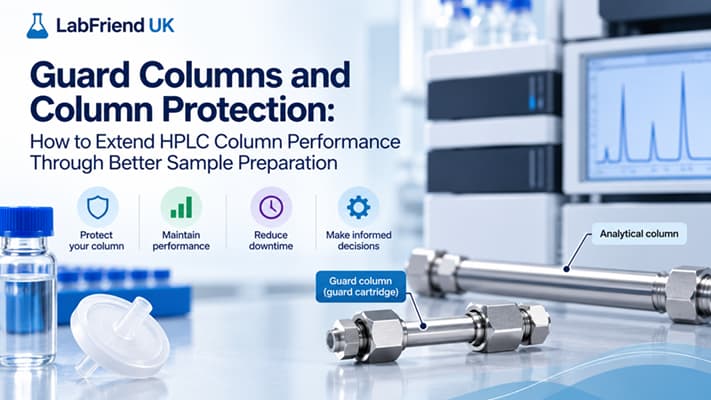
Guard Columns and Column Protection: How to Extend HPLC Column Performance Through Better Sample Preparation
Guard Columns and Column Protection: How to Extend HPLC Column Performance Through Better Sample Preparation
HPLC Column Purchasing Checklist for QA-QC and Procurement Teams
HPLC Column Purchasing Checklist for QA/QC and Procurement Teams