

Share :
Guard Columns and Column Protection: How to Extend HPLC Column Performance Through Better Sample Preparation
Updated On 09/23/2026

By Donal O’Sullivan, BSc. Reviewed by Michael Anderson, MBA.
A guard column can provide useful protection for an HPLC
analytical column when samples contain particulates, strongly retained
compounds or matrix components that could otherwise accumulate at the column
inlet or on the stationary phase. It is particularly worth considering for
repeated analysis of relatively complex or difficult samples, or where
protecting a higher-value analytical column is important. |
Key Takeaways
- Use
a guard column where there is a credible column-protection benefit.
Samples with significant matrix burden or components that may accumulate
on the analytical column are stronger candidates than consistently clean
samples.
- A
guard column and a pre-column filter are not the same thing. A filter
primarily intercepts particulates, while a guard column containing
stationary phase can also retain some sample components before they reach
the analytical column.
- Do
not use a guard column as a substitute for appropriate sample preparation.
Controlling particulates and unwanted matrix components before injection
can reduce the burden on both the guard and analytical columns.
- Check
compatibility with the analytical column and method. Stationary phase,
dimensions, hardware, connections, pressure capability and operating
conditions may all be relevant.
- Account
for what the guard adds to the chromatographic system. Additional
hardware can contribute pressure, connections and extra-column volume, so
suitability should be considered within the complete method.
- Do
not rely on a universal replacement interval. Guard-column service
life depends on sample load, matrix, method conditions and the performance
criteria used by the laboratory.
What Does a Guard Column Do in HPLC?
A guard column is a short column installed upstream of the
main analytical column. It is intended to intercept material that might
otherwise reach and progressively contaminate or foul the analytical column.

Depending on its design and stationary phase, a guard column
may help protect against some strongly retained sample components as well as
particulates or matrix material. Because the guard is shorter and typically
designed for replacement, contamination can sometimes be managed by replacing
the guard cartridge rather than exposing the analytical column to the full
accumulated burden.
This does not make a guard column a universal solution to
column deterioration. Its usefulness depends on what is causing the problem.
If the main risk is particulate material entering the
column, appropriate sample filtration or a suitable pre-column filter may
address that risk more directly. If the sample contains components that
interact with and accumulate on the stationary phase, a chemically compatible
guard column may provide an additional layer of protection.
The practical question is therefore not simply:
Can I fit a guard column?
It is:
What am I trying to protect the analytical column from,
and is a guard column an appropriate way to control that risk?
When Should You Use a Guard Column in HPLC?
A guard column is most worth considering when the expected
protection benefit justifies adding another component to the chromatographic
flow path.
Samples with significant matrix burden
Samples containing substantial non-target matrix components
can place greater demands on an analytical column than relatively clean
standards or simple prepared solutions.
Repeated injections may gradually introduce material that is
retained at or near the head of the analytical column or interacts strongly
with the stationary phase. Where a compatible guard column intercepts some of
this material, the replaceable guard cartridge takes more of that exposure.
This can be particularly relevant where sample cleanup
cannot practically remove all unwanted matrix components without affecting the
analytical workflow.
Repeated analysis of challenging samples
The effect of contamination is often cumulative.
A single injection may produce no obvious problem, while
repeated injections of the same type of sample can progressively increase the
burden on the column. Laboratories running recurring batches of matrix-rich
samples therefore have a different protection decision from laboratories making
occasional injections of clean preparations.
The number of injections alone is not enough to determine
whether a guard is needed. What is being injected matters.
Protecting an important analytical column
The practical consequences of contaminating the analytical
column also matter.
Where the analytical column is relatively costly, difficult
to replace quickly or important to a routine workflow, a suitable guard
configuration may be worth evaluating as part of the overall column-protection
strategy.
The objective should still be technical rather than purely
economic: the guard needs to be compatible with the chromatography and should
not introduce unacceptable effects merely to reduce exposure of the main
column.
Where strongly retained contaminants are a concern
A particulate filter cannot address every form of
contamination.
Some unwanted sample components may pass through a filter
but subsequently interact strongly with the chromatographic stationary phase. A
guard column containing an appropriate stationary phase can potentially
intercept some of these components before they reach the analytical column.
That distinction is one reason why guard columns and
pre-column filters should not be treated as interchangeable products.
When Might a Guard Column Add Limited Value?
Not every HPLC workflow benefits equally from guard-column
protection.
For clean samples that have already undergone effective
preparation, the contamination burden reaching the analytical column may be
relatively low. Adding a guard column in such a method may provide less
practical benefit.
A guard column may also be inappropriate where the problem
being investigated is unrelated to material entering the analytical column.
Instrument faults, inappropriate mobile-phase conditions, leaks, unsuitable
column chemistry and other chromatographic problems are not corrected simply by
installing additional column protection.
There is also a system-level trade-off. A guard column adds
packed volume to the separation path, while its holder, fittings and connecting
tubing can add extra-column volume. The complete assembly may also increase
system backpressure. These effects may be small in a well-matched, low-volume
configuration, but they can become important with high-efficiency or
small-volume analytical columns and should not simply be assumed to be
irrelevant.
The correct decision is therefore method-specific rather
than:
Guard column = better protection = always better
chromatography.
Guard Column vs Pre-Column Filter: What Is the
Difference?
Guard columns and pre-column filters can both sit upstream
of the analytical column, but they perform different functions.

|
Decision factor |
Guard column |
Pre-column filter |
|
Primary purpose |
Protect the analytical column from material that may be
retained by the guard stationary phase as well as some particulate/matrix
burden |
Intercept particulate material before it reaches the
analytical column |
|
Contains stationary phase |
Typically yes |
No chromatographic stationary phase |
|
Can protect against some strongly retained sample
components |
Potentially, where guard chemistry is appropriate |
Not through chromatographic retention |
|
Particulate protection |
Can contribute, depending on configuration |
Primary function |
|
Chromatographic compatibility |
Stationary phase and configuration need to be considered |
Filter material, porosity, hardware and system suitability
still need consideration |
|
Adds hardware to flow path |
Yes |
Yes |
|
Replaces sample preparation |
No |
No |
This distinction is important when diagnosing the actual
protection requirement.
If particulate contamination is the primary concern,
controlling those particles before injection may be more direct than expecting
a guard column to compensate for inadequate preparation.
If the concern includes sample components that pass through
filtration but subsequently interact with the analytical stationary phase, a
guard column may provide a different form of protection.
In some workflows, both controls may be appropriate. That
does not mean they should be added automatically; each should address a defined
risk.
Why Sample Preparation Still Matters
A guard column should be treated as part of a wider
column-protection strategy, not as permission to inject poorly prepared
samples.
Appropriate upstream preparation can reduce the amount of
unwanted material entering the chromatographic system in the first place.
Depending on the sample and method, that may involve clarification,
centrifugation, filtration or other sample-cleanup steps.
The objective is not necessarily to make every sample as
clean as possible. Sample preparation itself has to be appropriate for the
analytes, matrix and method. Excessive or unsuitable preparation can introduce
its own problems.
For HPLC users who need the broader workflow rather than the
specific guard-column decision, our guide to HPLC
sample preparation consumables covers filters, vials, syringes and solvent
handling in more detail.
The important relationship is:
Sample preparation reduces the burden entering the
system. A guard column provides an additional protective stage where the
remaining burden creates a meaningful risk to the analytical column.
Neither should automatically be expected to compensate for
weaknesses in the other.
How to Choose a Guard Column
Once there is a technical reason to use a guard column,
selection should begin with the analytical method and analytical column rather
than with the guard cartridge in isolation.
1. Check stationary-phase compatibility
Where the guard relies on chromatographic retention to
protect the analytical column, its stationary-phase characteristics matter.
As a general starting point, use the guard chemistry
recommended for the analytical column, commonly the same or closely matched
stationary phase from the relevant column family. A nominal phase designation
such as C18 does not by itself establish chromatographic equivalence between
different products. Differences in bonded-phase characteristics, base material
and other stationary-phase properties can affect selectivity, retention or peak
shape.
The appropriate configuration therefore needs to be assessed
against the analytical column and method rather than selected simply because a
cartridge physically fits the holder. Where the column manufacturer specifies a
particular guard chemistry or cartridge, follow that compatibility guidance.
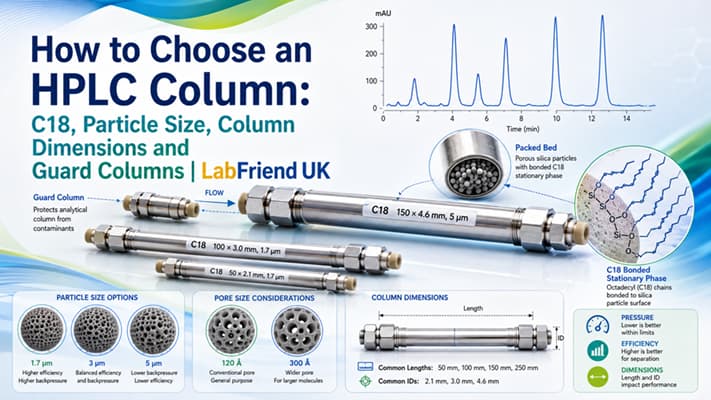
The wider considerations involved in selecting the
analytical column itself are covered in How
to Choose an HPLC Column - Particle Size, Column Dimensions and Guard Columns.
2. Check the physical configuration
Guard cartridges and holders are not automatically
interchangeable.
Confirm the relevant manufacturer specifications for the
cartridge, holder, analytical column and connection arrangement. Physical fit
alone does not establish that a combination is suitable for the method.
Where the guard is intended for a particular column family
or hardware system, follow the relevant manufacturer's compatibility
information.
3. Consider dimensions and particle characteristics
Guard-column dimensions and particle characteristics
influence the packed volume and hydraulic resistance added ahead of the
analytical column. The holder and connections can also contribute extra-column
volume and dispersion, particularly where small-bore or high-efficiency columns
are used.

Internal diameter is particularly important. Use the
analytical-column manufacturer's recommended guard dimensions; in many guard
systems, the guard internal diameter is matched or closely matched to the
analytical column to provide appropriate protection while limiting undesirable
dispersion or other chromatographic effects.
These factors should be considered in the context of the
analytical column, system and method rather than treated as independent
purchasing specifications.
There is no single guard-column configuration that is
optimal for every analytical column.
4. Confirm pressure capability
The complete guard assembly must be suitable for the
pressures expected during operation.
This includes the cartridge, holder, connections and other
relevant components. Do not assume suitability for an HPLC or UHPLC application
from the stationary-phase description alone.
Manufacturer specifications should be checked for the actual
configuration being considered.
5. Check operating-condition compatibility
The guard column must also be suitable for the method's
operating conditions.
Depending on the product and method, relevant limits can
include mobile-phase composition, pH and temperature. These should be verified
from the applicable manufacturer documentation rather than inferred from the
general stationary-phase description.
A Practical HPLC Column-Protection Decision
The following framework helps separate different protection
problems before adding hardware.

|
What are you seeing or trying to prevent? |
Guard column likely to be useful |
Pre-column particulate protection may be sufficient |
Investigate another cause |
|
Significant sample matrix burden |
Potentially, particularly where unwanted components may
interact with the stationary phase |
May help where the main burden is particulate |
Consider whether upstream sample preparation should first
be improved |
|
Visible or expected particulate material |
May contribute to protection |
Often the more direct protection mechanism |
Review sample preparation if particles should have been
removed earlier |
|
Strongly retained unwanted sample components |
Potentially useful with an appropriate guard chemistry |
A particulate filter alone will not selectively retain
dissolved contaminants |
Review whether alternative sample cleanup is more
appropriate |
|
Progressive pressure increase |
Potentially, if contamination of the analytical column
inlet is contributing |
Potentially, where particulates are responsible |
Do not assume contamination is the cause; investigate the
system and method |
|
Changes in retention, peak shape or separation |
A contaminated guard could potentially contribute, but the
symptom is not diagnostic |
Not automatically |
Investigate the wider chromatographic system and method |
|
Clean, well-controlled samples with stable performance |
Benefit may be limited |
Depends on particulate risk |
Additional protection may not be necessary |
The table is a starting point, not a diagnostic test.
Pressure changes or deteriorating chromatography can have multiple causes, and
replacing or installing a guard column should not substitute for investigating
the underlying problem.
Guard Columns Do Not Replace Good Sample Filtration
One of the easiest mistakes is to treat a guard column as a
sacrificial solution to whatever reaches the injector.
That can shift the contamination problem rather than control
it.
If samples routinely contain particles that could reasonably
be removed before injection, appropriate preparation reduces the burden on the
complete chromatographic flow path. A guard cartridge that becomes rapidly
blocked because particulate-rich samples are repeatedly injected is not
necessarily demonstrating successful column protection; it may indicate that
upstream sample handling deserves attention.
Conversely, filtration does not remove every dissolved
matrix component capable of interacting with the stationary phase. This is why
filtration and guard-column protection should be considered according to their
different functions rather than as competing versions of the same solution.
Detailed pore-size and membrane selection are separate
decisions and should be based on the sample, analyte, solvent and analytical
requirements rather than chosen simply to protect the column.
How Do You Know When a Guard Column Needs Replacing?
There is no universal number of injections or operating
hours after which every HPLC guard column should be replaced.
Service life depends on factors including:
- sample
matrix;
- amount
of material injected;
- effectiveness
of upstream sample preparation;
- guard-column
configuration;
- mobile
phase and operating conditions;
- nature
of retained contaminants;
- method
and system performance requirements.
A laboratory should therefore use method-relevant
performance observations and applicable manufacturer or internal guidance
rather than an arbitrary replacement interval.
Changes in pressure or chromatography can be useful reasons
to investigate the guard, but they should not be treated as proof that it is
exhausted.
Where the system and method permit, comparison of
performance with a fresh compatible guard cartridge can help determine whether
the installed guard is contributing to the change. Any such comparison should
be made under controlled method conditions and should not bypass required
system-suitability, change-control or laboratory procedures.
Where a laboratory uses guard cartridges routinely, it can
be useful to establish a controlled approach for monitoring performance and
recording replacement. Over time, this may provide a more meaningful basis for
planning than a generic replacement schedule.
Common Guard-Column and Column-Protection Mistakes
Using a guard column automatically. A guard should
address a defined protection requirement. Adding one to every method without
considering the sample and chromatography can introduce complexity without a
clear benefit.
Choosing a cartridge because it physically fits.
Mechanical fit is only one requirement. Stationary phase, dimensions, particle
characteristics, pressure capability and operating conditions may also matter.
Assuming any guard phase is suitable for any analytical
column. The guard becomes part of the chromatographic flow path. Its
chemistry should be assessed in relation to the analytical column and method.
Using the guard instead of appropriate sample
preparation. A replaceable cartridge is useful protection, but repeatedly
loading avoidable contamination into the system is not an efficient substitute
for controlling the sample before injection.
Treating a pre-column filter and guard column as
equivalent. They address overlapping but different risks. A particulate
filter does not reproduce the chromatographic retention provided by a
stationary-phase guard.
Replacing the analytical column before checking the
guard. Where a guard is fitted and performance begins to change, the guard
assembly should be considered during troubleshooting rather than ignored.
Assuming the guard is responsible for every change.
Pressure, peak shape, retention and resolution can be affected by many parts of
the system and method. Guard replacement should not replace systematic
investigation.
A Simple Seven-Step Guard-Column Selection Workflow
Before introducing guard-column protection into an HPLC
method:
- Define
the problem or risk. Is the concern particulate material, strongly
retained matrix components, recurring column contamination or another
issue?
- Review
sample preparation. Determine whether avoidable burden can
appropriately be removed before injection.
- Decide
what type of protection is needed. Distinguish particulate protection
from protection involving stationary-phase retention.
- Start
with the analytical column and method. Establish the chemistry,
dimensions, system and operating conditions that the guard must
complement.
- Check
the complete guard configuration. Confirm cartridge, holder,
connections, pressure capability and applicable operating limits from
manufacturer information.
- Assess
the method impact. Install the complete proposed guard configuration
and confirm under the method conditions that system pressure and
chromatographic performance remain acceptable. Evaluate the
method-relevant criteria used by the laboratory, such as retention, peak
shape, efficiency and resolution, rather than assuming that a physically
compatible guard has no chromatographic effect.
For an established validated, transferred or compendial
method, introducing or changing a guard column may also require assessment
under the laboratory's applicable change-control and method-governance
procedures. Confirm that the proposed configuration is permitted for the method
and that applicable system-suitability and performance requirements continue to
be met.
- Monitor
performance in use. Use method-relevant observations and laboratory or
manufacturer guidance to determine when the guard requires investigation
or replacement.
This approach keeps the guard-column decision centred on
protecting the analytical workflow rather than simply adding another
consumable.
Frequently Asked Questions
When should I use a guard column in HPLC?
A guard column is worth considering when sample components
could progressively contaminate or foul the analytical column and a compatible
guard can intercept some of that burden. It can be particularly useful with
repeated injections of matrix-rich or challenging samples. The benefit should
be weighed against the additional hardware, pressure and volume introduced into
the chromatographic system.
Does every HPLC column need a guard column?
No. A guard column is not necessary for every HPLC method.
Clean, appropriately prepared samples may present relatively little
contamination risk, while some methods may gain limited benefit from additional
column hardware. The decision should be based on the sample matrix, analytical
column, method and nature of the contamination risk rather than applying guard
columns routinely to every workflow.
Is a guard column the same as a pre-column filter?
No. A pre-column filter primarily intercepts particulate
material, while a guard column typically contains stationary phase and can
potentially retain some unwanted sample components as well as contributing to
particulate protection. They therefore address different, although sometimes
overlapping, column-protection requirements. Neither automatically replaces
appropriate sample preparation.
Should the guard column use the same stationary phase as
the analytical column?
Start with the guard chemistry recommended for the
analytical column, commonly the same or closely matched stationary phase from
the relevant column family. A shared phase label such as C18 does not by itself
establish chromatographic equivalence between different products. Follow
manufacturer compatibility guidance and confirm that the complete guard
configuration is suitable for the method, particularly where differences could
affect selectivity, retention or peak shape.
How do I know when a guard column may need replacing?
Investigate guard-column replacement when method-relevant
performance suggests that accumulated contamination may be affecting the
system, but pressure or chromatographic changes alone do not prove that the
guard is exhausted. Where the system and method permit, comparison with a fresh
compatible guard can help determine whether the installed guard is
contributing. Make that comparison under controlled method conditions and
follow applicable system-suitability, change-control and laboratory procedures.
Protect the Column by Controlling What Reaches It
Guard columns can be a useful part of HPLC column
protection, but their value comes from using them for the right reason.
Start with the sample and the analytical method. Reduce
avoidable contamination through appropriate sample preparation, identify
whether the remaining risk is particulate, chromatographic or both, and then
determine whether a guard column or other pre-column protection is technically
appropriate.
Where a guard is justified, treat it as part of the
chromatographic system. Check its stationary phase, physical configuration,
pressure capability and operating limits against the analytical column and
method, and monitor its effect during routine use.
For laboratories evaluating suitable protection
configurations, browse HPLC columns and guard-column options. Supporting HPLC accessories are
also available where appropriate to the system configuration.
Read More
- How to Choose an HPLC Column - Particle Size, Column Dimensions and Guard Columns
- HPLC Sample Preparation Consumables - Filters Vials Syringes and Solvent Handling
- The Complete Guide to Chromatography Consumables for UK Laboratories
Explore More
Written by: Donal O’Sullivan, BSc, Co-Founder and Sales Director, LabFriend UK. Donal brings deep chemistry-led technical expertise across analytical chemistry, biochemistry, environmental monitoring, laboratory instrumentation, consumables and scientific product selection.
Reviewed by: Michael Anderson, MBA, Founder and Managing Director, LabFriend UK. Michael reviews LabFriend UK content for customer relevance, commercial accuracy, operational practicality and alignment with LabFriend UK’s laboratory supply model.
Related Stories
Vial Closure Formats Explained for Laboratory Procurement Teams
Vial Closure Formats Explained for Laboratory Procurement Teams
Screw Neck vs Crimp Neck vs Snap Ring Vials: Which Should Your Lab Use?
Screw Neck vs Crimp Neck vs Snap Ring Vials: Which Should Your Lab Use?
HPLC Column Purchasing Checklist for QA-QC and Procurement Teams
HPLC Column Purchasing Checklist for QA/QC and Procurement Teams
How to Choose an HPLC Column - Particle Size, Column Dimensions and Guard Columns
How to Choose an HPLC Column - Particle Size, Column Dimensions and Guard Columns