

Share :
Autoclavable Laboratory Bottles - What to Check Before Buying
Updated On 09/17/2026

By Donal O’Sullivan, BSc. Reviewed by Michael Anderson, MBA.
Choosing an autoclavable laboratory bottle is not simply a
matter of finding a bottle labelled “autoclavable”. The complete
bottle-and-closure system must be suitable for the intended autoclave
conditions and laboratory workflow. |
Key Takeaways
- Autoclavability
is a product-level specification, not something to assume from material
alone.
- Check
the complete bottle-and-closure system, including the cap and any liner,
seal or accessory used during the process.
- Match
the manufacturer's stated autoclave conditions and restrictions to your
intended laboratory process.
- Consider
the contents, fill level and required headspace, as well as the bottle
itself.
- Do
not assume “autoclavable” also means chemically compatible, sterile as
supplied, suitable for unlimited repeated cycles, or suitable as a
pressure or vacuum vessel.
- Where
the manufacturer's information does not establish suitability for your
intended conditions, clarify the specification before purchasing.
What Does “Autoclavable” Actually Tell You?
“Autoclavable” indicates that a product has been specified
as suitable for autoclaving under defined conditions. It should not be
interpreted as a universal statement that the product can tolerate every
autoclave programme, every type of contents or unlimited processing cycles.
That distinction matters when comparing bottles.
Two products may both be described as autoclavable while
differing in bottle material, closure construction or manufacturer
instructions. The useful buying question is therefore not simply:
Is this bottle autoclavable?
It is:
Is this complete bottle system suitable for the autoclave
conditions and laboratory use I have in mind?
Autoclave suitability is also only one part of bottle
selection. Chemical compatibility, volume, closure, handling and other workflow
requirements still need to be considered. For the broader selection process,
see our Laboratory Bottles: Selection Guide for UK Laboratories.
1. Check the Bottle Material — but Don't Stop There
Material is an obvious starting point because laboratory
bottles are available in different types of glass and plastics, with different
properties.
Borosilicate glass and some polymer bottles may be offered
in autoclavable versions. However, recognising the material is not enough to
confirm that a particular product is suitable for your process.
For example, identifying a bottle as polypropylene does not
establish its permitted autoclave conditions. Similarly, recognising a bottle
as borosilicate glass does not establish the suitability of its cap, liner or
other components.
Check the actual product specification rather than relying
on a general assumption about the material.
Material selection also involves considerations beyond
autoclaving, including chemical compatibility, transparency, rigidity, breakage
risk and handling. If the material itself is still undecided, our guide to borosilicate glass, amber glass, HDPE, LDPE and PP laboratory bottles provides a broader
comparison.
2. Treat the Bottle and Closure as One System
A common selection error is to check the bottle body but
overlook the closure.
An autoclavable bottle body does not automatically make
every cap, liner, seal or accessory that fits it suitable for the same
conditions.
Before buying, identify what makes up the assembly you
intend to use:
|
Component |
What to check |
|
Bottle body |
Material and stated autoclave suitability |
|
Cap |
Material, fit and stated suitability for the intended
conditions |
|
Liner or seal |
Whether present and whether its specification permits the
intended process |
|
Other accessories |
Whether any fitted component has separate restrictions or
instructions |

Where a bottle and cap are supplied as an assembly, check
the specification for the complete configuration, rather than assuming
every component has identical limits.
Thread format also needs to be kept separate from autoclave
suitability. A particular thread designation tells you about the bottle/closure
interface; it does not by itself establish whether the complete system is
suitable for autoclaving.
For a deeper explanation of this distinction, see GL45 Laboratory Bottles Explained: Threads, Caps and Compatibility Checks.
3. Match the Product Specification to Your Autoclave Conditions
Once you have identified an autoclavable bottle and
compatible closure system, compare the manufacturer's instructions with the
conditions under which you intend to use it.
Depending on the product, relevant information may include:
- permitted
temperature, exposure time and cycle type, including any relevant heating,
exhaust, cooling or vacuum conditions;
- restrictions
on the bottle or closure configuration;
- instructions
relating to the cap during processing;
- limitations
affecting repeated autoclaving;
- requirements
or restrictions associated with particular components.
Also check whether the stated autoclavability applies to the
bottle when empty, when containing liquids, or both. A product described as
autoclavable may have application-specific restrictions; do not assume that an
empty-container rating establishes suitability for autoclaving the bottle with
its intended contents.
Avoid turning a generic statement such as “autoclavable”
into a more specific performance claim unless the manufacturer's documentation
supports it.
This is particularly important when replacing an existing
bottle. A new bottle that looks similar, has the same nominal volume or uses
the same general material should not automatically inherit the autoclave
conditions used for the previous product.
What about repeated autoclaving?
If a bottle will be autoclaved repeatedly, confirm that the
available product information supports the intended pattern of use.
A statement that a product is autoclavable does not, by
itself, establish an unlimited service life or guarantee unchanged performance
after an unspecified number of cycles.
Routine laboratories should therefore avoid creating their
own universal rule such as “PP bottles can always be reused for X cycles”. The
relevant product documentation and laboratory procedure should control the
decision.
Repeated-use suitability should also include inspection and
retirement criteria. Before reuse, inspect bottles and closures for damage or
deterioration relevant to the material and product, such as cracks, chips or
significant scratches in glass, and cracking, crazing, permanent distortion or
other visible deterioration in plastics. Remove damaged or materially
deteriorated components from service rather than relying on their original
autoclavability specification.
4. Check How the Closure Should Be Managed
Closure configuration during autoclaving deserves specific
attention because it affects the behaviour of the bottle system during the
process.
For conventional screw-capped laboratory bottles, the
closure must normally be vented during autoclaving by loosening it
sufficiently, completely disengaging the threads or removing it, as specified
by the manufacturer. Autoclaving a liquid-filled bottle with a tightly sealed
conventional closure can create hazardous pressure differences during heating
and cooling. A tightly closed configuration should be used only where the
manufacturer specifically documents the complete bottle-and-closure system for that
mode of autoclaving, for example with an appropriate pressure-equalising vented
closure or other specifically designed system.
Follow the manufacturer's instructions for the exact product
and closure configuration together with your laboratory's established autoclave
procedure.
This is also why selecting a cap simply because it
physically screws onto the bottle is inadequate. Mechanical fit and
autoclave suitability are different requirements.
Closure management can also extend into the cooling phase.
Do not assume that a loosened or removed closure should be tightened
immediately when the cycle ends. Premature sealing while the bottle and
contents are still hot can create a pressure differential as the system cools.
Follow the bottle manufacturer's and laboratory's instructions for cooling and
for when the closure may be safely tightened.

5. Consider the Contents, Fill Level and Headspace
Autoclave suitability is not determined by the empty bottle
alone.
The intended contents and the way the bottle will be filled
can affect whether a particular setup is appropriate. Before buying, consider:
What will be in the bottle?
The fact that a container can be autoclaved does not establish that its
contents can safely undergo the same process. Confirm that the intended liquid,
reagent, medium, sample or waste stream is permitted for autoclaving under your
laboratory procedure. Do not autoclave chemically hazardous contents merely
because the bottle is autoclavable; many laboratory autoclave procedures
specifically exclude flammable, volatile, reactive or corrosive chemicals and
other hazardous materials. Where the contents themselves are heat-sensitive,
volatile, reactive or otherwise process-limited, assess that requirement
separately from bottle compatibility.
How much will be added?
Nominal bottle capacity should not automatically be treated as the correct
working volume.
Is headspace required?
Where the process requires space for changes occurring during heating or
processing, the working fill level needs to accommodate that requirement.
If liquids will be autoclaved in the bottle, also confirm
that the bottle system is compatible with the cycle specified by your
laboratory procedure. Liquid loads normally require a liquid or slow-exhaust
cycle so that chamber pressure falls gradually and the risk of boil-over from
superheated liquid is reduced. Do not substitute a fast-exhaust or pre-vacuum
cycle unless the applicable autoclave procedure and product instructions
support it.
For liquid loads, also check that your workflow provides
suitable autoclave-compatible secondary containment for spills or bottle
failure. The secondary container itself must be compatible with the selected
cycle and arranged in accordance with the autoclave procedure.
This distinction between nominal capacity and practical
working volume is important throughout laboratory bottle selection. A bottle
labelled 500 mL, for example, should not automatically be interpreted as a
container that should be filled to 500 mL for every process.
Use the manufacturer's instructions and your laboratory
procedure to establish the maximum working fill, required headspace and
processing conditions for the specific application. Do not apply a universal
fill fraction to every bottle and process: permitted working volume can depend
on the container, contents, load configuration and autoclave procedure.

6. Autoclavable Does Not Mean Chemically Compatible
Autoclavability and chemical compatibility answer different
questions.
A bottle may be capable of tolerating specified autoclave
conditions but still be unsuitable for storing or processing a particular
substance.
Chemical compatibility can depend on factors including the
chemical involved, its concentration, temperature, contact duration and the
wider sample or reagent matrix. The cap, liner and seal may also need separate
consideration.
If chemical storage is part of the application, verify
compatibility for the actual bottle-and-closure system rather than using an
“autoclavable” specification as a substitute for a compatibility assessment.
7. Autoclavable Does Not Mean Sterile as Supplied
An autoclavable bottle is not necessarily supplied sterile.
These are separate characteristics.
“Autoclavable” concerns suitability for an autoclave process
under specified conditions. “Sterile” concerns the microbiological status of
the supplied product or the outcome of a defined sterilisation process.
If your workflow requires a bottle to be sterile before
use, check the supplied product specification and packaging rather than
assuming that an autoclavable bottle arrives sterile.
Likewise, successful sterilisation of a particular load is a
process question. Selecting an autoclavable bottle is necessary where the
container will undergo that process, but the bottle specification alone does
not establish that a laboratory sterilisation process is effective or
validated.
8. Do Not Treat Standard Laboratory Bottles as Pressure or Vacuum Vessels
Heating a closed system can create pressure-related
considerations. That does not mean an autoclavable laboratory bottle should be
treated as a pressure vessel.
Unless the manufacturer specifically documents pressure or
vacuum suitability for a product and its intended configuration, do not infer
it from bottle material, wall thickness, closure style or autoclavability.
If your application intentionally involves pressure or
vacuum, that requirement needs to be assessed separately using equipment
designed and documented for the purpose.
Pre-Purchase Autoclavable Bottle Checklist

Before placing an order, work through these checks:
|
Check |
Question to answer before buying |
|
Bottle specification |
Is this specific product documented as autoclavable? |
|
Bottle material |
Is the specified material appropriate for the intended
workflow? |
|
Cap and closure |
Are the cap, liner, seal and other relevant components
suitable too? |
|
Autoclave conditions |
Does the manufacturer's information support the intended
temperature, exposure time, cycle type and bottle configuration, including
whether the bottle may be autoclaved with the intended contents rather than
empty only? |
|
Closure configuration |
Are there instructions for how the cap or closure should
be managed during processing? |
|
Contents |
Are the intended contents themselves permitted for
autoclaving, and are the bottle, cap, liner and seal chemically and thermally
compatible with those contents under the intended processing and storage
conditions? |
|
Working volume |
Is the intended fill level appropriate rather than simply
based on nominal bottle capacity? |
|
Headspace |
Does the process require additional headspace? |
|
Repeated use |
If repeated autoclaving is intended, is that use supported
by the available information? |
|
Inspection and retirement |
For reusable bottles and closures, are appropriate
inspection criteria, replacement indicators or manufacturer limitations
available for identifying components that should be removed from service? |
|
Other requirements |
Have chemical compatibility, sterility and any other
workflow-specific requirements been assessed separately? |
If any critical answer is unclear, resolve it from the
manufacturer's technical information or with the supplier before treating the
bottle as suitable.
Common Mistakes When Buying Autoclavable Laboratory Bottles
Assuming the material is enough
“Borosilicate glass” or “PP” describes material; it does not
replace the product's autoclavability specification.
Checking the bottle but not the cap
A suitable bottle body combined with an unsuitable closure
does not give you a suitable complete system.
Assuming a tightly closed cap is safer during autoclaving
A leak-tight storage closure is not necessarily the correct
autoclaving configuration. Conventional screw-capped bottles normally require
venting during processing as specified by the manufacturer; tightly closed
autoclaving requires a system specifically designed and documented for that
configuration.
Assuming all autoclavable products have the same limits
The word “autoclavable” should not be used to infer
identical cycle conditions or restrictions across different products.
Treating nominal capacity as working volume
Bottle capacity and appropriate process fill level are
different considerations.
Assuming autoclavable means sterile
A bottle can be autoclavable without being supplied sterile.
Assuming a similar-looking replacement is equivalent
Matching appearance, material or nominal volume does not
establish equivalent autoclave performance. Check the actual specifications of
the proposed replacement.
Frequently Asked Questions
Are all polypropylene laboratory bottles autoclavable?
No. Polypropylene is used for many laboratory bottles,
including products designed for autoclaving, but material identity alone does
not establish that a specific bottle is autoclavable. Check the manufacturer's
specification for the exact product and intended conditions.
Are all borosilicate glass bottles autoclavable?
No. Borosilicate glass may be used in autoclavable
laboratory bottles, but you should still verify the specification of the particular
bottle and its closure system. Do not infer the permitted process conditions
from the glass description alone.
Does the bottle cap need to be autoclavable too?
Any cap, liner, seal or accessory that remains part of the
bottle assembly during autoclaving must be suitable for the intended
conditions. Check each relevant component where necessary, and follow the
manufacturer's instructions for the exact closure configuration used during
autoclaving.
Can I autoclave a laboratory bottle with the cap tightly
closed?
Not unless the manufacturer specifically documents the
complete bottle-and-closure system for that configuration and your autoclave
procedure supports it. Conventional screw-capped bottles normally require the
closure to be loosened, the threads completely disengaged or the cap removed as
specified by the manufacturer so that pressure can equalise during heating and
cooling. Purpose-designed vented closures or other specifically documented
systems may permit a different configuration.
Can I repeatedly autoclave a bottle if it is described as
autoclavable?
Repeated autoclaving should only be used where the
manufacturer's information supports repeated use under the intended conditions.
“Autoclavable” does not by itself establish unlimited service life. Check
relevant conditions, restrictions and guidance, and inspect reusable bottles
and closures for damage or deterioration before further use.
Does an autoclavable bottle arrive sterile?
An autoclavable bottle is not necessarily supplied sterile;
autoclavability and supplied sterility are separate specifications. If you
require a sterile product on receipt, check that the manufacturer or supplier
explicitly specifies the bottle as sterile and review any relevant packaging
information.
Choosing an Autoclavable Bottle with Confidence
The most reliable way to choose an autoclavable laboratory
bottle is to work from the actual process requirements back to the product
specification.
Start with the intended contents, working volume and
autoclave conditions. Then verify the bottle material, cap and complete closure
system against those requirements. Keep chemical compatibility, sterility and
any pressure or vacuum requirements as separate checks rather than assuming
that “autoclavable” covers them.
This approach gives you a stronger basis for comparing
products and reduces the risk of choosing a bottle that appears suitable but
does not match the complete workflow.
When you're ready to compare available options, browse Laboratory Glassware from LabFriend UK.
Read More
- Laboratory Bottles: Selection Guide for UK Laboratories
- Laboratory Bottle Materials Explained - Borosilicate Glass - Amber Glass - HDPE - LDPE and PP
- GL45 Laboratory Bottles Explained: Threads, Caps and Compatibility Checks
Explore More
Written by: Donal O’Sullivan, BSc, Co-Founder and Sales Director, LabFriend UK. Donal brings deep chemistry-led technical expertise across analytical chemistry, biochemistry, environmental monitoring, laboratory instrumentation, consumables and scientific product selection.
Reviewed by: Michael Anderson, MBA, Founder and Managing Director, LabFriend UK. Michael reviews LabFriend UK content for customer relevance, commercial accuracy, operational practicality and alignment with LabFriend UK’s laboratory supply model.
Related Stories
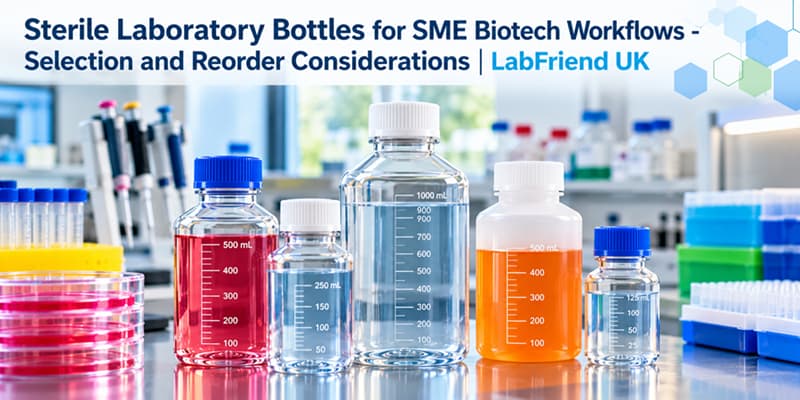
Sterile Laboratory Bottles for SME Biotech Workflows - Selection and Reorder Considerations
Sterile Laboratory Bottles for SME Biotech Workflows - Selection and Reorder Considerations

Choosing Bottles for Sterile Sampling and Contamination-Sensitive Workflows
Choosing Bottles for Sterile Sampling and Contamination-Sensitive Workflows
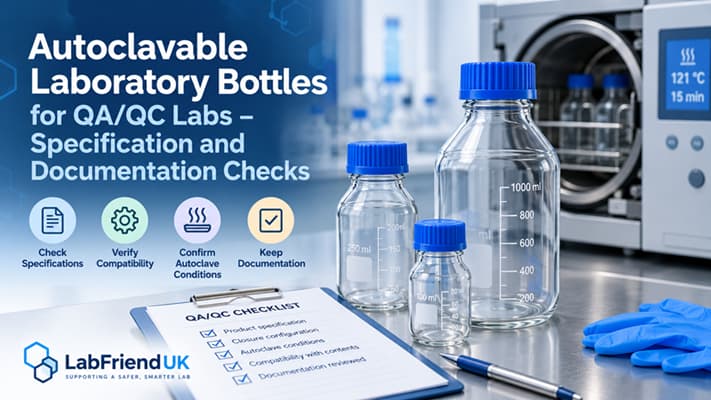
Autoclavable Laboratory Bottles for QA/QC Labs - Specification and Documentation Checks
Autoclavable Laboratory Bottles for QA/QC Labs - Specification and Documentation Checks
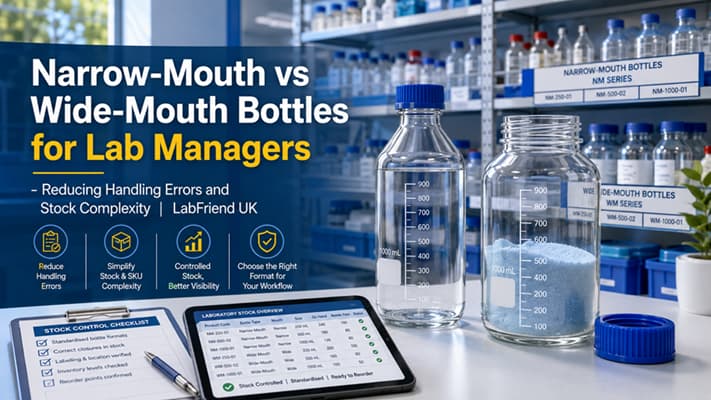
Narrow-Mouth vs Wide-Mouth Bottles for Lab Managers - Reducing Handling Errors and Stock Complexity
Narrow-Mouth vs Wide-Mouth Bottles for Lab Managers - Reducing Handling Errors and Stock Complexity